
The 9 Best Chest Exercises (Gym and Home)
In short
Which chest exercises should you know? I would keep a bench press, a dumbbell press, dips, a fly, push-ups and an incline press in mind, with cables, bands and a machine as useful options. That gives you a workout even when the machine you wanted is busy.
The chest muscles sit right at the front of your body, and they are among the first muscles people notice, even through a shirt. This article covers nine exercises for building your chest, with an explanation of its anatomy, my tips and the details that matter in a workout.
With so many chest exercises, it is easy to get confused and choose ones that do little for you. If you are serious about training, it helps to have a list you can use to put together a complete, effective chest workout.
One common mistake is stopping the workout to wait for a machine to free up. Know more than one option: waiting wastes valuable time and hurts the quality of your session. It also lets you vary the workout so it stays challenging and interesting. Change exercises every so often so your body does not adapt to doing the exact same workout and stop progressing.
Before we get to the exercises, let's see how the chest muscles are built.
How your chest is built
These are the muscles that make up your chest:
- Pectoralis major: the large chest muscle, with a sternocostal head and a clavicular head.
- Sternocostal head: the large middle and lower part of the chest. Flat bench presses, flat dumbbell presses and flat flies work it.
- Clavicular head: the upper part of the chest. It helps raise your arms in front of you; incline barbell presses, incline flies and incline dumbbell presses work it.
- Pectoralis minor: a small muscle underneath the pectoralis major. It acts on the shoulder blade rather than forming the lower part of the chest, so you do not need a special lower-chest exercise to isolate it.
The pectoralis major is the largest chest muscle. Most of the exercises in your workout should focus on it. Work the upper chest too, though you do not need the same volume there as for the larger middle and lower part.
Now that you know how the chest is built, let's move on to the exercises you can put in your workout.
The exercises at a glance
| Exercise | Main focus | Equipment |
|---|---|---|
| Barbell bench press | Chest, shoulders, triceps | Barbell, bench |
| Dumbbell chest press | Chest, each side independently | Dumbbells, bench |
| Dips | Chest, shoulders, triceps | Dip bars |
| Dumbbell fly | Chest | Dumbbells, bench |
| Push-ups | Chest, shoulders, triceps | None |
| Incline dumbbell press | Upper chest, front shoulders | Dumbbells, incline bench |
| Cable fly | Chest | Cable machine |
| Resistance-band upper-chest fly | Upper chest | Band |
| Machine fly | Chest | Pec deck |
The 9 best chest exercises
1. Barbell bench press
When you think of a gym exercise, this is probably the first one that comes to mind. The bench press is an old-school exercise that all serious bodybuilders do. It is also a main exercise for lifters because it can measure upper-body strength.
It is a compound chest exercise that also works the shoulders and triceps. Because these muscles work together, it is effective for building strength and muscle throughout the upper body.
- Lie on the bench with your eyes under the bar and your feet on the floor.
- Grip the bar a little wider than your shoulders and squeeze your shoulder blades together.
- Lower the bar under control to the middle of your chest, around nipple level, with your elbows angled slightly in toward your body.
- Press it back up without bouncing it off your chest.
Before you work with heavy weights, master the technique. Ask someone to spot you, because nobody wants a heavy bar falling on their chest. If you train alone, use a rack with safety bars or choose dumbbells.
2. Dumbbell bench press
Which exercise is better, the barbell bench press or the dumbbell chest press? This may be the oldest debate in the gym. There is no clear-cut answer: each exercise has advantages, and you should know how to use both.
Dumbbells bring a few things of their own:
- Each side of your chest works independently, which helps you work on balance between the two sides.
- Dumbbells allow a greater range of motion, which can contribute to building muscle.
- You also have to stabilize the dumbbells during the exercise.
Lie on a flat bench with a dumbbell in each hand at chest level, press them up until your arms are straight over your chest, and lower them slowly to the sides of your chest.
If you focus on building muscle, I give the dumbbell chest press the edge. If your goal is strength, I prefer the barbell bench press. Switch between the variations every so often to get the benefits of both.
3. Dips
There is no good chest program without dips. To build muscle well, you want to work its fibers from many angles. Dips are a unique movement that you cannot imitate with dumbbells.
Dips are a compound exercise involving your shoulders and triceps too. Working these muscles together can help you build muscle throughout the upper body.
One thing that affects muscle growth is putting a load on muscle fibers while they are stretched. Dips give you a strong stretch in the chest, which can contribute to growth.
- Support yourself on the bars with straight arms.
- Lean your torso slightly forward to bring the chest into the movement.
- Lower yourself under control until your upper arms are about parallel to the floor (a little deeper if your shoulders feel good), then press back up.
If dips are easy for you, add weight with a dip belt. If you cannot do one yet, an assisted dip machine or a band gives you a way to start.
4. Dumbbell fly
The dumbbell fly is a powerful isolation exercise for the chest. You can get a great pump from it. It looks simple, but it takes technique and precision.
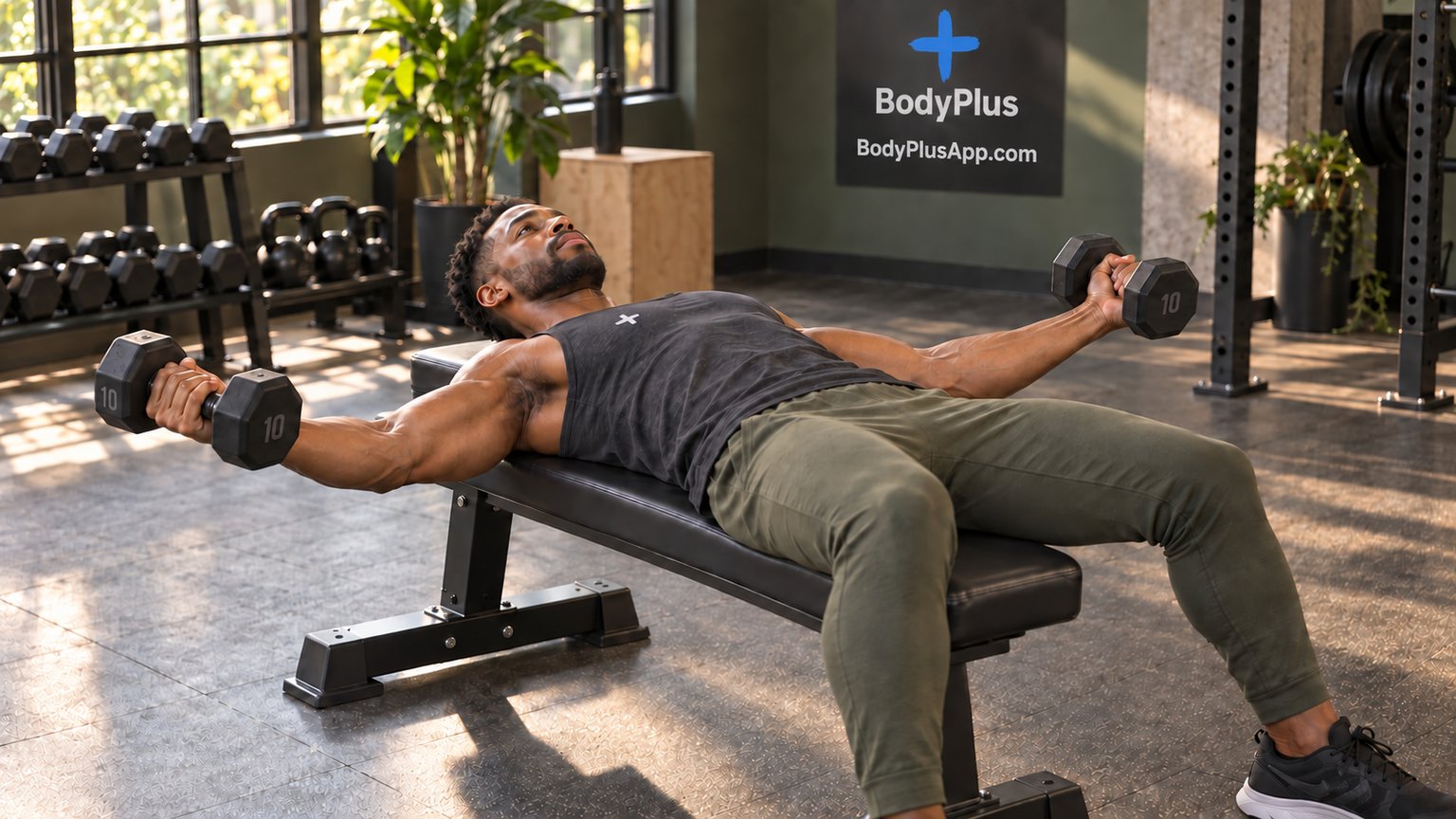
Lie on the bench with the dumbbells pointing upward and lower your elbows to the sides of your body.
- As you lower the dumbbells, keep a slight bend in your elbows. Many people use straight arms, which puts unnecessary pressure on the shoulders.
- Control the dumbbells throughout the movement. Lower them slowly, taking about 2 seconds.
- When your chest is fully stretched, pause for a moment, then lift them upward.
There is no need for heavy weights in a fly. Do not do this exercise with your ego: too much weight could put you at risk of a shoulder injury. Sets of 12–15 reps, or a little more, with a relatively light weight you can control are better here.
5. Push-ups
Push-ups are without a doubt one of the best-known exercises in the world. Many people underestimate their power because they use body weight, but they are wrong. They show your strength relative to your body weight. What is a 120 kg (265 lb) bench press worth if you cannot do 50 push-ups?
Push-ups work the chest, shoulders and triceps. Their clear advantage is that you need no equipment. You can do them anywhere, and they can be a main exercise in a chest workout.
Place your hands a little wider than your shoulders and keep your body straight from head to heels. Lower your chest to just above the floor, then press up without letting your hips sag.
Believe it or not, research supports them: in a 5-week study of university students with training experience, push-ups made as hard as the bench press (with an elastic band, at comparable muscle activity) built similar strength gains to the bench press. That doesn't mean push-ups should be your whole chest workout, but they definitely deserve a place on your list.
Make them harder over time: slower lowering, a pause at the bottom, feet on a bench, a resistance band across your back, or a weighted vest. Hands on a bench make them easier for beginners.
6. Incline dumbbell press
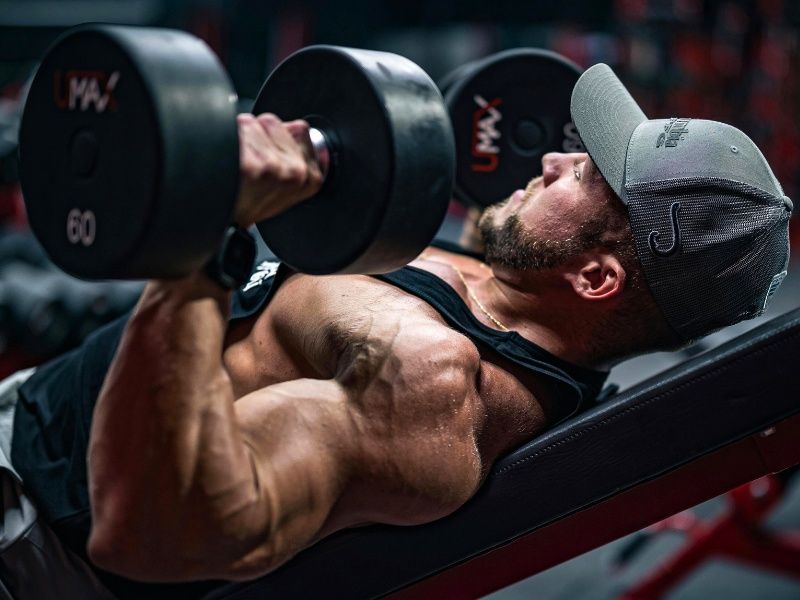
The incline chest press shifts the load to the upper chest and the front shoulder. This lets you increase the stimulus to the upper chest.
As I explained with the flat press, dumbbells can help balance the two sides. They also give you a greater range of motion, and you have to stabilize the weight.
- Set the bench to about 30 degrees.
- Press the dumbbells up over your upper chest and lower them slowly.
About 30 degrees is the best angle for this exercise, though it differs from person to person depending on your build. As with any exercise, changing the incline every few weeks is a good way to vary the workout and work the muscles in new ways.
What research says: in a study of 30 trained adults, upper-chest activation was highest at a 30-degree incline, while the steepest bench tested (60 degrees) gave the front shoulders the most work. An 8-week study in untrained young men also found more upper-chest growth with incline pressing than with flat pressing, with similar strength gains.
7. Cable fly (cable crossover)
The cable fly is an excellent isolation exercise for the chest, but there is one small problem: you will rarely find the machine free.
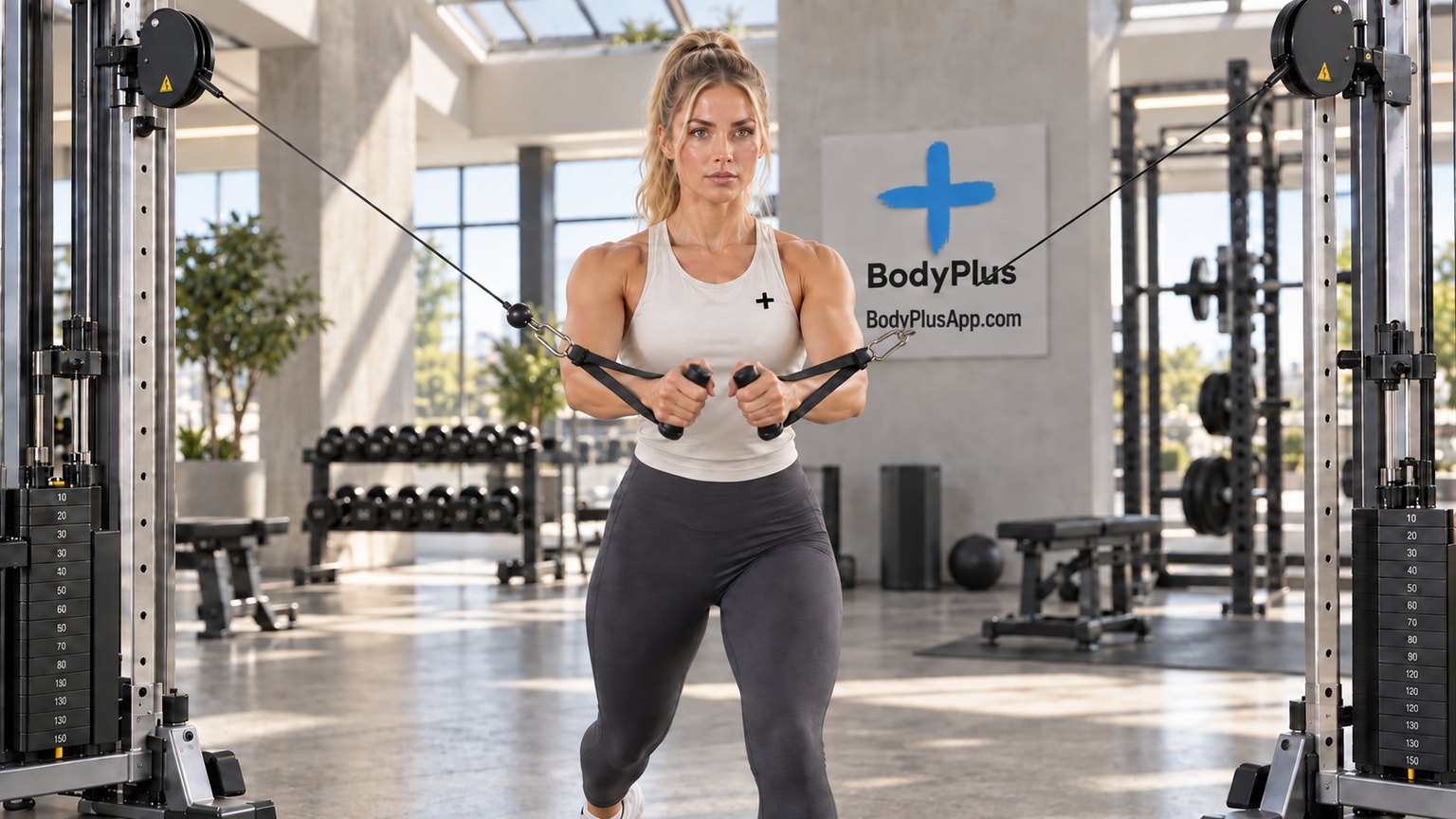
I like it because the cables keep a load on your chest throughout the movement. In a dumbbell fly, that load drops when your arms point straight up. Cables also let you get a full stretch and contraction.
Another advantage is that you can change the height of the cables and focus on different parts of the chest.
Set both handles at the height you chose, take one step forward, and with a slight bend in your elbows bring your hands together in front of you; return slowly.
Bring your arms together until your forearms form an X. Do not stop when your palms meet; continue the movement. This helps you get a stronger contraction and work through a full range of motion.
8. Resistance-band upper-chest fly
If you train at home, or the cables at the gym are occupied, here is an excellent option: the upper-chest fly with resistance bands. Anchor the band low behind you and bring your hands together on an upward path. Bands have several advantages:
- Cable machines are often busy, and waiting or sharing can be frustrating and waste your time.
- You can use bands anywhere.
- You can adjust the load by stretching the band more.
- Like cables, bands keep tension on your chest through the movement, though that tension rises as the band stretches.
9. Machine fly (pec deck)
Many people skip the machine fly because they cannot feel their chest working. It is not always easy to feel it here. It may take a little time, but it is worth it.
In an ACE-sponsored study with 14 trained men, the barbell bench press, the pec deck, and the bent-forward cable crossover produced the highest chest activation. One of the researchers said these three give about the same chest activation, so they can be used interchangeably. Activation in one session does not prove long-term growth. Researchers warn against ranking exercises by activation alone, so use these results as a guide, not a rule.
Set the seat so the handles are at chest height, bring the handles together in front of you, and open them slowly.
Do the exercise slowly, and try to stretch and contract your chest as strongly as you can.
A sample chest workout
Here is one way to turn the list into a session. Start with a press, follow it with an incline press and dips, then choose a fly. If the cables are busy, switch to the pec deck or a band instead of waiting.
| Exercise | Sets | Reps | Rest |
|---|---|---|---|
| Barbell or dumbbell bench press | 3 | 6-10 | 2 min |
| Incline dumbbell press (about 30°) | 3 | 8-12 | 90 s |
| Dips or assisted dips | 1-2 | 6-10 | 90 s |
| Cable fly or pec deck | 2-3 | 12-15 | 60-90 s |
Train your chest about twice a week. Stop most sets when you could do only one to three more good reps. The 2026 position stand of the American College of Sports Medicine (ACSM) links better muscle growth with at least about 10 sets per muscle group per week.
Home version: push-ups 3 sets close to your limit, feet-elevated push-ups 2 sets close to your limit, band upper-chest fly 2 x 12-15.
If you want to see when to do more, write down each set. For example:
| Date | Exercise | Weight | Set 1 | Set 2 | Set 3 |
|---|---|---|---|---|---|
| Tue | Dumbbell press | 22.5 kg (50 lb) each | 10 | 9 | 8 |
| Fri | Dumbbell press | 22.5 kg (50 lb) each | 10 | 10 | 10 |
| next Tue | Dumbbell press | 25 kg (55 lb) each | 8 | 8 | 7 |
When every set reaches the top of your rep range with control, move up to the next dumbbell and build the reps again. For push-ups, add reps first, then make the variation harder.
Safety
Warm up with light sets before your working sets, and start any unfamiliar chest exercise with a load you can control. For barbell presses, use safety arms set to catch the bar above your chest or someone who can spot you, and secure the plates with collars. At the pec deck, adjust the seat so the handles are at chest height and check that the seat and weight pin are locked in place.
Keep each rep controlled, and end the set if you feel pain or dizziness, or your form starts breaking down. For flies, keep a slight bend in your elbows and choose light dumbbells rather than forcing a deeper stretch with more weight. For step-by-step setup and technique, see the bench press and dumbbell chest press guides.
Bottom line
We started with a short look at the chest muscles, then went through nine exercises you can put in your workout. Whichever exercise you choose, proper technique matters. Without it, you cannot direct the load effectively to the chest muscles. Use the workout above as an example and choose another exercise from the list when equipment is taken.
Frequently asked questions
What is the best chest exercise?
In the ACE-sponsored test, the barbell bench press activated the chest most, with the pec deck (98% of the bench press) and the bent-forward cable crossover (93%) close behind. Most people do best with a press plus a fly.
What is the best angle for incline press?
Around 30 degrees emphasized the upper chest most in one study; the steepest bench shifted the most work to the shoulders. The best angle still varies a little from person to person.
Are push-ups enough to build the chest?
They are a good start and a good home option, and a study found similar strength gains to the bench press when they were made equally hard. As they get easy, make them harder or add presses.
How often should I train my chest?
About twice a week, with rest days between hard chest sessions.
Is the bench press enough for the chest?
It is a great base. Adding an incline press and a fly trains the upper chest and the stretched position better.
What if a chest exercise hurts my shoulder?
Stop that set and switch to a lighter or pain-free variation. Dumbbells, a machine or push-ups may feel better than the exercise that hurt.
How many chest exercises per workout?
Two to four is enough for most people.
How many sets per week for the chest?
About 10 or more hard sets per week is a good target for growth.
Should I use dumbbells or a barbell?
Both. I lean on dumbbells when the goal is muscle and on the barbell when the goal is strength, and I switch every few weeks.
The information on this page and on this website is intended to provide general information only. The content on this website does not constitute a professional opinion, a recommendation, or a substitute for consulting an expert in a specific field or obtaining a medical opinion. It is not medical advice. BodyPlus is not a medical device. If you have a health condition or an injury, or are pregnant, talk to a qualified healthcare professional before starting. Stop exercising and seek appropriate help if you feel pain, dizziness or other concerning symptoms.
Sources
Accessed September 17, 2026.
- Schanke W. et al., "ACE-Sponsored Research: Top 3 Most Effective Chest Exercises", ACE Certified News, October 2012. www.acefitness.org/certifiednewsarticle/2884/ace-sponsored-research-top-3-most-effective-chest-exercises
- Rodríguez-Ridao D. et al., "Effect of Five Bench Inclinations on the Electromyographic Activity of the Pectoralis Major, Anterior Deltoid, and Triceps Brachii during the Bench Press Exercise", Int J Environ Res Public Health 2020;17(19):7339. pubmed.ncbi.nlm.nih.gov/33049982
- Chaves S.F.N. et al., "Effects of Horizontal and Incline Bench Press on Neuromuscular Adaptations in Untrained Young Men", Int J Exerc Sci 2020;13(6):859-872. pubmed.ncbi.nlm.nih.gov/32922646
- Calatayud J. et al., "Bench press and push-up at comparable levels of muscle activity results in similar strength gains", J Strength Cond Res 2015;29(1):246-253. pubmed.ncbi.nlm.nih.gov/24983847
- Vigotsky A.D. et al., "Longing for a Longitudinal Proxy: Acutely Measured Surface EMG Amplitude is not a Validated Predictor of Muscle Hypertrophy", Sports Med 2022;52(2):193-199. pubmed.ncbi.nlm.nih.gov/35006527
- Currier B.S. et al., ACSM Position Stand, "Resistance Training Prescription for Muscle Function, Hypertrophy, and Physical Performance in Healthy Adults: An Overview of Reviews", Med Sci Sports Exerc 2026;58(4):851-872. pubmed.ncbi.nlm.nih.gov/41843416