
How to Do the Incline Dumbbell Press: Form, Bench Angle and Muscles Worked
In short
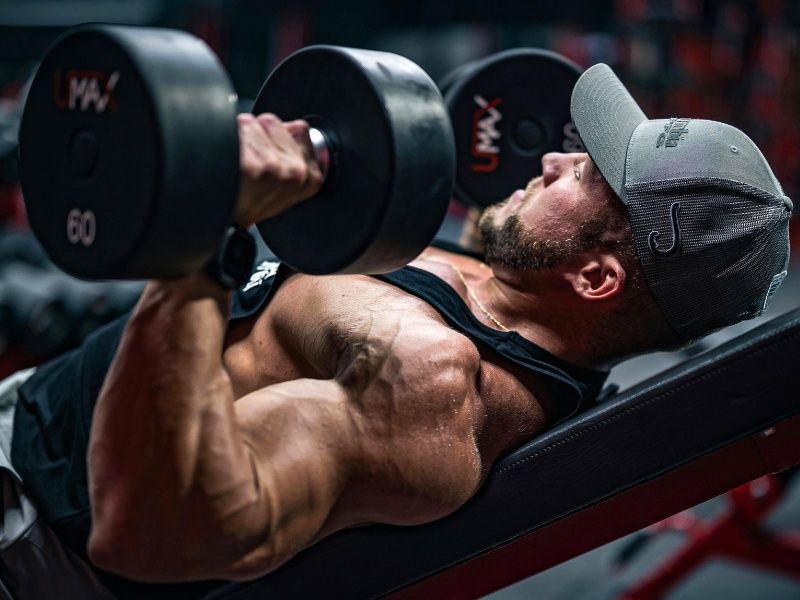
You start the exercise by lying on a bench set to 30-45 degrees. You hold a dumbbell in each hand and position them at the sides of your chest, in line with your nipples. Then you lower the weight toward your chest and press it back up until your arms are almost straight. The main muscles that work are the chest (with emphasis on the upper chest), the shoulders and the triceps. Many people start with the bench at about 30 degrees.
If you want a stronger upper chest, start doing the incline dumbbell press. It is an exceptional compound exercise that helps build a powerful upper body, with an emphasis on the upper part of the chest. In this article we will dive deep into the exercise: the benefits, the technique, the bench angle, common mistakes, tips and more. Let's begin.
Incline dumbbell press muscles worked
| Muscle | Role in the exercise |
|---|---|
| Chest (pectoralis major), mainly the upper part | the main mover: brings your arms up and in |
| Front of the shoulders (anterior deltoids) | helps press the weight up; works harder as the bench gets steeper |
| Triceps (back of the upper arm) | straightens your elbows at the top |
| Shoulder blade and core muscles | keep you steady on the bench and the dumbbells under control |
Benefits: why press on an incline with dumbbells
More emphasis on the upper chest
In every chest press, all of your chest muscles work. Still, you can put more emphasis on certain parts with different variations. The positive angle of the bench shifts part of the load from the middle chest (the sternocostal head) to the upper chest (the clavicular head). You can read more about how the chest muscles are built in my guide to the chest muscles.
A bigger range of motion than with a barbell
In the incline barbell press, at some point the bar stops at your chest, and you can't lower it any further. With dumbbells you don't have that barrier. You can lower them deeper and reach a greater stretch in your chest.
It is important to understand that the greater the range of motion, the greater the stretch on the muscle fibers, and so the muscle-building process will also be stronger. Reviews of the research found that full range of motion built more strength than partial range, and that training muscles at longer lengths tends to favor growth in several muscles. Most of those studies looked at leg and arm muscles, not the chest, so treat this as a strong principle rather than a proven chest result.
Better balance between your right and left sides
One of the benefits of working with dumbbells is improving the imbalance between your sides. With a barbell, the strong side of your body compensates for the weak side, and over time an imbalance forms between them. With dumbbells each side gets a similar load, so the difference between the sides will decrease.
How to do the incline dumbbell press with good form
- Set the bench to an incline of 30-45 degrees (see the angle section below). Sit on it holding the dumbbells, with your feet planted firmly on the floor.
- Position the dumbbells at the sides of your chest, in line with your nipples. You can help them up by kicking them up with your knees (step by step in the next section).
- Pull your shoulders back and down, tighten your core, and start pressing your arms up.
- As you press, try to squeeze your chest as hard as you can until your arms are almost straight. Make sure your elbows stay under the dumbbells and don't drift forward or backward.
- At the top, pause for a second, then start lowering the dumbbells.
- You can lower them until your upper arms are parallel to the floor or the dumbbells reach chest height. How low you go also depends on your shoulder mobility.
- Repeat until you finish the set.
How to get the dumbbells into position and set them down safely
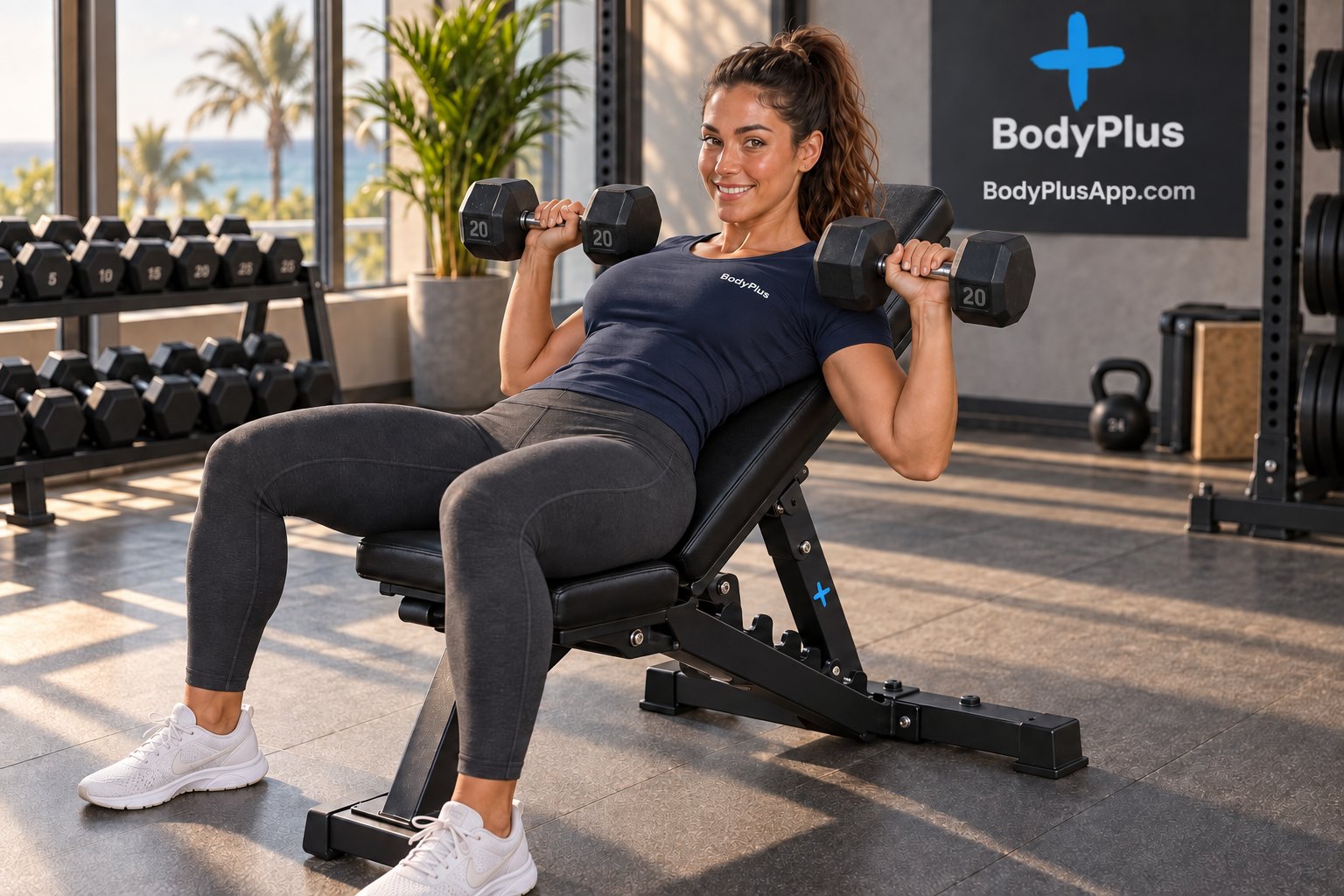
Getting heavy dumbbells up and putting them down are often the most awkward moments of the whole set. Here is a safe way to do it.
Getting into position
- Sit on the seat of the bench and stand each dumbbell on its end on your thighs, close to your knees.
- Lie back slowly, and as you do, lift one knee and then the other to "kick" each dumbbell up toward your shoulders. Keep the dumbbells close to your body the whole time.
- Settle into position with the dumbbells at the sides of your chest before you press.
- For heavy sets, ask a training partner to hand you the dumbbells one at a time once you are lying back.
Setting them down
- After the last rep, lower the dumbbells to your chest first. Don't drop them out to the sides with straight arms: that puts a sudden, heavy load on your shoulders.
- Bring them back to your thighs and use that momentum to sit up, or rest them on your chest and roll up with your knees bent.
- With light weights, sit up first, then lower them to the floor beside your feet, slowly and under control. Don't drop dumbbells near other people.
If you can't get the dumbbells into position without a struggle, the weight is too heavy for you today.
Incline dumbbell press angle: 30 or 45 degrees?
Use a range of 30-45 degrees. Many people start at about 30 degrees, and the angle that feels best can differ from person to person. You can also change the angle every few weeks to vary your training.
| Bench angle | What changes |
|---|---|
| 0 degrees (flat) | the most work for the middle and lower chest |
| 15-30 degrees | more upper chest; about 30 degrees gave the highest upper-chest activity in the study below |
| 45 degrees | still upper chest, with more front-shoulder work |
| Above 45 degrees | turns into more of a shoulder press |
What research says: in a study of 30 trained adults pressing a barbell at 60% of their one-rep max, upper-chest activity was highest at a 30-degree incline. The front of the shoulders worked hardest at 60 degrees, and inclines above 45 degrees shifted work away from the chest. This study measured muscle activity, not growth. In an 8-week study, 47 untrained young men trained the bench press flat, incline, or both, once a week. Strength gains were similar, and the incline group gained the most thickness at one upper-chest site (one of three sites measured).
Common mistakes and how to fix them
1. Lifting weights that are too heavy
Lifting weights that are too heavy with dumbbells is a mistake that can cost you dearly. Dumbbells demand a lot of stability. When a weight is heavy relative to your ability, it is easy to end up with incorrect movements in the joints.
An incorrect movement in the incline dumbbell press can put an enormous load on your shoulder joints, in positions where the joint is not stable, and this can lead to injury. When you don't control the weight, the risk rises significantly. Lifting too heavy is one of the most common problems in training, so train with weights that you can control the whole movement with.
2. A range of motion that is too short
One of the great benefits of this exercise is its large range of motion. Many trainees don't press the dumbbells all the way up or lower them all the way down. This mistake harms the effectiveness of the exercise: you won't reach the maximum stimulus in the muscle fibers, and they will develop less efficiently.
Press until your arms are almost straight, and lower the dumbbells as far as you can. Just make sure you don't feel discomfort in your shoulders.
3. Lowering the weight too fast
Many people lower the weight quickly in order to get less tired. The problem is that this dramatically reduces the effectiveness of the exercise. In addition, you may slip into an incorrect movement and get injured.
Keep the movement continuous and controlled on the way down. On the way up you can press quickly with explosive force, of course not excessively either.
Variations and alternatives
- Neutral grip (palms facing each other): many people find it more comfortable for their shoulders.
- Single-arm incline press: one dumbbell at a time; your core works hard to keep you steady, and it shows clearly if one side is weaker.
- Low incline (15-20 degrees): a middle ground between the flat and the incline press, if a steeper bench bothers your shoulders.
- Incline barbell press: lets you load more weight, with a shorter range at the bottom.
- Incline machine or Smith machine press: more stable, useful near failure or when you train alone.
- No incline bench? Do feet-elevated push-ups, a similar pressing movement you can do at home. Don't prop up a flat bench on a step or plates: it can slip.
Sets, reps and where it fits in your workout
- Reps: 6-12 per set for building muscle and strength, with a weight you control on every rep.
- Sets: 3-4, with about 90 seconds to 2 minutes of rest.
- Effort: stop most sets when you could do only one to three more good reps.
- Order: do it first or second in your chest or push workout, while you are fresh.
Sample chest workout
For a longer chest workout, see my guide to the best chest exercises.
| Exercise | Sets | Reps | Rest |
|---|---|---|---|
| Incline dumbbell press (about 30 degrees) | 3 | 8-12 | 2 min |
| Flat barbell or dumbbell press | 3 | 6-10 | 2 min |
| Cable or dumbbell fly | 3 | 10-15 | 60-90 s |
| Push-ups | 2 | as many good reps as you can | 60 s |
How to track it and when to go heavier
| Session | Weight per dumbbell | Set 1 | Set 2 | Set 3 |
|---|---|---|---|---|
| Week 1 | 16 kg (35 lb) | 12 | 10 | 9 |
| Week 2 | 16 kg (35 lb) | 12 | 12 | 11 |
| Week 3 | 16 kg (35 lb) | 12 | 12 | 12 |
| Week 4 | 18 kg (40 lb) | 10 | 9 | 8 |
When every set reaches the top of your rep range with good form, move up to the next pair of dumbbells. If the jump is too big, add reps or a slower lowering phase first.
Safety
Start with a weight you can control on every rep, and to do a lighter warm-up set or two before your first working set. Get the dumbbells up and down the way described above: with heavy weights, rest them on your thighs before you sit up, and with light weights, sit up first and lower them to the floor. Don't drop them out to the sides. For heavy sets close to failure, ask a training partner to hand you the dumbbells and stay nearby, or switch to a machine. Lower the weight slowly, and end the set when your form starts to break down, or when your shoulders pinch or you feel dizzy. If a shoulder complains, try a lower bench angle or a neutral grip, or pick a lighter weight or a pain-free press instead.
Bottom line
There is no such thing as a good chest workout without a pressing exercise, and the incline dumbbell press is an excellent option. The exercise puts a strong emphasis on the upper chest, but also works the middle chest, the shoulders and the triceps.
This variation of the press will help you vary your workouts and work the chest from several different angles. You can switch variations every period, and so you will gain the benefits of all of them. Remember that the incline dumbbell press has a very large range of motion, which is a big part of why it is worth doing. It is an exercise that suits almost everyone. It is only important that you keep correct technique and train with weights that you are able to control.
Frequently asked questions
What muscles does this exercise work?
Mainly your chest, with extra emphasis on the upper chest, plus the front of your shoulders and your triceps.
What is the best bench angle, 30 or 45 degrees?
Start at about 30 degrees. In one barbell study, upper-chest muscle activity peaked at 30 degrees, while steeper angles gave the front of the shoulders more of the work. A 45-degree bench still works if it feels better for you.
Are dumbbells better than a barbell for incline pressing?
Neither is better for everyone. Dumbbells give a bigger range of motion and load each side on its own. A barbell lets you lift more weight. Many people use both at different times.
Can I do this exercise at home without a bench?
You need a stable incline. An adjustable bench is the safest option. Without one, feet-elevated push-ups train a similar movement.
Is this exercise good for women?
Yes. The exercise and the technique are the same for everyone. Choose a weight that fits your level.
What if the exercise hurts my shoulder?
Stop the set, lower the weight, and try a lower incline or a neutral grip with a slightly shorter range. If it still hurts, switch to a pain-free variation, such as a machine press or push-ups.
The information on this page and on this website is intended to provide general information only. The content on this website does not constitute a professional opinion, a recommendation, or a substitute for consulting an expert in a specific field or obtaining a medical opinion. It is not medical advice. BodyPlus is not a medical device. If you have a health condition or an injury, or are pregnant, talk to a qualified healthcare professional before starting. Stop exercising and seek appropriate help if you feel pain, dizziness or other concerning symptoms.
Sources
Accessed September 17, 2026.
- Rodríguez-Ridao D. et al., "Effect of Five Bench Inclinations on the Electromyographic Activity of the Pectoralis Major, Anterior Deltoid, and Triceps Brachii during the Bench Press Exercise", Int J Environ Res Public Health 2020;17(19):7339. pubmed.ncbi.nlm.nih.gov/33049982
- Chaves S.F.N. et al., "Effects of Horizontal and Incline Bench Press on Neuromuscular Adaptations in Untrained Young Men", Int J Exerc Sci 2020;13(6):859-872. pubmed.ncbi.nlm.nih.gov/32922646
- Pallarés J.G. et al., "Effects of range of motion on resistance training adaptations: A systematic review and meta-analysis", Scand J Med Sci Sports 2021;31(10):1866-1881. pubmed.ncbi.nlm.nih.gov/34170576
- Kassiano W. et al., "Which ROMs Lead to Rome? A Systematic Review of the Effects of Range of Motion on Muscle Hypertrophy", J Strength Cond Res 2023;37(5):1135-1144. pubmed.ncbi.nlm.nih.gov/36662126