
How to Do Skull Crushers (Lying Triceps Extension): Form, Muscles and Variations
In short
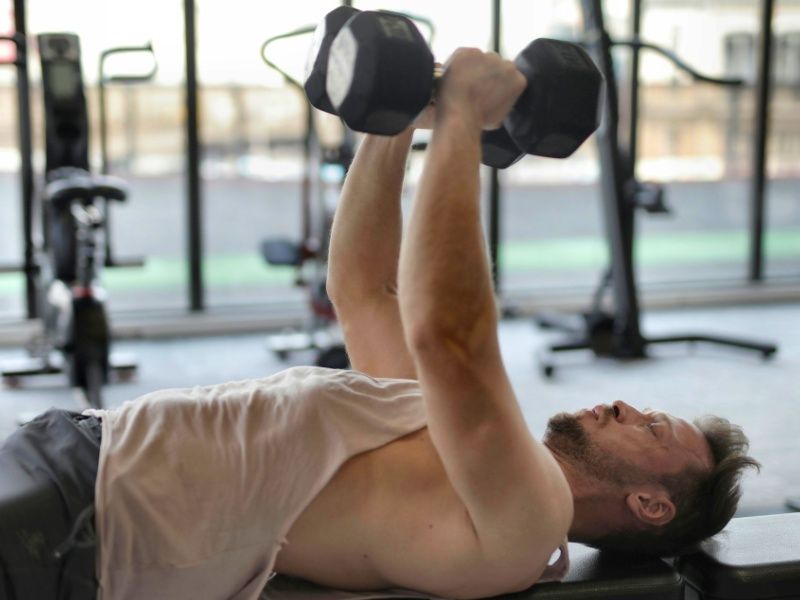
To do a skull crusher, lie on a bench with an EZ bar or dumbbells above your chest. Move your elbows slightly back and lower the weight slowly beyond the top of your head, then straighten your elbows. Use a weight you can control for every rep.
If there is one triceps exercise that bodybuilders don't give up, it is the French press, also called the skull crusher or lying triceps extension. It is an isolation exercise for the triceps that lets you load the muscle with remarkable precision. This guide covers the benefits, technique, tips, common mistakes and variations.
An interesting fact about the English name: “skull crusher” is a reminder to keep the weight under control and away from your face. Do it correctly, responsibly and with the right weight for you, and there is nothing to worry about.
You can do it with a straight bar, an H bar (the bar with parallel handles), dumbbells and more. Most people use a W bar (EZ bar) or dumbbells. Both are comfortable to hold and give your wrists a natural position. Dumbbells even increase the range of motion because your head does not get in the way.
The main muscles working here are the triceps. All three heads work when you straighten your elbows.
| Muscle | Role in the exercise |
|---|---|
| Triceps, long head | straightens the elbow; it also crosses the shoulder, so it gets more stretch when your upper arms point back behind your head |
| Triceps, lateral head | straightens the elbow; the outer part you see from the side |
| Triceps, medial head | straightens the elbow; lies deeper, under the other two heads |
| Shoulder, upper back and core muscles | hold your upper arms still and keep you steady on the bench |
The benefits of the French press
Builds a lot of muscle mass
The main benefit of the French press is that you can use it to build exceptional muscle mass in the triceps. Compared with other exercises, it lets you load heavy weights on the muscle. You can also stretch and contract the triceps especially effectively.
Improving strength, grip and working weights in presses
The triceps is a key muscle in pressing exercises, such as the bench press and shoulder press, whether you use a barbell or dumbbells. Strengthening your triceps can help you progress and increase your working weights in those exercises.
Working the triceps from different angles
The French press works the triceps with your upper arms in a different position from a pushdown, where your elbows stay close to your body. Combining exercises at different angles lets you work the triceps in different ways. You can also do a French press on an incline bench to put a little more load on the long head.
In a 12-week study, 21 adults trained one arm with overhead cable extensions and the other with extensions with the arm at the side of the body. The overhead arm grew more: the long head by 28.5% versus 19.6%, and the whole triceps by 19.9% versus 13.9%, measured by MRI, even though it lifted lighter weights. In this exercise your upper arms point up, which sits between those two positions, and lowering the weight behind your head moves your arms a little closer to the overhead position.
A second study measured muscle activity (EMG), not growth, in 21 trained men. The lying dumbbell extension and the overhead dumbbell extension showed similar activation patterns in the long and lateral heads. The authors suggested not putting both in the same workout. It was a short test with one to two reps per exercise, so treat it as a hint, not a rule.
How to do a French press
- Choose a weight you can control, with the bar resting on your knees. Drive your feet firmly into the floor.
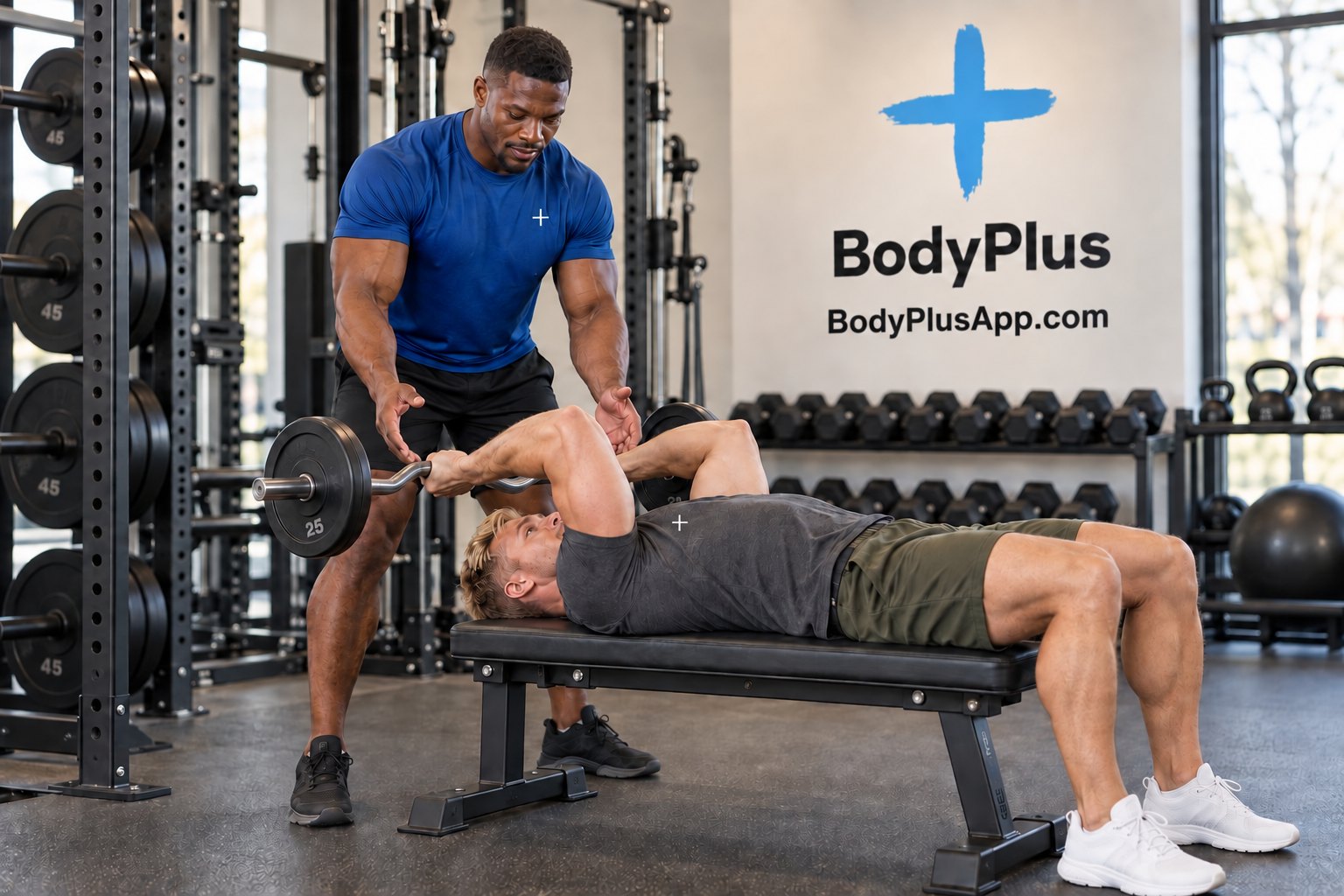
- Lie back and place the bar on your chest. Hold the bar with your thumbs wrapped around it.
- Raise the bar until your arms are straight.
- Move your elbows slightly back so the bar goes a little beyond your head as you lower it, rather than toward your face.
- Lower the bar slowly, as far as you can control without discomfort. The slow movement helps you avoid hitting yourself.
- Pause for a moment at the bottom.
- Raise the bar by extending your elbows until your arms are straight.
- Repeat until the set is finished.
My important tip: don't stop between one rep and the next. Resting at the top reduces the load on your triceps. The pause reduces the stimulus the muscle gets, so building muscle mass becomes less effective.
When the set is over, bring the bar back to your chest under control before you sit up. If you cannot do that, the weight is too heavy for you.
Common mistakes
Too much weight
Choosing the right weight is an art in itself. In training, it is tempting to lift as much as possible, and that's great, but not at the expense of technique. Here, that mistake matters even more.
Too much weight makes it harder to focus the load on your triceps. You use other muscles, such as the shoulders, to lift it. You get more tired overall, your triceps get less stimulus, and you could hurt your shoulders. If you cannot control the weight, it could fall on your face.
Work in a range of 10 reps or more, with a weight that challenges you but that you can control well. That way you give the muscle fibers a strong stimulus and get an exceptional pump.
Lowering the weight toward your face
Do yourself a favor: don't lower the bar toward your face or forehead. Lower it a little beyond your head instead, and be careful not to hit your head on the way back up.
Don't worry: lowering beyond your head does not make the exercise less effective. Quite the opposite. It increases the range of motion and works your triceps while they are stretched. A review of range-of-motion studies concluded that training muscles at longer lengths tends to favor growth in several muscles, the triceps among them. The triceps evidence is thin, though: the review's only triceps result came from partial reps in the middle of the range, which grew the muscle more than full reps. So treat the stretched position as a sensible choice, not a proven advantage.
Not doing the variation that suits you
Every person has a different body, anatomy, muscles and joints. Some people like the W bar. Others don't feel the muscle well with it and are better off switching to dumbbells, an H bar or a straight bar.
There is no shortage of options. Find the variation in which you feel most comfortable. By the way, this applies to every bodybuilding exercise, not only triceps work.
Safety
Use a stable bench, secure the plates with collars and ask a spotter to help you get the bar into position and take it back at the end of the set. Warm up with a light set before adding weight, and start with a load you can control from setup to finish.
Wrap your thumbs around the bar and lower it slowly a little beyond your head, away from your face. Keep the return controlled too, without bouncing or jerking the weight.
End the set if you feel pain or dizziness, or if your form starts to break down. Bring the bar back to your chest under control before sitting up, or have your spotter take it if you need help.
Variations of the French press
French press with dumbbells
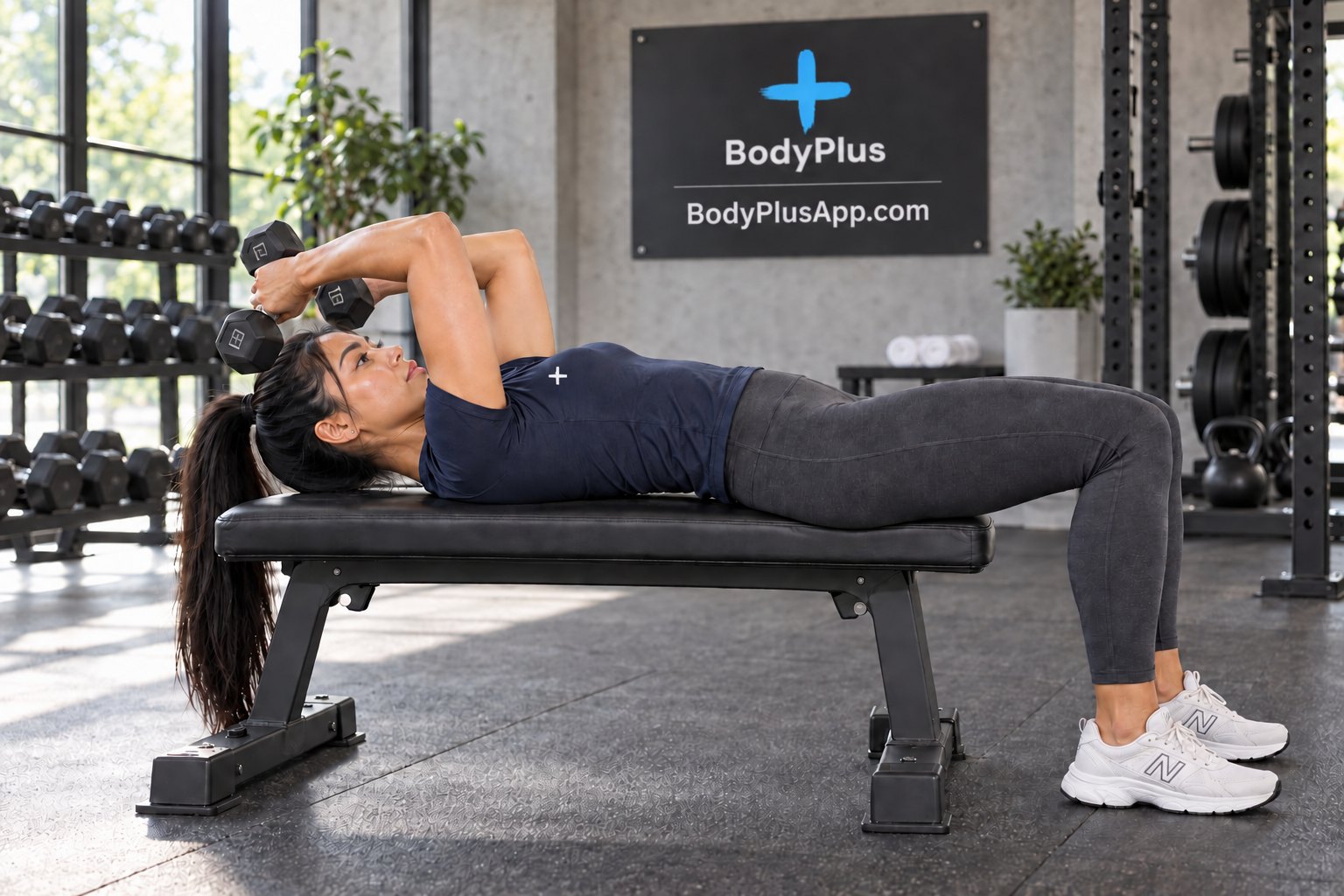
The dumbbell version is very similar to the bar version. With dumbbells, you can work each arm separately and thus correct an imbalance between sides. You can also reach a greater range of motion, giving the muscle fibers a stronger stimulus.
Switch between variations every so often to get the benefits of each one. A review of eight studies found that planned variation of exercises can help growth and strength, while changing exercises too often and at random may hold your progress back.
French press with a straight bar
Most people prefer the W bar because of its grip angle, but some prefer a straight bar. A straight bar puts more load on the wrist joints. Not many people prefer this variation.
French press on an incline
An incline bench can increase the range of motion and the stretch in your triceps a little. It can also put a little more load on the long head. You can do it with a bar, a dumbbell, kettlebells and more.
Sets, reps and a workout example
As a starting point, use the 10-or-more-rep range described above. Here is an example of where the exercise can fit in a triceps workout:
Sample triceps workout
| Exercise | Sets | Reps | Rest |
|---|---|---|---|
| Close-grip bench press | 3 | 6-10 | 2 min |
| EZ-bar skull crusher | 3 | 10-15 | 90 s |
| Rope pushdown | 3 | 12-15 | 60 s |
How to track it and when to go heavier
| Session | EZ bar, total weight | Set 1 | Set 2 | Set 3 |
|---|---|---|---|---|
| Week 1 | 25 kg (about 55 lb) | 13 | 12 | 10 |
| Week 2 | 25 kg (about 55 lb) | 14 | 13 | 11 |
| Week 3 | 25 kg (about 55 lb) | 15 | 14 | 13 |
| Week 4 | 25 kg (about 55 lb) | 15 | 15 | 15 |
| Week 5 | 27.5 kg (about 60 lb) | 12 | 11 | 10 |
When every set reaches 15 good reps, add the smallest weight step your gym has. Triceps progress in small steps, so a log helps you see it.
Frequently asked questions
Is the French press more effective with a bar?
Not necessarily. Every person is built differently: some prefer a bar and others prefer dumbbells. Try both until you find what suits you best, and even then switch every so often.
Is the French press the best triceps exercise?
There is no single best exercise for the triceps. Varying your triceps exercises lets you work the muscle in different ways.
What muscles do skull crushers work?
All three heads of the triceps work. Your shoulders, upper back and core help keep you steady on the bench.
Should I lower the weight to my forehead or behind my head?
A little beyond your head, away from your face. Lower it slowly and under control.
Are a skull crusher, a lying triceps extension and a French press the same exercise?
The first two names mean the same exercise. “French press” is used for it too, and some people also use the name for a seated or standing overhead extension.
What if this exercise hurts my elbows?
Stop the set if it hurts. You can try a lighter weight or a variation that feels comfortable, such as dumbbells.
Bottom line
The French press is an exceptional exercise that can be the main exercise in your triceps workout. Many bodybuilders like it for the benefits it offers. You can use a different variation each time, with a slightly different incline. This gives you the benefits of each one, varies your triceps training, and keeps your body from getting used to one exercise and your progress from stalling.
The most important thing is to keep yourself safe. Don't train with a weight you are not sure you can control. If you can, get a friend to watch over you during the set.
The information on this page and on this website is intended to provide general information only. The content on this website does not constitute a professional opinion, a recommendation, or a substitute for consulting an expert in a specific field or obtaining a medical opinion. It is not medical advice. BodyPlus is not a medical device. If you have a health condition or an injury, or are pregnant, talk to a qualified healthcare professional before starting. Stop exercising and seek appropriate help if you feel pain, dizziness or other concerning symptoms.
Sources
Accessed September 17, 2026.
- OpenStax, Anatomy and Physiology 2e, "11.5 Muscles of the Pectoral Girdle and Upper Limbs" (the triceps brachii and its action on the elbow). openstax.org/books/anatomy-and-physiology-2e/pages/11-5-muscles-of-the-pectoral-girdle-and-upper-limbs
- Maeo S. et al., "Triceps brachii hypertrophy is substantially greater after elbow extension training performed in the overhead versus neutral arm position", Eur J Sport Sci 2023;23(7):1240-1250. pubmed.ncbi.nlm.nih.gov/35819335
- Alves D., Matta T., Oliveira L., "Effect of shoulder position on triceps brachii heads activity in dumbbell elbow extension exercises", J Sports Med Phys Fitness 2018;58(9):1247-1252. pubmed.ncbi.nlm.nih.gov/28677940
- Kassiano W. et al., "Which ROMs Lead to Rome? A Systematic Review of the Effects of Range of Motion on Muscle Hypertrophy", J Strength Cond Res 2023;37(5):1135-1144. pubmed.ncbi.nlm.nih.gov/36662126
- Kassiano W. et al., "Does Varying Resistance Exercises Promote Superior Muscle Hypertrophy and Strength Gains? A Systematic Review", J Strength Cond Res 2022;36(6):1753-1762. pubmed.ncbi.nlm.nih.gov/35438660