
How to Do the Dumbbell Bench Press: Form, Muscles Worked and Mistakes
In short
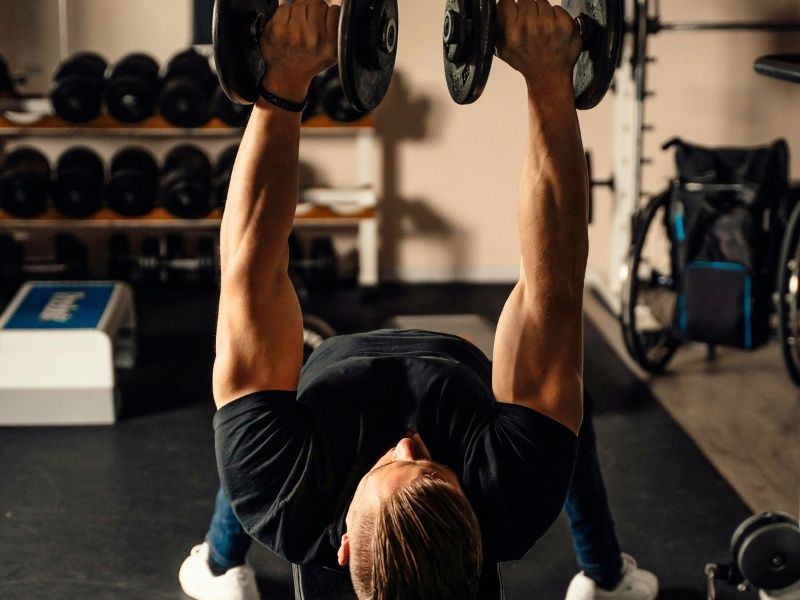
To do the dumbbell bench press, lie on a flat bench with a dumbbell in each hand. Pull your shoulder blades back and down, lower the weights under control toward your chest, then press them up until your arms are almost straight. Your chest, shoulders and triceps do the work.
If I had to list the craziest chest exercises for building muscle mass, the dumbbell chest press would be among the first. It is a press like the barbell bench press, except you use a pair of dumbbells. That gives it some unique advantages. Let's start!
Benefits and muscles worked
Builds serious muscle mass in the chest, shoulders and triceps
Chest presses are among the most powerful exercises for building the front of your upper body. Several muscles work together to lift the weight: your chest does the main pressing work, while your shoulders and triceps work hard too.
Helps improve an imbalance between your right and left sides
One of the most important advantages of dumbbells is the work each side has to do. With a barbell, your stronger side can compensate for your weaker side. With dumbbells, each arm carries its own weight, so both sides get a similar load, so the imbalance gets better.
Gives you more room to adjust for sensitive shoulders
If your shoulders are sensitive, I'd rather you try the dumbbell chest press than the barbell press. You can change your hand position and grip. Bring your elbows a little closer to your body and turn your grip slightly inward; this may feel more comfortable on your shoulders. The exercise still works your shoulders, so stay within a range you can control comfortably.
Dumbbells can also travel a little farther than a barbell, which stops at your chest. Reviews by Pallarés et al. (2021) and Kassiano et al. (2023) found advantages to a fuller range or training at longer muscle lengths in some exercises; most of that evidence was not about the chest, so I use the range that feels good rather than chasing extra depth.
How to do the dumbbell bench press
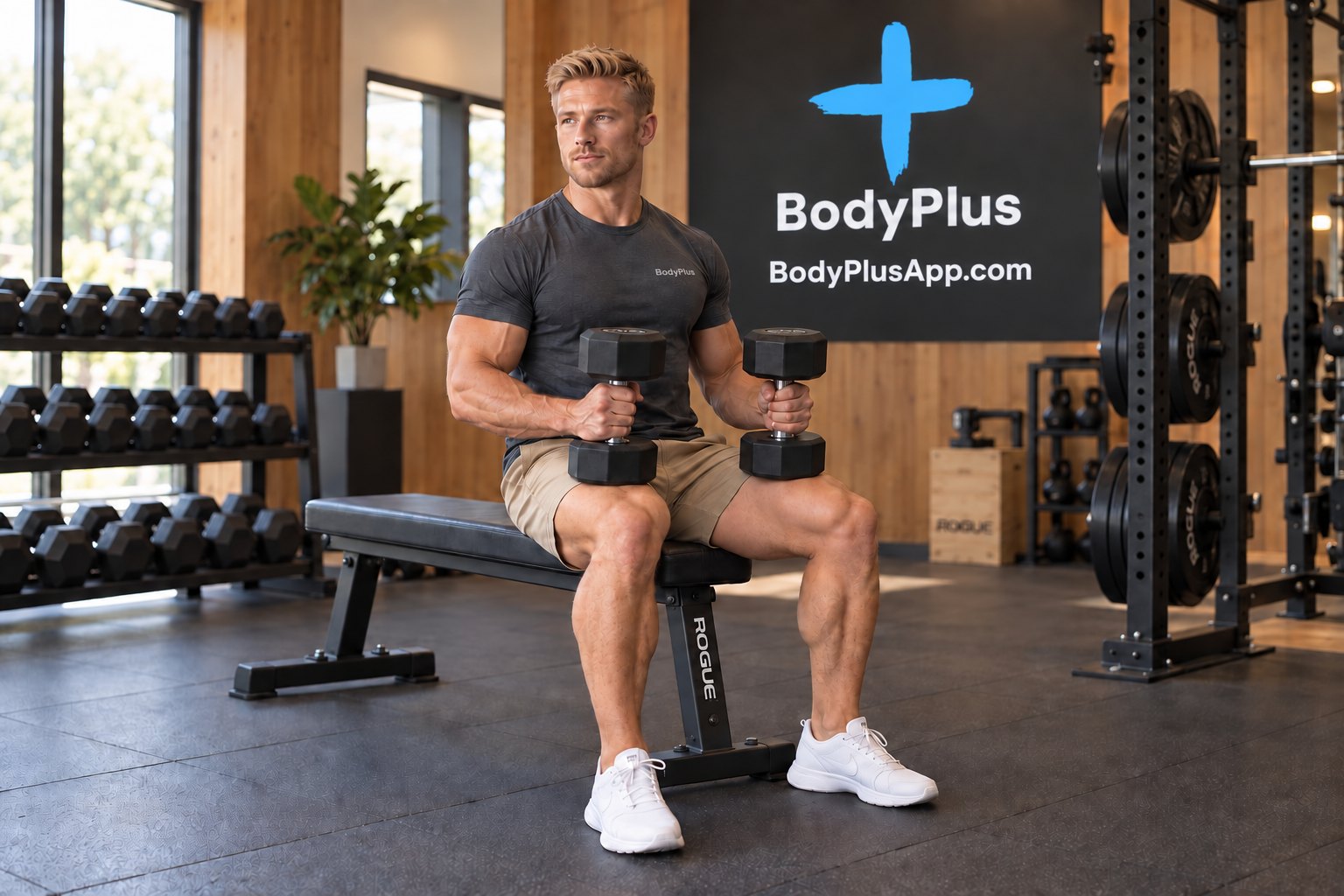
- Sit on the bench with a dumbbell resting on each thigh and your feet planted on the floor.
- Lie back and use your knees to help bring the dumbbells up. This helps especially with heavy weights.
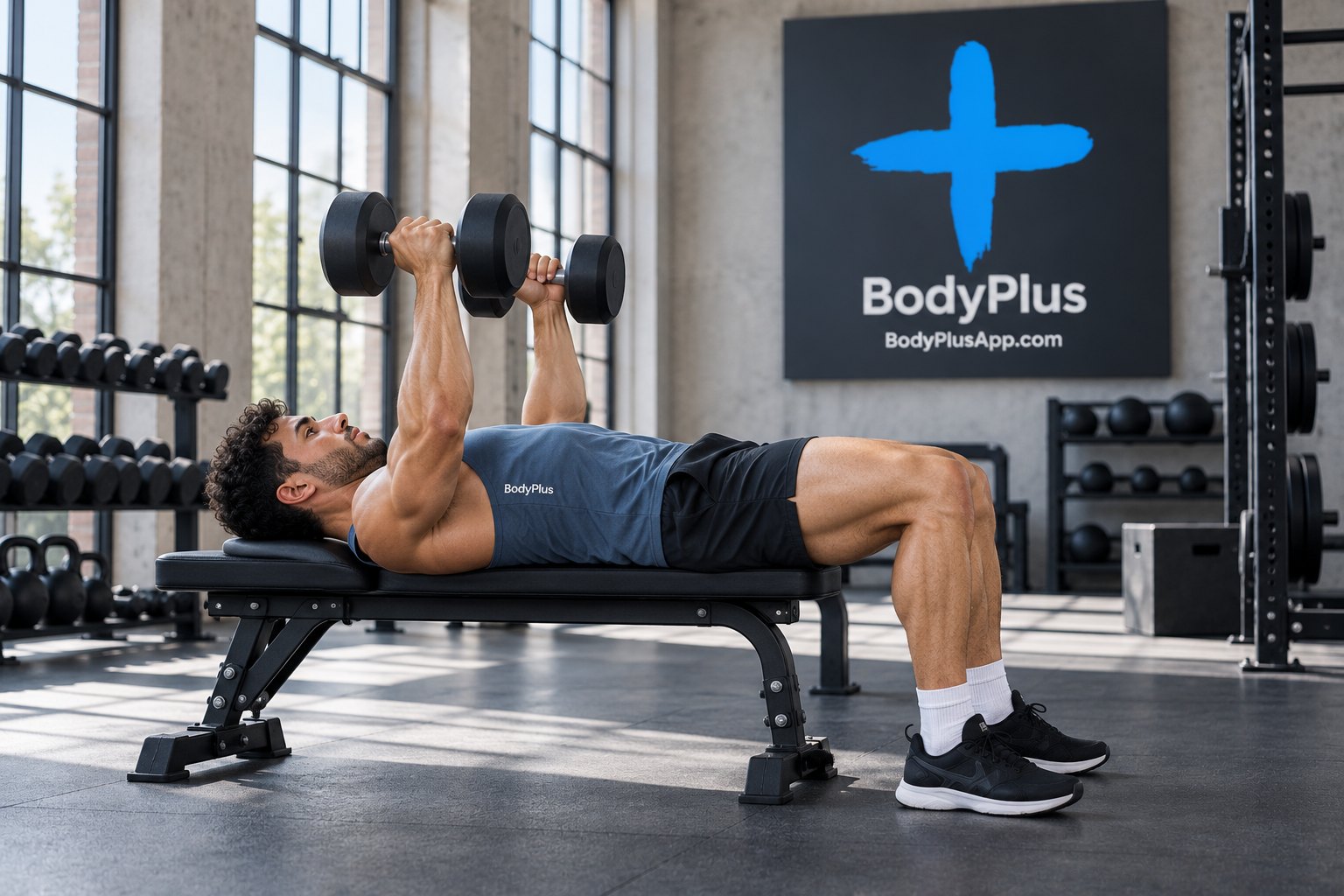
- Position the dumbbells over your chest, around nipple level, with your arms straight at about a 90-degree angle to your torso, pointing up, and your wrists over your elbows.
- Set your shoulder girdle: pull your shoulder blades back and down.
- Lower the dumbbells in a controlled movement, keeping your elbows a little below shoulder level and angled slightly toward your stomach.
- Lower until your upper arms are about parallel to the floor or the dumbbells touch your chest, as far as your shoulders feel comfortable.
- Press back up. Stop just short of fully straightening your arms, then begin the next controlled rep.
- Repeat for the number of reps in your set.
Getting the dumbbells up
Rest each dumbbell upright on your thighs, close to your knees. As you lie back, lift one knee and then the other to help move the dumbbells toward your chest; keep them close to your body. Once they are over your chest, set your shoulder blades before the first rep. For a heavy set, a training partner can hand you the dumbbells once you are lying down.
Setting them down
After the last rep, lower the dumbbells toward your chest and bring them back onto your thighs with your knees bent. Sit up, then place them on the floor beside your feet under control. Avoid dropping them to your sides with straight arms.
Common mistakes
Too much weight
With dumbbells, each weight needs its own stabilization. If you choose dumbbells that are too heavy, you may not be able to steady them, and a bad movement under load may strain your shoulder. Choose a pair you can control from the first rep to the last, including the setup.
Elbows in line with your shoulders
When you lower the dumbbells, don't flare your elbows straight out in line with your shoulders. Bring them a little toward your stomach, but not all the way against your body; the closer they come in, the more your triceps work. Flaring them all the way out puts a lot of pressure on your shoulder joints.
Noteboom et al. (2024) modeled shoulder forces at different elbow angles in a barbell press and found tradeoffs between positions, not one proven injury-free angle. It was a barbell model, not a dumbbell injury study, so I use the elbow cue above as a starting point rather than an exact rule.
Dumbbell bench press variations
Barbell chest press
The first exercise many people think of for chest training is the barbell bench press. It is a powerful choice for building strength and lifting heavier weights. It needs less stabilization than dumbbells, and lifting heavier can train your nervous system to use your muscles more efficiently. The dumbbell press gives you a longer range of motion. You can switch between them from time to time and get the benefits of both.
| Point | Dumbbell bench press | Barbell bench press |
|---|---|---|
| Range of motion | a little deeper at the bottom | the bar stops at your chest |
| Weight you can lift | lower | higher |
| Each side | works on its own | the stronger side can help the weaker one |
| Stability demand | higher | lower |
| Hand and elbow position | free to adjust | fixed by the bar |
| Small weight jumps | harder (the next pair adds weight on both sides) | easier (you can add 2.5 kg, about 5 lb, in total) |
| Training alone | no bar to get trapped under, but heavy dumbbells are hard to get into position | needs a spotter or safety arms for heavy sets |
Saeterbakken et al. (2011) found a lower dumbbell maximum than barbell maximum in 12 trained men; Farias et al. (2017) and Heinecke et al. (2021) also compared performance in single sessions. These small, short comparisons do not show which press builds more muscle over time, so use both if you enjoy both.
Incline dumbbell chest press
Want to emphasize the upper chest? Raise the bench to about 30–45 degrees and press the dumbbells diagonally. The technique is similar, but your shoulders take on more load, so pay attention to the weight you use. See my incline dumbbell press guide for more.
Neutral-grip dumbbell press
Turn your palms toward each other and keep your elbows a little closer to your body. For sensitive shoulders, try this grip with a lighter pair and see whether it feels comfortable.
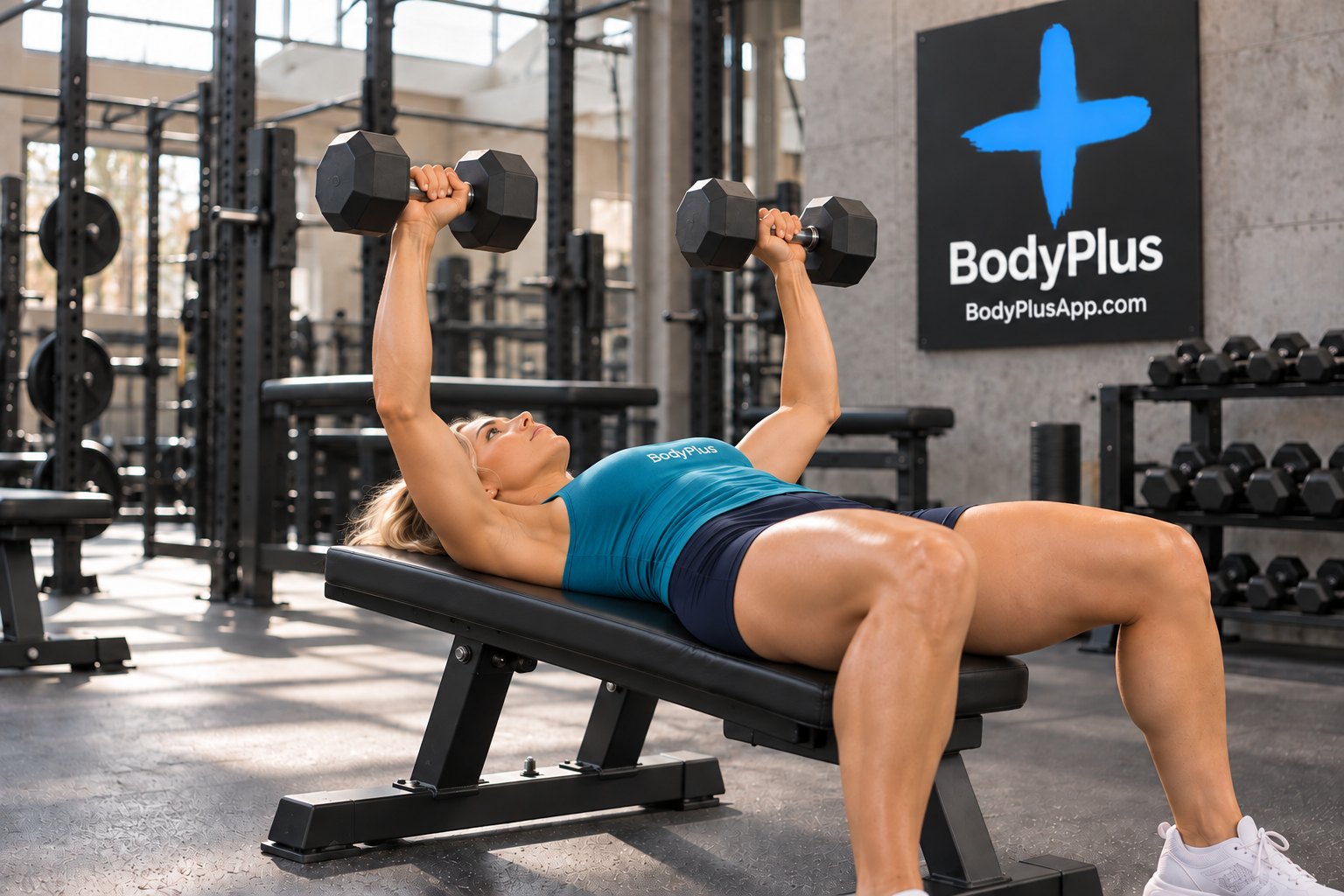
Dumbbell floor press
No bench? Lie on the floor with your knees bent and press from there. The floor stops your elbows, so the range is shorter; lower them gently rather than banging them on the floor.
Sets, reps and a sample workout
If you are learning the movement, begin with light dumbbells for 10–15 controlled reps. For a chest workout, you could do three sets of 8–12 reps and rest about two minutes between them. Keep the weight where you can steady both dumbbells throughout the set.
Sample chest workout
| Exercise | Sets | Reps | Rest |
|---|---|---|---|
| Dumbbell bench press | 3 | 8-12 | 2 min |
| Incline barbell or dumbbell press (about 30 degrees) | 3 | 8-10 | 2 min |
| Cable or dumbbell fly | 3 | 10-15 | 60-90 s |
| Push-ups | 2 | as many good reps as you can | 60 s |
When you can do every rep with good control, you can try the next pair. A jump of 2.5 kg (about 5 lb) per hand may feel big, so you might get fewer reps at first; that is fine. If the jump is too much, keep the lighter pair and build your reps.
Safety
Start with a light pair and a warm-up set so you can control both weights on the way down. Check that adjustable dumbbells are secured before you lift them, and ask a training partner for a hand with a heavy setup. Keep the lowering controlled and end the set if a dumbbell wobbles, your form breaks down, you feel pain or you get dizzy. Bring the weights back to your thighs before you sit up; don't throw them out to the sides. Let your weaker arm set the limit, even if the other one could do another rep.
Bottom line
The dumbbell chest press is an excellent exercise for building serious muscle mass in the chest, while your shoulders and triceps work too. You get a large range of motion and each side has to carry its own weight. Make sure you have mastered the technique before you lift heavy dumbbells.
I like changing the variation from time to time so your body doesn't get used to just one exercise and you get the benefits of both the dumbbell and barbell press.
Frequently asked questions
What muscles does the dumbbell bench press work?
Your chest does most of the pressing, with your front shoulders and triceps working hard too.
Is the dumbbell press better than the barbell bench press?
Use both if they suit you: dumbbells let each side work on its own and give you more room to move; the barbell lets you lift heavier weights. Choose the one that fits your goal, or change between them.
How low should I lower the dumbbells?
Aim for your upper arms to be about parallel to the floor or for the dumbbells to touch your chest, but only go as low as your shoulders feel comfortable.
Should the dumbbells touch at the top?
They don't need to. Press them over your chest with control and stop just short of fully straightening your arms.
What if the press hurts my shoulder?
Stop the set. You can try lighter dumbbells, a slightly inward grip or a shorter range. If it still hurts, leave this variation out for now.
The information on this page and on this website is intended to provide general information only. The content on this website does not constitute a professional opinion, a recommendation, or a substitute for consulting an expert in a specific field or obtaining a medical opinion. It is not medical advice. BodyPlus is not a medical device. If you have a health condition or an injury, or are pregnant, talk to a qualified healthcare professional before starting. Stop exercising and seek appropriate help if you feel pain, dizziness or other concerning symptoms.
Sources
Accessed September 29, 2026.
- Saeterbakken A.H. et al., "A comparison of muscle activity and 1-RM strength of three chest-press exercises with different stability requirements", J Sports Sci 2011;29(5):533-538. pubmed.ncbi.nlm.nih.gov/21225489
- Farias D.A. et al., "Maximal Strength Performance and Muscle Activation for the Bench Press and Triceps Extension Exercises Adopting Dumbbell, Barbell, and Machine Modalities Over Multiple Sets", J Strength Cond Res 2017;31(7):1879-1887. pubmed.ncbi.nlm.nih.gov/27669189
- Heinecke M.L. et al., "Relationship of Barbell and Dumbbell Repetitions With One Repetition Maximum Bench Press in College Football Players", J Strength Cond Res 2021;35(Suppl 1):S66-S71. pubmed.ncbi.nlm.nih.gov/33666593
- Noteboom L. et al., "Effects of bench press technique variations on musculoskeletal shoulder loads and potential injury risk", Front Physiol 2024;15:1393235. pubmed.ncbi.nlm.nih.gov/38974522
- Pallarés J.G. et al., "Effects of range of motion on resistance training adaptations: A systematic review and meta-analysis", Scand J Med Sci Sports 2021;31(10):1866-1881. pubmed.ncbi.nlm.nih.gov/34170576
- Kassiano W. et al., "Which ROMs Lead to Rome? A Systematic Review of the Effects of Range of Motion on Muscle Hypertrophy", J Strength Cond Res 2023;37(5):1135-1144. pubmed.ncbi.nlm.nih.gov/36662126