
How to Do Hip Thrusts: Form, Muscles Worked and Variations
In short
To do a hip thrust, sit on the floor with your upper back against a bench and a padded barbell over your hip crease. Plant your feet so your shins are about vertical at the top, tuck your chin, keep your ribs down, and squeeze your glutes to lift your hips until your shoulders, hips and knees form a straight line. Pause, then lower slowly. The exercise mainly works your glutes, with help from your hamstrings, quads and core.
Looking for an exercise that builds strong glutes? Then the hip thrust is the exercise you need. It is an excellent exercise that helps us build significant strength in the glutes and the legs. You may ask what makes it so effective and how to do it correctly, and you have come to the right article. Here you will find the benefits, the technique, common mistakes, variations, tips and more. So let's begin!
There is a tendency to think the hip thrust is an exercise only women need to do. Of course, that is a mistake. Men can get a great deal out of this exercise too.
This page goes deep into one exercise. For a full glute workout with more exercises, see my guide to the best glute exercises.
Muscles worked
The main muscles that work in the exercise are the three gluteal muscles, the hip abductors, the hamstrings and the quadriceps. In a little more detail:
| Muscle | Role in the exercise |
|---|---|
| Gluteus maximus (the big glute muscle) | the main mover: straightens your hips and lifts the weight |
| Gluteus medius and minimus (side of the hips) | help keep your knees and pelvis steady |
| Hamstrings (back of the thighs) | help straighten your hips |
| Quadriceps (front of the thighs) | keep your knees in position; work harder if your feet are too close |
| Adductors (inner thighs) | help and keep your knees in line |
| Core and lower-back muscles | keep your trunk steady so the movement comes from your hips |
Benefits: why it belongs in your workout
The hip thrust has many benefits. Whether you are a beginner or an experienced bodybuilder, you have plenty of reasons to include it in your training program.
It builds strong and powerful glutes
The hip thrust is an outstanding glute exercise, for a very clear reason. It is not for nothing that serious trainees include it in their programs. It lets us focus the load on the glute muscles with exceptional precision.
During the movement the bar sits directly over your hips. Gravity pulls the bar down, and the glute is the muscle located right beneath the bar, so it has to deal with all the resistance that is created. In addition, you can load crazy weights, and they will reach the glute muscles exactly.
It can help you lift more in the squat and the deadlift
The hip thrust can help us improve our working weights in exercises such as squats, lunges and split squats. The glute muscles are the biggest muscles in the body in terms of the amount of muscle fibers, and they are capable of producing enormous force. Strengthening them will help us improve the weights in the exercises in which the glutes are involved. Men and women alike can get a great deal out of adding the hip thrust to a lower-body workout.
Keep your expectations realistic: in the study described below, hip thrust training raised deadlift strength about as much as squat training did, but squat strength rose more in the group that trained squats. To get better at a lift, you still need to train that lift.
A safe alternative to the squat
The squat builds lower-body strength very well, but some people cannot safely place a heavy bar on their back. For example, people with shoulder, back, neck or lower-back problems prefer not to take the risk of putting weight on their back.
With the hip thrust you can train your glutes without loading weight on your upper body. However, you will need to add other exercises for the front of your legs, such as the leg press or split squats. My best leg exercises guide has options.
Many variations, so it suits every level
It is easy to adapt the hip thrust to different fitness levels. You can use a barbell, dumbbells, a band, a machine, or even just your body weight.
Hip thrust vs squat: which is better?
Many people ask which is better, the hip thrust or the squat. The question is a bit problematic, because it depends on the goal for which you are doing the exercise.
If you want an exercise that works all the leg muscles and builds muscle mass in a balanced way, the squat will suit you. If you want to focus the load on the glutes and the hamstrings, the hip thrust is better. In a muscle-activity study of 13 trained women, the hip thrust used the gluteus maximus and the biceps femoris more than the back squat (study).
What research says: in a 9-week study, 34 untrained young adults trained either the hip thrust or the back squat, with the same number of sets. MRI scans showed similar glute growth in both groups, and the squat group grew more quad and inner-thigh (adductor) muscle. So the squat builds glutes well too, and the hip thrust lets you load them more directly. Each group's strength gains favored its own exercise, and deadlift strength rose about the same in both. The hip thrust showed higher glute activity in the first session, but that did not consistently predict who grew more. The people in the study were beginners, so results in experienced lifters may differ.
Note that a muscle working during an exercise does not always mean it grows much from it: in that study, the side glutes (gluteus medius and minimus) and the hamstrings grew little or not at all in either group. So add some work for them too, such as band hip abduction or side-lying leg raises. My hip dips exercises guide shows several.
It is important to know that to build a complete and balanced body, you need to train all the muscles in your body. You can do both exercises in your leg workout, and that way you get the benefits of both.
Hip thrust form, step by step
- Sit on the floor with your knees bent and the bench behind you. Place the bar near your legs. You can use a pad to reduce the discomfort the bar causes.
- Roll the bar so that it is directly over your hips. Hold the bar so that it does not move. Do not use your hands to lift it.
- Lean back on the bench so that your shoulder blades are close to the top of it.
- Squeeze your glutes and lift the bar straight up until your hips are in one line with your shoulders and knees. The bench should support the mid-shoulder-blade area.
- Pause for a second, stabilize, and then start the movement.
- Lower your butt down until it is a few centimeters (an inch or two) from the floor.
- Pause for a moment.
- Lift your butt up to maximum contraction.
- Repeat for the number of repetitions until the end of the set.
Common mistakes and how to fix them
1. Feet too close to your hips
The first mistake is placing your feet too close to your butt. Ideally, you should create a 90-degree angle at the knee, with the hips in full extension.
If you feel that your quadriceps are working too hard, or you feel discomfort in your knees, it may be that your feet are too close to your hips. If you mostly feel your hamstrings, your feet may be too far away. In one small study, 7 experienced personal trainers using a light load did four versions with different foot positions and ways of pushing. The activity of every measured leg muscle except the gluteus medius changed between them. That study measured muscle activity, not growth, so take it as a sign that foot position changes how the work is shared, and let what you feel guide your adjustments.
2. Positioning the bar incorrectly
Some people find it hard to position the bar correctly. This makes the exercise clumsy and reduces the weights they can lift. It is important that you learn and practice how to position the bar correctly. Using a pad that softens the contact with the bar can help.
The bar should be over the joint between the pelvis and the thigh (the upper part of the leg). This puts it right beneath your glutes, and then you can focus the load precisely on the muscle.
3. Lowering the bar too fast
Both the concentric phase (the lift) and the eccentric phase (the lowering) are important during the hip thrust. A large share of people do the lowering phase quickly, in order to save strength for another repetition.
This is a mistake, because even in the eccentric phase the muscle fibers still receive load.
To get the full effectiveness of every rep, lower the bar over about 2 seconds.
4. Lifting your head and neck
Some people also lift their head and neck during the rising part. This can cause pressure on the neck and on the vertebrae of the spine, and then cause pain.
During the exercise make sure that the back of your neck stays against the bench, and that you do not raise it or bend it excessively.
5. Arching your lower back at the top
Pushing the hips too high by arching the lower back shifts the work from your glutes to your lower back. Stop when your body is straight from shoulders to knees, keep your ribs down, and finish with a hard glute squeeze.
6. Stopping short of the top
Stopping before your hips are fully extended cuts off the part of the rep where your glutes work hardest. If you can't reach the top with a pause, the weight is too heavy for now.
Variations: dumbbell, band, machine and more
Glute bridge
If you are looking for a body-weight exercise for the glutes, the glute bridge is a great option. The movement is very similar to the hip thrust, except that here you do it lying on the floor with your legs bent.
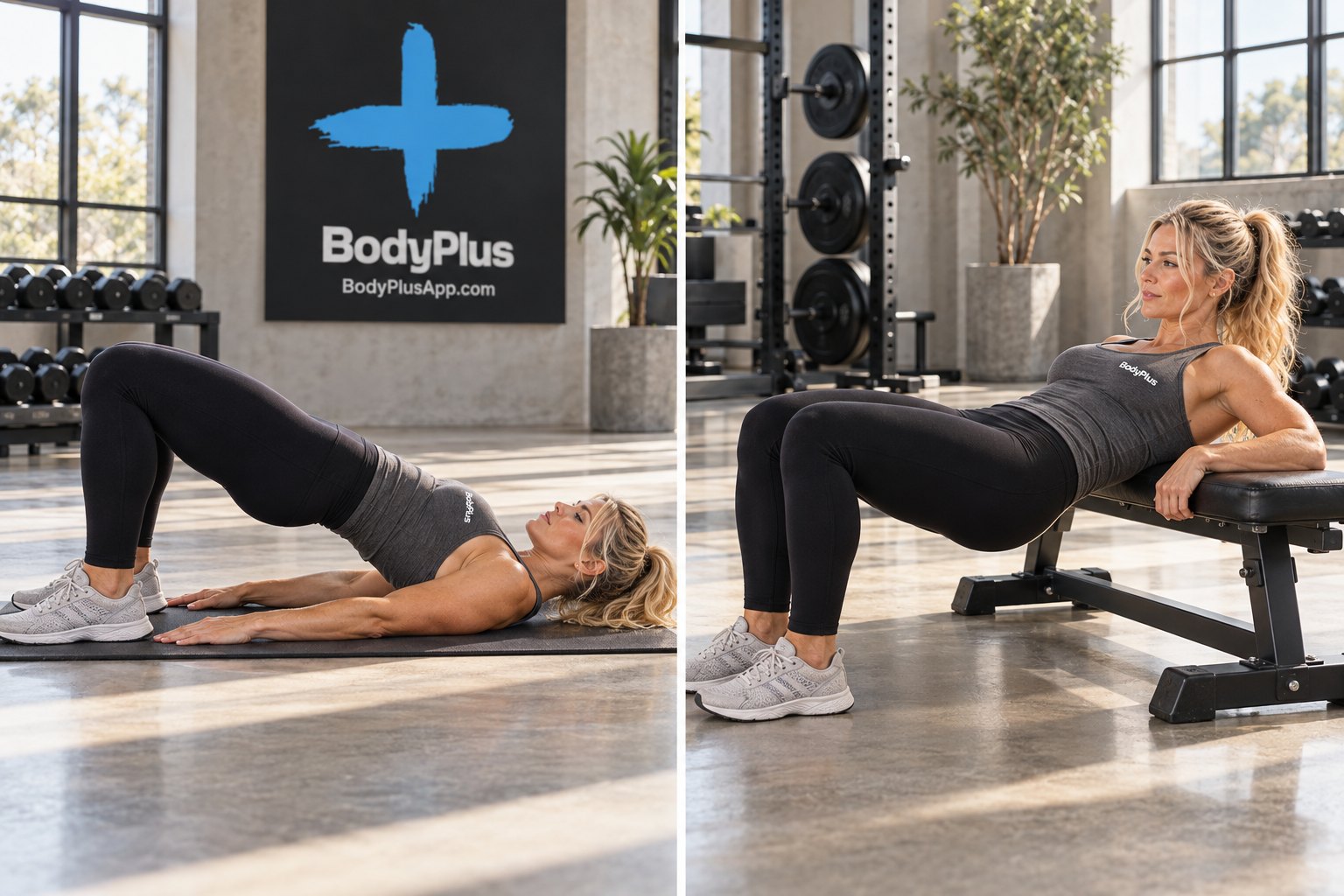
You can perform it with body weight only, or raise the difficulty level with additional resistance such as a dumbbell or a resistance band.
In the bridge your upper back is on the floor, so your hips move through a shorter range. The bench version lets your hips travel further and makes heavy loading easier. The bridge needs no bench, so it is easy to do anywhere.
What research says: in one small study of 10 men, the barbell glute bridge showed higher glute muscle activity than the barbell hip thrust on a bench, while the bench version showed more quad activity. That study measured muscle activity, not growth. Both are good exercises; choose the one that fits your equipment and feels best.
Hip thrust with TRX straps
The technique of this exercise is very similar to the bridge, except that you place your feet in TRX straps. This variation demands serious balance. Because of the instability, it is less suitable for hypertrophy (building muscle mass). It is more suitable for improving stability and balance.
Hip thrust with a dumbbell
A great variation for beginners or for people who train at home. Instead of placing the bar on your hips, you place a dumbbell there.
Most beginners find it hard to train with a bar, and the dumbbell helps them build the base for working with one. After you have mastered the movement, it is worth switching to a bar. With the bar it is more comfortable to lift heavy weights.
Band hip thrust
Loop a resistance band over your hips and hold it down on each side with your hands, or anchor it under the bench legs or to dumbbells on the floor. The band gets harder as you rise, so the top of the movement is the hardest part. It is a handy option at home or when you have no bar.
Glute machine and Smith machine
Many gyms have a dedicated hip thrust machine, or you can use a Smith machine, where the bar runs on rails. Both make the setup quicker and keep the bar steady, which helps when you train alone. Set the pad or bar over your hips and use the same form cues.
Single-leg version
Do the movement with one foot on the floor and the other leg lifted. It is much harder with body weight alone, trains each side on its own, and shows you quickly if one side is weaker. Start without weight, then hold a dumbbell on the working hip.
Sets, reps and where it fits in your workout
These are common ranges to start from, not fixed rules:
- Reps: 6-12 per set with a barbell or machine; 12-20 for body-weight, band or light dumbbell versions.
- Sets: 3-4, with about 2 minutes of rest for heavy sets.
- Effort: stop most sets when you could do only one to three more good reps, with a pause at the top of each rep.
- How often: once or twice a week, with at least two rest days between hard lower-body sessions.
- Order: do it early in your leg or glute workout, while you are fresh.
Sample glute workout
| Exercise | Sets | Reps | Rest |
|---|---|---|---|
| Barbell hip thrust | 3 | 8-12 | 2 min |
| Romanian deadlift | 3 | 8-12 | 2 min |
| Split squat | 2 | 8-12 each leg | 90 s |
| Band hip abduction | 2 | 15-20 | 60 s |
Home version: single-leg glute bridge 3 x 12-15 each side, a banded or dumbbell version with your back on a sturdy sofa that can't slide 2 x 15-20, split squat 2 x 10-12 each leg, and side-lying leg raise 2 x 15-20 each leg.
How to track it and when to go heavier
One session a week, with the total bar weight including the bar:
| Session | Bar weight | Set 1 | Set 2 | Set 3 |
|---|---|---|---|---|
| Week 1 | 60 kg (132 lb) | 10 | 9 | 8 |
| Week 2 | 60 kg (132 lb) | 10 | 10 | 9 |
| Week 3 | 60 kg (132 lb) | 11 | 10 | 10 |
| Week 4 | 60 kg (132 lb) | 12 | 11 | 10 |
| Week 5 | 60 kg (132 lb) | 12 | 12 | 12 |
| Week 6 | 65 kg (143 lb) | 10 | 9 | 8 |
When every set reaches the top of your rep range with a pause at the top and good form, add a small amount of weight, such as 2.5 kg (5 lb) per side. If a rep loses its pause or your lower back starts to arch, count the set as finished there.
Safety
Before you start loading heavy weights, make sure you have mastered the technique. Learn the hip thrust without weight at first, and check that you can do it correctly without pain or discomfort in your pelvis, knees or lower back. It is very important to set up the bar properly, especially if you plan to lift heavy: use a pad, keep the bench at about knee height, and make sure it cannot slide, for example by setting it against a wall or a rack. Add weight in small steps, and stop the set if your form breaks down or you feel pain; then switch to a lighter or pain-free variation.
After the last rep, lower your hips to the floor, roll the bar down your thighs toward your knees and slide out from under it, or ask a partner to lift it off, and don't try to throw a heavy bar off your hips.
Bottom line
The hip thrust is one of the most powerful exercises for building muscle in your glutes. It focuses the load directly on the glute muscle fibers, and it can help you improve your weights in other exercises such as the squat and the deadlift.
To get the full benefit it offers, you need to master the technique perfectly.
And I almost forgot: this exercise may have a funny side effect. If your glutes grow, your jeans may stop fitting you.
Frequently asked questions
What muscles do hip thrusts work?
Mainly your glutes, especially the gluteus maximus. Your hamstrings, quads, inner thighs, core and lower-back muscles help.
Why do I feel this exercise in my lower back?
Usually because you arch your back at the top instead of finishing with your glutes. Keep your ribs down, stop when your body is straight, and lower the weight. Stop the set if it hurts, and switch to a lighter or pain-free variation such as the glute bridge.
Why do I feel it in my quads or hamstrings?
If you feel it mostly in your quads, your feet are probably too close to you. If you feel it mostly in your hamstrings, they may be too far away. Adjust until your knees are bent about 90 degrees at the top.
How high should the bench be?
About knee height. A standard flat bench fits most people, as long as it can't slide.
Do I need a pad?
It is not required, but a bar pad or a thick folded mat makes heavy sets much more comfortable on your hips.
Can I do this exercise at home?
Yes. Use a sturdy sofa or bench that can't slide, with a dumbbell, a band or just your body weight. The glute bridge needs no bench at all.
Is the machine as good as the barbell?
It trains the same movement and is quicker to set up. Use whichever lets you train with good form and add weight over time.
How heavy should I go?
Choose a weight you can lift for your target reps with a pause at the top and no lower-back arch. Add weight in small steps.
Is this exercise good for men?
Yes. The exercise and the technique are the same for everyone. Choose a weight that fits your level.
The information on this page and on this website is intended to provide general information only. The content on this website does not constitute a professional opinion, a recommendation, or a substitute for consulting an expert in a specific field or obtaining a medical opinion. It is not medical advice. BodyPlus is not a medical device. If you have a health condition or an injury, or are pregnant, talk to a qualified healthcare professional before starting. Stop exercising and seek appropriate help if you feel pain, dizziness or other concerning symptoms.
Sources
Accessed September 17, 2026.
- Plotkin D.L. et al., "Hip thrust and back squat training elicit similar gluteus muscle hypertrophy and transfer similarly to the deadlift", Front Physiol 2023;14:1279170. pubmed.ncbi.nlm.nih.gov/37877099
- Kennedy D. et al., "Electromyographic differences of the gluteus maximus, gluteus medius, biceps femoris, and vastus lateralis between the barbell hip thrust and barbell glute bridge", Sports Biomech 2024. pubmed.ncbi.nlm.nih.gov/35586943
- Collazo García C.L. et al., "Differences in the Electromyographic Activity of Lower-Body Muscles in Hip Thrust Variations", J Strength Cond Res 2020;34(9):2449-2455. pubmed.ncbi.nlm.nih.gov/30335717
- Contreras B. et al., "A Comparison of Gluteus Maximus, Biceps Femoris, and Vastus Lateralis Electromyographic Activity in the Back Squat and Barbell Hip Thrust Exercises", J Appl Biomech 2015;31(6):452-458. pubmed.ncbi.nlm.nih.gov/26214739