
Triceps Muscles: Anatomy of the Three Heads and How to Train Them
In short
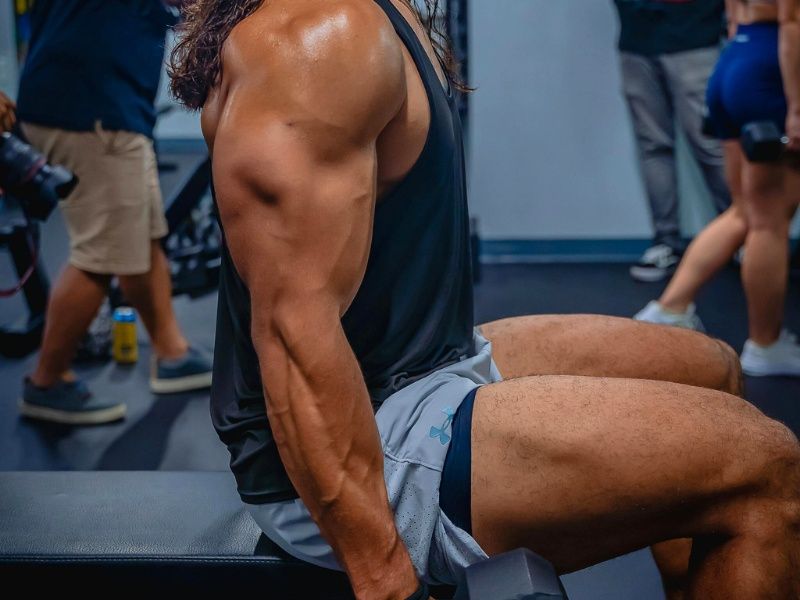
So many people who train dream of big, powerful arms. The problem is that many do not realize they do not know how to train their triceps properly. The triceps has three heads that straighten your elbow, and knowing how they work helps you choose your exercises.
In this guide, I will explain the muscle's anatomy, give you my tips for training it, and show you a ready-made workout you can start with. We will begin with the basic structure, move to the training tips, and then put them into a plan. Come on, let's get started!
Anatomical structure of the triceps
The triceps starts on the upper-arm bone (humerus) and the shoulder blade. Its three heads join in one tendon that attaches to a forearm bone (ulna). Its main job is elbow extension: increasing the angle between your forearm and upper arm, or simply straightening your arm when it is bent.
It is called the three-headed muscle because it has three heads:
- Long head
- Lateral head
- Medial head
| Head | Starts on | Ends on | Crosses | What it does | Where you see it |
|---|---|---|---|---|---|
| Long head | the shoulder blade, just below the shoulder socket | the olecranon (the point of your elbow) | shoulder and elbow | straightens the elbow; helps move the arm back and toward the body at the shoulder | back and inner side of the upper arm |
| Lateral head | the back of the upper-arm bone, high up | the olecranon | elbow only | straightens the elbow | outer side of the upper arm |
| Medial head | the back of the upper-arm bone, lower down | the olecranon | elbow only | straightens the elbow | mostly hidden; shows just above the elbow |
The long head
The long head starts on your shoulder blade, at a small bump just below the shoulder socket (the infraglenoid tubercle). It ends on the olecranon, the bony point you feel at the back of your elbow.
It is the only head that crosses two joints, the shoulder and the elbow. The long head is the largest of the three and has the biggest share of the muscle's overall size.
The lateral head
The lateral head starts on the back of your upper-arm bone, high up, and it also ends on the olecranon.
This is the prominent muscle you see from the side in the mirror. It looks like an arrow pointing toward your elbow and gives the arm much of its visible thickness and width.
The medial head
The medial head also starts on the back of your upper-arm bone, lower down, and it also ends on the olecranon.
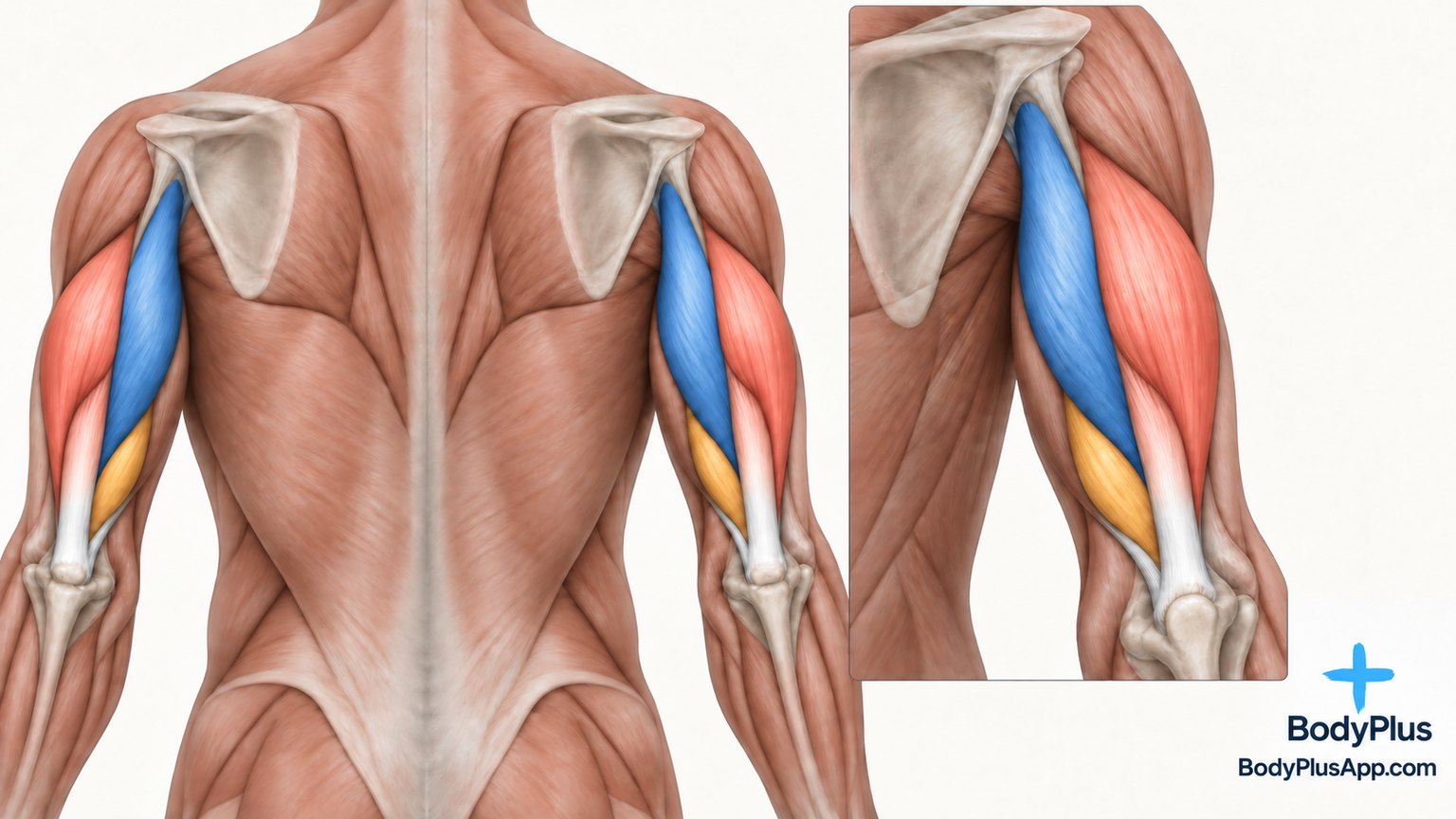
You can see it only at the back of the triceps, right near the elbow, because the other two heads cover it. It helps extend the elbow and keep the movement steady.
How do you focus on each part of the triceps?
All three heads work in every triceps exercise, but the load that reaches each one depends mainly on the position of your upper arm and the movement. Here is how I think about the emphasis:
- Long head: I use overhead extensions when I want to put more training emphasis on it; the longer-term growth study below supports that choice.
- Lateral head: takes the biggest share when your elbows are close to your body, as in pushdowns.
- Medial head: works hardest in exercises that let you bend your elbow all the way, such as the cable pushdown at a high pulley or an extension behind your head.
What the research says (and doesn't say)
These studies put the coaching view in context. They are useful, but the evidence for isolating a head is limited:
- Overhead versus arms at your sides: In a 12-week study of 21 adults, each person trained one arm overhead and the other at the side; MRI showed about 28.5% versus 19.6% growth in the long head and about 14.6% versus 10.5% in the lateral and medial heads together, even though the overhead arm lifted less weight. Both arms grew.
- Short activation tests: In a small lab study of 10 adults using surface EMG and an arm model, with no added weight reported, the long head produced the most force with the arm at the side and the medial head took over at shoulder height or higher; a separate study of 21 trained men found similar long- and lateral-head activation across the motion in an overhead dumbbell extension and a lying extension during one or two light reps.
- What this means for your workout: These studies do not show that you can isolate one head. You can shift the emphasis, but every triceps exercise trains the whole muscle.
Triceps training tips
Understand the muscle's function, then understand the technique
To train a muscle and keep good technique, you need to understand its anatomical job. The triceps extends your elbow: it straightens your arm from a bent position.
When you do an isolation exercise for the triceps, keep your upper arms and elbows steady so the movement comes from your forearms at the elbow. Now you know what the muscle does, you can see why technique is the most basic part of training it.
Include compound exercises for the triceps
Start your triceps workout with compound exercises such as dips or a close-grip bench press. You can put a lot of weight on the triceps in these exercises and build strength for your isolation exercises.
They also work several muscles at once. This helps you train the muscles that work with the triceps and gives you a better base for developing it. Strong shoulders and joints that can handle the load matter when you want to build strong triceps.
For the close-grip bench press, grip the bar about shoulder-width apart, keep your elbows close to your body, and use a spotter or safety bars when you go heavy. For dips, keep your body upright, and skip them if they bother your shoulders. Technique for both is in my best tricep exercises guide and the bench press guide.
Include exercises at different shoulder angles
Do not choose exercises without understanding why. Pick several at different shoulder angles. That way, you can give the muscle fibers a broader stimulus.
This tip is for you if you do at least three or four exercises in your triceps workout. Here are examples by arm position:
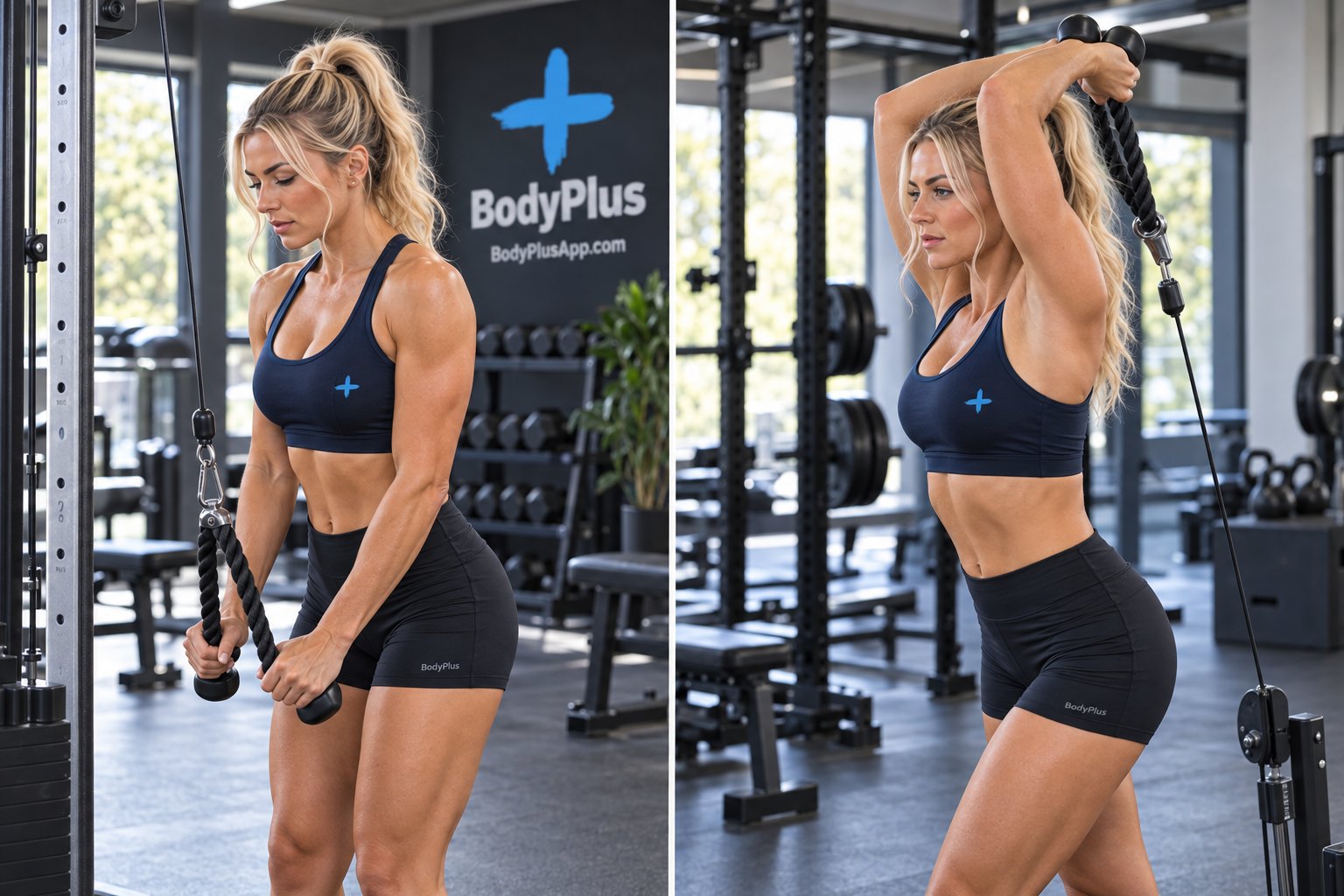
- Arms overhead: overhead cable, dumbbell or EZ-bar extension.
- Arms in front of you: the lying extension, also called the skull crusher.
- Arms at your sides: the tricep pushdown with a bar or a rope, and the kickback.
- Pressing: the close-grip bench press, dips and close-grip push-ups.
Plan your training program properly
Enough sleep and nutrition should be a given when we talk about recovery. There is another critical point: many people do not plan their training around recovery, so their triceps get too little work or too much.
The triceps work in every pressing exercise, including chest and shoulder presses. If, for example, you train chest and triceps together once a week, that is not the best setup. By the time you reach the triceps, the chest work has already tired them, so that part of the session may be less effective.
The opposite can happen too. If you train arms, chest and shoulders in separate sessions, your triceps may not recover enough between them.
Match your program to your level. A plan for someone who has trained for a month can look similar to one for someone with three years of experience, but the work needs to suit each person.
A few practical ways to plan around this:
- Count your presses when you plan your triceps work, and leave at least a day between hard pressing sessions and hard triceps sessions when you can.
- If you train triceps after chest, put the exercise that matters most to you, such as the overhead extension, first in the triceps part.
- Most people build muscle well with about 10 or more hard sets per muscle per week, which a 2026 position stand of the American College of Sports Medicine linked with more muscle growth. For the triceps, your presses already cover part of that.
For ready-made weekly structures, see the push/pull/legs and upper/lower split plans.
Track your progress and always aim for more
Many people go to the gym for years, do the same workout with the same weights, and wonder why they are not progressing. To build muscle, you need to give it a stimulus it is not used to.
Aim to progress in every workout. You can progress in the weight, the number of sets, the reps or the intensity. Change the exercises and their order from time to time too. A 2022 review found that planned variation can help muscle growth and strength, while changing exercises too often or at random may hold your progress back.
Progress cannot and should not be big from one workout to the next. Even one extra rep can add up. Over time, you may get stronger, and your triceps may grow too.
A ready-made triceps workout
Planning a workout is not simple. You have to consider the muscle's structure, the exercises and their technical difficulty, risk and benefit, strength and muscle growth, sets, rep ranges, and more. Here is one ready-made sample you can use as a starting point: a compound press followed by exercises with your arms in different positions.
| Exercise | Arm position | Sets | Reps | Rest |
|---|---|---|---|---|
| Close-grip bench press or dips | pressing | 3 | 6-10 | 2 min |
| Overhead cable extension (rope) | overhead | 3 | 8-12 | 90 s |
| Bar or rope pushdown | at your sides | 2-3 | 10-15 | 60-90 s |
How to use it
- As a triceps or arm session: do the whole workout once a week, with at least a day between it and your hardest chest or shoulder session.
- At the end of a push day: you have already pressed in the same session, so skip the first exercise and do only the overhead extension and the pushdown, 2-3 sets each.
- How hard: stop most sets when you could do only one to three more good reps. Warm up with one or two light sets of pushdowns before you start.
- At home: close-grip push-ups instead of the bench press, a one-dumbbell overhead extension, and a band pushdown anchored above you.
Overhead extension, step by step
1. Set the pulley at about head height or a little lower and attach a rope. Hold the rope with both hands, turn to face away from the machine, and step forward until the cable is tight, with the rope behind your head and your elbows pointing up. 2. Stand in a split stance, brace your stomach, and keep your lower back from arching. 3. Straighten your arms up and forward until your elbows are straight, keeping your upper arms still. 4. Lower the rope slowly behind your head until you feel a stretch, then repeat.
If this position bothers your shoulders or elbows, use a lighter weight or a smaller range, or swap it for a skull crusher.
A simple log
Write down every set. Add weight only when every set reaches the top of the rep range with good form:
| Week | Exercise | Weight | Set 1 | Set 2 | Set 3 |
|---|---|---|---|---|---|
| 1 | Overhead cable extension | 12.5 kg (about 28 lb) | 12 | 11 | 10 |
| 2 | Overhead cable extension | 12.5 kg (about 28 lb) | 12 | 12 | 11 |
| 3 | Overhead cable extension | 12.5 kg (about 28 lb) | 12 | 12 | 12 |
| 4 | Overhead cable extension | 15 kg (about 33 lb) | 10 | 9 | 9 |
In week 4 the reps drop after the weight goes up; that is normal. Build them back up to 12 before the next jump.
Bottom line
We started with the anatomy of the triceps because, you cannot build a good workout for a muscle without understanding how it is built and what it does. Then we moved to tips that can take your training to the next level: understand the movement, start with compound exercises, use different shoulder angles, plan around your pressing sessions, and track your progress.
There is more to consider when you plan a workout. Use the sample as a starting point, then match the work to your level and the rest of your training.
Frequently asked questions
What are the three heads of the triceps?
The long head, the lateral head and the medial head. All three straighten your elbow; the long head also works at your shoulder.
What is the full name of the triceps muscle?
The triceps brachii, Latin for "three-headed muscle of the arm".
What are the origin and insertion of the triceps?
The long head starts on the shoulder blade just below the shoulder socket; the lateral and medial heads start on the back of the upper-arm bone. All three attach through one tendon to the olecranon, the point of your elbow.
Which triceps head is the biggest?
The long head is usually described as the largest of the three.
What are the best long head triceps exercises?
Exercises with your arms overhead, such as overhead cable, dumbbell or EZ-bar extensions, because they stretch the long head. In a 12-week study, overhead cable extensions grew the long head about 1.5 times as much as extensions with the arms at the sides.
Can you isolate one head of the triceps?
No. Every triceps exercise trains all three heads. Arm position shifts the emphasis, most clearly toward the long head with overhead work.
Which nerve controls the triceps?
The radial nerve.
Do I need direct triceps work if I bench press?
Presses train your triceps, but they don't take the long head into a stretched, overhead position. Adding an overhead extension gives the muscle something presses don't.
The information on this page and on this website is intended to provide general information only. The content on this website does not constitute a professional opinion, a recommendation, or a substitute for consulting an expert in a specific field or obtaining a medical opinion. It is not medical advice. BodyPlus is not a medical device. If you have a health condition or an injury, or are pregnant, talk to a qualified healthcare professional before starting. Stop exercising and seek appropriate help if you feel pain, dizziness or other concerning symptoms.
Sources
Accessed September 17, 2026.
- OpenStax, Anatomy and Physiology 2e, "11.5 Muscles of the Pectoral Girdle and Upper Limbs" (the triceps brachii, its origins and its action on the elbow). openstax.org/books/anatomy-and-physiology-2e/pages/11-5-muscles-of-the-pectoral-girdle-and-upper-limbs
- Tiwana M.S., Sinkler M.A., Bordoni B., "Anatomy, Shoulder and Upper Limb, Triceps Muscle", StatPearls, NCBI Bookshelf, updated 2023-08-28 (origins of each head, insertion, shoulder action of the long head, nerve supply). www.ncbi.nlm.nih.gov/books/NBK536996
- Maeo S. et al., "Triceps brachii hypertrophy is substantially greater after elbow extension training performed in the overhead versus neutral arm position", Eur J Sport Sci 2023;23(7):1240-1250. pubmed.ncbi.nlm.nih.gov/35819335
- Kholinne E. et al., "The different role of each head of the triceps brachii muscle in elbow extension", Acta Orthop Traumatol Turc 2018;52(3):201-205. pubmed.ncbi.nlm.nih.gov/29503079
- Alves D., Matta T., Oliveira L., "Effect of shoulder position on triceps brachii heads activity in dumbbell elbow extension exercises", J Sports Med Phys Fitness 2018;58(9):1247-1252. pubmed.ncbi.nlm.nih.gov/28677940
- Vigotsky A.D. et al., "Longing for a Longitudinal Proxy: Acutely Measured Surface EMG Amplitude is not a Validated Predictor of Muscle Hypertrophy", Sports Med 2022;52(2):193-199. pubmed.ncbi.nlm.nih.gov/35006527
- Kassiano W. et al., "Does Varying Resistance Exercises Promote Superior Muscle Hypertrophy and Strength Gains? A Systematic Review", J Strength Cond Res 2022;36(6):1753-1762. pubmed.ncbi.nlm.nih.gov/35438660
- Currier B.S. et al., ACSM Position Stand, "Resistance Training Prescription for Muscle Function, Hypertrophy, and Physical Performance in Healthy Adults: An Overview of Reviews", Med Sci Sports Exerc 2026;58(4):851-872. pubmed.ncbi.nlm.nih.gov/41843416