
How to Do the Shoulder Press: Standing Barbell and Seated Dumbbell Form
In short
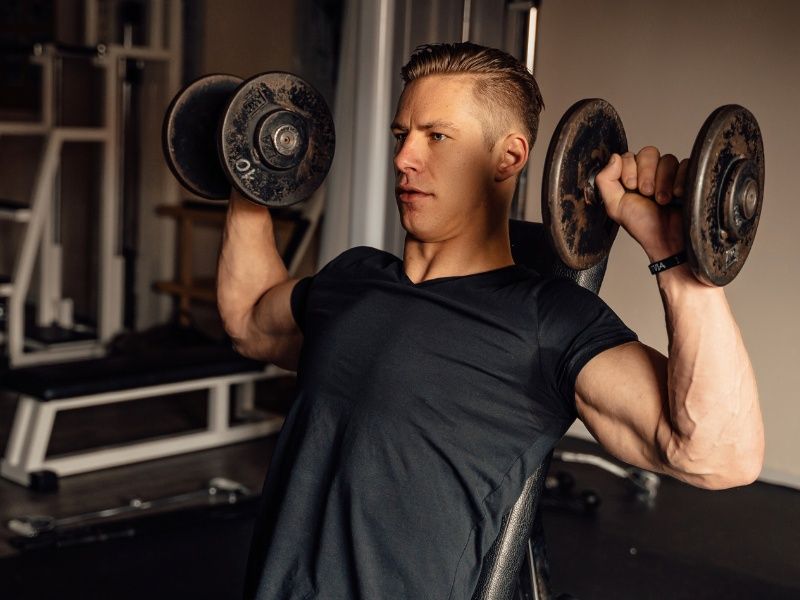
To do a shoulder press, start with the weight at shoulder height, brace your core and squeeze your glutes, then press the weight straight up until your arms are straight overhead, and lower it under control back to your shoulders. You can do it standing with a barbell (the overhead press, also called the military press) or seated with dumbbells. Both versions work all three parts of your shoulder muscle, mainly the front and the middle, plus your triceps, with your core helping to keep you steady.
All bodybuilders and weightlifters know that there are four exercises that must be part of every training program: the squat, the bench press, the deadlift and the shoulder press. The shoulder press (overhead press) with a barbell is a compound shoulder exercise in which all three heads of the shoulder work: the front, the middle and the rear. If you want to build a strong upper body, this is the exercise that should be the main one in your shoulder workout.
Every bodybuilder knows that the best shoulder exercises are the presses. Whether with a barbell or with dumbbells, include at least one press variation in your shoulder workout.
Like most shoulder exercises, the shoulder press looks simple to perform, but there are very important cues that will help you get the most out of it and prevent unnecessary injuries. In this article I guide you through the technique, the benefits and the variations of the exercise, for both the standing barbell press and the seated dumbbell press.
For a complete shoulder workout with more exercises, see my guide to the best shoulder exercises.
Muscles worked
| Muscle | Role in the press |
|---|---|
| Front delts (anterior deltoid) | a main mover: raises your arms up in front |
| Side delts (lateral deltoid) | a main mover: raises your arms up and out |
| Rear delts (posterior deltoid) | help keep the weight steady |
| Triceps (back of the upper arm) | straighten your elbows at the top |
| Upper back and shoulder blade muscles | turn and hold your shoulder blades so your arms can go overhead |
| Core (abs, lower back) and glutes | keep your torso stiff, mostly in the standing version |
Benefits of the shoulder press
Building strength throughout the upper body
In general, pressing overhead is one of the best movements for gaining upper-body strength as a whole. The entire upper body helps in this movement, whether as a main muscle or as a stabilizer of the weight. Since all the muscles of the upper body work, they will also get stronger and help you lift heavy weights in other exercises.
Working all parts of the shoulders
The shoulder muscle is divided into three parts: the front, the middle and the rear. The main movers in the shoulder press are the front and middle parts. But the rear part also works, by stabilizing the weight. It is very rare to work all three parts together, because the front shoulder works in pressing and the rear shoulder works in pulling. These two movements are opposite to each other.
Improving your bench press weight
The shoulder press works some of the same muscles as the bench press, only with a different emphasis. Here the focus is on the shoulders, and when your shoulders get stronger, you will also get stronger in the bench press.
How to do the standing barbell overhead press
Setup
Place the bar in the rack a little below shoulder height. You should be able to take the bar off the rack without standing on your toes or bending down. Stand with your feet shoulder-width apart and your knees slightly bent, not straight. Bending the legs helps with stability.
Step by step
- Get into the starting position. Lift the bar so that it rests on the front part of your shoulders. Your elbows should point forward and your hands should be shoulder-width apart.
- Lock in and brace. Lock your shoulders back by squeezing your shoulder blades together, tighten your abs and your glutes, and take a deep breath.
- Press in a straight line. Lift the bar overhead in a straight line and make sure it does not drift forward or backward. Tuck your chin slightly and move your head back just enough for the bar to pass; once it is above your forehead, bring your head forward again so the bar ends up over the middle of your head.
- Lock out. Lock your elbows so your arms are straight, with the bar over your shoulders and mid-foot.
- Lower it. Lower the bar in a straight line back to the front of your shoulders while you exhale.
- Repeat until the end of the set, then walk the bar back into the rack.
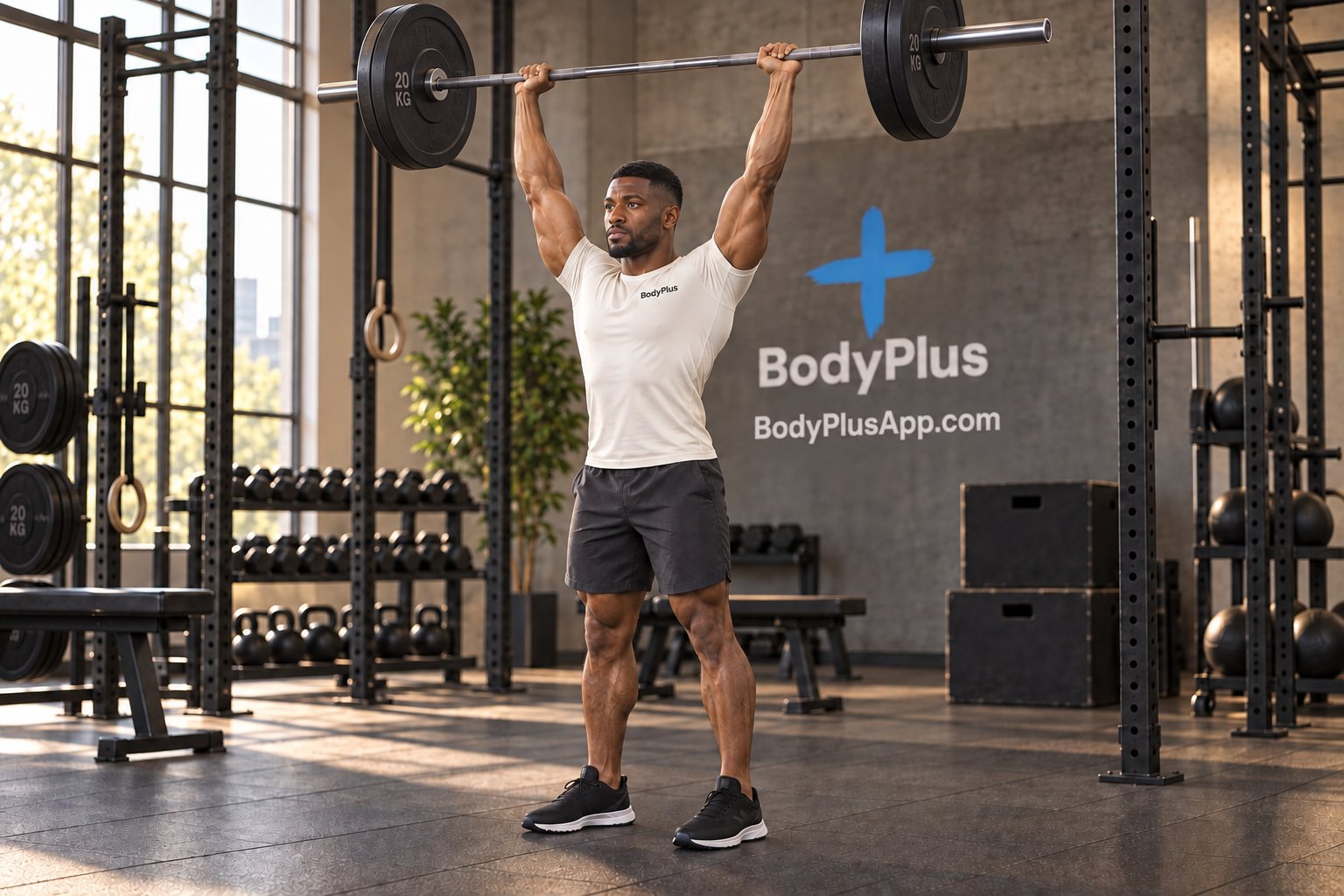
A tip for your lower back: keep your ribs down and your glutes squeezed so your body stays in one straight line. If you can only finish a rep by leaning back, the weight is too heavy for you today.
How to do the seated dumbbell shoulder press
Step by step
- Hold the dumbbells and sit up straight on the bench. Plant your feet firmly on the floor and keep your back straight against the back support.
- Bring the dumbbells to shoulder height with your palms facing forward. Your elbows should be right under the dumbbells. To get heavier dumbbells up, you can gently kick them up with your knees (see below).
- Press the dumbbells up over your head until your arms are straight.
- When your arms are straight, pause for a moment, then lower the dumbbells back to the start position, as deep as you can control.
- Repeat until you finish the set.
Getting the dumbbells up and down safely
- Sit with each dumbbell standing on its end on your thighs, close to your knees.
- Lift one knee and then the other to "kick" each dumbbell up to your shoulder, close to your body.
- After the last rep, lower the dumbbells to your shoulders, then to your thighs, never out to the sides with straight arms.
- For heavy sets, ask a training partner to hand you the dumbbells one at a time.
Common mistakes and how to fix them
The shoulder press is an exercise whose technique is not as simple as it looks. There are many mistakes that people make. On one hand, they can keep you from increasing the weight, and on the other hand they can cause an injury. It is very important that before you start working heavy you make sure your technique is good.
To make it easier on yourself before you increase the weight, fix one mistake at a time. That way you will reach good technique in a very short time.
1. A grip that is too wide (barbell)
A wide grip on the bar reduces the amount of force the body can recruit, because it puts the main muscles that drive the movement in uncomfortable positions. In addition, when a large load reaches the shoulder in an uncomfortable position, it can cause an injury.
A rule for a correct grip: your forearms should be at a 90-degree angle to the bar, straight up and down when you look from the front. You get that angle when you hold the bar at about shoulder width. A study of 11 resistance-trained men doing the seated barbell press to failure found that narrower grips let them lift more weight than wider grips.
2. Not pressing in a straight line
This mistake happens for two main reasons:
- You are lifting a weight your body can't stabilize. This usually happens to people who are starting to do the exercise. If you are a beginner, take your time and not increase the weight if your technique is not right.
- Your elbows are not positioned correctly (barbell). Your elbows should point forward, meaning they go past the bar, and not sit under the bar. Only then will you be able to control the movement and lift the bar in a straight line over your head.
3. Bending your wrists
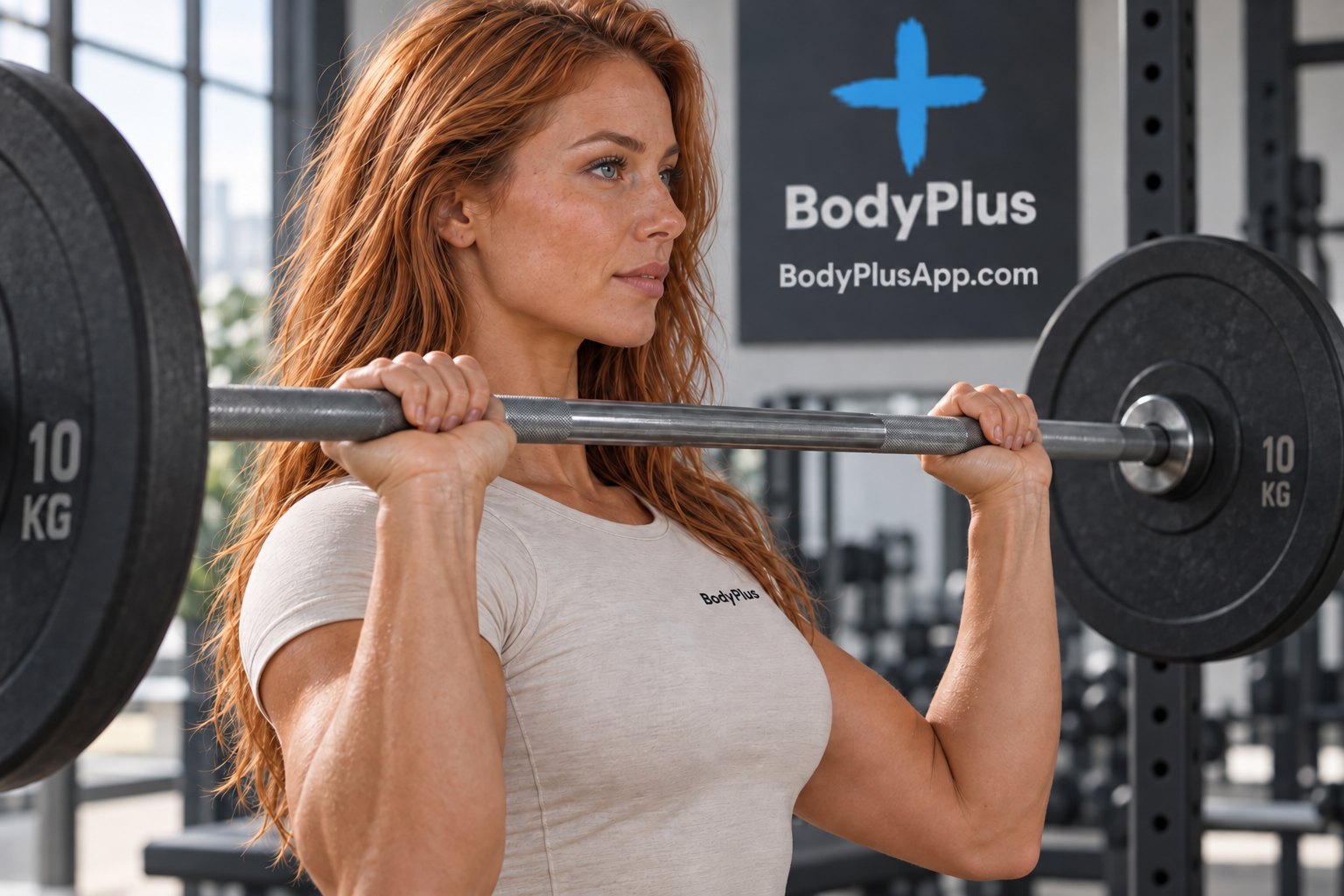
This is a common mistake in the bench press too. Many people hold the bar with the wrist bent instead of in line with the forearm. Your hand should be almost straight with your forearm. That way the position will be natural and will keep your wrists from hurting. For fixing this mistake, the knuckles of your fingers should be at the same angle as your wrist. The same goes for dumbbells.
4. Leaning forward or back on the bench (dumbbells)
When you sit on the bench, sit up straight against the back support. This is about your body, not the angle of the bench: if your torso leans forward or away from the support, it is easy to slip into a bad movement, and a bad shoulder position under a heavy weight is what you want to avoid.
5. Elbows too far forward or pulled back (dumbbells)
- Elbows too far forward: this can put extra load on your shoulders and rotator cuff.
- Elbows pulled back behind your body: this takes load off your shoulders and moves it to your triceps, and at the top the dumbbells can tip forward.
Make sure your elbows move in line with your shoulders throughout the whole movement.
6. Not adapting the exercise to your body
Look, each of us is built a little differently, and you can't ignore that. The most important thing is that you feel comfortable during the exercise. Don't stick to a certain movement pattern just because someone else does it.
You may need a different grip or a different seat angle. You may need to work in a shorter range of motion, because your shoulders aren't mobile enough yet. What matters is that you don't force your body into movements that feel wrong.
Shoulder press variations
Seated shoulder press with a barbell
You can also do the overhead press seated with a barbell, ideally on a bench with a back support inside a rack. This variation takes the load off your lower body, and seated you can lift 10%-20% more weight. Its disadvantage is that the range of motion is smaller and fewer muscles work.
You can combine the standing and the seated barbell press, changing the exercise every period, so that the body does not get used to a particular exercise.
Seated shoulder press with dumbbells
The seated shoulder press with dumbbells (steps above) has several advantages:
- A bigger range of motion. You can lower dumbbells a little further than a bar, and a fuller range of motion keeps your muscles working through more of the movement.
- Balance between your sides. With a barbell, your stronger side can make up for your weaker side, so a difference between your right and left can build up over time. With dumbbells, each side lifts its own weight, so both sides get a similar load and you notice quickly if one lags behind.
- Easier to learn. The technique is simpler than with a barbell, and the seat keeps you stable. For beginners, the seated dumbbell press is a good first press until your shoulders are strong enough and your barbell technique is good enough.
- Some bodybuilders feel that using dumbbells reduces the risk of injury.
The barbell has its own advantage. Once your dumbbells get heavy, about 30 kg (about 66 lb) each or more, getting them into position at your shoulders without help from others becomes a real problem. A barbell starts from a rack, so it is easier to load heavy.
Standing dumbbell press
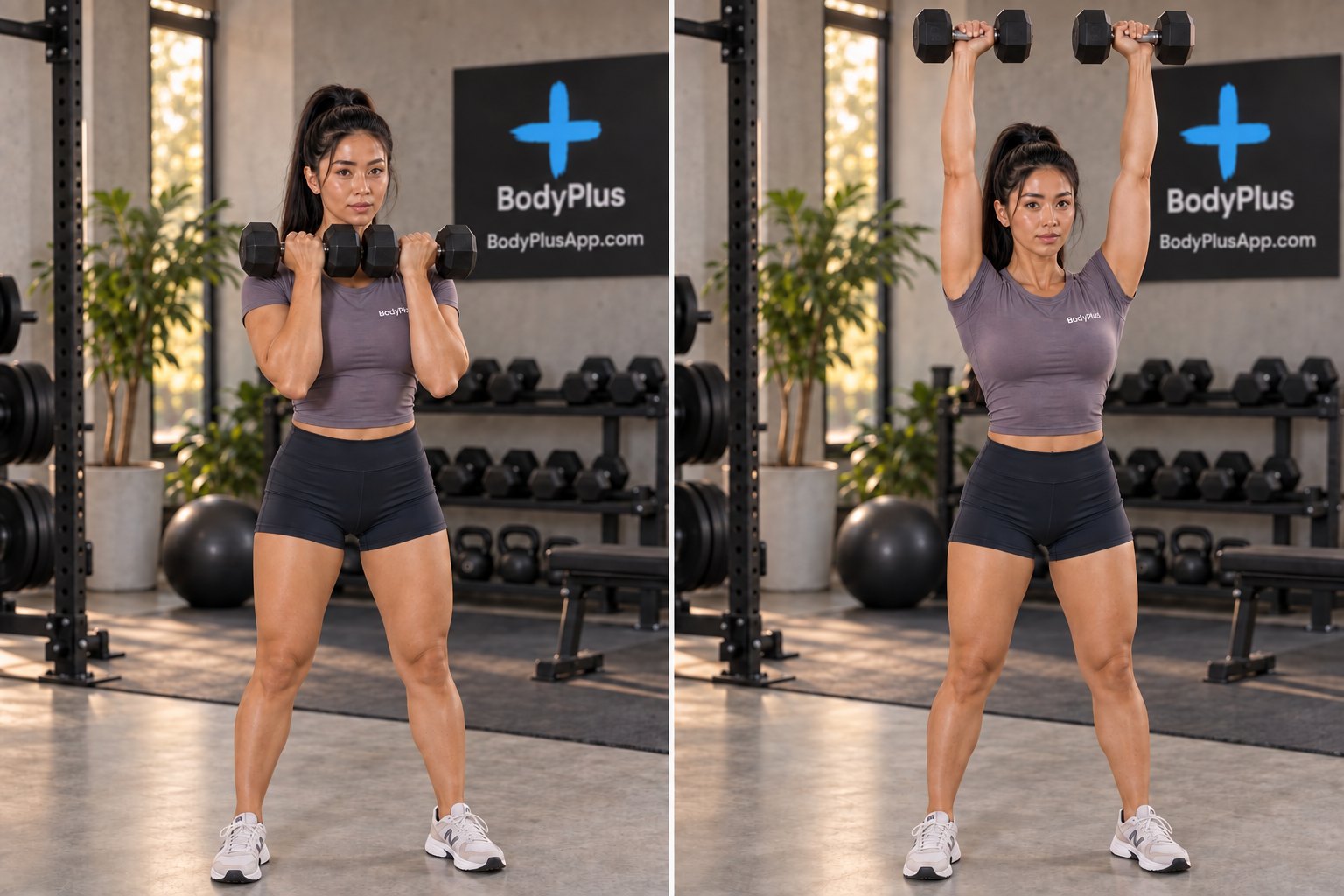
You can also press dumbbells standing. Because you have to go light, it doesn't suit a main exercise, but it works well as an extra. Standing, you have to put effort into stabilizing the dumbbells, because you don't have the support the seat gives you. That instability can also be an advantage: your shoulders and core have to work harder to keep the weights under control.
Arnold press
The Arnold press is named after the bodybuilder Arnold Schwarzenegger. You start with the dumbbells in front of your face, palms facing you, and turn your hands as you press so your palms face forward at the top. Reverse the turn on the way down. The turn takes your shoulders through a large range of motion, so do it slowly, with a high rep range and a relatively light weight.
Machine shoulder press
You can use the shoulder press machine to isolate your shoulders. The machine removes the element of stabilizing the weights, so you can isolate the shoulders effectively. You can remove the stabilization element in any exercise by using a machine. Set the seat so the handles start at about shoulder height.
I recommend doing the machine press as an addition to the press with dumbbells, because your stabilizers still need to be worked.
Which version should you choose?
| Version | What changes | Good for |
|---|---|---|
| Standing barbell (overhead press) | your legs, glutes and core work hard to keep you steady; easy to load heavy from a rack | building strength |
| Seated barbell | less lower-body work; you can usually lift more weight | a heavy press with more support |
| Seated dumbbells | more support, bigger range, each side works on its own; heavy dumbbells are awkward to get into position | building muscle, beginners, side-to-side balance |
| Standing dumbbells | hardest to stabilize; lightest weight | an extra exercise, not the main press |
What research says: in one study, 15 healthy men did barbell and dumbbell presses, seated and standing, and the researchers measured muscle activity at 80% of each lift's one-rep max. Front-delt activity was about 11% lower in the seated barbell press than the seated dumbbell press, and about 15% lower standing. Side-delt activity was about 7% lower in the standing barbell press than with standing dumbbells. Sitting lowered rear-delt activity by about a quarter with both a barbell and dumbbells. The standing dumbbell press, the least stable version, showed the highest shoulder activity but the lowest maximum weight. The study measured muscle activity in one session, which doesn't reliably predict how much a muscle will grow.
Choose the version that fits your goal and your body, and switch between presses every few weeks.
Sets, reps and where it fits in your workout
- Reps: 8-12 per set for the barbell and dumbbell press; 10-15 for the Arnold press.
- Sets: 3-4 working sets, with about 2 minutes of rest.
- Effort: finish most sets with one or two good reps left, especially when you train alone.
- Order: do your main press first in your shoulder or push workout, while you are fresh.
- Weekly: an American College of Sports Medicine (ACSM) position stand found larger strength gains with at least two sessions a week and more muscle growth with 10 or more sets per muscle group per week (in practice, about 10 or more hard sets). Chest presses also work your front delts, so count them too.
Sample shoulder workout
| Exercise | Sets | Reps | Rest |
|---|---|---|---|
| Standing barbell overhead press or seated dumbbell press | 3 | 8-10 | 2 min |
| Arnold press | 3 | 10-15 | 90 s |
| Lateral raise | 3 | 12-15 | 60-90 s |
| Reverse dumbbell fly | 3 | 12-15 | 60 s |
The press works mainly the front of your shoulders, with help from the side delts. The side delts often need extra work, and the rear delts need their own exercise, which is why the lateral raise and the reverse fly are in this workout.
How to track it and when to go heavier
A sample log for the standing barbell press, with a range of 8-10 reps. The rule: when all three sets reach 10 good reps, add the smallest jump your gym allows (here 2.5 kg in total).
| Session | Bar weight | Set 1 | Set 2 | Set 3 |
|---|---|---|---|---|
| Week 1 | 30 kg (about 66 lb) | 10 | 9 | 8 |
| Week 2 | 30 kg (about 66 lb) | 10 | 10 | 9 |
| Week 3 | 30 kg (about 66 lb) | 10 | 10 | 10 |
| Week 4 | 32.5 kg (about 72 lb) | 9 | 8 | 8 |
| Week 5 | 32.5 kg (about 72 lb) | 10 | 9 | 8 |
Progress on the overhead press is slow; some weeks you will only match your last session. With dumbbells, the jump to the next pair is often a big one, so add reps first. To estimate your one-rep max, use the one rep max calculator instead of testing a true max overhead.
Safety
Your shoulders are sensitive, so warm up well before you press heavy weight: start with dynamic moves such as shoulder circles and raising and lowering your arms, then do 2-4 light sets, starting with no weight and adding a little each set until you reach your working weight, and only then start counting your sets. Do the shoulder press for 8 or more reps: with a low number of reps the risk of injury is significantly greater, and in the 8-and-up range you can keep very good technique, so one imperfect rep matters much less than it would in a set of 3.
Press the standing barbell inside a rack with the safety arms set just below the height of the bar on your shoulders, so you can bend your knees and set it down if a rep fails. If you feel the bar got away from you in the middle of a set, lower it to your shoulders, set it in the right position and continue; don't lean back to grind out a rep, and don't drop a bar or dumbbells from overhead.
Breathe out as you lower the weight instead of holding your breath through the whole set. Stop the set if a rep hurts your shoulder, elbow or wrist, and switch to a lighter or pain-free variation such as the machine press.
Bottom line
The shoulder press with a barbell (overhead press) is an excellent exercise that should be a main exercise in your shoulder workout. Give it your full attention in the workout, because it has a great many benefits. The seated dumbbell press is a great partner for it: a larger range of motion, balance between your sides and technique that is friendly for beginners.
It is important to remember: shoulder exercises require correct technique. The shoulder joint is complex and different, because it moves in all three planes of motion. Before you increase the weight, learn to work correctly; this will both make you progress quickly and prevent injuries that would sideline you.
Frequently asked questions
Is the overhead press the same as the shoulder press?
Yes. "Overhead press" and "military press" usually mean the standing barbell version; "shoulder press" also covers seated, dumbbell and machine versions.
What muscles does the shoulder press work?
Mainly your front and side delts and your triceps; your rear delts, upper back and core help.
Is it better to press standing or seated?
Seated usually lets you lift more; standing works your core and lower body harder. Many people use both.
Dumbbells or a barbell?
Dumbbells give more range and load each side on its own; a barbell is easier to load heavy.
How should I set the bench for a seated dumbbell press?
Upright, or one step back if that feels better for your shoulders. Once the back rest is clearly reclined, it becomes more of an incline chest press.
Can I do a dumbbell shoulder press without a bench?
Yes. Press standing (glutes and core tight, lighter dumbbells), or sit on a sturdy chair with a back rest.
Is the Smith machine shoulder press a good option?
It can be: like the machine press, the bar moves on a fixed track. Keep a free-weight press in your plan too.
What if the shoulder press hurts my shoulder?
Stop the set. Try a lighter weight, a slightly narrower grip, a shorter range, or, with dumbbells, palms turned a little inward.
The information on this page and on this website is intended to provide general information only. The content on this website does not constitute a professional opinion, a recommendation, or a substitute for consulting an expert in a specific field or obtaining a medical opinion. It is not medical advice. BodyPlus is not a medical device. If you have a health condition or an injury, or are pregnant, talk to a qualified healthcare professional before starting. Stop exercising and seek appropriate help if you feel pain, dizziness or other concerning symptoms.
Sources
Accessed September 17, 2026.
- Saeterbakken A.H., Fimland M.S., "Effects of body position and loading modality on muscle activity and strength in shoulder presses", J Strength Cond Res 2013;27(7):1824-1831. pubmed.ncbi.nlm.nih.gov/23096062
- Gundersen A.H. et al., "The impact of grip width on kinetics and kinematics in the shoulder press among resistance-trained men", Sports Biomech 2026;25(6):841-854. pubmed.ncbi.nlm.nih.gov/41335596
- Vigotsky A.D. et al., "Longing for a Longitudinal Proxy: Acutely Measured Surface EMG Amplitude is not a Validated Predictor of Muscle Hypertrophy", Sports Med 2022;52(2):193-199. pubmed.ncbi.nlm.nih.gov/35006527
- Currier B.S. et al., ACSM Position Stand, "Resistance Training Prescription for Muscle Function, Hypertrophy, and Physical Performance in Healthy Adults: An Overview of Reviews", Med Sci Sports Exerc 2026;58(4):851-872. pubmed.ncbi.nlm.nih.gov/41843416
- OpenStax, Anatomy and Physiology 2e, "11.5 Muscles of the Pectoral Girdle and Upper Limbs" (the deltoid and the triceps brachii). openstax.org/books/anatomy-and-physiology-2e/pages/11-5-muscles-of-the-pectoral-girdle-and-upper-limbs