
The 9 Best Back Exercises for a Stronger, Wider Back

In short
Which exercises belong in your back workout? I start with rows, pulls and pullovers, then choose from these nine: deadlift, bent-over row, pull-up, cable pullover, lat pulldown, one-arm dumbbell row, band row, machine row and shrug. Pick at least one of each main movement, and make room for your lower back too.
Developed back muscles are one of nature's masterpieces. They give the upper body much of its size, and a strong back is a symbol of physical strength for women and men alike. I want to show you the exercises I find most effective, along with the tips that matter when you put them into a workout. Before we start, it is important to me that you understand the muscles you are training.
How your back is built
The back is not one muscle. It is made up of many muscles, and the exact number depends on where you draw its boundaries. Broadly speaking, about 40 muscles are attributed to the back, 20 on each side.
I will give you a general explanation of the main muscles; there is no point in going through each one. The smaller muscles work together with the larger ones. These are four muscle groups to know:
- Trapezius (traps): from your neck across the top of your shoulders down to your mid back. They lift, squeeze and lower your shoulder blades.
- Rhomboids: between your shoulder blades. They pull the blades together.
- Latissimus dorsi (lats): the wide muscles on the sides of your back, the "wings". They pull your arms down and back and create the V shape.
- Erector spinae: along your spine. They keep your torso upright.
When we plan a back workout, one of the most important things is variety. In an American Council on Exercise (ACE) sponsored study, different exercises emphasized different back muscles: pull-ups and chin-ups led for the lats, while the bent-over row led for the middle and lower traps and the spinal erectors.
The main back movements are rows, pulls and pullovers. Rows emphasize the traps and rhomboids more; in vertical pulls and pullovers, the lats are the main muscle.
My rule is to include at least one exercise from each of those three movements. Work in different rep ranges, arrange the exercises in a sensible order, and make sure you work the lower back enough too. For more detail, see the back muscles guide. Now let's start with the exercises.
The 9 best back exercises
1. Deadlift
The deadlift is weightlifting in its purest form: you lift a weight from the floor and lower it back to the floor. It is an incredible tool for building muscle and strength.
It is much more than a back exercise. It works the whole back side of the body, from calves, thighs and glutes to the spinal erectors, lats and rhomboids, along with the abdominal muscles and arms.
The movement imitates picking up something heavy from the floor. Train it and you strengthen the muscles you use for that everyday task. Once you master the technique, you also learn to lift a heavy object from the floor with good form.
- Stand with the bar over your mid-foot.
- Push your hips back and bend your knees until you can grip the bar just outside your legs, with your back long and your shins close to the bar.
- Stand up by driving through your feet and extending your hips, keeping the bar close to your legs.
- Lower the bar the same way, under control.
As simple as this exercise looks, its technique is hard to learn. There are many points to watch at once: when to rise with your hips and when with your legs, keeping your back straight, and more. Start light and give yourself time to practice before adding weight. Despite all that complexity, once you master the technique, the sky is the limit. For more detail, see the complete deadlift guide.
2. Barbell bent-over row
Only serious trainees do bent-over rows in the gym. Why do others skip them? Most prefer to sit comfortably at a machine or cable row. Don't get me wrong: machines have their place in a back workout, but I want the main exercises to use free weights.

The bent-over row is an old-school exercise from the Iron Age, and there is no doubt it can help you add muscle to your back. It works the lats, rhomboids and traps directly. Your spinal erectors work hard to stabilize your body. It can also improve your strength and stability in other pulling exercises.
Its technique is not easy to learn either. You need stability, coordination and practice. Before you start piling on weight, make sure you can do the movement well.
- Hinge forward with a long, flat back and soft knees.
- Pull the bar toward your lower ribs by driving your elbows back.
- Lower it under control. Do not swing your body to move the weight.
The two most important things are keeping your back straight throughout the movement and pulling the bar with your elbows. This exercise can improve your posture, balance and coordination. And I want to note that it is just as good a choice for women's back workouts as for men's. See the bent-over row guide for more technique tips.
3. Pull-up
Want to build a strong back and impress your friends? Start doing pull-ups. This is one of the best pulling exercises there is, and one of the best measures of strength relative to your body weight. It focuses directly on the lats, the muscles that give the back its width.
- Hang from the bar with straight arms.
- Pull your chest up toward the bar by driving your elbows down.
- Lower yourself all the way under control. No swinging.
There are many pull-up variations you can use. A few examples:
- band-assisted pull-ups
- chin-ups (underhand grip)
- wide-grip pull-ups
- muscle-ups (advanced)
- weighted pull-ups
Each variation works the muscles a little differently and has its own benefits. Change things up every so often to challenge them in another way. If you cannot do pull-ups yet, try a lat pulldown or assisted pull-ups on a machine. For the full movement, see the pull-up guide.
Pull-ups with a belt for adding weight
If you want to take your pull-ups to the next level, add weight with a belt. Some people place a weight between their legs, but it can move around or fall, making it hard to concentrate. A weight belt sits close to your waist, with the weight attached to a chain. Choose one with a secure clasp.
4. Cable pullover
The high-pulley cable pullover is an isolation exercise for the lats, the “wings.” It gives them another working angle and lets you work them through a long range of motion, including a stretch at the top.
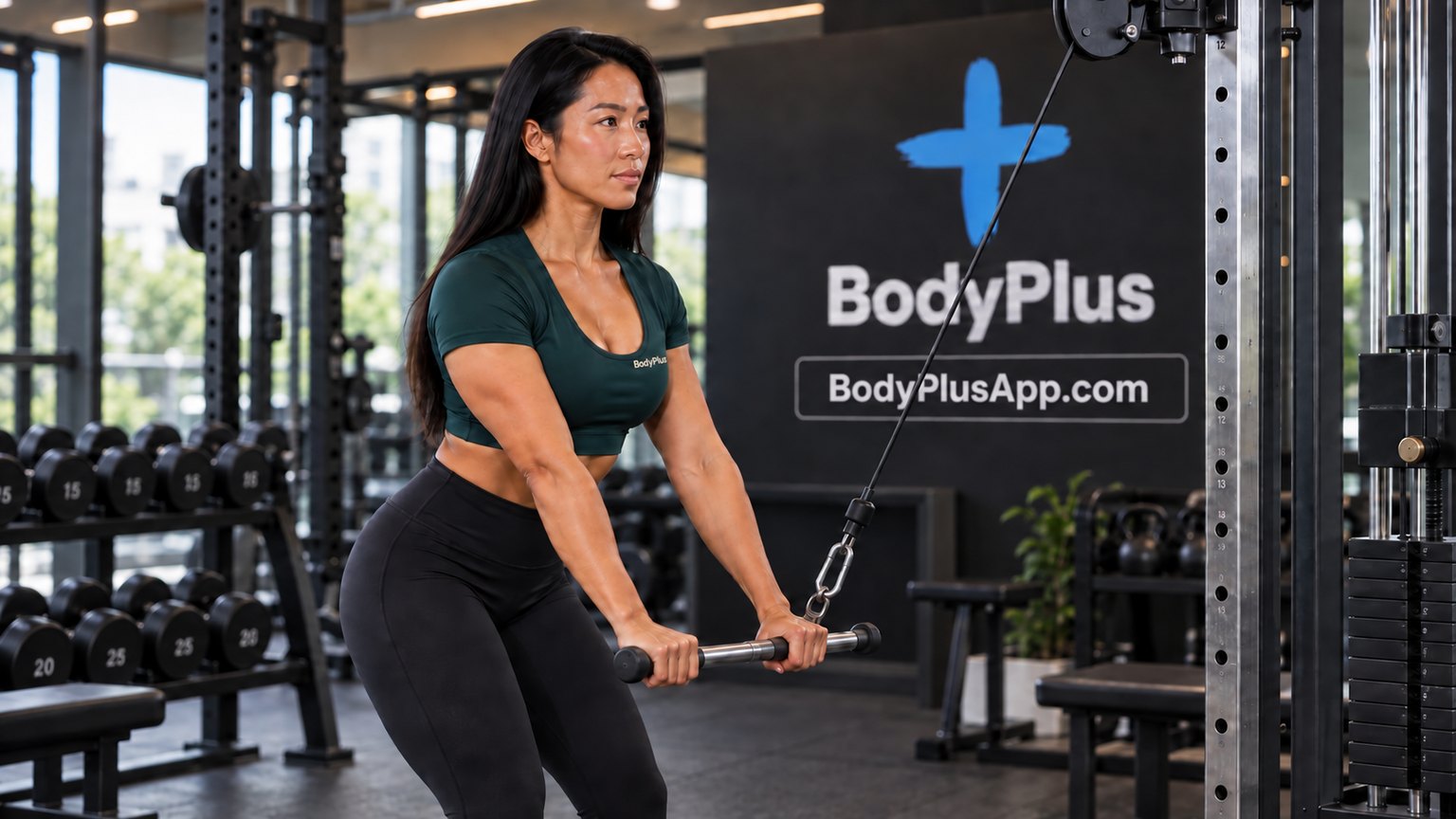
The technique is fairly simple and easy to learn, which makes it a great choice for beginners.
- Stand facing a high cable with a straight bar or rope.
- With almost straight arms, move the handle down in an arc toward your thighs.
- Return slowly until you feel the stretch in your lats.
There are many variations you can include in your back workout. You can use a bar, a rope or a triangle handle on the cable, or lie on a bench and use a dumbbell.
5. Lat pulldown
The lat pulldown is an excellent exercise if you struggle with pull-ups. It imitates the movement and works similar muscles. Unlike a pull-up, the machine supports your position, so you have less stabilizing to do.
That can be both an advantage and a disadvantage. You can focus the load on your lats, but the muscles that would normally stabilize you get less work. The lats can still grow with pulldowns.
- Sit with your thighs locked under the pads.
- Pull the bar to your upper chest by bringing your elbows down and back.
- Let the bar rise slowly until your arms are straight.
Like pull-ups, this exercise has many variations: wide, narrow, shoulder-width and underhand grips. If there is no particular back muscle you want to emphasize, my pick is a regular shoulder-width grip. It lets you use a long range of motion for the lats. Studies on lat pulldowns found similar lat activation across grip widths; one found that people could lift a little more with a narrow or medium grip.
6. One-arm dumbbell row
The “saw,” or one-arm dumbbell row, is similar to the barbell row, except that you use a dumbbell and a bench. You work each side separately, with the same load, which helps you work on a strength gap between your right and left sides.
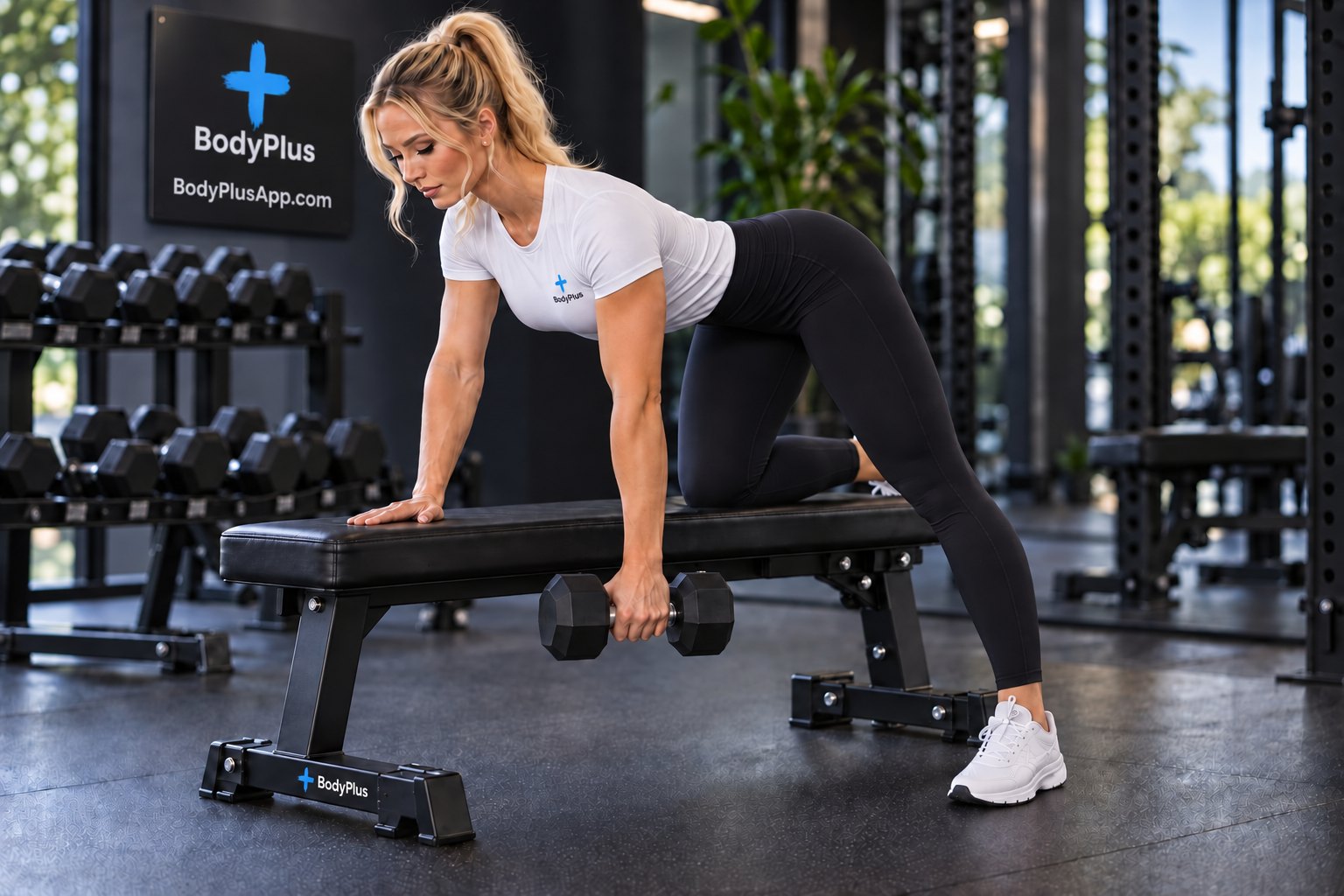
- Put one knee and one hand on the bench and keep your back flat.
- Pull the dumbbell toward your hip, elbow close to your body.
- Lower it slowly until your arm is straight.
A common mistake is pulling the dumbbell with your hand instead of your elbow. Then your arm works hard and tires before your back. Imagine your arm as a lifting hook and your elbow doing the pulling. Try not to grip the dumbbell too tightly; that can help you feel the technique.
7. Resistance-band row (and other band exercises for the back)
Resistance bands are useful for bodybuilding because you can do almost any exercise with them, anywhere. There are many types, including heavy bands that their makers rate at tens of kilograms of resistance. The more you stretch one, the harder it becomes.
To do a band row, anchor the band at chest height, step back until it is tight, and pull with your elbows. Check that the anchor is secure and the band has no tears before you start. You can also do band pulldowns, pullovers and face pulls at home. Bands are a great tool for stretching after a workout too.
8. Machine row
The machine row is a wonderful exercise when you want to emphasize the upper back: traps, rhomboids and lats. Of course, it is relevant only if you train in a gym with the machine. Sit tall, pull the handles toward your lower ribs with your elbows, then return slowly.
Machines have pros and cons:
- You can focus the work on your back because the machine reduces the need to stabilize your body.
- The stabilizing muscles get less work.
- It is very easy to change the weight.
Every exercise has advantages and disadvantages, which is one reason building a great back workout is hard. My solution is to do the machine row after the barbell bent-over row. You work the stabilizing muscles in the row, then give focused extra work to your lats, traps and rhomboids on the machine.
9. Shrug
Big traps that show through a T-shirt are a goal for many lifters. Contrary to what many people think, the traps are large muscles and a substantial part of the upper back. They run from your neck and shoulders toward the middle of your back. Strong traps matter in an impressive back.
- Hold the weights at your sides with straight arms.
- Lift your shoulders straight up toward your ears.
- Pause for a moment and lower slowly.
Shrugs are usually done with fairly heavy weights. Holding them works your forearms isometrically (without moving), which helps you build a stronger grip and stronger forearms.
Some bodybuilders do shrugs in a back workout and some in a shoulder workout. It is not critical. Add them where they fit your program, taking your sets and split into account. You can use dumbbells, a barbell, plates or kettlebells.
Build your back workout
To plan a workout program, you need to take many things into account. Start with an understanding of the muscles and choose exercises accordingly. Think about the right combination, the sets and reps, recovery, the stimulus and the order of the work. That is why I start by choosing movements, not just picking every exercise I like. Include rows, pulls and pullovers, and make sure your lower back gets work as well.
Use this table to choose. The hip hinge is optional if you already train it elsewhere. Deadlifts and bent-over rows make your lower back work to hold your position; for direct work you can add controlled back extensions.
| Movement | Gym choice | Home or beginner swap |
|---|---|---|
| Row | barbell bent-over row | one-arm dumbbell row or band row |
| Vertical pull | pull-up | lat pulldown, band-assisted pull-up |
| Lat isolation | cable pullover | dumbbell pullover on a bench |
| Hip hinge (optional) | deadlift | dumbbell Romanian deadlift or back extension |
One caution when choosing from studies: in the ACE-sponsored study, 19 trained men performed eight exercises. Pull-ups and chin-ups had the highest lat activation, while the bent-over row ranked first or second for all five back muscles measured. As researchers point out, high activation in one session does not prove more muscle growth over time.
The 2026 American College of Sports Medicine position stand found better muscle growth with at least about 10 sets per muscle group per week; equipment type did not consistently change results. I still like to start with free weights and use machines afterward.
A sample back workout
Here is one gym example with rows, a pull and a pullover in different rep ranges:
| Exercise | Sets | Reps | Rest |
|---|---|---|---|
| Barbell bent-over row | 3 | 6-10 | 2 min |
| Pull-up or lat pulldown | 3 | 6-12 | 2 min |
| One-arm dumbbell row | 2 | 8-12 each side | 90 s |
| Cable pullover | 2 | 10-15 | 60-90 s |
That is 10 sets for your back. You can spread them over two shorter sessions. Leave one to three good reps in reserve on most sets, then add a little weight or a rep as you improve. If you include deadlifts, put them first in a longer session or on a separate day; put shrugs last.
Beginner or home version: one-arm dumbbell row 3 x 10 each side, band-assisted pull-up or band pulldown 3 x 8-10, band pullover 2 x 12-15.
Track your work
Write down what you did so you can decide when to progress. Here is one example:
| Date | Exercise | Weight | Set 1 | Set 2 | Set 3 | Reps left |
|---|---|---|---|---|---|---|
| Mon | Barbell row | 50 kg (110 lb) | 10 | 9 | 8 | 1-2 |
| Thu | Barbell row | 50 kg (110 lb) | 10 | 10 | 10 | 1 |
| next Mon | Barbell row | 52.5 kg (116 lb) | 8 | 8 | 7 | 2 |
My rule: pick a rep range, for example 8 to 10. Keep the weight until you reach the top of the range on every set with good form, then add a small amount and build up again. If your numbers stall for several weeks, check your sleep, your weekly sets, and whether the jump in weight was too big.
Safety
Secure barbell plates with collars, adjust machine seats and pads to fit you, and check band anchors before starting. Warm up with light sets and practice the movement before adding weight. Lift and lower under control, and end the set if you feel pain or dizziness, or your form starts to break down.
Keep your back position steady in rows rather than swinging the weight, and check the belt clasp before weighted pull-ups. Leave recovery time between hard back sessions, go lighter if you are still tired, and increase the load only when your reps stay clean. For detailed setup and technique, see the deadlift and bent-over row guides.
Bottom line
A strong, powerful back is a clear sign of strength. Its muscles give the upper body much of its width and thickness. That is why back training deserves real thought.
Planning a back workout is not easy! There are many muscles to work together, so combine different movements and variations. Choose your sets and reps, decide on the exercise order, then use the example above as a starting point. Keep track of what you do and adjust your next workout from there.
Frequently asked questions
What is the best back exercise to build muscle?
If you can do only one, a row is a strong choice: in the ACE-sponsored study, the bent-over row worked all five measured back muscles at or near the top level. Muscle activity is not proof of growth, so a mix of rows and vertical pulls still trains your back more completely.
How many back exercises should I do in one workout?
Three to five is enough for most people, with at least one row, one vertical pull and one pullover.
How many sets per week does my back need?
Around 10 or more hard sets per week is a good target for growth, based on the 2026 ACSM position stand.
How often should I train my back?
Twice a week works well for most people, with at least one rest day between hard back sessions.
Are pull-ups enough for the back?
They are one of the best exercises, but add a row as well: rows put more emphasis on the traps and rhomboids.
Can I train my back with dumbbells only, or at home?
Yes. One-arm dumbbell rows, dumbbell pullovers, resistance-band rows, and pull-ups on a doorway bar cover the main movements.
Are machines worse than free weights?
Not necessarily. Research did not find equipment type to consistently change results. I still build back sessions around free-weight rows first and add machines after them.
The information on this page and on this website is intended to provide general information only. The content on this website does not constitute a professional opinion, a recommendation, or a substitute for consulting an expert in a specific field or obtaining a medical opinion. It is not medical advice. BodyPlus is not a medical device. If you have a health condition or an injury, or are pregnant, talk to a qualified healthcare professional before starting. Stop exercising and seek appropriate help if you feel pain, dizziness or other concerning symptoms.
Sources
Accessed September 17, 2026.
- Edelburg H. et al., "ACE-Sponsored Research: What Is the Best Back Exercise?", ACE Certified, April 2018. www.acefitness.org/continuing-education/certified/april-2018/6959/ace-sponsored-research-what-is-the-best-back-exercise
- Andersen V. et al., "Effects of grip width on muscle strength and activation in the lat pull-down", J Strength Cond Res 2014;28(4):1135-1142. pubmed.ncbi.nlm.nih.gov/24662157
- Buonsenso A. et al., "Electromyographic Analysis of Back Muscle Activation During Lat Pulldown Exercise", J Funct Morphol Kinesiol 2025;10(3):345. pmc.ncbi.nlm.nih.gov/articles/PMC12452428
- Vigotsky A.D. et al., "Longing for a Longitudinal Proxy: Acutely Measured Surface EMG Amplitude is not a Validated Predictor of Muscle Hypertrophy", Sports Med 2022;52(2):193-199. pubmed.ncbi.nlm.nih.gov/35006527
- Currier B.S. et al., ACSM Position Stand, "Resistance Training Prescription for Muscle Function, Hypertrophy, and Physical Performance in Healthy Adults: An Overview of Reviews", Med Sci Sports Exerc 2026;58(4):851-872. pubmed.ncbi.nlm.nih.gov/41843416