
How to Use the Chest Press Machine: Form, Setup and Muscles Worked
In short
Looking for exercises for your chest workout? The machine chest press can be an excellent option. You just need to know how to include it properly in a training program. To do it, set the handles just below your shoulders, sit with your back against the seat, and press forward with control. This article has everything you need to know about the exercise, including benefits, technique, tips, variations, and more. So let's get started!
You do this exercise using a special machine. There are many different types of machines that offer different body positions and grip options. Most machines are seated, with you sitting upright and facing forward. Usually, you do a medium to high number of repetitions on the machine chest press, between 8 and 15.
The benefits of the machine chest press
Building strength and muscle mass in the chest, shoulders, and triceps
The chest is not the only part working in this exercise; the shoulders and triceps work too. That is why the machine chest press can help you build serious strength and muscle mass in the upper body. Try doing the exercise with high repetitions while controlling the movement.
| Muscle | Role in the exercise |
|---|---|
| Chest (pectoralis major) | the main mover: brings your upper arms forward as you press |
| Front of the shoulders (anterior deltoids) | helps the chest press the handles forward |
| Triceps (back of the upper arm) | straighten your elbows as your arms extend |
| Upper back and core | keep your shoulder blades and torso steady against the pad |
Why the guided path can feel safer
One of the benefits of machine exercises is that the machine guides the movement, leaving less balancing for you to do. On many chest press machines, you can finish a set without someone spotting you. That can make the exercise feel safer than pressing free weights when you train alone.
Machine chest press vs bench press: what's the difference?
The difference between a barbell chest press and a machine chest press is that the machine removes the need to stabilize the bar. When we do a barbell chest press, we also have to stabilize the bar. On the machine, all you need to do is push the handles forward. This has both advantages and disadvantages, depending on how you use the exercise. It is not suitable as a first and main exercise.
It is excellent if you want to do it in the middle or at the end of your chest workout. This exercise will focus the work on the chest muscles while requiring less stabilization than a barbell press. In addition, it can help you improve your regular presses.
What research says: machines can build muscle and strength well too.
- In an 8-week study of 38 trained men, one group did the squat, bench press, row and shoulder press with free weights, and the other did machine versions of the same lifts, with the same training plan (sets, reps and relative effort). Both groups gained similar strength and similar muscle size, chest included. Each group improved most on the equipment it trained with.
- A review that pooled 13 studies (about 1,000 adults, most of them men) found no difference between free weights and machines in overall strength or muscle growth. Strength gains were specific, though: people who trained with free weights improved more on free-weight tests.
For the barbell version, see my bench press guide.
How to do a machine chest press
Before you start the exercise, you need to adjust the machine. Adjust the height of the seat and the handles so that the handles are slightly below your shoulders; otherwise, a lot of load will be placed on your shoulders.
- Sit upright on the seat with your lower back against the seat, and place your feet on the floor.
- Hold the handles with a neutral grip. Your hands should be at the same angle as your forearms, and your elbows should be at 90 degrees.
- Push the handles forward until your arms are almost straight. Stop just short of snapping your elbows straight, keeping the press controlled.
- Be sure to keep your shoulder blades and head against the chair throughout the exercise.
- Return the handles to the starting position while breathing out.
- Do the number of repetitions you want.
If your machine has a foot lever to bring the handles into position, use it before the first rep and to take the load off after the last one.
Common mistakes
Positioning the seat and handles incorrectly
This is the most common mistake in the machine chest press. You may be able to lift more weight, but the risk of injury will also increase. The handles should be slightly below your shoulders, around nipple level.
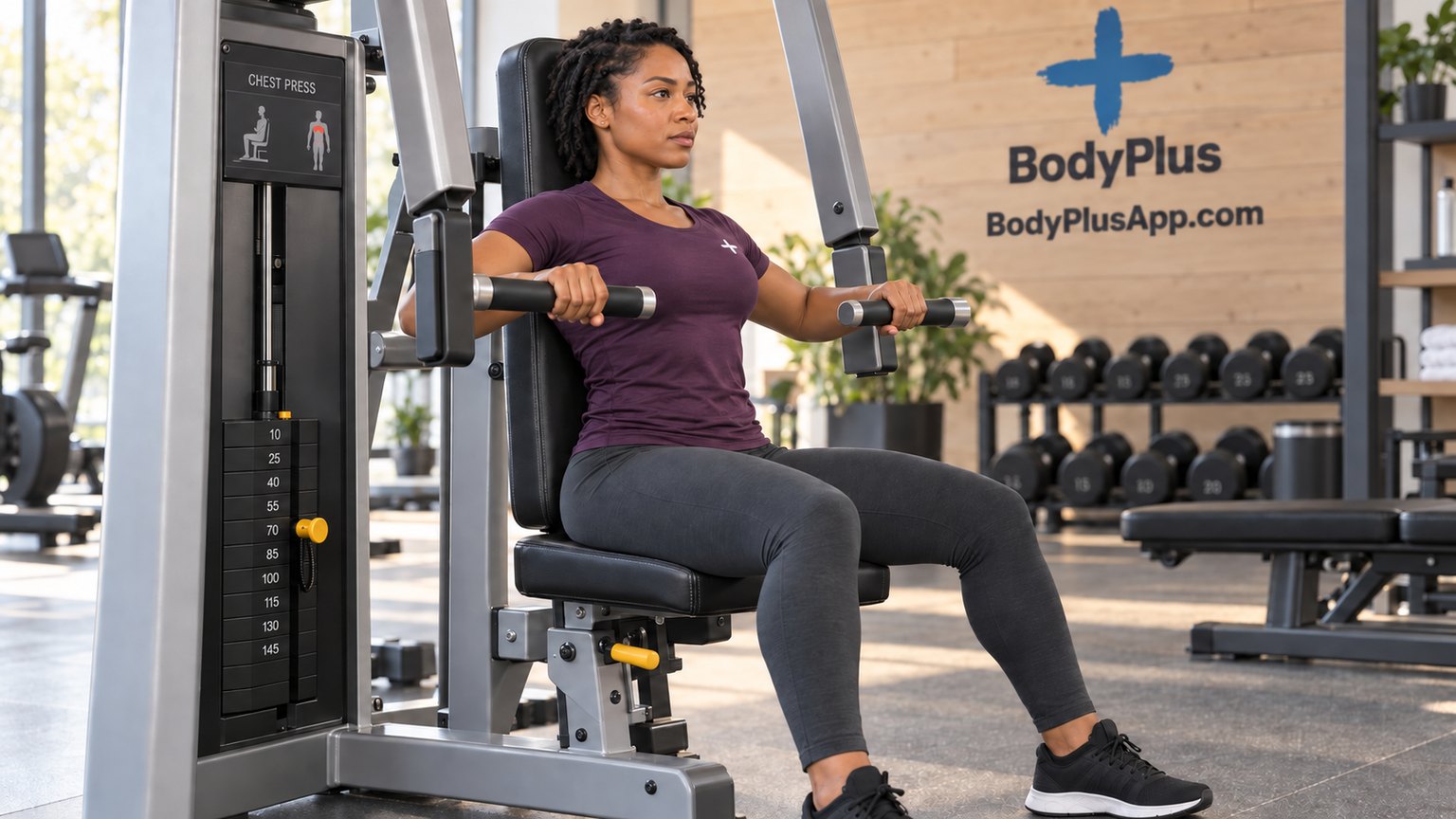
If you place the handles at shoulder level, a lot of load will be placed on your shoulders. This can cause injury. If you place the handles too low, the load will leave the chest and shift to the triceps.
Bending the back
This usually happens when people lift a weight they cannot control. This can put pressure on the lower back. You can easily avoid this mistake. First, choose a weight you can control. Second, make sure you sit upright and keep your back against the chair throughout the movement.
Machine chest press variations
Incline machine chest press
This exercise is excellent for people who want to focus on their upper chest muscles. If your machine can be adjusted so that you sit at an incline, you can do a regular press and then one at an incline. This will help you work the entire chest evenly. For a free-weight option, see my guide to the incline dumbbell press.
Smith machine chest press
The Smith machine is also a type of machine that reduces the need to stabilize the bar during the exercise. This machine is very similar to regular machines, but it is a little harder to work with. Set its safety stops before you start.
Workout example
Here is one way to put the machine press in the middle or at the end of your chest workout.
| Exercise | Sets | Reps | Rest |
|---|---|---|---|
| Barbell or dumbbell bench press | 3-4 | 6-10 | 2 min |
| Incline dumbbell press (about 30 degrees) | 3 | 8-12 | 2 min |
| Chest press machine (last set as a drop set) | 3 | 10-12 | 90 s |
| Cable or machine fly | 2 | 12-15 | 60 s |
Safety
Before loading the machine, set the seat so the handles sit slightly below your shoulders, and check that the seat adjustment and any weight-selection pin are secure. Warm up with a light set before adding weight, choosing a load you can control from the first rep to the last. Keep your back against the pad as you press and return the handles at a steady pace, without letting them snap back.
If your machine has a foot lever, use it to bring the handles into position and take the load off after the last rep. For the Smith machine variation, set the safety stops before you start. End the set if you feel pain or dizziness, or if your back lifts off the pad or you can no longer control the movement.
Bottom line
The machine chest press is an excellent exercise that should be on your list of chest exercises. You can include it at the beginning of your workout as a warm-up or as a secondary exercise. It is not suitable as a main exercise.
When you do it, it is important to make sure you use proper technique. In addition, you can significantly increase its intensity with a drop set or a super set. For more exercises, see my best chest exercises guide.
Frequently asked questions
How high should the seat be?
Set it so the handles sit slightly below your shoulders, around nipple level. Adjust the seat before you begin pressing.
Is the chest press machine as good as the bench press?
The two studies above found similar muscle and strength gains overall with machines and free weights. The machine works best in the middle or at the end of a chest workout.
How many reps should I do?
Usually 8 to 15. Choose a weight you can control for each rep.
The information on this page and on this website is intended to provide general information only. The content on this website does not constitute a professional opinion, a recommendation, or a substitute for consulting an expert in a specific field or obtaining a medical opinion. It is not medical advice. BodyPlus is not a medical device. If you have a health condition or an injury, or are pregnant, talk to a qualified healthcare professional before starting. Stop exercising and seek appropriate help if you feel pain, dizziness or other concerning symptoms.
Sources
Accessed September 17, 2026.
- Hernández-Belmonte A. et al., "Free-Weight and Machine-Based Training Are Equally Effective on Strength and Hypertrophy: Challenging a Traditional Myth", Med Sci Sports Exerc 2023;55(12):2316-2327. pubmed.ncbi.nlm.nih.gov/37535335
- Haugen M.E. et al., "Effect of free-weight vs. machine-based strength training on maximal strength, hypertrophy and jump performance - a systematic review and meta-analysis", BMC Sports Sci Med Rehabil 2023;15(1):103. pubmed.ncbi.nlm.nih.gov/37582807