
The 9 Best Glute Exercises for Stronger Glutes (Gym and Home)
In short
Which glute exercises should you choose? I like to start with a squat, a deadlift variation, and a hip thrust or bridge, then add an exercise for the side of your glutes. Below are my nine picks, from squats to machine leg curls, with tips you can use in your next workout.
Choosing the right exercises is the first step toward building stronger glutes. I will explain how the muscles are built, walk you through my favorite exercises, and share the details that make each one useful.
There is more to training your glutes than appearance. The gluteus maximus is one of the body's largest and strongest muscles, and the glutes help stabilize your pelvis. Let's look at their anatomy, then get to the exercises.
The anatomy of your glutes
Your glutes are made up of three main muscles:
Gluteus maximus
This is the main and largest glute muscle. It is mainly responsible for extending your hip and rotating it outward. You use it when you climb stairs, get up from a chair, or straighten up from a bend.
Gluteus minimus
This is the smallest of the three muscles, deep under the medius. It helps stabilize your hip and move your leg out to the side, helping to keep your pelvis steady as you walk or run.
Gluteus medius
This muscle sits on the outer side of your hip. It also helps stabilize your pelvis and move your leg out to the side.
All three muscles work together. When I put together glute training, I include exercises that place more emphasis on the smaller muscles too. The right combination gives their muscle fibers a balanced stimulus and makes the workout more effective for building muscle.
Hip thrusts and deadlift variations are excellent choices for the gluteus maximus. Side leg raises and hip abduction can put more emphasis on the gluteus medius and minimus.
Now that you know the muscles, let's get to the exercises!
The 9 best glute exercises
1. Squat
The squat is the king of leg and lower-body training. True, it is not an isolation exercise for your glutes, but it gives you more than most other exercises.
Why? Because it trains your glutes along with your quads and inner thighs. One exercise covers a lot of your lower body; the deadlifts and leg curl below give your hamstrings more attention.
- Stand with your feet about shoulder-width apart.
- Sit down between your heels, knees tracking over your toes, chest up.
- Stand up by driving through your whole foot and squeezing your glutes.
Go down as low as you can without discomfort or pain, while keeping good form. The lower you go, the harder your glutes work. In a 10-week study by Kubo and colleagues, full squats increased glute muscle volume more than half squats.
Before you start with a barbell, learn the technique well. You can start with body-weight squats or a squat holding one dumbbell.
2. Romanian deadlift
It is almost impossible to build a strong lower body without at least one deadlift variation.
The Romanian deadlift is one of the most powerful exercises for building muscle on the back of your lower body. It works your glutes, hamstrings, the muscles along your spine, and your core very hard.
Unlike a conventional deadlift, you don't lower the bar all the way to the floor. Lower it to around your knees, or as far as you can while keeping good form. This gives your muscles more time under load, which I value for building muscle. You don't need the very heavy weights of a conventional deadlift to make it challenging.
It also trains the hip bend you use when you pick things up.
- Stand tall holding the weight in front of your thighs, knees slightly bent.
- Push your hips back and lower the weight along your legs, back flat.
- When you feel a strong stretch in your hamstrings, drive your hips forward and squeeze your glutes to stand up.
You can also do it with dumbbells, a kettlebell, or a resistance band.
3. Stiff-leg deadlift
The stiff-leg deadlift is an advanced variation of the Romanian deadlift, and it is even better for building your glutes and hamstrings. Keep your legs almost straight and lower the weight until your back is about parallel to the floor, or as far as you can with good form.
It gives you two things I value for building muscle: your glutes and hamstrings work in a more stretched position, and they move through a greater range. Together, these can dramatically increase the load on the muscle fibers and the stimulus for growth.
Before you try it, make sure you have mastered the Romanian deadlift technique.
4. Hip thrust
The hip thrust is one of a kind: it lets you load very heavy weights and focus the work remarkably precisely on your glutes.
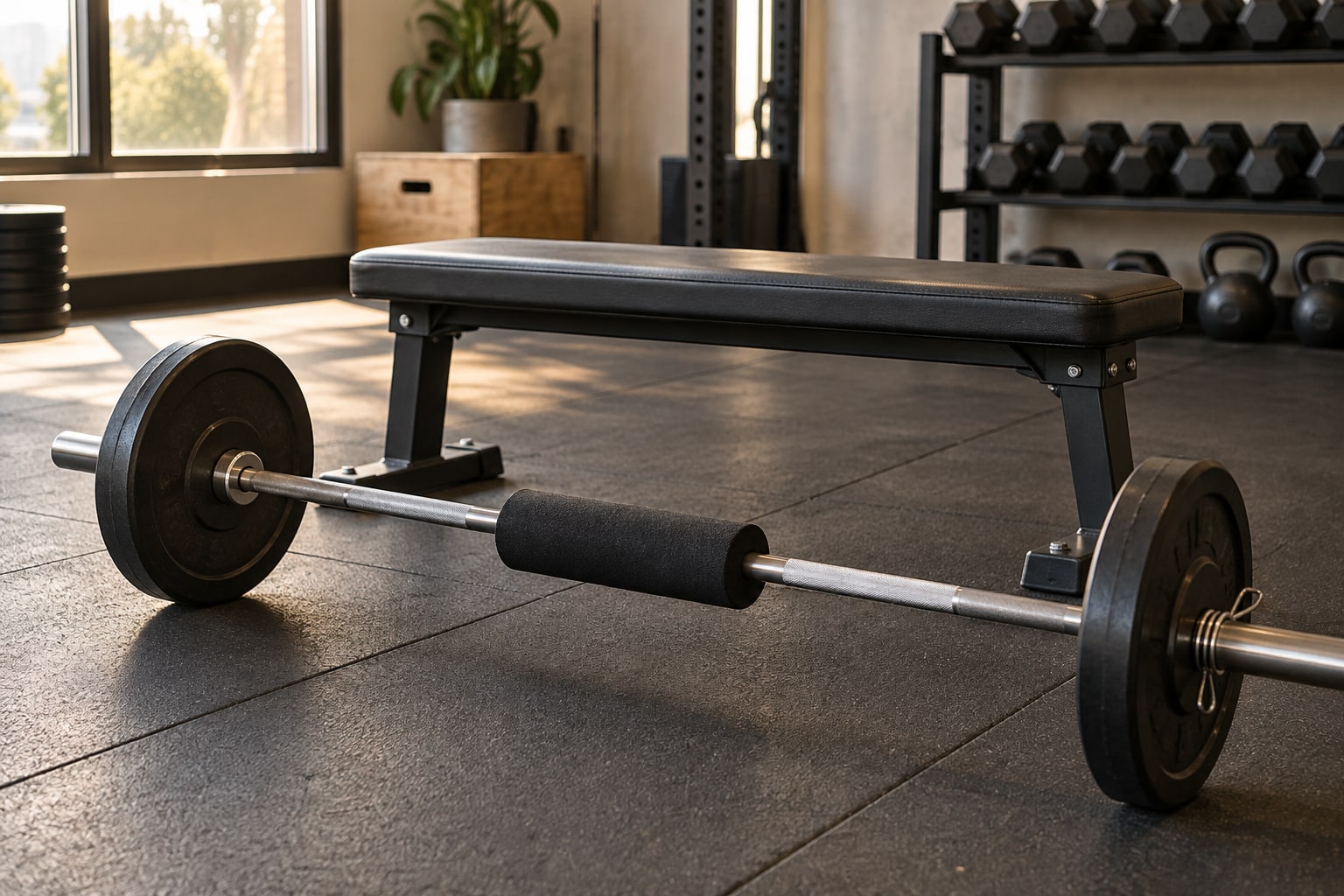
Your glutes sit right under the bar, and gravity pulls it downward. Your hamstrings and lower back also work, but your glutes are the focus.
- Sit on the floor with your upper back against a bench and the bar (with a pad) across your hips.
- Plant your feet about hip-width apart, shins close to vertical at the top.
- Drive through your heels to lift your hips until your body is straight from shoulders to knees, squeeze for a moment, and lower slowly. Keep your chin tucked and ribs down at the top; don't arch your lower back.
It is usually done with a barbell, because that lets you load the most weight. There are also beginner-friendly versions with a dumbbell or a band. I like all of them; at some point, though, it gets hard to keep increasing the load without a barbell.
5. Cable kickback
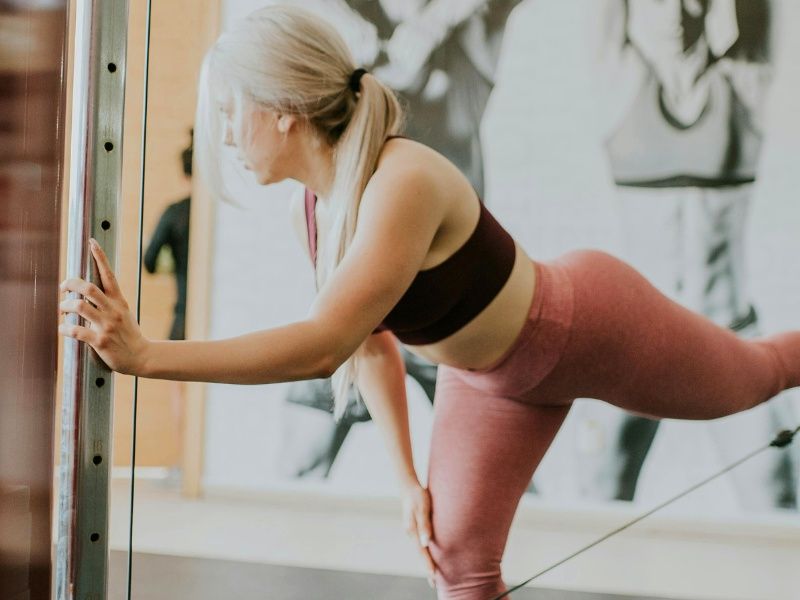
The cable kickback is an isolation exercise for your glutes. You attach the low cable to your ankle with a special strap. Then you kick your leg back and squeeze your glutes as hard as you can.
- Face the machine and hold it for support, hips slightly bent.
- Kick the strapped leg straight back without arching your lower back.
- Squeeze at the end, then return slowly.
The cable keeps tension on your muscles throughout the movement. That increases the time they spend under load, which helps make the exercise more effective for building muscle.
If you train at home, do it on all fours with body weight, or standing with a band around your ankles.
6. Band hip abduction
Hip abduction with a resistance band strengthens the muscles that keep your pelvis stable.
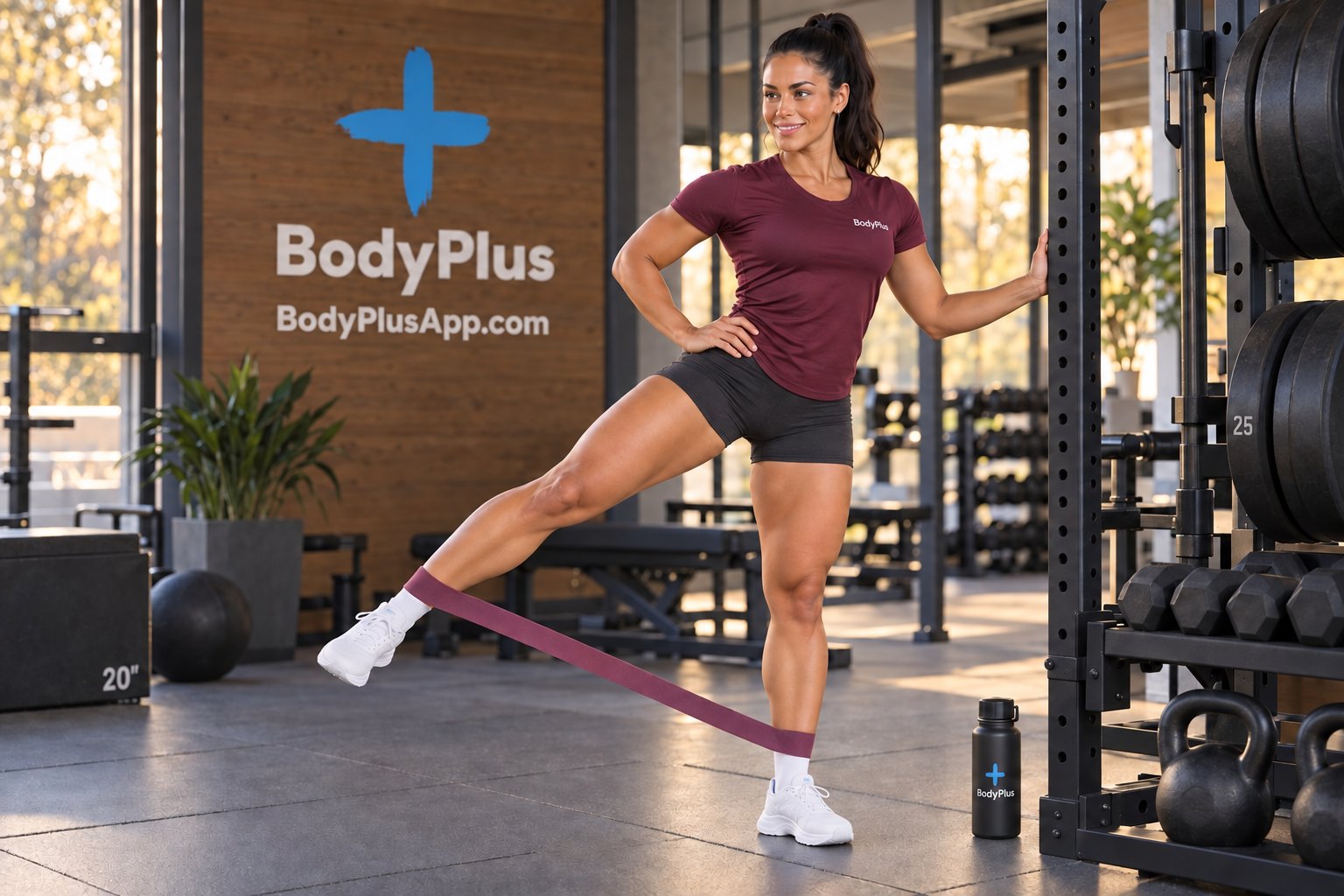
One of the muscles it works is the gluteus medius, on the outer edge of your glutes and the side of your hip. It helps stabilize your hip, keep your balance, and produce force.
The gluteus maximus also takes part. This is not the most effective exercise for it, but it gives the muscle another working angle.
- Put a band around your thighs, just above your knees.
- Sit on a bench, feet flat, and push your knees out against the band. Standing version: stand tall and lift one leg out to the side.
- Hold for a moment and return slowly.
7. Glute bridge
The glute bridge is very similar to the hip thrust, but you do it from the floor. It is a good exercise for training at home, because you don't need a bench. The technique is also very easy to learn, so it suits beginners. You can make it harder with a band or a dumbbell.
- Lie on your back, knees bent, feet flat on the floor.
- Push through your heels to lift your hips until your body is straight from shoulders to knees.
- Squeeze your glutes for a moment, ribs down (don't arch your lower back), then lower slowly.
If you have a bench, I prefer the hip thrust because it gives your glutes a larger range of motion.
8. Split squat
The split squat is an outstanding exercise for building all the muscles of your lower body, including your glutes. It upgrades a workout and gives the gluteus maximus another working angle.
In this exercise each leg works on its own. That helps you avoid an imbalance between your legs, because the stronger leg can't make up for the weaker one.
- Stand in a long stride, rear foot on the floor or on a bench.
- Lower your back knee toward the floor.
- Push through your front foot to rise. Finish all reps, then switch.
You can put more load on your glutes with a small change. Lean your torso slightly forward; your glutes stretch more, so they take on more of the work.
9. Leg curl (machine)
The leg curl doesn't work your glutes directly, but it supports your glute training indirectly. It works your hamstrings, on the back of your thigh right under your glutes.
- Line up your knees with the machine's pivot.
- Curl your heels toward your glutes while your hips stay down, then lower slowly.
Your hamstrings work alongside your glutes in deadlift variations, so I include leg curls to train that part of the back of your thigh too.
There are two kinds of leg curl machine: seated and lying. Choose the one that is most comfortable for you and in which you can squeeze and stretch the muscles the hardest.
Choose a lighter weight for 10 to 15 reps. With a very heavy weight, you can't fully squeeze and stretch the muscle, and the muscle fibers get a weaker stimulus.
How to pick your glute exercises
To put my nine picks into a workout, choose a hip extension, a hinge, a squat or split squat, and something for the side of your glutes. Here are gym and home options.
| Movement | Gym choice | Home swap |
|---|---|---|
| Hip extension, heavy | hip thrust | glute bridge with a band or dumbbell |
| Hinge | Romanian deadlift | dumbbell or band Romanian deadlift |
| Squat or single leg | squat or split squat | goblet squat or body-weight split squat |
| Side of the glutes | band hip abduction or abduction machine | band hip abduction |
| Isolation (optional) | cable kickback | band kickback |
What research says about glute exercises
In a nine-week study of 34 untrained adults, Plotkin and colleagues found similar glute muscle growth from squats and hip thrusts. The squat group also grew more quad and inner-thigh muscle; higher glute activity during the first hip-thrust session did not consistently predict more growth.
Kubo and colleagues found more glute muscle growth with full squats than half squats in a 10-week study. The 2026 American College of Sports Medicine position stand also reported better muscle growth with about 10 or more weekly sets per muscle group.
A sample glute workout
| Exercise | Sets | Reps | Rest |
|---|---|---|---|
| Hip thrust | 3 | 8-12 | 2 min |
| Romanian deadlift | 3 | 8-12 | 2 min |
| Split squat | 2 | 8-12 each leg | 90 s |
| Band hip abduction | 2 | 15-20 | 60 s |
| Cable kickback | 2 | 12-15 each leg | 60 s |
You can do this workout once or twice a week. If you also squat on leg day, count those sets too. I would finish most sets when I could do only one to three more good reps.
Home version: glute bridge with a band 3 x 15-20, dumbbell Romanian deadlift 3 x 10-12, split squat 3 x 10 each leg, band hip abduction 3 x 20.
How to know when to progress
Choosing the exercises is only the beginning. I like to write down each set, so I can see what to aim for next time:
| Date | Exercise | Weight | Set 1 | Set 2 | Set 3 |
|---|---|---|---|---|---|
| Mon | Hip thrust | 60 kg (132 lb) | 12 | 11 | 10 |
| Thu | Hip thrust | 60 kg (132 lb) | 12 | 12 | 12 |
| next Mon | Hip thrust | 65 kg (143 lb) | 10 | 10 | 9 |
When you reach the top of the rep range in every set with good form, try adding a little weight. At home, you can add reps, use a thicker band, or lower the weight more slowly.
Safety
Warm up with body-weight movements and light sets before adding weight. For barbell squats, set the safety arms just below your lowest controlled position and secure the plates with collars; at the leg-curl machine, adjust the seat and pads so your knees line up with its pivot.
Keep each rep controlled, and end the set if you feel pain or dizziness, or your form starts breaking down. Master the Romanian deadlift before trying the stiff-leg version, and only squat as deep as you can comfortably keep good form.
Allow recovery between hard leg sessions, add weight only when your reps stay clean, and go lighter when fatigue makes the movement hard to control. For more setup and technique details, see my squat, hip thrust and Romanian deadlift guides.
Bottom line
There are countless glute exercises, but I chose these nine because each has a useful role in building or supporting your glutes.
Choosing exercises is only the start. You also need a training plan: which exercises to do, how many, in what order, how many sets and reps, and enough recovery. Start with the sample workout, write down your sets, and adjust it as you progress.
Frequently asked questions
What is the best glute exercise?
I wouldn't pick just one. Plotkin and colleagues found similar glute growth from squats and hip thrusts in untrained adults. Try a squat or split squat, a deadlift variation, and a hip thrust or bridge.
Can I build my glutes at home?
Yes. Glute bridges, split squats, band hip abduction and dumbbell or band Romanian deadlifts cover the main movements. Make them harder over time with bands, weights, or more reps.
How often should I train glutes?
I would start with the sample workout once or twice a week, depending on how well you recover. Count your other hard leg sessions too.
Do squats build the glutes?
Yes, especially deep squats. Squats also train your quads and inner thighs, which hip thrusts do less.
How many glute exercises per workout?
I would start with three to five: a hip thrust or bridge, a deadlift variation, a squat or split squat, and, if you like, abduction or kickbacks.
Are the best glute exercises different for women and men?
No. The same exercises work for both. Choose weights and reps that fit your level.
What if an exercise hurts my back or knees?
Stop that set. Try a lighter weight or a version that feels comfortable, and don't push through pain.
The information on this page and on this website is intended to provide general information only. The content on this website does not constitute a professional opinion, a recommendation, or a substitute for consulting an expert in a specific field or obtaining a medical opinion. It is not medical advice. BodyPlus is not a medical device. If you have a health condition or an injury, or are pregnant, talk to a qualified healthcare professional before starting. Stop exercising and seek appropriate help if you feel pain, dizziness or other concerning symptoms.
Sources
Accessed September 17, 2026.
- Plotkin D.L. et al., "Hip thrust and back squat training elicit similar gluteus muscle hypertrophy and transfer similarly to the deadlift", Front Physiol 2023;14:1279170. pubmed.ncbi.nlm.nih.gov/37877099
- Kubo K. et al., "Effects of squat training with different depths on lower limb muscle volumes", Eur J Appl Physiol 2019;119(9):1933-1942. pubmed.ncbi.nlm.nih.gov/31230110
- Currier B.S. et al., ACSM Position Stand, "Resistance Training Prescription for Muscle Function, Hypertrophy, and Physical Performance in Healthy Adults: An Overview of Reviews", Med Sci Sports Exerc 2026;58(4):851-872. pubmed.ncbi.nlm.nih.gov/41843416