
How to Do Push-Ups: Form, Muscles Worked, Variations and a Progression Plan
In short
To do a push-up, start in a high plank with your hands on the floor a little wider than your shoulders and your body straight from head to heels. Bend your elbows, keeping them at about 45 degrees from your body, and lower your chest until it is just above the floor. Then push the floor away until your arms are straight again. Push-ups mainly work your chest, the front of your shoulders and your triceps, while your core holds your body in a straight line.
New workout trends keep popping up and disappear after a short time. Push-ups have stayed, and they will stay with us for good. It is one of the most famous exercises in the world, and still most people don't understand the crazy value in it, or how to do it with perfect technique. In this article I cover everything you need to know about push-ups: technique, benefits, 11 variations, tips and more.
For a full chest workout, see my guide to the best chest exercises.
What are push-ups?
This exercise is one of the most effective measures of physical fitness. It tests the ratio between your strength and your body weight. That is the reason the army, the police and various security bodies use push-ups to sort people into certain roles.
A lot of bodybuilders also add push-ups to a chest workout. The movement is very similar to a dumbbell chest press, except that you use your body weight as the resistance instead of dumbbells.
A simple push-up count may also say something about your general fitness. In a 10-year study of 1,104 male firefighters (average age about 40), men who could do more than 40 push-ups at the start had far fewer heart and blood vessel events than men who could do fewer than 10. This was an observational study of active men only: it shows a link, not that push-ups prevent disease.
Muscles worked
The main muscles working in push-ups are the chest, the shoulders and the triceps.
| Muscle | Role in the push-up |
|---|---|
| Chest (pectoralis major) | the main mover: presses your body away from the floor |
| Front of the shoulders (anterior deltoids) | helps the chest press |
| Triceps (back of the upper arm) | straightens your elbows |
| Serratus anterior (on the side of your ribs) | moves and steadies your shoulder blades |
| Core (abs and lower back), glutes | hold your body in a straight line, like in a plank |
| Biceps and back | support the movement |
In a study of 22 healthy adults, the serratus anterior was the most active of the four shoulder muscles measured (the upper and lower trapezius, the infraspinatus and the serratus anterior) during the pushing phase of a regular push-up done as a "push-up plus" (with an extra push of the shoulder blades at the top).
Warm-up
Before you start, it is important to prepare your body with a warm-up. A good warm-up for the joints and muscles helps you avoid strains and gets you ready for the work. The best way to warm up is with dynamic movements such as arm circles and joint circles.
After the warm-up, I recommend starting the workout with a low load and building up gradually to the maximum. This takes about 2-3 sets after the dynamic movements. If you are able to do 40 push-ups, you can start with a set of 5, then a set of 10, then a set of 20, and then start your workout.
If you do push-ups in the middle or at the end of a workout, there is no point in doing a special warm-up for them.
Benefits
Strengthening the upper body
Push-ups are an outstanding exercise for strengthening the upper body. They work several muscle groups at the same time, including the chest, the shoulders, the triceps and the core. You hold a position similar to a plank, so your core muscles work hard to hold your body there.
A stronger upper body can help you with daily tasks that need strength, such as lifting groceries, lifting heavy objects from the floor and home maintenance work.
Researchers have also compared push-ups with the bench press; the studies are in "Push-ups vs the bench press" below.
Variations for every difficulty level
One of the advantages of push-ups is the number of different variations. Each variation has a different difficulty level, some easier and some especially hard.
Each variation also works the muscles slightly differently. By combining several variations in a workout, you can build a training program that works efficiently on many different muscles. Later I go through the variations one by one, but here are a few examples:
- Diamond grip: emphasis on the triceps.
- Wide grip: a harder position with a shorter range of motion.
- Clap push-ups: emphasis on explosive power.
No special equipment needed
The beauty of this exercise is that you can do it anywhere and any time. It requires no equipment at all, so all you need is self-discipline. If you want to do a home workout, push-up variations can serve as a main exercise for the chest, shoulders and triceps. My guide to home workout exercises builds a full home workout around them.
An excellent exercise that bodybuilders use
Quite a few bodybuilders add push-ups in the middle or at the end of a chest workout. They do it for several reasons.
First, bodybuilders and serious trainees want to avoid injuries as much as possible. An injury keeps us from training and progressing, hurts us mentally and can ruin a few good months of progress. Push-ups improve the body's relative strength, which is the strength we have relative to our body weight. Building it helps us develop a strong, functional body with stable joints.
In addition, push-ups can give you a crazy pump. You will truly understand how powerful this is only once you try it. Add 2-3 sets of maximum reps at the end of a chest workout, and you will feel a pump like never before.
How to do push-ups with good form
Everyone knows this exercise, but a large part of people still don't do it correctly, so we added a short explanation of the technique.
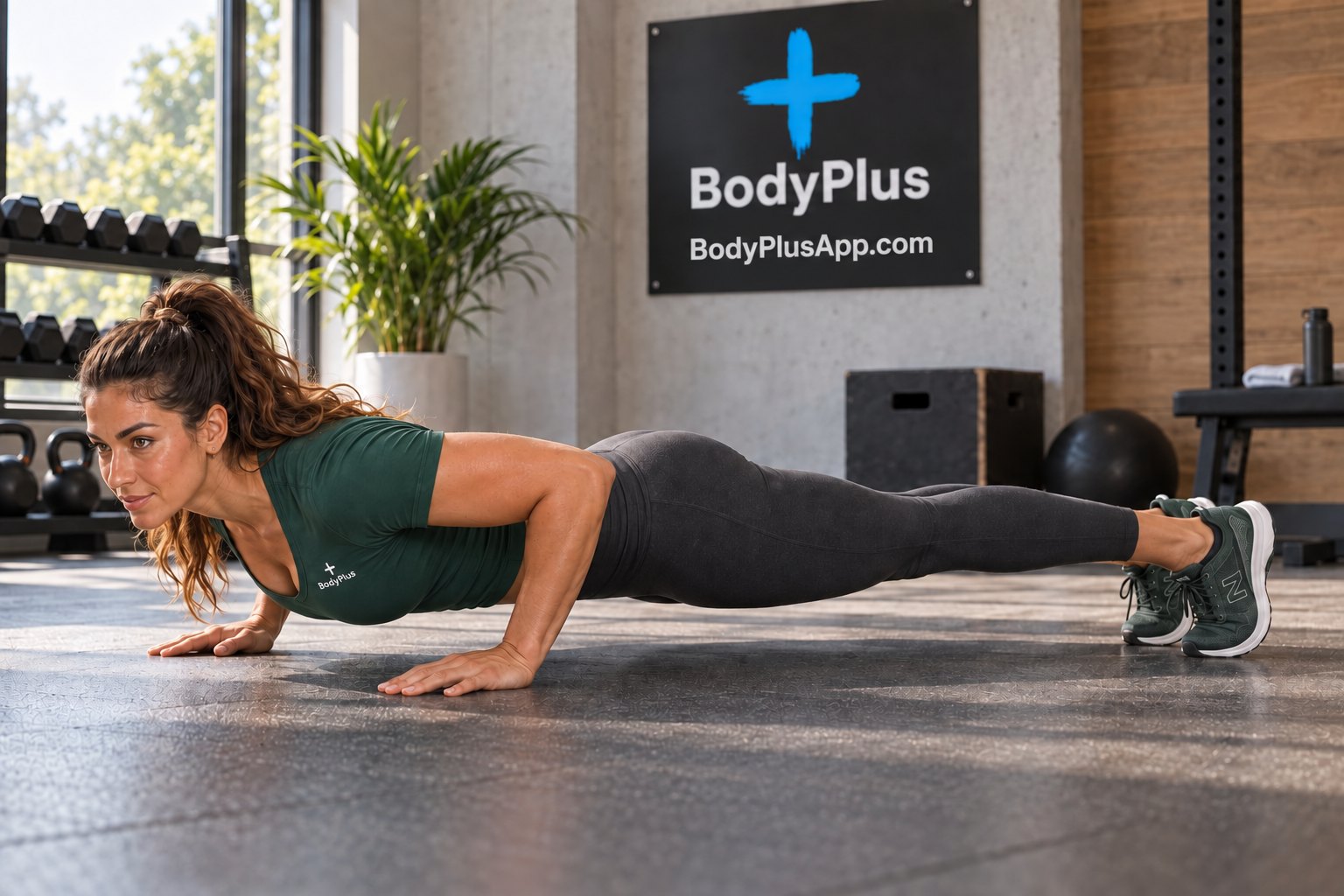
- Get into a plank position: arms straight, hands on the floor a little wider than your shoulders, legs straight behind you with your toes on the floor.
- Keep your body completely straight, from your head to your heels.
- Position your body so that, on the way down, your elbows are at about 45 degrees, halfway between your shoulders and your belly.
- Bend your elbows and lower your whole upper body until your chest is just above the floor.
- At the bottom, pause for a moment, then push your body up powerfully until your arms are straight.
- Do the number of reps you planned until the end of the set.
It is very important that you keep your body straight throughout the whole movement.
Breathing: breathe in as you lower yourself and breathe out as you push up, and don't hold your breath for the whole set.
Hand width
Most people do well with their hands a little wider than their shoulders. Narrower hands work your chest and triceps more, and wider hands take some of that work away from them, so choose the width that feels good for your shoulders. Narrow and wide versions are covered in variations 4 and 6 below.
Handles: why they help
If you want to maximize the effectiveness of push-ups and make them much more efficient, use push-up handles. They have a huge variety of important benefits:
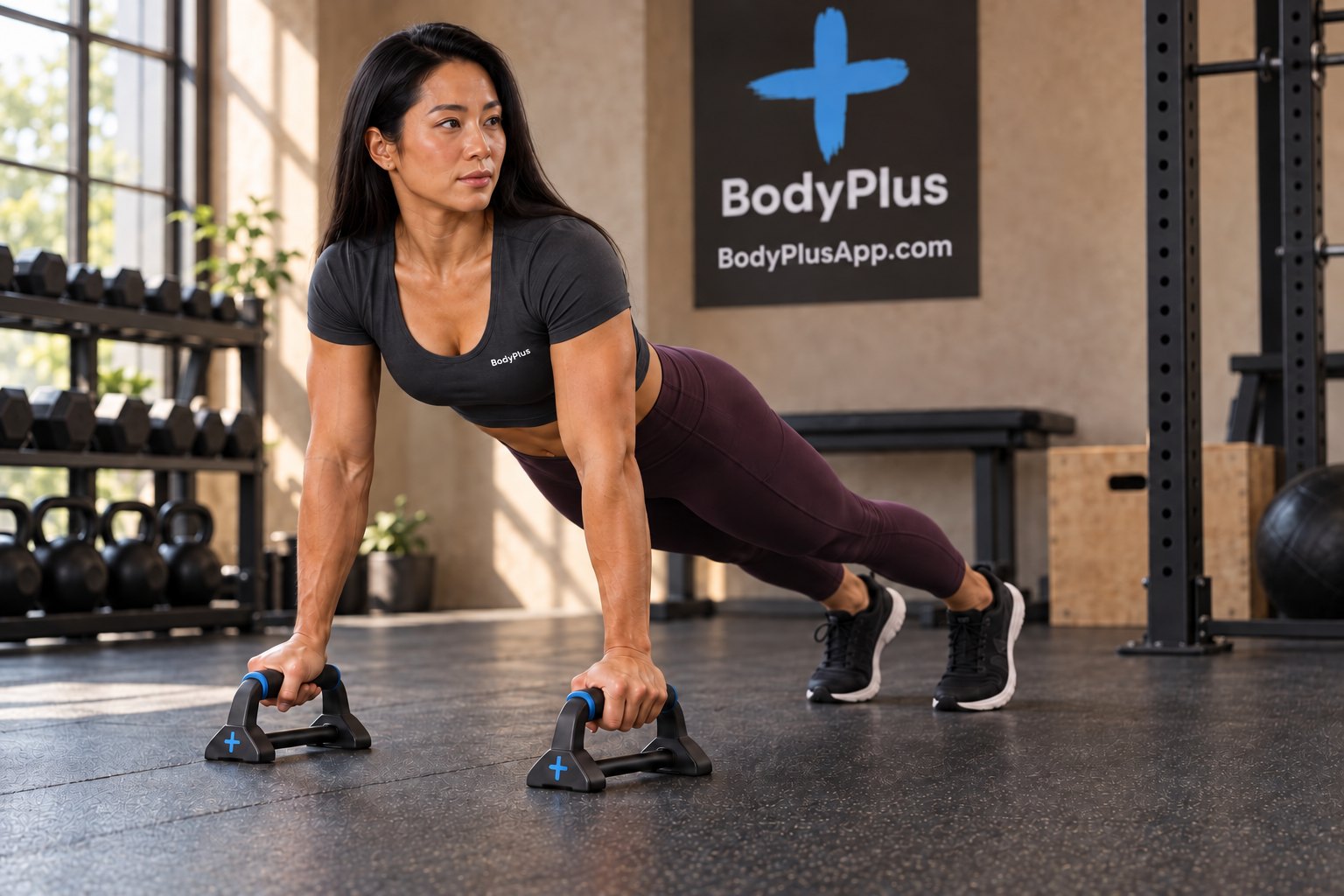
- They reduce the load on the wrist joints, so you can do more reps for longer. On handles your wrists stay straight instead of bent back; in a lab study of 8 wrists from body donors, a straight (knuckle) position produced lower peak pressure in one part of the wrist than a bent-back position.
- They help focus the load on the chest, so you can build more chest muscle (hypertrophy is the process of building muscle mass).
- They increase the range of motion. Your hands are raised, so your chest can go lower than your hands, and you work the muscle fibers in the optimal way.
- They improve your stability during the movement and let you do a wide variety of variations.
Choose handles with a non-slip grip and a stable base. Hexagonal dumbbells can do the same job; round dumbbells can roll, so don't use them.
Common mistakes and how to fix them
1. Back sagging down: lower back pain
This is a very common mistake, especially among people who don't train and are only starting to do push-ups. It stems mainly from weak core muscles (the abs and lower back). Keep your body straight and rigid during the exercise, from your legs up to your shoulder blades.
To fix it, do planks and strengthen your core. Until then, an easier variation (hands on a bench, or on your knees) helps you keep the straight line.
2. Looking forward instead of down: neck pain
An unnatural, straight-ahead neck position can cause pressure and pain in the area. During the exercise, keep your neck at the same angle as your back. In other words, keep your gaze on the floor a little in front of your hands, without feeling pressure or discomfort in your neck.
3. Wrong hand placement: shoulder pain
Some people do the exercise with their elbows in line with their shoulders on the way down. This can put high pressure on the shoulder joint and cause pain and injury.
The best elbow position depends a lot on each person's build. For most people, though, elbows about halfway between the shoulders and the belly (roughly 45 degrees from the body) work very well. With time and the experience you accumulate, you will find the position that is best for you.
4. Half reps
Stopping halfway down leaves part of the exercise undone. Go down until your chest is just above the floor and come all the way up. If you can't do full reps yet, use an easier variation instead of shortening the range.
5. Hips piking up or rushing the reps
Hips high in the air turn the exercise into something easier and less useful, and dropping fast and bouncing off the bottom does the same. Lower yourself with control, in a couple of seconds, and keep the straight line.
11 push-up variations
The table ranks the 11 variations below, plus the wall push-up, the regular push-up and band or weighted push-ups, from easiest to hardest.
| Variation | Difficulty | Main emphasis |
|---|---|---|
| Wall or high incline (counter, table) | very easy | learning the movement |
| Knee push-up | easy | chest, shoulders, triceps |
| Incline push-up (bench) | easy to medium | chest, shoulders, triceps |
| Regular push-up | medium | chest, shoulders, triceps |
| Wide push-up | medium | chest |
| Slow push-up, 1.5-rep push-up | medium to hard | more time under load |
| Diamond push-up | hard | triceps |
| Decline push-up (feet raised) | hard | chest, often felt more in the upper chest |
| Pike push-up | hard | shoulders |
| Band or weighted push-up | hard | strength |
| Explosive (jump) and clap push-ups | hard | explosive power |
| Archer push-up | very hard | one arm at a time, balance |
What research says about difficulty: in a study of 23 recreationally fit adults (14 men and 9 women), push-ups with the feet on a box (30 or 61 cm, about 1 or 2 ft) pressed more force into the floor than regular push-ups. Push-ups with the hands on a box and push-ups on the knees produced less force than all the other versions. The authors suggest using these numbers to progress push-ups step by step.
1. Knee push-ups
Knee push-ups are an excellent exercise for beginners who find it hard to do the regular version. The only difference is that your body rests on your knees instead of your feet. This position makes the exercise much easier, and it is excellent for building a stable base to progress from. Keep a straight line from your head to your knees, and put a mat or a folded towel under your knees.
2. Incline push-ups
In this variation you put your hands on a high surface and your feet on the ground, so your body is on a diagonal. This position slightly reduces the resistance, which makes the exercise easier. Get into position and do the movement exactly as you do the regular push-up. The higher your hands, the easier it gets: a wall is easiest, then a kitchen counter, then a bench or a sturdy step. Use a surface that can't slide or tip over.
3. Decline push-ups
In this exercise you put your feet on a raised surface and your hands on the floor. This position puts a higher load on the chest, which raises the difficulty of the exercise, and it focuses the load on the upper chest. Start with a low step and keep your hips in line; don't let your lower back sag.
4. Diamond push-ups: triceps emphasis
An excellent variation that puts the emphasis on the triceps. It is considered a compound exercise (it works several joints and muscles), so it is excellent for building triceps muscle.
You make a diamond shape with both hands (thumbs and index fingers touching) and place them under the middle of your chest. While lowering your body, keep your elbows close to your belly. It is worth opening your hands slightly, because that reduces the pressure on your wrists. Beginners can do them on their knees. My triceps exercises guide shows where they fit in a triceps workout.
5. Pike push-ups: shoulder emphasis
If you are looking for a shoulder exercise with body weight, this is the exercise you need. Pike push-ups put the emphasis mainly on the shoulders and will help you build strong shoulders.
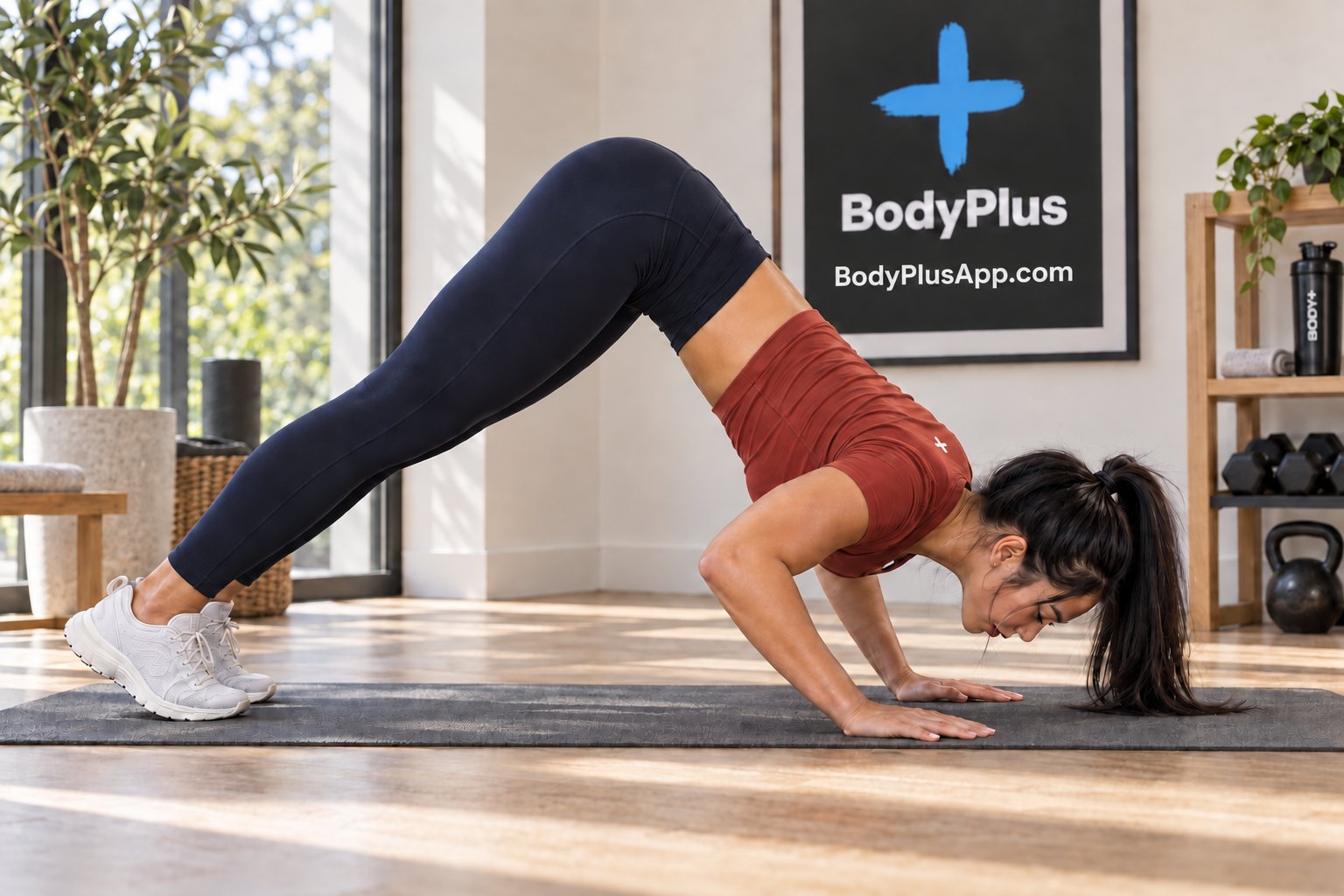
Start in a regular push-up position. Raise your hips up and back until your body forms an upside-down V (Ʌ). It is important to keep your arms and legs as straight as possible. Start bending your elbows and lower your upper body toward the ground, with the top of your head moving a little in front of your hands, then push back up.
The technique of this exercise is not simple, so it is worth learning it well before you try it with all your might. For more shoulder exercises, see my shoulder exercises guide.
6. Wide push-ups
If you want to raise the difficulty, this is the variation for you. The technique is similar to the classic variation, only you place your hands wider than shoulder width. The wide position shortens the range of motion, but it raises the resistance and the difficulty. Don't go so wide that your elbows flare straight out to the sides.
7. Jumping push-ups: emphasis on explosive power
An outstanding exercise that adds an element of explosive power to push-ups. It is similar to the classic exercise, except that at the end of the descent you push your body up with all your force and try to lift your hands off the floor. Keep your arms almost straight in the air so you land on your hands, with slightly soft elbows.
8. Clap push-ups: emphasis on explosive power
After you have mastered the jumping push-up, raise the difficulty with a clap. This variation is excellent for improving explosive power. It is just important that you are fast enough, otherwise your nose may hurt for at least a few days.
It goes like this: get into a regular push-up position. Start the movement downward until you reach the lowest point. Then push your body off the ground in a burst of energy, clap quickly in the air, and return to the starting position.
9. Side to side: archer push-ups
This exercise is especially hard, especially if you do it slowly and correctly. It is good mainly for adding variety to the workout and improving endurance, balance and the stability of the upper body. Place your hands wide. As you lower yourself, shift your body toward one hand while the other arm stays almost straight, so the entire weight of your body passes from one hand to the other. Push back up and switch sides on the next rep.
10. Slow push-ups: emphasis on building muscle
This exercise is similar to the classic form; you simply do every movement especially slowly. It is excellent for building muscle, because you increase the time under load in the exercise. Each movement should take between 5-10 seconds: when you go down, count 5-10 seconds until you reach the bottom, and the same on the way up.
11. One and a half reps: for building muscle and a crazy pump
A special variation for building muscle (hypertrophy). These push-ups increase the time under tension and so are an effective way to build muscle.
The technique is quite simple. You do a regular push-up and add another half rep in the middle. In the classic exercise you go down and all the way up, and then lock the elbows. In this exercise you go all the way down, come up a little, and then go down to the bottom again. After that, when you have done one and a half reps, you come up until your elbows are straight.
It is important to note that you can do one and a half reps in any of the variations.
Two more ways to progress
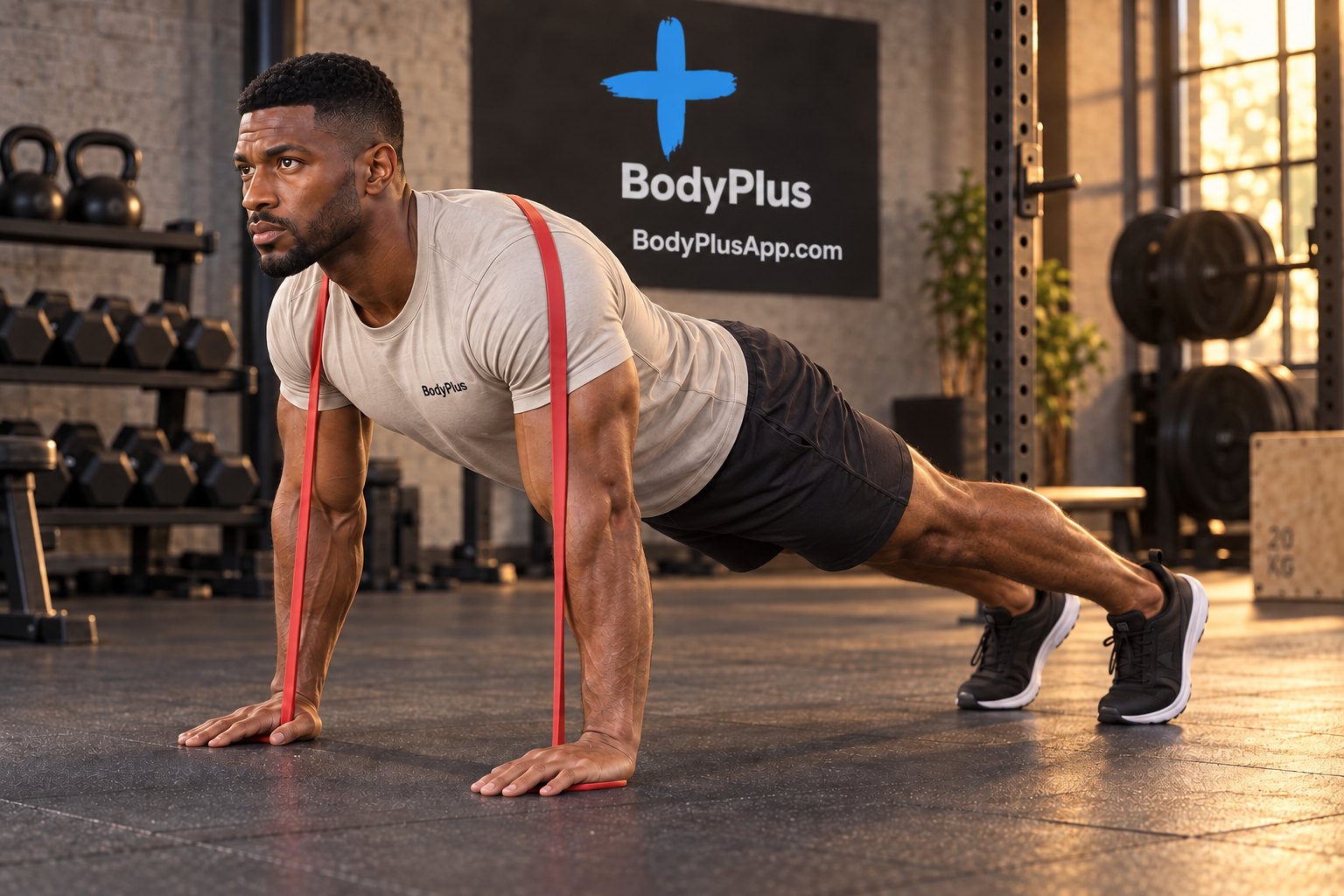
- Band push-ups: hold the ends of an elastic band under your hands with the band across your upper back. This is the setup used in the band push-up study.
- Weighted push-ups: wear a weighted vest, or have a training partner place a weight plate on your upper back (not your lower back) once you are in position and lift it off at the end of the set. Start light.
Push-ups vs the bench press
The two exercises train the same muscles in a similar movement. Push-ups need no equipment, let your shoulder blades move freely, and also train your core. The bench press lets you load much more weight and increase it in small steps.
Researchers have compared the two. In a 5-week study of 30 university students with advanced training experience, push-ups made as hard as a 6-rep-max bench press (with an elastic band across the back, at comparable muscle activity) built similar strength gains to the bench press. In another study, 18 young men trained twice a week for 8 weeks with either a light bench press (40% of their one-rep max) or push-ups adjusted to a similar load (for example on the knees). Both groups gained similar strength and similar chest and triceps thickness. A third study, of 20 resistance-trained people, found no differences in movement or muscle activity between push-ups and the bench press across several loads, and with a weight vest push-ups can mimic different bench press loads (study). These studies were small, and the second used only men.
Regular push-ups soon get too easy for many trained people, who then need harder variations, a band or extra weight. Many people use both: the bench press as the main heavy exercise, and push-ups as a finisher or for training at home.
Sets, reps and how often
- Beginners: 2-3 sets of an easier variation you can do for 8-12 good reps.
- Intermediate: 3-4 sets of 8-15 reps. When you reach 3 sets of 12 good regular push-ups, move to a harder variation (slow, 1.5-rep, decline) instead of adding endless reps.
- As a finisher: 2-3 sets of as many good reps as you can at the end of a chest or push workout.
- Rest: about 60-90 seconds between sets.
- How often: you can do them 3-4 times a week, with at least a day between hard sessions, because the body has to recover from the workouts. If you have an organized training routine, add them to a chest workout. A 2026 position stand of the American College of Sports Medicine linked training at least twice a week with more strength gains, and about 10 or more hard sets per muscle group per week with more muscle growth. Your presses and push-ups both count toward that for the chest. If you follow a push/pull/legs split, add push-ups to your push day.
A progression plan from your first rep
Use this rule: do 3 sets. When all three sets reach 12 good reps, move to the next, harder step.
| Step | Variation |
|---|---|
| 1 | hands on a wall |
| 2 | hands on a kitchen counter (about 90 cm, 3 ft) |
| 3 | hands on a bench (about 45 cm, 18 in) |
| 4 | hands on a low step (about 20-30 cm, 8-12 in) |
| 5 | regular push-ups on the floor |
| 6 | slow, 1.5-rep or decline push-ups |
| 7 | diamond, band or weighted push-ups |
Knee push-ups can replace steps 3-4 if you have no stable surface; keep the same rule.
Example log
| Week | Variation | Set 1 | Set 2 | Set 3 |
|---|---|---|---|---|
| 1 | kitchen counter | 10 | 9 | 8 |
| 2 | kitchen counter | 12 | 10 | 9 |
| 3 | kitchen counter | 12 | 12 | 12 |
| 4 | bench | 9 | 8 | 7 |
| 5 | bench | 10 | 9 | 8 |
| 6 | bench | 12 | 10 | 9 |
| 7 | bench | 12 | 12 | 12 |
| 8 | low step | 8 | 7 | 6 |
Progress is rarely a straight line; a week with no change is normal. If your form breaks down at a new step, go back one step for another week.
Safety
Push-ups need no equipment, so the safety work is mostly about how you build up. Warm up your wrists and shoulders first, and start with an easier variation than you think you need; move to a harder one only when every rep looks the same as the first. End the set as soon as your hips sag or your elbows start to flare, because that is where the strain moves to your lower back and shoulders. If you can't finish a rep, lower yourself to the floor with control and rest. For jumping and clap push-ups, use a floor that isn't slippery and try them only once regular push-ups feel easy. Stop the set if something hurts, and switch to a lighter, pain-free variation such as incline push-ups, or use push-up handles if your wrists complain.
Bottom line
Push-ups are without a doubt one of the most classic and well-known exercises in the world. Many organizations, such as the army and the police, use this exercise, and rightly so, to measure people's strength relative to their body weight.
It is an outstanding exercise for building a powerful upper body. In addition, it has a lot of different variations, with which you can focus on different muscles in a targeted way, raise the difficulty and add variety to the workout.
The most important thing is that you keep correct technique. Correct technique will help you get the full effectiveness of the exercise and prevent unnecessary injuries.
Frequently asked questions
What muscles do push-ups work?
The main muscles are the chest, the shoulders and the triceps. Other muscles support the movement, including the core, the biceps and the back.
Can I do push-ups every day?
No, because your body must also recover from workouts. If you overload too much you will probably get injured. You can do them 3-4 times a week. If you have an organized training routine, add them to a chest workout.
How many push-ups a day should I do?
There is no magic number. Rather than a daily target, aim for 3-4 sessions a week of 2-4 sets close to your limit, and add reps or move to a harder variation over time.
How many push-ups should I be able to do?
It depends on your age, sex, body weight and training. Instead of comparing yourself with a chart, test yourself once a month with one set of as many good reps as you can, and try to beat your own number.
Are push-ups enough to build my chest?
They are a good base, especially at home. To keep progressing, you will need harder variations, a band or extra weight, or other exercises from the best chest exercises guide.
Should women do push-ups differently?
No. The technique is the same for everyone. Choose the variation that fits your current level and progress from there.
Why do my wrists hurt during push-ups?
Your wrists are bent back under your body weight. Try push-up handles or hexagonal dumbbells to keep your wrists straight, warm up your wrists first, or raise your hands on a bench to reduce the load. If it still hurts, stop the set and switch to a pain-free variation.
The information on this page and on this website is intended to provide general information only. The content on this website does not constitute a professional opinion, a recommendation, or a substitute for consulting an expert in a specific field or obtaining a medical opinion. It is not medical advice. BodyPlus is not a medical device. If you have a health condition or an injury, or are pregnant, talk to a qualified healthcare professional before starting. Stop exercising and seek appropriate help if you feel pain, dizziness or other concerning symptoms.
Sources
Accessed September 17, 2026.
- Calatayud J. et al., "Bench press and push-up at comparable levels of muscle activity results in similar strength gains", J Strength Cond Res 2015;29(1):246-253. pubmed.ncbi.nlm.nih.gov/24983847
- Kikuchi N., Nakazato K., "Low-load bench press and push-up induce similar muscle hypertrophy and strength gain", J Exerc Sci Fit 2017;15(1):37-42. pubmed.ncbi.nlm.nih.gov/29541130
- Cogley R.M. et al., "Comparison of muscle activation using various hand positions during the push-up exercise", J Strength Cond Res 2005;19(3):628-633. pubmed.ncbi.nlm.nih.gov/16095413
- Ebben W.P. et al., "Kinetic analysis of several variations of push-ups", J Strength Cond Res 2011;25(10):2891-2894. pubmed.ncbi.nlm.nih.gov/21873902
- San Juan J.G. et al., "The effects of exercise type and elbow angle on vertical ground reaction force and muscle activity during a push-up plus exercise", BMC Musculoskelet Disord 2015;16:23. pubmed.ncbi.nlm.nih.gov/25881172
- Daly B.T. et al., "Effect of Push-Up Position on Wrist Joint Pressures in the Intact Wrist and Following Scapholunate Interosseous Ligament Sectioning", J Hand Surg Am 2018;43(4):339-345. pubmed.ncbi.nlm.nih.gov/29157783
- Yang J. et al., "Association Between Push-up Exercise Capacity and Future Cardiovascular Events Among Active Adult Men", JAMA Netw Open 2019;2(2):e188341. pubmed.ncbi.nlm.nih.gov/30768197
- Currier B.S. et al., ACSM Position Stand, "Resistance Training Prescription for Muscle Function, Hypertrophy, and Physical Performance in Healthy Adults: An Overview of Reviews", Med Sci Sports Exerc 2026;58(4):851-872. pubmed.ncbi.nlm.nih.gov/41843416
- Tillaar R.V.D., "Comparison of Kinematics and Muscle Activation between Push-up and Bench Press", Sports Med Int Open 2019;3(3):E74-E81. pmc.ncbi.nlm.nih.gov/articles/PMC6728153