
The 9 Best Shoulder Exercises for Wider, Stronger Shoulders
In short
If you want the best shoulder exercises for a balanced workout, I would choose one press, one lateral raise and one rear-delt move first. Below are my nine picks, from standing barbell presses to shrugs, with a shoulder workout you can use today.
Strong, impressive shoulders matter to women and men alike. In this article I will explain how the shoulder muscles are built, show you the exercises I rate most and share the tips that help you train with purpose. Let's start!
Before we start with the exercises, it is important to me that you understand how your shoulder muscles are built. Without that, you cannot plan your shoulder workout properly.
How your shoulders are built
The shoulder muscles are divided into three parts:
- Front (anterior) deltoid: its main role is to raise your arm forward and upward and rotate it inward. This part works very hard in pressing exercises.
- Middle (lateral) deltoid: its main role is to raise your arms out to the sides. The middle shoulder plays an essential part in shoulder width and builds a strong base for growing your arm muscles.
- Rear (posterior) deltoid: its main role is to bring your arm back and rotate it outward. This part gives your shoulders and upper back thickness.
Planning your shoulder workout
To plan a shoulder workout well, you have to think about more than one thing. On one hand, you want shoulders that can produce serious power. On the other, you want them mobile, stable and strong through the range of motion you can control.
The front shoulder works in pressing exercises. If you already do chest presses and shoulder presses, that may be enough for it. I would add an exercise for the middle and rear shoulders, because other movements may not give them enough work.
Now that you know how the shoulders are built, we can get to the exercises.
| Exercise | Main focus | Equipment | Good for |
|---|---|---|---|
| Standing barbell overhead press | all three parts, front delts most | barbell | strength |
| Seated dumbbell press | front and side delts | dumbbells, bench | muscle, balance between sides |
| Arnold press | all three parts | dumbbells | full range |
| Seated barbell press | front delts | barbell, bench | heavier, focused pressing |
| Lateral raise | side delts | dumbbells, cable or band | shoulder width |
| Upright row | side delts, traps | barbell, dumbbells, cable, band or kettlebell | an extra angle |
| Reverse dumbbell fly | rear delts | dumbbells | the back of the shoulder |
| Band front raise | front delts | band | optional extra front work |
| Shrug | upper traps | barbell or dumbbells | the shoulder girdle, upper body |
The 9 best shoulder exercises
1. Standing barbell overhead press (military press)
The barbell shoulder press is an old-school exercise that helps you build incredible power throughout the shoulder girdle. All three parts of the shoulder take part in this movement, and it has several unique advantages.
First, you can load it with heavy weights and focus on the shoulders. They also have to stabilize the bar as you press. I would still choose a weight I can control.
- Stand with the bar at your upper chest, grip slightly wider than shoulders.
- Brace your midsection, move your head back slightly, and press the bar straight up past your chin; bring your head forward once the bar is overhead.
- Lower it under control to your upper chest.
2. Seated dumbbell shoulder press
The dumbbell shoulder press is also excellent for building muscle and stability throughout the shoulder girdle. It resembles the barbell press, but there are a few differences worth knowing.
The range of motion can be a little greater with dumbbells because you can lower them further. Sitting reduces the work your lower body does and lets you focus on your shoulders. I consider both useful when training for muscle growth.
Dumbbells can also help with an imbalance between your right and left sides. With a barbell, your stronger side can compensate for the weaker one. With dumbbells, each side works independently with the same load.
You can do this exercise seated or standing. Standing demands more stabilization from your lower body.
- Sit on a bench with back support, dumbbells at shoulder height, palms forward.
- Press up until your arms are almost straight.
- Lower slowly, as deep as you can control.
What research says: in a study of 15 men, the standing dumbbell press produced the highest shoulder activation but the lowest maximum weight, and seated presses reduced rear-delt activation. In an ACE-sponsored test, the dumbbell shoulder press ranked highest for the front delts.
3. Arnold press
The Arnold press is named after the iconic bodybuilder and movie star Arnold Schwarzenegger. You add a rotation to the shoulder press, letting your hands turn as you lift while working all three parts of the shoulder and the shoulder rotators in one movement.
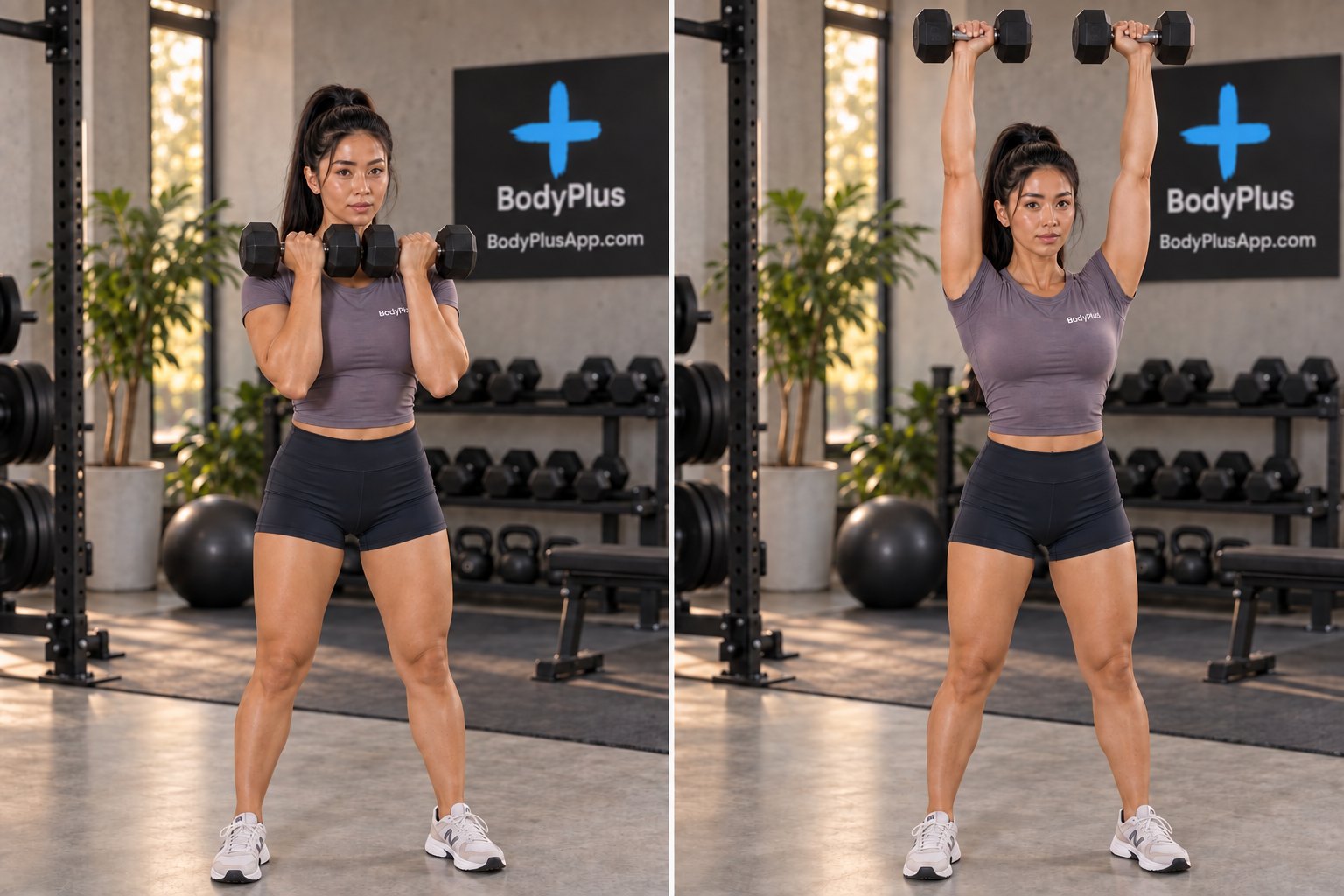
- Sit tall with dumbbells in front of your shoulders, palms facing you.
- Press up while turning your palms to face forward at the top.
- Reverse the turn on the way down.
Shoulder stability and mobility matter to me. With this exercise, I want you to work through a range you can control, instead of chasing more weight at an awkward point in the turn.
Use a high rep range here. The main goal is the full, controlled movement, not a heavy dumbbell when your hand is facing forward.
4. Seated barbell shoulder press
The seated barbell press is similar to the overhead press. The main difference is that you do it sitting down. That brings a few advantages and disadvantages:
- You may be able to lift more weight while directing the work toward your shoulders.
- Sitting reduces help from your lower body and can make it easier to avoid leaning back too far.
- The standing press involves more muscles; your core works hard to stabilize the weight.
This variation can be the main press in your shoulder workout. I like changing the presses from time to time: it adds variety and gives the muscles a slightly different load.
5. Lateral raise
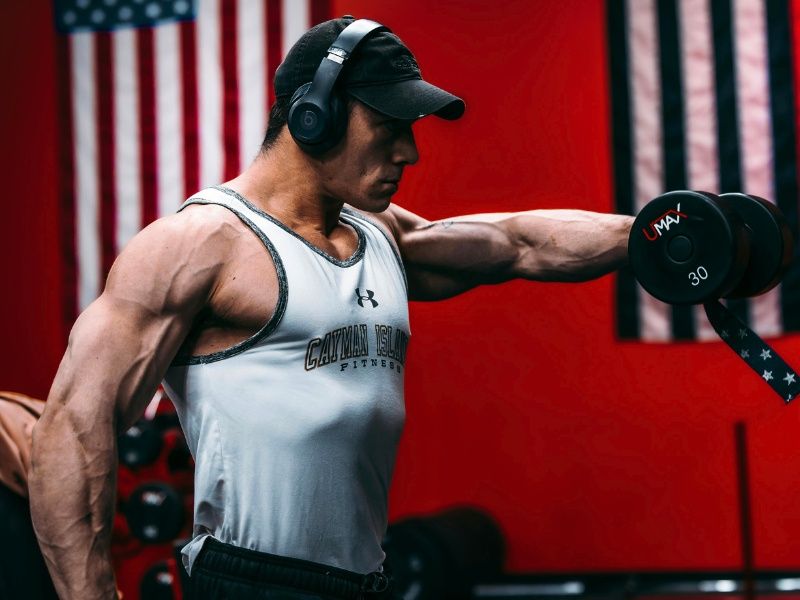
The middle shoulder plays an essential part in the power your upper body projects, so I want you to develop it. Lateral raises let you focus on that part. I do not think a good shoulder workout is complete without a lateral raise, and dumbbells are an excellent option.
Hold two dumbbells and raise your elbows to the sides. That movement contracts the middle shoulder. It looks simple, but many people miss the feeling in that muscle. Here are my tips:
- Think about lifting your elbows to the sides, not your wrists. Keep a slight bend in your elbows.
- Do not stop between reps, or the load on the muscles drops.
- Avoid momentum; it takes work away from the middle shoulder.
- Choose a light weight and focus on the contraction and stretch of the middle shoulders.
You can also do lateral raises with cables or bands, seated or lying down. Keep the movement controlled, especially as your arms reach out to the sides.
What research says: in a small study of 10 competitive bodybuilders, a lateral raise with a neutral arm (thumbs pointing forward) produced more side-delt activity than a thumbs-up raise, a raise with the elbows bent to 90 degrees, and a front raise; the thumbs-down version mostly raised rear-delt and upper-trap activity. The study measured muscle activity in one session, not growth.
6. Upright row
The barbell upright row is an outstanding exercise that works the shoulder girdle, including the trapezius muscles. It gives you another working angle on the muscle fibers, which will maximize hypertrophy; that is why I like it in a shoulder workout.
- Hold the bar with your hands about shoulder-width apart or a bit wider.
- Pull it up along your body toward your chest, elbows leading.
- Lower it under control.
People tend to load this exercise too heavily, and that creates two problems. First, they recruit their whole body to move the bar, so the exercise works less well. Second, the top of the movement can put the shoulder in a less stable position. I would keep the weight manageable and stop at a height that feels comfortable.
If the barbell is difficult for you, try dumbbells, cables, bands or kettlebells.
7. Reverse dumbbell fly (rear delts)
For most people, the rear shoulder lags behind. It is at the back of your body, where you cannot see it, so it is easy to forget to train it.
The dumbbell reverse fly works the rear shoulder very effectively. Its technique is not easy, but it is worth taking the time to learn it.
- Hold light dumbbells and hinge forward at the hips with a flat back until your chest faces the floor.
- Instead of pulling your elbows back, move them out to the sides, with a slight bend.
- Lower slowly.
Start in a position similar to a bent-over barbell row. Instead of pulling your elbows backward, move them out to the sides. That follows the rear shoulder's movement and puts the work there.
It takes time to feel the rear shoulder working properly. I consider strengthening it key to strong, balanced shoulders.
8. Band front raise
You do not have to add a front-shoulder exercise because that part already works hard in pressing exercises. If you still want more work for it, a front raise with a resistance band is an excellent choice.
Many people use dumbbells, but I recommend a band. With one-arm dumbbell raises, the other shoulder rests during each rep. Holding a band in both hands keeps both shoulders working together.
- Stand on the band and hold one end in each hand.
- Raise your arms straight in front of you to shoulder height.
- Lower slowly.
Use a high rep range so you can focus on the front shoulder.
9. Shrug
Although the shrug is not a deltoid exercise, the traps are an integral part of the shoulder girdle. Strong traps matter for a strong upper body. Shrugs are a simple, effective exercise that fits alongside your shoulder training.
- Hold the weights at your sides with straight arms.
- Lift your shoulders straight up toward your ears, pause, and lower slowly.
Some people train traps on shoulder day; others train them on back day. It is not critical. You can shrug with a barbell or dumbbells. There is more about the upper back in the back exercises guide.
Your shoulder workout plan
Choosing exercises is only the first step. You also have to think about sets, reps, recovery and how you spread the work across the shoulder muscles. Here is a simple example you can start with and adjust to your training.
| Exercise | Sets | Reps | Rest |
|---|---|---|---|
| Standing overhead press or seated dumbbell press | 3 | 6-10 | 2 min |
| Lateral raise | 3 | 12-15 | 60-90 s |
| Reverse dumbbell fly or face pull | 3 | 12-15 | 60-90 s |
| Band front raise (optional) | 2 | 15-20 | 60 s |
You could do this workout once or twice a week. On most sets, stop when you feel you could still do one to three good reps. Start with weights you can control and leave time to recover before you train shoulders hard again.
Dumbbell-only or home version: standing dumbbell press 3 x 8-10, dumbbell lateral raise 3 x 12-15, reverse dumbbell fly or band face pull 3 x 12-15.
What research says: An ACE-sponsored study with 16 men found that the top exercise differed for each part of the shoulder, and the authors concluded there is no single best shoulder exercise. In an ACE-sponsored test, the 45-degree incline row was among the top choices for both the side and rear delts. Muscle activation in one session is not a direct measure of long-term growth, so use these results to choose a mix, not to crown one winner.
Safety
Warm up your shoulders with easy movements and light practice sets before adding weight. For barbell presses, secure the plates with collars and set safety arms just below your lowest bar position; check that the bench is stable and, if using a machine, adjust the seat and handles before starting.
Keep raises light enough to lead with your elbows without swinging, and lower every rep under control. End the set if you feel pain or dizziness, or if your form breaks down. Leave time to recover between hard shoulder workouts, add weight only when your reps stay controlled, and go lighter when you cannot keep that control.
For the setup and movement details, see the shoulder press and lateral raise guides.
Bottom line
Your shoulders play a central role in how powerful your upper body looks. I have given you the exercises I rate most, considering the benefit, the effort, the time and how hard each technique is to learn. Choosing them is only the first step.
Plan the exercises, sets, reps, recovery and nutrition so all three parts of the shoulder get their share. Start with the example workout if you need a place to begin, and record your sets so you can see what changes over time.
Frequently asked questions
What are the 3 best shoulder exercises?
One press (overhead or dumbbell), one lateral raise, and one rear-delt exercise (reverse fly or face pull).
What is the best shoulder exercise with dumbbells?
The seated or standing dumbbell press for overall work, plus dumbbell lateral raises for width.
Is the overhead press enough for the shoulders?
It trains the front delts well, but the side and rear delts need their own work.
Standing or seated press?
Seated lets you lift a little more and focus on the shoulders; standing makes your core and lower body work harder. Switch between them every few weeks.
Are lateral raises enough for the side delts?
They are the main exercise. Cable and band versions add variety, and the 45-degree incline row also works the side delts.
Do I need to train my rear delts?
Yes. They are often underdeveloped, and direct work helps balance your shoulders.
Do I need front raises?
Not necessarily. Presses already work the front delts; a band front raise is an optional extra.
How many shoulder exercises per workout?
Three or four is enough for most people. If a movement hurts or your form breaks down, stop the set and choose a lighter or more comfortable variation.
The information on this page and on this website is intended to provide general information only. The content on this website does not constitute a professional opinion, a recommendation, or a substitute for consulting an expert in a specific field or obtaining a medical opinion. It is not medical advice. BodyPlus is not a medical device. If you have a health condition or an injury, or are pregnant, talk to a qualified healthcare professional before starting. Stop exercising and seek appropriate help if you feel pain, dizziness or other concerning symptoms.
Sources
Accessed September 17, 2026.
- Sweeney S. et al., "Dynamite Delts: ACE Research Identifies Top Shoulder Exercises", ACE ProSource, September 2014. www.acefitness.org/continuing-education/prosource/september-2014/4972/dynamite-delts-ace-research-identifies-top-shoulder-exercises
- Coratella G. et al., "An Electromyographic Analysis of Lateral Raise Variations and Frontal Raise in Competitive Bodybuilders", Int J Environ Res Public Health 2020;17(17):6015. pubmed.ncbi.nlm.nih.gov/32824894
- Saeterbakken A.H., Fimland M.S., "Effects of body position and loading modality on muscle activity and strength in shoulder presses", J Strength Cond Res 2013;27(7):1824-1831. pubmed.ncbi.nlm.nih.gov/23096062
- Vigotsky A.D. et al., "Longing for a Longitudinal Proxy: Acutely Measured Surface EMG Amplitude is not a Validated Predictor of Muscle Hypertrophy", Sports Med 2022;52(2):193-199. pubmed.ncbi.nlm.nih.gov/35006527
- Currier B.S. et al., ACSM Position Stand, "Resistance Training Prescription for Muscle Function, Hypertrophy, and Physical Performance in Healthy Adults: An Overview of Reviews", Med Sci Sports Exerc 2026;58(4):851-872. pubmed.ncbi.nlm.nih.gov/41843416