
How to Do a Romanian Deadlift: Form, Muscles Worked and Variations
In short
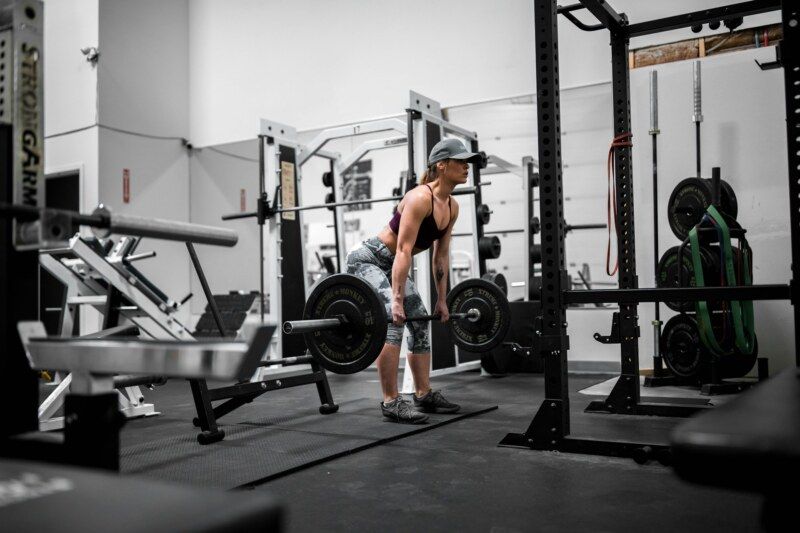
To do a Romanian deadlift (RDL), stand tall holding a barbell at your hips, knees slightly bent. Push your hips back and slide the bar down your thighs, keeping your back flat and the bar close to your legs. Stop when your hamstrings are stretched, or at about mid-shin, then drive your hips forward to stand up. It mainly works your hamstrings and glutes. Your back, grip and core hold the position.
If I had to make a list of the best exercises for bodybuilding, I have no shadow of a doubt that the Romanian deadlift has to be among the leaders. It is a rare compound exercise that combines a relatively simple technique with building a lot of muscle in the muscles at the back of the body. This guide has everything you need to know about the exercise, including benefits, technique, common mistakes, tips, variations and more. So let's begin!
It is a perfect exercise for both women and men. It trains the glutes, the back of the thighs and the back, so it helps anyone build a strong, balanced lower body.
This page goes deep into one exercise. For complete workouts, see my guides to the best leg exercises and the best glute exercises.
Muscles worked
The main muscles that work in the Romanian deadlift are the lats, traps, glutes, hamstrings, forearms, abs and erector spinae (the muscles along your spine). They don't all work in the same way:
| Muscle | Role in the exercise |
|---|---|
| Hamstrings (back of the thighs) | main movers: they extend your hip and are stretched on the way down |
| Gluteus maximus (the big glute muscle) | main mover: drives your hips forward to stand up |
| Adductor magnus (inner thigh) | helps extend your hip |
| Spinal erectors (muscles along your spine) | hold your back flat the whole time |
| Lats, traps and rhomboids (upper back) | keep the bar close to your body and your shoulders set |
| Forearms and grip | hold the bar without moving (isometric work) |
| Abs and core | brace your trunk so the movement comes from your hips |
If you want a map of these muscles, my leg muscles guide explains how they are built and what each one does.
Where the name comes from
Benefits: why it belongs in your workout
It strengthens all the muscles at the back of your body
The back of the body is neglected in a considerable share of trainees. These are muscles you can't see in the mirror, so people tend to give them little importance. In addition, it is hard to see whether there is an imbalance between muscles that you can't see clearly.
The Romanian deadlift has enormous potential for building all the muscles at the back of the body, starting from the traps, rhomboids and lats, through the erector spinae and glutes, down to the hamstrings. It trains all of them in a balanced way. Even if you have a muscle that is relatively weak, the exercise forces it to improve and balances it against the rest.
Does it build the hamstrings? In a 6-week study, 32 young adults trained twice a week with either the RDL, with a slow lowering phase, or the Nordic hamstring curl. Ultrasound scans showed the hamstrings grew by about 10% in cross-sectional area, with no clear difference between the two exercises. That is a short study in young adults, but it shows the RDL can build the back of the thighs.
This matters because squats alone do little for the hamstrings. In a 10-week study of 17 men, full and half squats both grew the quads, but the hamstrings did not change. A hinge like the RDL fills that gap.
Your muscles stay under load for a very long time
In this variation of the deadlift there is constant tension on the muscles, because you don't lower the bar to the floor. This constant tension raises the load your muscles receive. Remember that the greater the tension on the muscles, the more effectively you will build muscle.
For more intensity, don't stop and rest between reps. When you reach a standing position, pause for a moment, and start another rep.
It strengthens your lower back for everyday bending
As we age, the importance of strengthening muscles increases. A weak lower back can cause you pain, poor posture, injuries in training and more. Many people suffer from lower back pain, because of prolonged sitting or excess weight.

The Romanian deadlift is a functional exercise that can strengthen your back, your flexibility, your balance and more. The exercise simulates bending. It works all the muscles that help you bend, so it will make tasks in everyday life, such as lifting a box, easier for you.
It improves grip strength
The Romanian deadlift is an outstanding exercise for building a powerful grip. Your forearms have to hold the whole weight. The heavy load makes them work hard in an isometric contraction (they hold without moving). That work helps you build arms that are able to hold a heavy weight for a long time.
By the way, you can make it easier for your hands to hold the bar by using lifting straps.
Romanian deadlift vs the regular deadlift: which is better?
The Romanian deadlift is a variation of the classic deadlift. It comes with a significant special advantage for bodybuilding: you can develop the back of your body effectively, without loading it with heavy weights and risking injury.
In addition, in the Romanian deadlift you don't lower the bar all the way to the floor, so the tension on the muscles is maintained throughout the whole exercise. The greater the tension on the muscles, the more effective the hypertrophy will be.
If your goal is to build strength and lift high weights, you are better off sticking to the classic deadlift.
| Romanian deadlift | Conventional deadlift | Stiff-leg deadlift | |
|---|---|---|---|
| Starts from | the top (standing) | the floor | the floor or the top |
| Knees | slightly bent, fixed | bend and straighten a lot | almost straight |
| Bar goes down to | about mid-shin, or as far as your back stays flat | the floor on every rep | as low as your flexibility allows with a flat back |
| Main muscles | hamstrings, glutes | glutes, quads, back, hamstrings | hamstrings, glutes |
| Best for | building muscle on the back of the thighs | maximal strength, the heaviest loads | a bigger stretch (advanced) |
What research says: in one study of 21 men, the conventional deadlift showed more muscle activity in the front of the thigh (rectus femoris) and somewhat more in the glutes than the RDL, at the same load. That fits the bigger knee bend of the conventional lift. In another study, 10 experienced bodybuilders did the RDL, the RDL standing on a step, and the stiff-leg deadlift. The stiff-leg version showed more glute activity, and the RDL more activity in one of the inner hamstrings (semitendinosus). The step version, with its larger range, showed the most activity overall.
Both studies measured muscle activity, not growth, and activity does not always predict growth. All three lifts are good exercises. Choose the one that fits your goal and your flexibility.
How to do a Romanian deadlift, step by step
- Grip the bar with your hands shoulder-width apart, or a little wider. What matters is that your hands are a bit wider than your knees, so your arms don't rub your legs on the way down.
- Stand straight with your feet shoulder-width apart (in a study of 30 trained men, shoulder-width and wide stances allowed more reps than a narrow one, and a wide stance used the gluteus maximus more; study), your back upright and your chest lifted. Unlock your knees into a slight bend and keep that bend for the whole rep.
- Push your hips back until your back is straight and your torso is close to parallel with the floor.
- Keep the bar close to your body throughout the exercise, so your back stays straight. At the top it should be around hip height.
- Push your glutes back and go down with a straight back and straight arms until the bar reaches the middle of your shins.
- Pause for a moment, focus on the stretch in your hamstrings, and rise back up until your body is straight. Squeeze your glutes at the top and don't lean back.
If you have a weight rack, set the bar at about the height of your upper thighs, so you can lift it out standing. If you don't have a rack, you can start the exercise from the floor: bend your knees and lift the bar like a regular deadlift, with a flat back, until you stand tall. Then do your reps from the top.
Bar path: the bar moves in a nearly straight vertical line over the middle of your feet. If it drifts forward, away from your legs, the load moves to your lower back.
Learning the hinge: practice with no weight first. Stand about a foot's length in front of a wall and push your hips back until your glutes touch it, keeping your back flat and your knees soft. Another option is to hold a light stick along your back, touching your head, upper back and tailbone. If one of those points loses contact, your back is rounding.
How low should you go?
Your hamstring flexibility and your back position decide how low you go, not the floor. Lower the bar only as far as you can with a flat back and your hips still moving back.
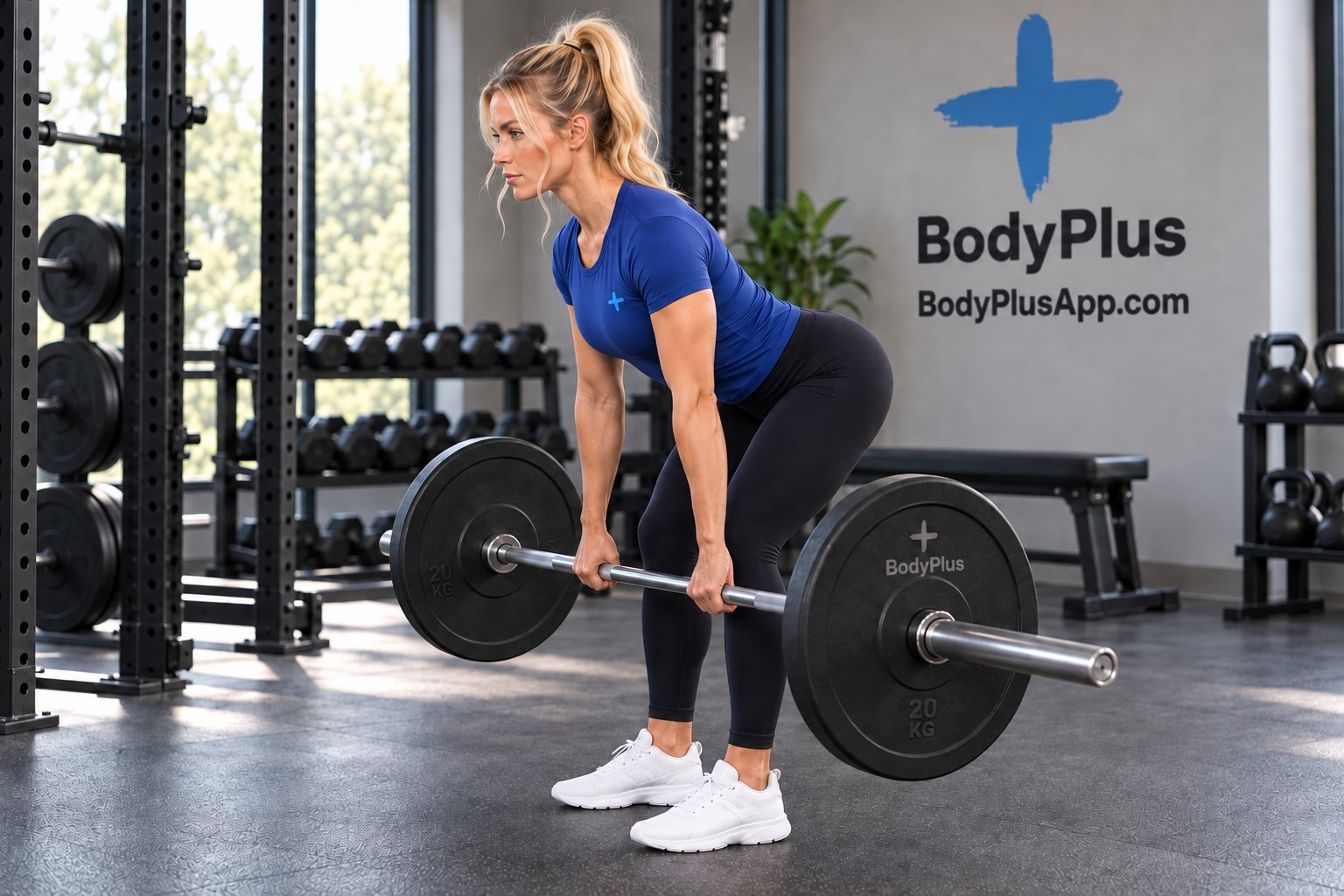
- For most people, that is about mid-shin.
- If your hamstrings are tight, you may stop a little higher than mid-shin at first. That is fine; go as low as your flexibility allows with a flat back, and your range often grows with practice.
- The moment your lower back starts to round, or your hips stop moving back and your back just bends forward, you have gone far enough.
Common mistakes and how to fix them
1. Bending your knees too much
You can bend your knees too much, and then the Romanian deadlift becomes a regular deadlift or even a kind of squat. This causes the quads to take a large part of the load, and then you miss the main purpose of the exercise, which is to work the back of the body.
Pull your hips up toward the ceiling. In the deadlift the hips move in a horizontal plane (forward and back), whereas in the squat the hips move in a vertical plane (up and down). Instead of thinking "up and down" during the Romanian deadlift, think "forward and back".
2. Incomplete range of motion
This is one of the common mistakes people make when performing the exercise. Many people lower the bar only to knee height before returning to a standing position. This half movement causes a huge miss of stimulus in the muscles. Partial stimulus will bring partial hypertrophy.
True, when we work with a full range of motion we lift less weight, but the effectiveness will increase drastically and the risk of injuries will decrease.
When you go down, make sure you reach the middle of your shins. If you can't get that low, go down until your flexibility stops you, with your back still flat.
3. Rounding your back
Reaching for the floor by rounding your back moves the load from your hamstrings to your spine. Lower the weight, lift your chest a little, and only go as low as you can with a flat back.
4. Letting the bar drift away from your legs
If the bar swings forward, your lower back has to work much harder. Keep your lats tight, as if you want to push the bar into your thighs, and let it slide along your legs.
5. Leaning back at the top
At the top, stand straight with your glutes squeezed. Leaning back past upright adds nothing for your muscles and puts extra stress on your lower back.
Variations
Stiff-leg deadlift
The stiff-leg deadlift is a powerful variation for developing the glutes and hamstrings. In this exercise you keep your legs almost completely straight during the descent. The position completely neutralizes the quads, causes a stretch in the hamstrings and glutes, and shifts most of the load to them.
Not many trainees manage to do this exercise. It requires high flexibility and high mastery of barbell exercise techniques. Master the Romanian deadlift first.
Romanian deadlift with dumbbells
Not everyone has access to a barbell, so it is important that you know that you can do this exercise with dumbbells too. The technique of this variation is very similar, only here you hold the dumbbells at the sides of your body or in front of your thighs.

It is an excellent exercise for beginners, or for people who work with relatively low weights. With high weights, it is very hard to progress with dumbbells. With dumbbells the jumps are 2.5 kg (5 lb) in each hand. With a barbell the jump is 2.5 kg (5 lb) in both hands together. In addition, holding dumbbells makes the exercise harder on your grip, and the movement is less comfortable to perform.
Single-leg Romanian deadlift
The single-leg Romanian deadlift is performed with one leg at a time: stand on one leg, and let the other leg rise behind you as you hinge forward. You can do the exercise with body weight, a pair of dumbbells, a kettlebell, or resistance bands.
The main advantage of the single-leg Romanian deadlift is that it is a functional exercise that will improve your coordination, flexibility, stability and balance. Of course, it is not an exercise suited to working with heavy weights. It is done only to improve these elements. Hold on to a wall or a rack with one hand if you lose your balance.
Romanian deadlift with resistance bands
If you don't have access to a barbell and dumbbells, you can do a Romanian deadlift with resistance bands. There are bands whose resistance is very large and they can be very challenging.
The exercise is done with a technique similar to the classic exercise, only with a few adjustments. Stand on the bands with both feet, hold them in front of you, and rise upward with the regular technique. The band gets harder as you rise, so squeeze your glutes hard at the top.
Sets, reps and where it fits in your workout
- Reps: 6-12 per set with a barbell; 10-15 with dumbbells or a band; 8-12 per leg for the single-leg version.
- Sets: 3-4, with about 2 minutes of rest.
- Effort: stop most sets when you could do one to three more good reps. Your form ends the set, not your ego.
- Tempo: lower the bar over about 2-3 seconds, pause briefly at the bottom, and come up with power.
- How often: once or twice a week, with at least two rest days between hard sessions for the back of your legs.
- Order: early in your leg or lower-body workout, after a warm-up with a few light sets.
Sample leg workout
| Exercise | Sets | Reps | Rest |
|---|---|---|---|
| Squat | 3 | 6-10 | 2-3 min |
| Romanian deadlift | 3 | 8-12 | 2 min |
| Split squat | 2 | 8-12 each leg | 90 s |
| Leg curl | 2 | 10-15 | 60-90 s |
| Standing calf raise | 3 | 10-15 | 60 s |
Home version: dumbbell or band Romanian deadlift 3 x 12-15, single-leg Romanian deadlift 2 x 10-12 each leg, split squat 2 x 10-12 each leg, and single-leg glute bridge 2 x 12-15 each side.
How to track it and when to go heavier
One session a week, with the total bar weight including the bar, and a rep range of 8-12:
| Session | Bar weight | Set 1 | Set 2 | Set 3 |
|---|---|---|---|---|
| Week 1 | 50 kg (about 110 lb) | 10 | 9 | 8 |
| Week 2 | 50 kg (about 110 lb) | 11 | 10 | 9 |
| Week 3 | 50 kg (about 110 lb) | 12 | 11 | 10 |
| Week 4 | 50 kg (about 110 lb) | 12 | 12 | 11 |
| Week 5 | 50 kg (about 110 lb) | 12 | 12 | 12 |
| Week 6 | 52.5 kg (about 115 lb) | 9 | 9 | 8 |
When every set reaches 12 reps with a flat back and a full range, add the smallest jump you have, such as 2.5 kg (5 lb) in total on the barbell. Write down how low you went too. If a rep stops higher than usual or your back starts to round, count the set as finished there. If you want to estimate your strength without testing a true maximum, the one rep max calculator can help.
Safety
Start light and add weight in small steps until the hinge feels natural. Keep your back flat from your head to your tailbone, brace your core before each rep, and keep the bar in contact with your legs or very close to them. Lower the bar only as far as you can with a flat back, and end the set as soon as your lower back starts to round or your form breaks down. If your grip gives out before your hamstrings do, use lifting straps instead of letting your back round to hold on. Set the bar in a rack at about upper-thigh height so you don't have to pull it up from the floor, and walk it back into the rack when you finish. Stop the set if it hurts, and switch to a lighter weight or a pain-free variation such as the dumbbell version.
Bottom line
If trainees understood the amount of value this exercise offers, the field of training would look completely different. Including the Romanian deadlift will help you build a lot of muscle in all the muscles at the back of the body. In addition, it will build you a more functional body, and make a wide variety of daily activities easier for you.
It takes a little time to learn the technique, but it is still significantly easier than the classic deadlift. Before you start lifting heavy weights, make sure you have a good command of the technique.
Frequently asked questions
What muscles does the Romanian deadlift work?
Mainly your hamstrings and glutes. The muscles along your spine, your upper back, your forearms and your core work hard to hold the position and the bar.
Is the RDL better than the deadlift?
It depends on your goal. The RDL is easier to learn and keeps constant tension on the back of your thighs, which suits muscle building. The conventional deadlift uses more of your quads and lets you lift the heaviest weights, which suits strength goals.
What is the difference between the RDL and the stiff-leg deadlift?
In the RDL your knees stay slightly bent and your hips move back. In the stiff-leg deadlift your legs stay almost straight, so the stretch is bigger. It needs more flexibility and is better left to experienced trainees.
How much should my knees bend?
Only slightly, and the bend stays the same through the rep. If your knees move forward and your hips drop, the exercise is turning into a squat.
Should the bar touch the floor?
No. Lower it to about mid-shin, or as far as your back stays flat, and stand up again without resting it.
Why do I feel it in my lower back?
Usually because your back rounds, the bar drifts away from your legs, or you go lower than your flexibility allows. Lighten the weight, keep the bar close and shorten the range. Stop the set if it hurts.
Why don't I feel it in my hamstrings?
Your knees may bend too much, or your hips may be moving down instead of back. Push your hips further back and keep your shins nearly vertical.
Barbell or dumbbells?
Dumbbells are great for learning and for lighter weights. The barbell lets you add weight in smaller steps and lift heavier over time.
Can I do it at home?
Yes, with dumbbells, a band, or on one leg with body weight.
How heavy should I go?
Choose a weight you can lift for your target reps with a flat back and a full range. Add weight in small steps.
The information on this page and on this website is intended to provide general information only. The content on this website does not constitute a professional opinion, a recommendation, or a substitute for consulting an expert in a specific field or obtaining a medical opinion. It is not medical advice. BodyPlus is not a medical device. If you have a health condition or an injury, or are pregnant, talk to a qualified healthcare professional before starting. Stop exercising and seek appropriate help if you feel pain, dizziness or other concerning symptoms.
Sources
Accessed September 17, 2026.
- Crawford S.K. et al., "Hamstrings Muscle Architecture and Morphology Following 6 wk of an Eccentrically Biased Romanian Deadlift or Nordic Hamstring Exercise Intervention", Med Sci Sports Exerc 2025;57(8):1799-1809. pubmed.ncbi.nlm.nih.gov/40085810
- Kubo K. et al., "Effects of squat training with different depths on lower limb muscle volumes", Eur J Appl Physiol 2019;119(9):1933-1942. pubmed.ncbi.nlm.nih.gov/31230110
- Lee S. et al., "An electromyographic and kinetic comparison of conventional and Romanian deadlifts", J Exerc Sci Fit 2018;16(3):87-93. pubmed.ncbi.nlm.nih.gov/30662500
- Coratella G. et al., "An Electromyographic Analysis of Romanian, Step-Romanian, and Stiff-Leg Deadlift: Implication for Resistance Training", Int J Environ Res Public Health 2022;19(3):1903. pubmed.ncbi.nlm.nih.gov/35162922
- Vigotsky A.D. et al., "Longing for a Longitudinal Proxy: Acutely Measured Surface EMG Amplitude is not a Validated Predictor of Muscle Hypertrophy", Sports Med 2022;52(2):193-199. pubmed.ncbi.nlm.nih.gov/35006527
- Koderi M.F. et al., "The effects of stance width on muscle activation and performance during Romanian deadlift exercise", J Phys Conf Ser 2020;1529(2):022026. iopscience.iop.org/article/10.1088/1742-6596/1529/2/022026