
How to Do the Leg Extension: Form, Muscles Worked and Knee Tips
In short
Looking for an exercise that will give you a crazy pump in your quads? The machine leg extension can be an excellent addition. It lets you focus the load on your quads with remarkable precision. Here is how to set it up, lift with control, avoid common mistakes and use it in your leg workout.
Muscles worked
The main muscles worked are the quadriceps (quads), on the front of your thighs above your knees.
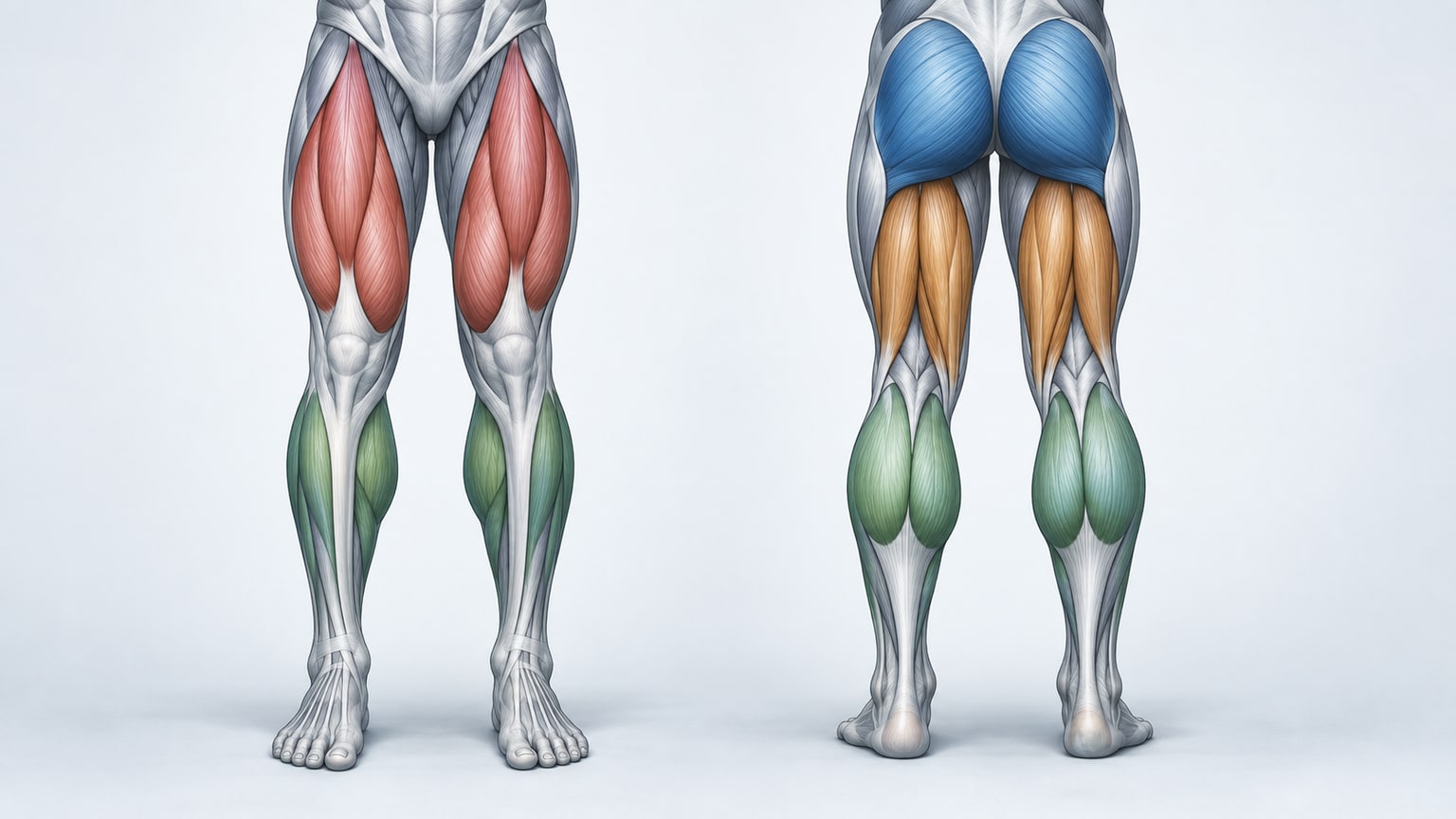
The quads have four parts: the rectus femoris, vastus lateralis, vastus medialis and vastus intermedius. All four help straighten your knee. For a map of the rest of your legs, see the leg muscles guide.
In the 12-week MRI study by Kinoshita and colleagues, 17 untrained adults trained one leg with extensions and the other with the leg press. The quads as a whole grew by similar amounts; the rectus femoris grew about 13% with extensions and about 1% with the press. The press also grew the glutes and inner thighs. It was a small study. In another MRI study, 17 men did 10 weeks of squats and their rectus femoris did not grow.
Benefits
Beginner-friendly
Beginners often find complex exercises like squats and Romanian deadlifts hard. Their technique takes time to learn, which can be frustrating.
On the leg extension, it is easy to feel a pump in your quads. The machine gives you stability and is easy to adjust. Once you learn the technique of compound exercises, it is worth focusing on those too.
Focuses the load on your quads
Adding isolation exercises helps you increase the volume your quads get. More volume can give the muscles more stimulus for hypertrophy (building muscle). The 2026 American College of Sports Medicine position stand found more growth with about 10 or more hard sets per muscle per week.
It is easier to add workout volume with isolation exercises than with compound exercises. Here the load is focused on your quads, while compound exercises call on other muscles too. I like isolation exercises for adding volume while keeping overall fatigue lower.
Balance between the front and back of your legs
If the front of your legs is weak compared with the back, the leg extension is a great addition. Add a few extra sets to help address that imbalance. An imbalance will prevent you from increasing the weights in exercises like squats and lunges.
Every now and then, check whether a particular muscle is lagging behind and act accordingly. If the back of your legs is weaker, you can add a few sets of leg curls.
Machine leg extension technique
- Adjust the seat so that the pad rests on the lower part of your shins, just above your ankles. Line up your knees with the machine's pivot.
- Sit upright with your buttocks all the way back in the seat and your back against the backrest.
- To get started, choose a weight you can lift for 8–15 reps. For the 10–20-rep sets I recommend below, adjust the weight so you can control every rep.
- Lift until your legs are almost straight. You do not have to straighten them completely; stop just short of locking your knees.
- Slowly lower your feet to the starting position.
- Repeat until your set is finished, then lower the weight under control before taking your legs out from under the pad.
Common mistakes
Too much weight
Leg extensions are not an exercise in which strength is measured, so there is no reason to lift crazy weights. Heavy weight can put more load on your knees and make the movement harder to control. Remember, in bodybuilding the goal is to load the muscle effectively, not just lift as much as possible.
Do 10–20 controlled reps, because that way you can squeeze your muscle fibers to the maximum. Try holding still for 2–3 seconds at the top so you can really work your quads.
Straightening your knees all the way
On this machine, I prefer lifting until your legs are almost straight, without snapping your knees into a hard lockout. Then lower the weight slowly. In a lab study of 10 men, the knee extension produced its highest force between the thigh and shin bones near full extension and placed tension on the ACL there. That measurement alone does not show that a controlled lockout causes injury.
Take your time on the way down, too, so you control both halves of the rep.
Variations
Leg extension with a resistance band
If you do your leg workout at home, this is the perfect option. All you need is a resistance band.
Tie one end of the band to an anchor point and wrap the other end around your ankle. Hold on to something, such as a chair, for balance. Aim for the band to be slack when your knee is bent, with tension building as you start to straighten your leg. Then bend your knee slowly to return.
Partial reps in the bent-knee range
Two studies by Pedrosa and colleagues in untrained women also looked at partial leg extensions. The first, with 45 women, found more growth in some quad regions from the bent-knee part of the lift than from full reps. The later study, with 50 women, found that bent-knee partials, full reps and a mix all grew the quads more than top-range partials alone. I would still begin with the controlled machine reps described above and treat bent-knee partials as an option.
Sets, reps and a sample workout
I would put leg extensions after your compound leg exercises to add quad volume. Aim for 2–4 sets of 10–20 reps. Hold the top for 2–3 seconds, lower under control, and rest about 60–90 seconds between sets.
A sample leg workout
| Exercise | Sets | Reps | Rest |
|---|---|---|---|
| Squat or leg press | 3 | 6-10 | 2 min |
| Romanian deadlift | 3 | 8-12 | 2 min |
| Leg extension | 3 | 12-15 | 60-90 s |
| Seated leg curl | 3 | 10-15 | 60-90 s |
Here the compound exercises come first, while you are fresh, and the isolation exercises follow. For more options, see the leg exercises guide.
How to track your progress
Write down the weight and reps of each set, and note the seat and pad settings. When you reach 15 reps on all three sets with the pause at the top, you can move up one step on the weight stack and build the reps again. Compare your numbers on the same machine.
| Session | Weight | Set 1 | Set 2 | Set 3 |
|---|---|---|---|---|
| Week 1 | 30 kg (about 66 lb) | 13 | 12 | 11 |
| Week 2 | 30 kg (about 66 lb) | 14 | 13 | 12 |
| Week 3 | 30 kg (about 66 lb) | 15 | 14 | 13 |
| Week 4 | 30 kg (about 66 lb) | 15 | 14 | 13 |
| Week 5 | 30 kg (about 66 lb) | 15 | 15 | 14 |
| Week 6 | 30 kg (about 66 lb) | 15 | 15 | 15 |
| Week 7 | 35 kg (about 77 lb) | 12 | 11 | 10 |
If the next step on the stack is too big a jump, keep the weight and make the lowering slower, or hold the pause at the top a little longer.
Safety
Before you start, line up your knees with the machine's pivot, set the pad just above your ankles and check that the seat adjustment and weight pin are secure. Warm up with a light set before moving to your working weight.
Keep the lift and lowering slow and controlled, without swinging your legs or lifting your hips off the seat. Stop with your legs almost straight, without snapping your knees into a hard lockout.
End the set if you feel pain, get dizzy or can no longer keep that form. Lower the weight under control before taking your legs out from under the pad.
Bottom line
If you want to build strong quads, leg extensions are an excellent addition to your leg workout. They are an isolation exercise that will give you a crazy pump in your quads. They do not replace compound exercises like squats or lunges, but they are great for adding quad volume.
Remember, this is not an exercise where I would chase heavy weights. Control the weight on the way up and down. Try 10–20 reps, with a weight you can move smoothly.
Frequently asked questions
What muscles does the leg extension work?
The quadriceps on the front of your thighs: the rectus femoris, vastus lateralis, vastus medialis and vastus intermedius.
Is the leg press or the leg extension better?
It is hard to compare them. If you want to build overall muscle in your legs, do the leg press. If you want to emphasize your quads, do leg extensions. Of course, you can include both in a leg workout.
Are leg extensions better than squats?
Each exercise has its own purpose. The squat is good for building overall muscle in the lower body, while the leg extension focuses the load on your quads. You will not build strong legs with leg extensions alone; with squats, you can. You can also replace squats with dumbbell lunges or Bulgarian split squats.
Are leg extensions bad for your knees?
The Escamilla lab study found that they load the knee differently from squats and leg presses; that does not by itself mean harm. A review by Culvenor and colleagues found moderate-certainty evidence that open-chain exercises such as leg extensions and closed-chain exercises such as squats were similarly effective for quad strength in knee rehabilitation studies, mostly involving men after ACL injuries. For your set, use a weight you can control and stop if you feel sharp pain.
Should I straighten my legs fully?
Lift until your legs are almost straight, pause and lower slowly, without snapping into a hard lockout.
How much weight should I use?
Choose a weight you can control for 10–20 reps, with a 2–3 second pause at the top.
Can I train this movement without a machine?
Yes. You can use a resistance band anchored behind you and hold a chair for balance.
Do leg extensions work the glutes?
They focus on the quads. For your glutes, try hip thrusts, squats or the leg press.
The information on this page and on this website is intended to provide general information only. The content on this website does not constitute a professional opinion, a recommendation, or a substitute for consulting an expert in a specific field or obtaining a medical opinion. It is not medical advice. BodyPlus is not a medical device. If you have a health condition or an injury, or are pregnant, talk to a qualified healthcare professional before starting. Stop exercising and seek appropriate help if you feel pain, dizziness or other concerning symptoms.
Sources
Accessed September 17, 2026.
- Kinoshita M. et al., "Hypertrophic Effects of Single- versus Multi-Joint Exercise: A Direct Comparison between Knee Extension and Leg Press", Med Sci Sports Exerc 2026;58(7):1566-1580. pubmed.ncbi.nlm.nih.gov/41630124
- Escamilla R.F. et al., "Biomechanics of the knee during closed kinetic chain and open kinetic chain exercises", Med Sci Sports Exerc 1998;30(4):556-569. pubmed.ncbi.nlm.nih.gov/9565938
- Culvenor A.G. et al., "Rehabilitation after anterior cruciate ligament and meniscal injuries: a best-evidence synthesis of systematic reviews for the OPTIKNEE consensus", Br J Sports Med 2022;56(24):1445-1453. pubmed.ncbi.nlm.nih.gov/35768181
- Kubo K. et al., "Effects of squat training with different depths on lower limb muscle volumes", Eur J Appl Physiol 2019;119(9):1933-1942. pubmed.ncbi.nlm.nih.gov/31230110
- Pedrosa G.F. et al., "Partial range of motion training elicits favorable improvements in muscular adaptations when carried out at long muscle lengths", Eur J Sport Sci 2022;22(8):1250-1260. pubmed.ncbi.nlm.nih.gov/33977835
- Pedrosa G.F. et al., "From full to partials: Investigating the impact of range of motion training on maximum isometric action, and muscle hypertrophy in young women", J Sports Sci 2025;43(15):1440-1451. pubmed.ncbi.nlm.nih.gov/40366729
- Currier B.S. et al., ACSM Position Stand, "Resistance Training Prescription for Muscle Function, Hypertrophy, and Physical Performance in Healthy Adults: An Overview of Reviews", Med Sci Sports Exerc 2026;58(4):851-872. pubmed.ncbi.nlm.nih.gov/41843416
- OpenStax, Anatomy and Physiology 2e, "11.6 Appendicular Muscles of the Pelvic Girdle and Lower Limbs" (names, positions and actions of the quadriceps). openstax.org/books/anatomy-and-physiology-2e/pages/11-6-appendicular-muscles-of-the-pelvic-girdle-and-lower-limbs