
How to Do a Dumbbell Squat: Form, Muscles Worked and Variations
In short
To do a dumbbell squat, hold the weight close to your body, lower your hips down and back, then stand up again. A squat is one of the best exercises there is in bodybuilding. It builds strength, muscle mass, flexibility, balance, and many more benefits. The classic squat is done with a barbell, but you can also do it with a dumbbell. Here is what you need to know about its benefits, technique, common mistakes, and variations.
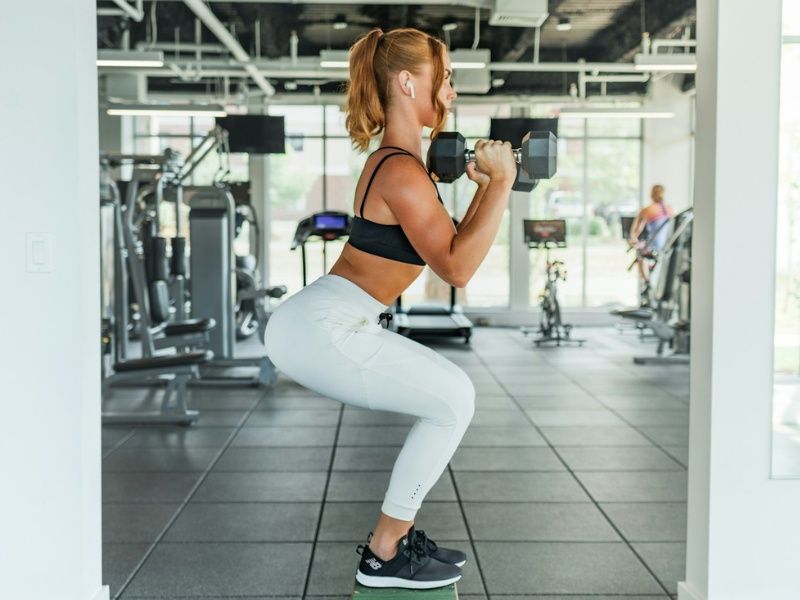
There are several positions in which you can hold the dumbbell. The goblet squat is one of the most common and comfortable: you hold one dumbbell at your chest. You can also let one dumbbell hang between your legs, or hold a pair at the sides of your body.
Main muscles worked: quadriceps, thighs, glutes, abdomen, and lower back.
Benefits of dumbbell squats
A great exercise for beginners
This exercise is excellent for beginners' leg workouts. Its technique is fairly easy to learn compared with a barbell squat. After you practice it well, it will be much easier to learn the technique with a barbell and start loading heavier weights.
No squat rack or barbell needed
To do a squat with a barbell, you need a squat rack to hold the bar. The rack lets you start from a height and its safety bars protect you if you fail a rep. In contrast, to do a squat with a dumbbell, you only need a dumbbell.
Many holds to choose from
There are lots of holds for squats with dumbbells, so you can choose the one that is most comfortable for you. You can do them with dumbbells resting on your shoulders, at the sides of your body, at your chest in a goblet squat, or with one hanging between your legs.
Here is a quick way to choose a hold:
| Hold | How you hold it | What it feels like | Best for |
|---|---|---|---|
| Goblet squat | one dumbbell upright at your chest, hands under the top end | keeps you upright, easiest to learn | beginners, learning depth |
| Dumbbells at your sides | one dumbbell in each hand, arms hanging | lets you hold the most total weight, grip tires first | more load with two dumbbells |
| Front rack | one dumbbell in each hand, resting on your shoulders | upright torso, harder on your upper back | a front-squat feel without a barbell |
| Between your legs | one dumbbell hanging between your legs, often with a wider stance | feels steady; the dumbbell may touch the floor before you reach full depth | a wide-stance (sumo) squat |
How to do a dumbbell squat
- Stand with your feet a little wider than shoulder width. Point your feet slightly outward.
- Hold the dumbbells at your shoulders, as in a shoulder press, or at the sides of your body. You can also hold one in the middle between your legs. For a goblet squat, hold one close to your chest. Keep the dumbbells close to your body; otherwise, lifting heavier weights becomes harder.
- Lift your chest and tighten your core muscles.
- Lower your hips down and back, as if you are sitting on a chair. Make sure your knees follow your toes and do not collapse inward.
- Go down until your thighs are parallel to the floor, or as low as you can.
- Pause for one second, then push up through your whole foot, keeping your heels down. Straighten your legs and return to the starting stance.
- Repeat for the number of repetitions in your set.
How deep should you squat?
Go down until your thighs are parallel to the floor or as low as you can with control. In a 10-week study of 17 men doing barbell squats, full squats (well below parallel) grew the glutes and inner thighs more than half squats (to about 90 degrees at the knee), while the quads grew about the same in both groups.
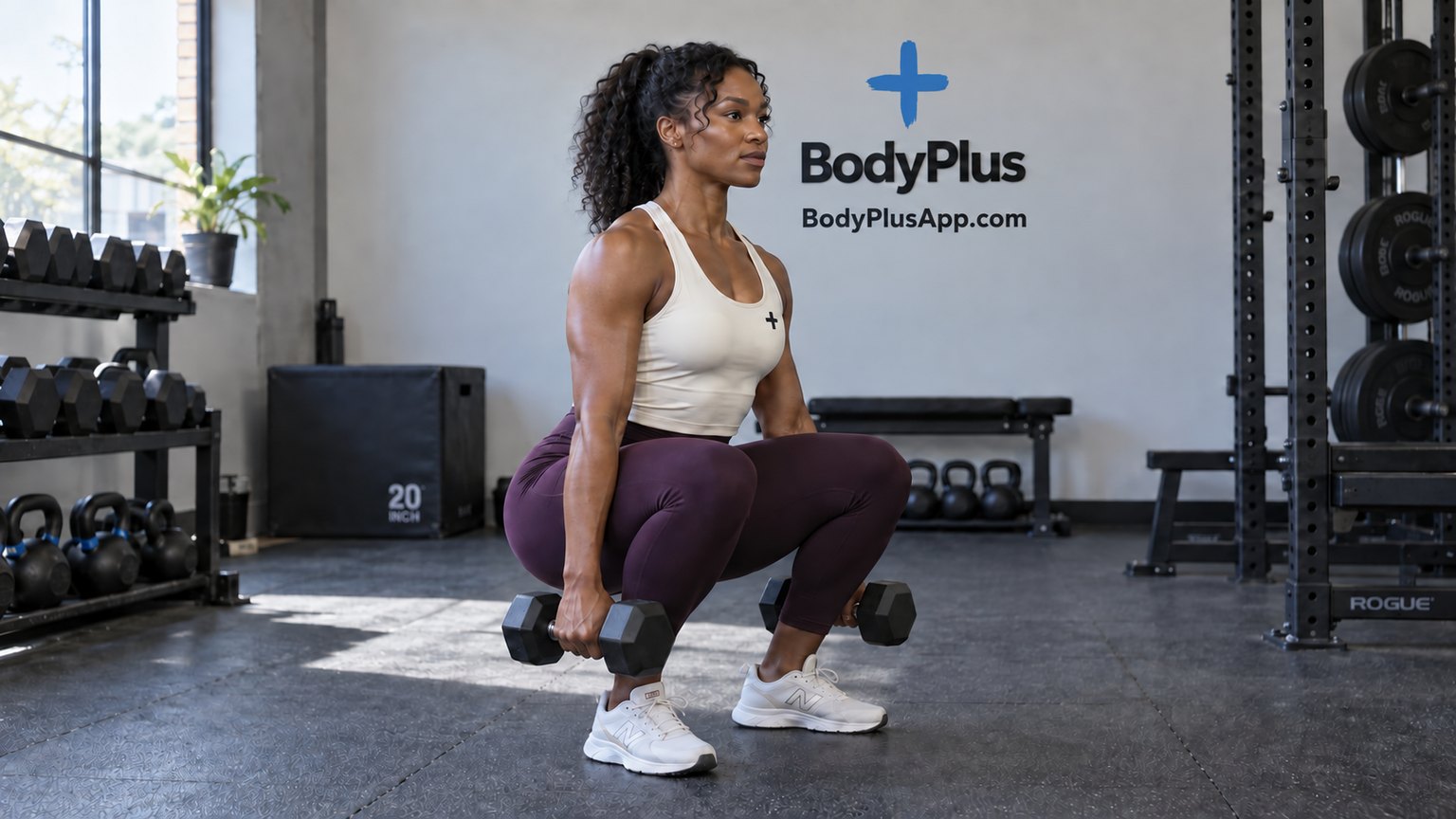
If your heels lift or your lower back rounds before you reach that depth, stop a little higher for now and practice with a lighter dumbbell.
Common mistakes
Rounding the back
Do not round your back during the exercise. Rounding the lower back puts pressure on the spine and may cause injuries. Keep your buttocks back and push your chest upward. This can help you prevent the bend in your back.
Knees collapsing inward or outward
During the movement, your knees should move outward, in line with your feet. Do not let them drift inward or too far outward. This may cause a lot of strain and injuries to the knees.
Too much weight
There is no point in doing this exercise with heavy weights, because your hands will get tired long before your legs. I would choose a light weight, do more repetitions, between 10 and 20, and go as low as you can. These things will increase the intensity much more effectively than a heavy dumbbell.
In a review of 21 studies, muscle grew about the same with light and heavy loads when every set was taken to failure; heavy loads mainly mattered for maximal strength.
If you want to work with heavy weights, do the squat with a barbell.
Dumbbell squat variations
Kettlebell squat
This variation is very similar to a squat with a dumbbell, except that you use kettlebells instead. In general, you can use many kinds of resistance: a weight plate, bands, suspension straps, and more.
Dumbbell split squat
A split squat is a variation of a squat that you do with one leg at a time. It helps all the leg muscles at the same time, so it is excellent for a leg workout. This exercise helps improve strength, stability, balance, and imbalance between the legs.
Stand in a long stride with a dumbbell in each hand, lower your back knee toward the floor, then push through your front foot to come back up.
Bulgarian split squat
A Bulgarian split squat is very similar to a split squat, except that you place your back foot on a bench. To do it, stand with one leg in front and one leg behind. Then lower your body using the front leg.
Sets, reps and a sample workout
For the lighter dumbbell work I recommend above, aim for 10 to 20 repetitions per set. Here is one way to build a leg workout around the squat:
A dumbbell leg workout (gym or home)
| Exercise | Sets | Reps | Rest |
|---|---|---|---|
| Goblet squat or dumbbell squat | 3 | 10-20 | 90 s |
| Dumbbell Romanian deadlift | 3 | 10-12 | 90 s |
| Dumbbell split squat | 2 | 10-12 each leg | 60-90 s |
| Calf raise on a step | 3 | 12-15 | 60 s |
For a full-body option, see my full body workout plan.
How to track your progress
Write down your sets. When all your sets reach the top of the rep range with good form, try the next dumbbell and build the reps again. Here is an example log:
| Day | Exercise | Weight | Set 1 | Set 2 | Set 3 |
|---|---|---|---|---|---|
| Mon | Goblet squat | 16 kg (35 lb) | 15 | 13 | 12 |
| Thu | Goblet squat | 16 kg (35 lb) | 16 | 14 | 13 |
| 3 weeks later | Goblet squat | 16 kg (35 lb) | 20 | 20 | 20 |
| next session | Goblet squat | 20 kg (45 lb) | 14 | 13 | 12 |
When one dumbbell is no longer a challenge, you can move to two dumbbells or to a barbell squat.
Safety
Clear the floor around you so you have room to set the dumbbells down, and secure the collars or locking mechanism if you use adjustable dumbbells. Warm up with a few bodyweight squats, then start with a light weight you can hold comfortably. Lower slowly, pause briefly at the bottom, and stand up without bouncing.
Keep the dumbbells close to your body, your heels on the floor and your knees following your toes; only squat as low as you can while keeping your back steady. End the set if you feel pain or dizziness, your form breaks down or your grip starts to slip, even if your legs could do more. If your hands tire first or you cannot keep that control, use lighter dumbbells for the next set.
Bottom line
A squat with a dumbbell is an exceptional leg exercise that is especially suitable for beginners. It helps work all the leg muscles together, builds strength and muscle mass, and improves stability and flexibility. It also makes learning the squat with a barbell much easier.
The main disadvantage of the exercise is that you cannot do it with heavy weights. With heavy weights, your hands will get tired long before your legs. When working with heavy weights, the barbell has a clear advantage.
Frequently asked questions
What muscles does the dumbbell squat work?
It mainly works your quads, glutes and inner thighs. Your abdomen and lower back help you stay steady.
Is the goblet squat different from a dumbbell squat?
A goblet squat is a dumbbell squat with one weight held at your chest. You can also squat with dumbbells at your sides or shoulders.
Do dumbbell squats build your glutes?
Yes, especially deep squats. In a 9-week study, squats and hip thrusts built similar glute muscle in untrained adults.
How heavy should my dumbbells be for squats?
I would choose a weight that lets you do 10 to 20 controlled reps and squat as low as you can.
Should I push through my heels?
Keep your heels down and push through your whole foot. Pushing only through your heels can tip you backward.
The information on this page and on this website is intended to provide general information only. The content on this website does not constitute a professional opinion, a recommendation, or a substitute for consulting an expert in a specific field or obtaining a medical opinion. It is not medical advice. BodyPlus is not a medical device. If you have a health condition or an injury, or are pregnant, talk to a qualified healthcare professional before starting. Stop exercising and seek appropriate help if you feel pain, dizziness or other concerning symptoms.
Sources
Accessed September 17, 2026.
- Kubo K. et al., "Effects of squat training with different depths on lower limb muscle volumes", Eur J Appl Physiol 2019;119(9):1933-1942. pubmed.ncbi.nlm.nih.gov/31230110
- Plotkin D.L. et al., "Hip thrust and back squat training elicit similar gluteus muscle hypertrophy and transfer similarly to the deadlift", Front Physiol 2023;14:1279170. pubmed.ncbi.nlm.nih.gov/37877099
- Schoenfeld B.J. et al., "Strength and Hypertrophy Adaptations Between Low- vs. High-Load Resistance Training: A Systematic Review and Meta-analysis", J Strength Cond Res 2017;31(12):3508-3523. pubmed.ncbi.nlm.nih.gov/28834797
- Currier B.S. et al., ACSM Position Stand, "Resistance Training Prescription for Muscle Function, Hypertrophy, and Physical Performance in Healthy Adults: An Overview of Reviews", Med Sci Sports Exerc 2026;58(4):851-872. pubmed.ncbi.nlm.nih.gov/41843416