
How to Do the Incline Bench Press: Form, Bench Angle and Safety
In short
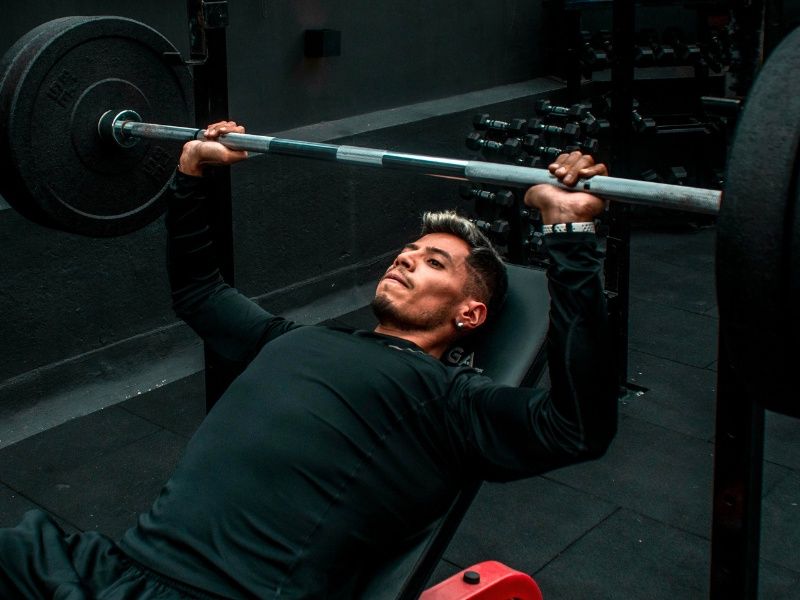
To do the incline bench press, set an adjustable bench to 30-45 degrees (about 30 is a good start), lie back with your feet planted and your back and head on the bench, and grip the bar a little wider than your shoulders. Pull your shoulders back and down, lift the bar out of the rack, lower it slowly to your upper chest, pause for a second, and press it back up. The exercise works your chest with extra emphasis on the upper chest, plus the front of your shoulders and your triceps.
Bodybuilders love the barbell incline press, and for good reason. It is a variation of the bench press in which you set the bench to an incline of 30-45 degrees. It puts the emphasis on the upper chest and the shoulders, and so it helps you build a strong upper body. In this guide I explain everything you need to know about it: the benefits, the technique, tips, and how to fit it into your chest workout.
This page goes deeper into one exercise. For the flat version, see my bench press guide. For a full chest workout with more exercises, see my guide to the best chest exercises.
Muscles worked
| Muscle | Role in the exercise |
|---|---|
| Chest (pectoralis major), with emphasis on the upper part | the main mover: brings your upper arms up and in as you press |
| Front of the shoulders (anterior deltoids) | helps press the bar; works harder as the bench gets steeper |
| Triceps (back of the upper arm) | straighten your elbows, especially near the top |
| Upper back, core and legs | keep your shoulder blades, body and the bar steady |
Benefits of pressing a barbell on an incline
It helps focus the load on your upper chest
If you want to put the work on your upper chest, this is the exercise to do. It is true that every chest press works all of your chest muscles, whatever the incline, and whether you use a barbell or dumbbells. Still, the incline lowers the share of the load that goes to the middle chest (the sternocostal head) and moves it to the upper chest (the clavicular head) and the shoulders.
A long range of motion
The bar travels all the way from straight arms down to your upper chest. That long path gives you a large range of motion, and training through a full range builds more strength than partial-range training.
Made for building muscle
Most bodybuilders use this exercise in a range of 8-12 reps. It is less suited to working on strength and more suited to building muscle mass. For strength, the flat bench press is the better fit (more on that under variations).
Best bench angle: 30 or 45 degrees?
Set the bench to 30-45 degrees. About 30 degrees is a good place to start, and the angle that feels best can differ from person to person. Use the same notch every time, so your logged weights stay comparable from week to week.
| Bench angle | What changes |
|---|---|
| 0 degrees (flat) | the most work for the middle and lower chest |
| About 30 degrees | more upper chest; this angle gave the highest upper-chest activity in the study below |
| 45 degrees | still upper chest, with more front-shoulder work |
| Above 45 degrees | turns into more of a shoulder press |
What research says: in one study, 30 trained adults did the barbell bench press at five angles, including flat, 30, 45 and 60 degrees. Upper-chest activity was highest at 30 degrees, the middle and lower chest were most active on the flat bench, and the front of the shoulders worked hardest at 60 degrees. Inclines above 45 degrees shifted work away from the chest. The study measured muscle activity, not growth. In an 8-week study of 47 untrained young men, strength gains were similar with the flat bench press, the incline bench press or both, and the incline group gained the most thickness at one upper-chest site (one of three sites measured).
How to do it step by step
- Set the bench to an incline of 30-45 degrees and the rack to a suitable height.
- Lie on the bench with your feet planted on the floor, and press your back and head against the bench.
- Grip the bar a little wider than your shoulders, with your thumbs wrapped around the bar. Make sure your wrists stay straight.
- Lock your shoulders: pull them back and down.
- Lift the bar out of the rack and aim it to be above your upper chest.
- Lower the bar slowly toward your upper chest. Don't let it fall onto your chest.
- When the bar reaches your upper chest, pause for a second, then start pressing it up.
- Press the bar until your arms are straight, or almost straight (see the tip under "Not using the full range of motion").
- Repeat for all your reps, then guide the bar back into the hooks before you let go.
Breathe in as you lower the bar and out as you press it up, and don't hold your breath for longer than one rep at a time.
Bar path and where the bar touches
- Touch point: the upper chest, a few finger-widths below your collarbones. That is higher than on the flat bench press, where the bar touches around your nipple line.
- Elbows: keep them tucked a little, not flared straight out to the sides, so that your forearms are roughly vertical at the bottom.
- Path: the bar moves close to a straight line up and down over your upper chest. If it drifts toward your neck, stop the set and rack it.
Common mistakes
1. Bouncing the bar off your chest
Lots of people bounce the bar off their chest on the way down, because it helps them start the way up. The bounce does help lift the bar, and so it lets them use heavier working weights.
First, the bounce makes the exercise less effective, because the muscle fibers get less of the stimulus, and so less of the growth. Second, the bounce may push you into an incorrect movement, and so raise your risk of injury.
It is very important to lift weights you can handle. Make sure you control the bar through the whole movement. When you reach the bottom, pause for a moment, and only then press the bar up.
2. A grip that is too wide
A grip that is too wide sends too much of the load to your shoulders, and this may cause injury. In addition, the load will not be divided among the muscles in the best way, so you may not be able to lift as much as you are capable of.
Everyone has a unique body with a different structure, so the best grip width differs from person to person, and it takes time to find yours. To begin, grip the bar at shoulder width, then widen your grip slightly. In a study of 28 men on the flat bench press, chest activity was similar with narrow, medium and wide grips, which fits the idea that the best width is personal (see my bench press guide).
3. Not using the full range of motion
The large range of motion is one of the big advantages of this exercise. Lots of people don't lower and raise the bar enough, and so make the exercise much less effective.
Work through the full range and use the whole movement. Lower the bar until it reaches your upper chest, and press it up until your arms are almost straight.
Tip: if your goal is purely building muscle, don't straighten your arms all the way. When your arms are completely straight, the load leaves the muscles and moves to your elbows.
4. Setting the bench too steep
Above about 45 degrees, the exercise turns into more of a shoulder press. If you mainly feel your shoulders, lower the bench a notch.
5. Lifting your hips or losing your shoulder lock
If your glutes lift off the seat, your body turns the incline into a flatter press. If your shoulders roll forward, the front of your shoulders takes over more of the work. Keep your glutes down and your shoulders back and down on every rep, and lower the weight if you can't.
Variations
1. Incline dumbbell press
In this variation you replace the bar with a pair of dumbbells. With dumbbells it is possible to activate even more muscle fibers, because the range of motion is larger. Dumbbells can also help with an imbalance between your left and right sides.
Each variation has its own advantages, as the table shows.
| Barbell | Dumbbells | |
|---|---|---|
| Load | heavier weights, small 2.5 kg (5 lb) steps | lighter; the jumps between pairs are bigger |
| Range of motion | the bar stops at your chest | the dumbbells can go a little deeper |
| Left and right sides | the stronger side can help the weaker one | each side carries its own weight |
| Safety alone | needs a spotter or safety arms for hard sets | no bar to fall on your neck, but lower the dumbbells under control |
| Setup | unrack from the hooks | you kick the dumbbells up into position |
What research says: in a study of 12 trained men on the flat press, the maximal load was about 17% lower with dumbbells than with a barbell, while chest and front-shoulder activity were similar. It tested flat pressing and one-rep maxes, not growth or the incline.
With the bar you can lift heavier weights, and so load the nervous system more, something that leads to more muscle building. You can switch every training block and get the benefits of both. For the dumbbell version, the setup and the angle in detail, see my guide to the incline dumbbell press.
2. Incline machine press
You can also do the incline press on a machine. The machine helps you focus the load on the upper chest, because you don't need to stabilize the weight. It also provides a controlled movement, and so may reduce the chance of getting injured. Set the seat and safety stops to fit your body and use a load you can control.
I don't recommend making this variation the main exercise in your chest workout, but it works well as an addition: you don't have to stabilize the weight, so it doesn't load the nervous system the way a free bar does. A Smith machine with its safety stops set is a similar option when you train alone.
3. Barbell bench press (flat)
The bench press may be the most popular exercise among bodybuilders and weightlifters. You press the bar while lying on a flat bench. It suits people who want to improve their strength in particular, because it lets you put the heaviest load on your chest.
It is also a great way to train the nervous system, which is responsible for contracting your muscles. A more efficient nervous system helps you contract your muscles strongly and efficiently, and that helps you get stronger. The full guide is here: bench press.
Sets, reps and where it fits in your workout
- Reps: 8-12 per set, the range bodybuilders usually use for this exercise.
- Sets: 3-4, with about 90 seconds to 2 minutes of rest.
- Effort: stop most sets when you could do one to three more good reps, and two to three when you have no spotter.
- Order: first or second in your chest or push workout. If your upper chest lags behind, put it first.
- Beginners: learn the flat bench press first, then add the incline.
Sample chest workout
| Exercise | Sets | Reps | Rest |
|---|---|---|---|
| Barbell bench press | 3 | 6-8 | 2-3 min |
| Incline bench press (about 30 degrees) | 3 | 8-12 | 2 min |
| Cable or dumbbell fly | 3 | 12-15 | 60-90 s |
| Push-ups or dips | 2 | stop 1-2 reps before failure | 60-90 s |
How to track it and when to add weight
The log below uses one bench angle (30 degrees) and a 20 kg bar.
| Session | Bar weight | Set 1 | Set 2 | Set 3 |
|---|---|---|---|---|
| Week 1 | 40 kg (about 90 lb) | 12 | 10 | 9 |
| Week 2 | 40 kg (about 90 lb) | 12 | 11 | 10 |
| Week 3 | 40 kg (about 90 lb) | 12 | 12 | 12 |
| Week 4 | 42.5 kg (about 95 lb) | 10 | 9 | 8 |
| Week 5 | 42.5 kg (about 95 lb) | 11 | 10 | 9 |
When all three sets reach 12 reps with good form, add the smallest step, 2.5 kg (5 lb) in total, and work back up the rep range. If you change the bench angle, start a new log. To estimate your working weights from a recent set, use the one rep max calculator, and don't test a true one-rep max without a spotter or safety arms.
Safety
You must do this exercise with someone who watches over you: if you reach failure, the bar can fall onto your neck, and a good spotter will also advise you on your technique and give you a shot of motivation to finish the set.
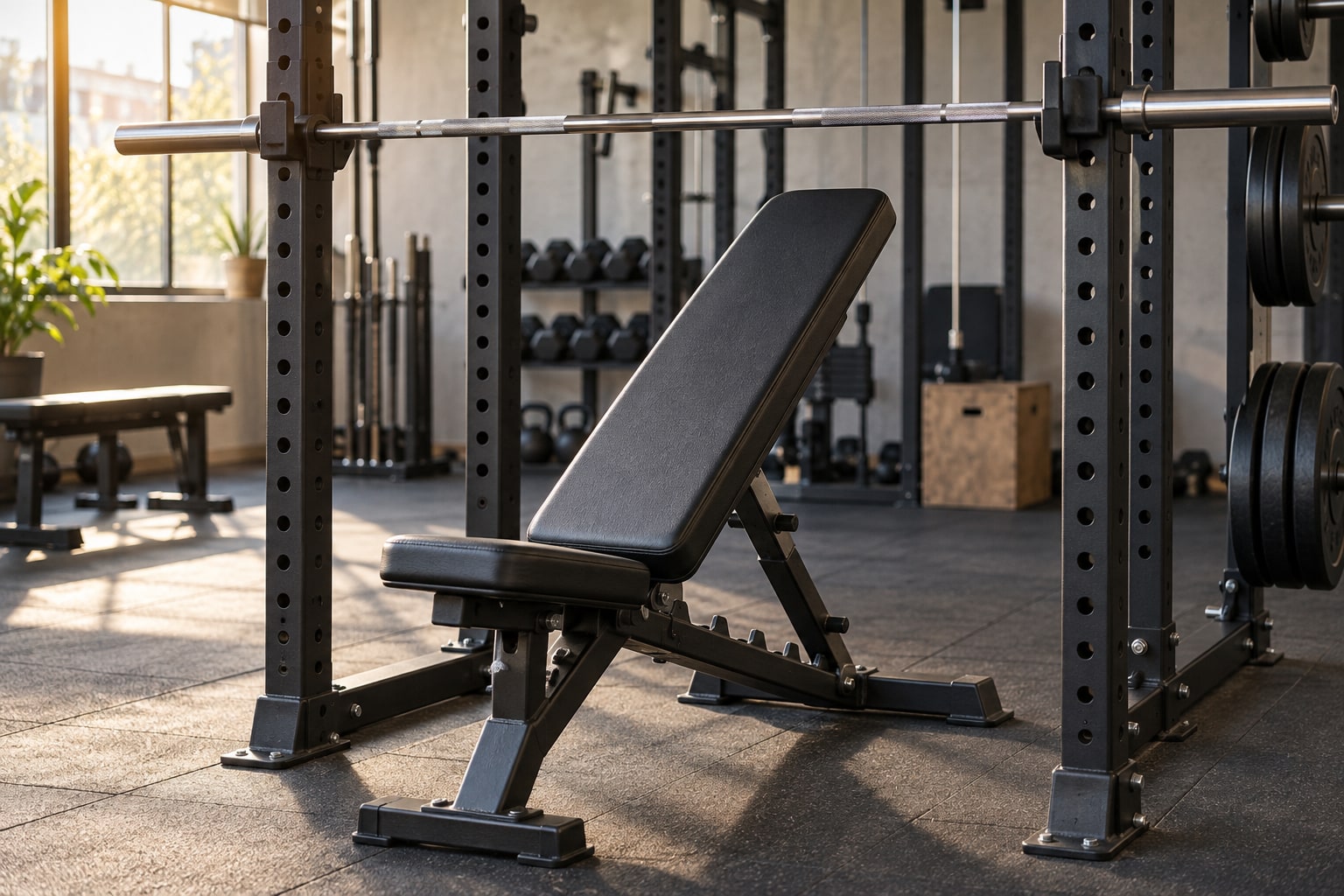
If you train alone, use an adjustable bench inside a power rack with the safety arms set just below your upper chest, and test the height with the empty bar: lower it to your chest, relax, and check that it rests on the arms and not on you. On an incline, don't try the flat-bench trick of rolling a stuck bar down over your stomach, because the bar sits high, close to your neck; lower it onto the safety arms, slide down the bench toward your feet, and step out. Put collars on both sides of the bar and warm up with lighter sets before your heavy ones. Without a spotter, stop each set two or three reps before failure. If a rep hurts your shoulder, elbow or wrist, stop the set and switch to a lighter or pain-free variation, such as dumbbells or a lower incline.
Bottom line
The incline barbell bench press is excellent for building muscle mass in the upper body. It works the chest, shoulders and triceps, with an emphasis on the upper chest. It has plenty of benefits, but its technique is not easy. If you are a beginner, you had better first learn the chest press without an incline.
And remember: do it with someone who watches over you, or with the safety arms set.
Frequently asked questions
What is the best angle for the incline bench press?
A range of 30-45 degrees; about 30 is a good start. In one barbell study, upper-chest activity was highest at 30 degrees, and steeper angles gave the front of the shoulders more of the work.
What muscles does it work?
Mainly your chest, with emphasis on the upper chest, plus the front of your shoulders and your triceps.
Is the incline press better than the flat bench press?
Neither is better for everything. The flat press lets you lift more and works the middle and lower chest most; the incline adds emphasis on the upper chest. In an 8-week study in untrained men, strength gains were similar with flat, incline or both. Many programs use both.
Where should the bar touch my chest?
On your upper chest, a few finger-widths below your collarbones, never on your neck.
Why can I lift less on the incline than on the flat bench?
The incline gives more of the work to your shoulders, which are smaller muscles, so most people lift less than on the flat press. Compare your incline weights only with your own earlier incline sessions.
Can I do it on a Smith machine?
Yes. It is a more guided version and a good option when you train alone with the safety stops set. It adds less balance work than the free bar.
Can I do the incline bench press alone?
Only with safety arms set in a power rack, or with a machine or dumbbells. A heavy bar on an incline is best pressed with a spotter or safety arms.
What if it hurts my shoulder?
Stop the set, lower the weight, and try a lower incline, a slightly narrower grip or dumbbells. If it still hurts, switch to a pain-free variation.
The information on this page and on this website is intended to provide general information only. The content on this website does not constitute a professional opinion, a recommendation, or a substitute for consulting an expert in a specific field or obtaining a medical opinion. It is not medical advice. BodyPlus is not a medical device. If you have a health condition or an injury, or are pregnant, talk to a qualified healthcare professional before starting. Stop exercising and seek appropriate help if you feel pain, dizziness or other concerning symptoms.
Sources
Accessed September 17, 2026.
- Rodríguez-Ridao D. et al., "Effect of Five Bench Inclinations on the Electromyographic Activity of the Pectoralis Major, Anterior Deltoid, and Triceps Brachii during the Bench Press Exercise", Int J Environ Res Public Health 2020;17(19):7339. pubmed.ncbi.nlm.nih.gov/33049982
- Chaves S.F.N. et al., "Effects of Horizontal and Incline Bench Press on Neuromuscular Adaptations in Untrained Young Men", Int J Exerc Sci 2020;13(6):859-872. pubmed.ncbi.nlm.nih.gov/32922646
- Pallarés J.G. et al., "Effects of range of motion on resistance training adaptations: A systematic review and meta-analysis", Scand J Med Sci Sports 2021;31(10):1866-1881. pubmed.ncbi.nlm.nih.gov/34170576
- Saeterbakken A.H. et al., "A comparison of muscle activity and 1-RM strength of three chest-press exercises with different stability requirements", J Sports Sci 2011;29(5):533-538. pubmed.ncbi.nlm.nih.gov/21225489
- Saeterbakken A.H. et al., "The Effect of Grip Width on Muscle Strength and Electromyographic Activity in Bench Press among Novice- and Resistance-Trained Men", Int J Environ Res Public Health 2021;18(12):6444. pubmed.ncbi.nlm.nih.gov/34198674