
How to Do the Lateral Raise: Form, Muscles Worked, Mistakes and Variations
In short
To do a dumbbell lateral raise, stand tall with a light dumbbell in each hand at your sides, palms facing in and elbows slightly bent. Lift your elbows out to the sides until your arms reach about shoulder height, pause for a second, then lower the weights slowly back to your sides. The exercise mainly works the side (lateral) part of your shoulder muscle, the part that gives your shoulders their width.
Even though the lateral raise is one of the most important movements in shoulder training, so many people still don't do it correctly. It is the movement that isolates the middle part of the shoulder best. In this article I explain why it matters, its benefits, how to do it correctly, and everything else you need to know about it, including sets, reps and a sample training log.
For a full shoulder workout with more exercises, see my guide to the best shoulder exercises.
Muscles worked: how your shoulders are built
To understand its importance in a training program, you need to understand how the shoulders are built. The shoulder muscle, the deltoid, is divided into three parts:
- Front (anterior) delt: at the front of the shoulder.
- Side (lateral) delt: on the outside of the shoulder.
- Rear (posterior) delt: at the back of the shoulder.
The fibers of the side delt sit between the front and rear parts, and all three parts attach to your upper arm bone (the humerus). The deltoid as a whole is the main muscle that lifts your arm out to the side, which is exactly the movement of this exercise.
| Muscle | Role in the exercise |
|---|---|
| Side delt | the main mover: lifts your arm out to the side |
| Front and rear delts | help, especially as your hand position changes |
| Upper trapezius (upper back, next to the neck) | supports the shoulder blade; takes over when you shrug or swing |
| Forearm and grip muscles, core | hold the dumbbells and keep your body still |
What research says about hand position: in one small study of 10 competitive bodybuilders, raises with the thumbs pointing forward at the top gave higher side-delt activity than the thumbs-up version, a version with the elbows bent to 90 degrees, and the front raise. The thumbs-down version ("pouring a jug") gave the highest activity in the rear delt and the upper trapezius. It measured muscle activity in one session, not growth, and activity alone does not reliably predict growth, so treat it as a hint for hand position, not proof.
Benefits of the lateral raise
It isolates the side delt
The side delt (the middle shoulder) is a somewhat problematic muscle, because it doesn't get much work in compound exercises. Even if you do a shoulder press, it often won't get enough stimulus to build serious muscle mass.
The lateral raise is the movement that isolates the side delt best. That is the reason this exercise belongs in every shoulder workout you do. It helps you train the middle shoulder for muscle growth in a very effective way.
It trains the muscle that gives your shoulders their width
Wide shoulders are one of the things that stand out most when you look at someone, even through a shirt. The side delt sits on the outside of the shoulder, so it plays a big part in how wide your upper body looks. The exercise is just as useful for women who want a strong upper body.
It helps improve imbalance between your sides
Another benefit of the lateral raise with dumbbells is that it helps create balance between the right and left sides of your body. In exercises with a barbell and some of the machines, the strong side takes more of the load, because to lift the weight it always tries to compensate for the weak side. When you work with dumbbells, each side gets an equal load.
How to do a lateral raise with good form
- Pick up two dumbbells and stand with your back straight and tall. Your arms hang at your sides with your palms facing in, toward your body. Keep your feet about hip-width apart and your knees soft.
- Bend your elbows slightly, so your arms are not completely straight. Keep that small bend for the whole set.
- Raise your elbows out to the sides until they reach shoulder height. Lead with your elbows, not your hands, and keep your hands roughly level with your elbows.
- When you reach the top, hold the weights for one second and feel the squeeze in the middle of your shoulders.
- Lower your arms slowly and under control back to your sides.
- Do 8-15 reps to finish the set.
- Breathe out as you lift and in as you lower, without holding your breath.
- After the last rep, lower the dumbbells to your sides and set them down by bending your knees, not by dropping them.
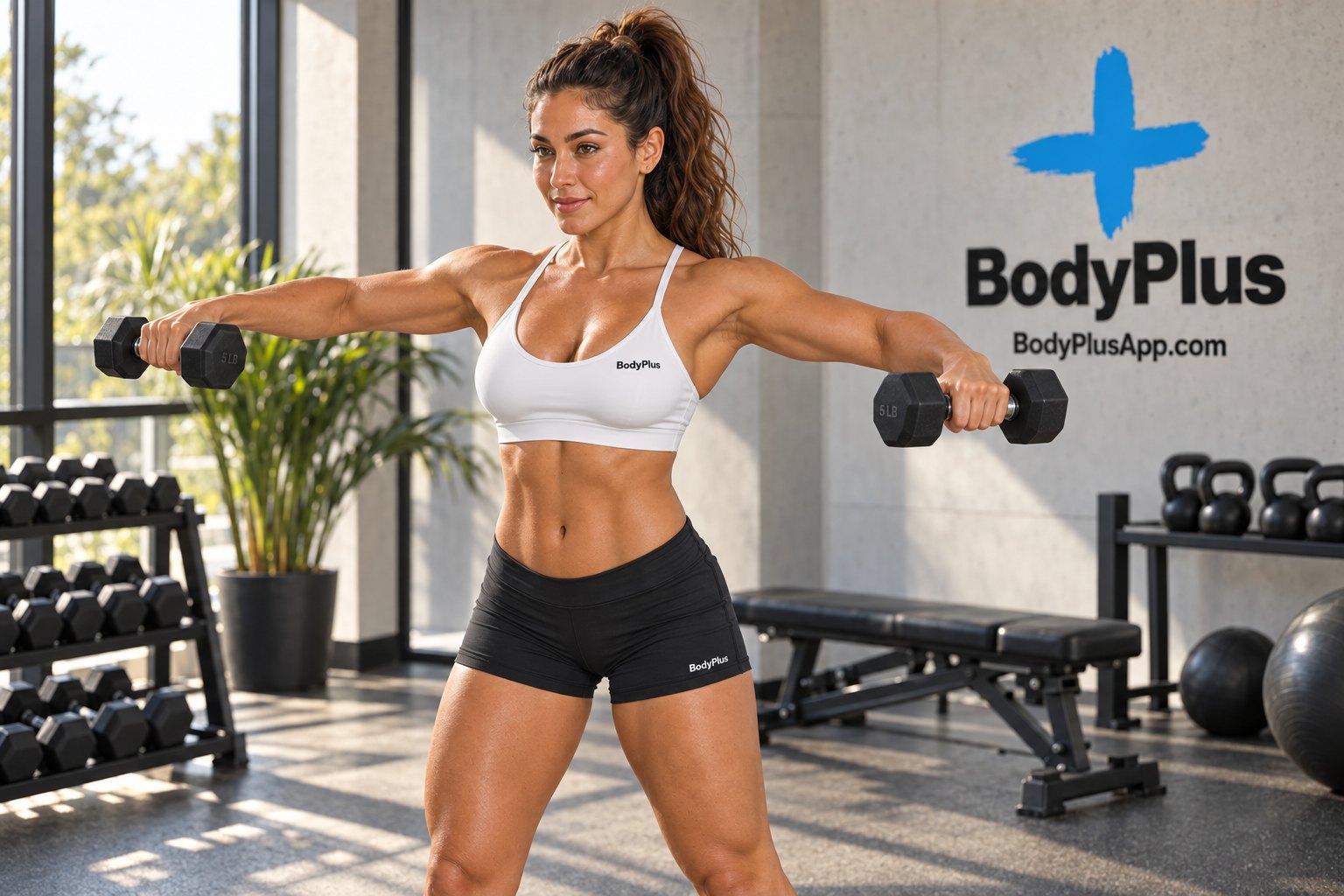
Hand position: at the top, your thumbs point roughly forward and your palms face the floor. Turning your thumbs down, as if pouring a jug, shifts more of the work to the rear delts and upper traps (see the research above), so avoid it as your default.
Common mistakes and how to fix them
1. Choosing a weight that is too heavy
This is the most common mistake with the dumbbell raise. A heavy weight makes it hard to focus the load on the middle of your shoulders.
This is not an exercise for heavy weights, and there are a few reasons for that. First, the side delt is a small muscle, so it is not that strong. Second, the angle of the movement doesn't allow you to lift a heavy weight.
Remember that the goal in bodybuilding is to stimulate the muscles as effectively as possible, not to lift as much weight as possible. To build muscle in the best way, you need to focus the load precisely on the muscle fibers. This mistake leads straight to the next one.
2. Using momentum (swinging)
This mistake comes straight from choosing a weight you can't control. Momentum usually shows up as swinging back and forth, or bending and straightening the knees.
Momentum takes load away from the side delt. That means the muscle fibers get less stimulus, so the muscle-building effect is weaker. On top of that, throwing the dumbbells out to the sides may cause you an injury.
For feeling your shoulders, choose a really light weight, 2-4 kg (about 4.5-9 lb), and do the exercise very slowly. Try to use your shoulder muscles and lead with your elbows to lift your arms out to the sides. After you practice this a few times, you will notice a big improvement in your technique with heavier weights.
3. Lowering the weight too fast
When you start the way down, don't let the weights drop. Try to control them all the way. The way down is half of the exercise, and it is easy to miss it, which can mean a weaker muscle-building stimulus.
Try to make the lowering last 2 seconds. This will increase the effectiveness of the exercise dramatically.
4. Shrugging your shoulders
If your shoulders creep up toward your ears as you lift, your upper traps take over part of the work. This usually happens when the weight is too heavy or when you raise your arms well above shoulder height. Keep your shoulders relaxed and down, stop at about shoulder height, and lower the weight if you can't stop the shrug.
Variations of the lateral raise
With resistance bands or straps
Many bodybuilders like to train with resistance bands and straps, for a few reasons:
- You can train anywhere. If you don't have the time or the option to go to a gym, training with bands is an excellent solution.
- You can choose the difficulty level. You can easily adjust it, either with an additional band or by simply stretching more.
- Variety in exercises. You can stand on the band with both feet, grip the handles and lift them to the sides. You can also anchor the band to the bottom part of a door and lift to the side, and more.
If you anchor a band in a door, use a proper door anchor on the hinge side, close the door fully, and check the band for tears before each workout.
Seated
This exercise is very similar to the classic variation, only here you do it seated. Sitting eliminates the use of momentum.
On a machine
You can do the lateral raise on a machine if you do your shoulder workout in a gym. Only gyms have this machine, so it cannot be done at home. The machine also helps reduce the use of momentum, although it is still possible. An excellent solution for adding variety to the training program. Set the seat so your shoulders line up with the machine's pivot points, and keep your back or chest against the pad your machine has.
With a cable (single arm)
Set a pulley at its lowest position, stand side-on to the machine, and hold the handle in the hand farther from it, so the cable crosses in front of your body. Raise your arm out to the side as in the dumbbell version. The cable keeps tension on your shoulder even at the bottom, where a dumbbell feels light. Do the same number of reps on each side.
| Variation | Equipment | Why choose it |
|---|---|---|
| Standing dumbbell | dumbbells | the classic; easy to set up anywhere |
| Seated | dumbbells, bench | less momentum |
| Band | resistance band | train at home; easy to adjust |
| Cable, single arm | cable machine | steady tension from the bottom |
| Machine | lateral raise machine | a guided path; less momentum; adds variety |
A large overview of reviews from the American College of Sports Medicine found that the type of equipment did not consistently change training results. So pick the versions you can do with good control and enjoy, and switch between them for variety.
Sets, reps and where it fits in your workout
- Reps: 8-15 per set, with a weight you control on every rep.
- Sets: 3-4, with about 60-90 seconds of rest.
- Effort: stop most sets when you could do only one to three more good reps.
- Order: after your main press in a shoulder or push workout.
- Weekly volume: the same review linked higher weekly volume (about 10 or more sets per muscle a week) with more muscle growth. Two shoulder sessions with about 5 sets of raises each (3 dumbbell plus 2 cable sets, as in the sample workout below) get you there for the side delts.
Sample shoulder workout
| Exercise | Sets | Reps | Rest |
|---|---|---|---|
| Seated dumbbell shoulder press | 3 | 6-10 | 2 min |
| Dumbbell lateral raise | 3 | 12-15 | 60-90 s |
| Cable lateral raise, single arm | 2 per side | 12-15 | 60 s |
| Reverse dumbbell fly | 3 | 12-15 | 60-90 s |
The push/pull/legs and upper/lower plans show where shoulder work fits in a full week.
How to track it and when to go heavier
| Session | Weight per dumbbell | Set 1 | Set 2 | Set 3 |
|---|---|---|---|---|
| Week 1 | 6 kg (about 13 lb) | 15 | 13 | 12 |
| Week 2 | 6 kg (about 13 lb) | 15 | 14 | 13 |
| Week 3 | 6 kg (about 13 lb) | 15 | 15 | 15 |
| Week 4 | 7 kg (about 15 lb) | 13 | 12 | 11 |
| Week 5 | 7 kg (about 15 lb) | 14 | 13 | 12 |
The rule: when all three sets reach 15 clean reps, move to the next pair of dumbbells. For this exercise, a small jump already feels big. If your gym jumps straight from 6 to 8 kg (about 13 to 17.5 lb), add reps, add a set, or slow the lowering first, or switch to a cable, where the steps are smaller.
Safety
Start light: a pair of 2-4 kg (about 4.5-9 lb) dumbbells is plenty for the first sessions, and one easy warm-up set before your working sets helps you find the movement. Keep the tempo controlled and lower the weights in about 2 seconds; if you need to swing to get them up, the weight is too heavy. Keep your shoulders relaxed and down, and stop at shoulder height. End the set when your form starts to break down, or right away if you feel a sharp pain in the shoulder, and switch to a lighter weight or a pain-free variation. When you finish, set the dumbbells down by bending your knees rather than dropping them.
Bottom line
In summary, the lateral raise is one of the shoulder exercises that you must include in your training. It is the most efficient way to focus on the side delt, the middle part of your shoulder. It trains the muscle that gives your shoulders their width, and it can even improve the weight you lift in the shoulder press.
Make sure you keep correct technique, so that you take full advantage of all the benefits the exercise offers: a light weight, a slight bend in the elbows, a raise to about shoulder height, and a slow way down.
Frequently asked questions
What muscles do lateral raises work?
Mainly the side delts, the middle part of your shoulder. The front and rear delts and the upper traps help, and your grip and core keep the weights and your body steady.
How high should I raise my arms?
To about shoulder height, so your arms are roughly parallel to the floor. Going much higher tends to bring in a shrug, which shifts work to your upper traps.
Should my elbows be straight or bent?
Slightly bent, and the bend stays the same for the whole set. In one small study, a raise with the elbows bent to 90 degrees gave less side-delt activity than the version with the arms nearly straight and the thumbs pointing forward.
What weight should I use?
Lighter than you think. Start with a weight you can lift 12-15 times with no swinging and a slow way down. To learn the movement, 2-4 kg (about 4.5-9 lb) is enough.
Why do I feel lateral raises in my traps or neck?
Usually because the weight is too heavy, you shrug, you lift above shoulder height, or your thumbs turn down. Lower the weight, keep your shoulders down, and stop at shoulder height.
Are cable lateral raises better than dumbbells?
Neither is better for everyone. The cable keeps tension at the bottom of the movement, and dumbbells are simple and work anywhere. Many people use both.
Can I do lateral raises at home?
Yes, with light dumbbells or a resistance band under your feet.
What if the exercise hurts my shoulder?
Stop the set. Then lower the weight, check that you are not shrugging or lifting above shoulder height, and try a shorter range. If it still hurts, switch to a lighter or pain-free variation, such as the seated version or a cable, and leave the painful one for another day.
The information on this page and on this website is intended to provide general information only. The content on this website does not constitute a professional opinion, a recommendation, or a substitute for consulting an expert in a specific field or obtaining a medical opinion. It is not medical advice. BodyPlus is not a medical device. If you have a health condition or an injury, or are pregnant, talk to a qualified healthcare professional before starting. Stop exercising and seek appropriate help if you feel pain, dizziness or other concerning symptoms.
Sources
Accessed September 17, 2026.
- Coratella G. et al., "An Electromyographic Analysis of Lateral Raise Variations and Frontal Raise in Competitive Bodybuilders", Int J Environ Res Public Health 2020;17(17):6015. pubmed.ncbi.nlm.nih.gov/32824894
- Vigotsky A.D. et al., "Longing for a Longitudinal Proxy: Acutely Measured Surface EMG Amplitude is not a Validated Predictor of Muscle Hypertrophy", Sports Med 2022;52(2):193-199. pubmed.ncbi.nlm.nih.gov/35006527
- Currier B.S. et al., ACSM Position Stand, "Resistance Training Prescription for Muscle Function, Hypertrophy, and Physical Performance in Healthy Adults: An Overview of Reviews", Med Sci Sports Exerc 2026;58(4):851-872. pubmed.ncbi.nlm.nih.gov/41843416
- OpenStax, Anatomy and Physiology 2e, "11.5 Muscles of the Pectoral Girdle and Upper Limbs" (the deltoid as the major abductor of the arm). openstax.org/books/anatomy-and-physiology-2e/pages/11-5-muscles-of-the-pectoral-girdle-and-upper-limbs