
How to Do a Plank: Correct Form, How Long to Hold It, and Variations
In short
To do a plank, rest on your forearms and toes, with your elbows directly under your shoulders. Keep your body in a straight line, look at the floor and breathe. End the hold when you can no longer keep that line.
It is rare to find someone who has never heard of the plank. It is one of the best-known exercises in fitness. The problem is that most people don't know how to get everything it offers. In this guide I will take you through its benefits, correct technique, common mistakes, variations and my tips. Let's start!
What is a plank?
A plank is a static exercise in which your core muscles work to stabilize your body. The goal is to hold the position as long as you can while keeping your body straight. It is one of the best exercises for strengthening your abs, the muscles around your pelvis and your back extensors.
There are a few important points to get right if you want to make the most of it. Before I explain the technique, let's look at the benefits of this excellent exercise.
Benefits of planks
Helps you train your abdominal muscles
When you plan an ab workout, I want you to work all four groups of abdominal muscles:
- Rectus abdominis: the outer muscle that forms the "six-pack".
- Transversus abdominis: the deepest ab muscle, which wraps around your midsection like a belt.
- Internal obliques: on the sides of your waist, under the external obliques.
- External obliques: on the sides of your waist, closest to the surface.
The beauty of the plank is that all four groups work together. Your glutes, back, shoulders and thighs help you hold the line too:
| Muscle | Its job |
|---|---|
| Glutes | keep your pelvis in line |
| Spinal erectors | hold your back in a neutral position |
| Shoulders and upper back | support you on your forearms |
| Front of the thighs (quadriceps) | keep your legs straight |
To build muscle, you need to train in a way that challenges it. The plank is one way to train your abs, especially when you choose a version that challenges you. You can combine it with other exercises from my best ab exercises guide.
In a 2021 case report by Park and colleagues, one middle-aged man did hard forearm planks five days a week for four weeks, in sessions of about 20 minutes, roughly half of it rest: his fitness test results improved, his total muscle mass went up (the study did not measure the abs on their own) and his body fat went down. That is one person with no comparison group, so it shows what happened to him, not what planks will do for everyone.
A plank does not pick where you lose fat. In a small 6-week trial by Vispute and colleagues with 24 untrained adults, the group that did crunch-type ab exercises five days a week, without changing their diet, improved their ab endurance but lost no more belly fat or waist size than the group that did nothing.
Strengthens the muscles that support your back
Some back discomfort can be related to posture or weak core muscles. Training your core gives those muscles more work to do, but I would not promise that a plank will prevent back pain.
In people who already have chronic low back pain, trunk-focused exercise helps: a 2023 review of 40 trials by Prat-Luri and colleagues found it improved pain and disability compared with no exercise, and slightly more than general exercise. That does not show that planks prevent back pain. In a 2025 study of 117 adults by Eimiller and colleagues, people with low back pain actually held the plank longer on average than people without it, so a long hold is not a sign of a healthy back. Those whose back-of-body endurance kept up with their front plank reported somewhat less disability, but the link was modest.
Suitable for all levels
The plank has many variations. Each one differs in difficulty and in how the work is shared among your muscles. You can start with an incline plank, progress to a weighted plank, or use a mountain climber to add an aerobic element. Later in the article, I have plenty of variations for your workout plan.
Helps build strong core muscles
There are not many exercises that emphasize your core as intensely as the plank. Whichever variation you choose, your abdominal muscles, the muscles around your pelvis and your back extensors all have to work.
You can do it anywhere
One of the huge benefits of this exercise is that you can do it anywhere, without special equipment: at work, at home, on a trip, or wherever else you can think of. Combine it with a few more bodyweight exercises and you have a full-body workout; my home workout exercises guide has ideas.
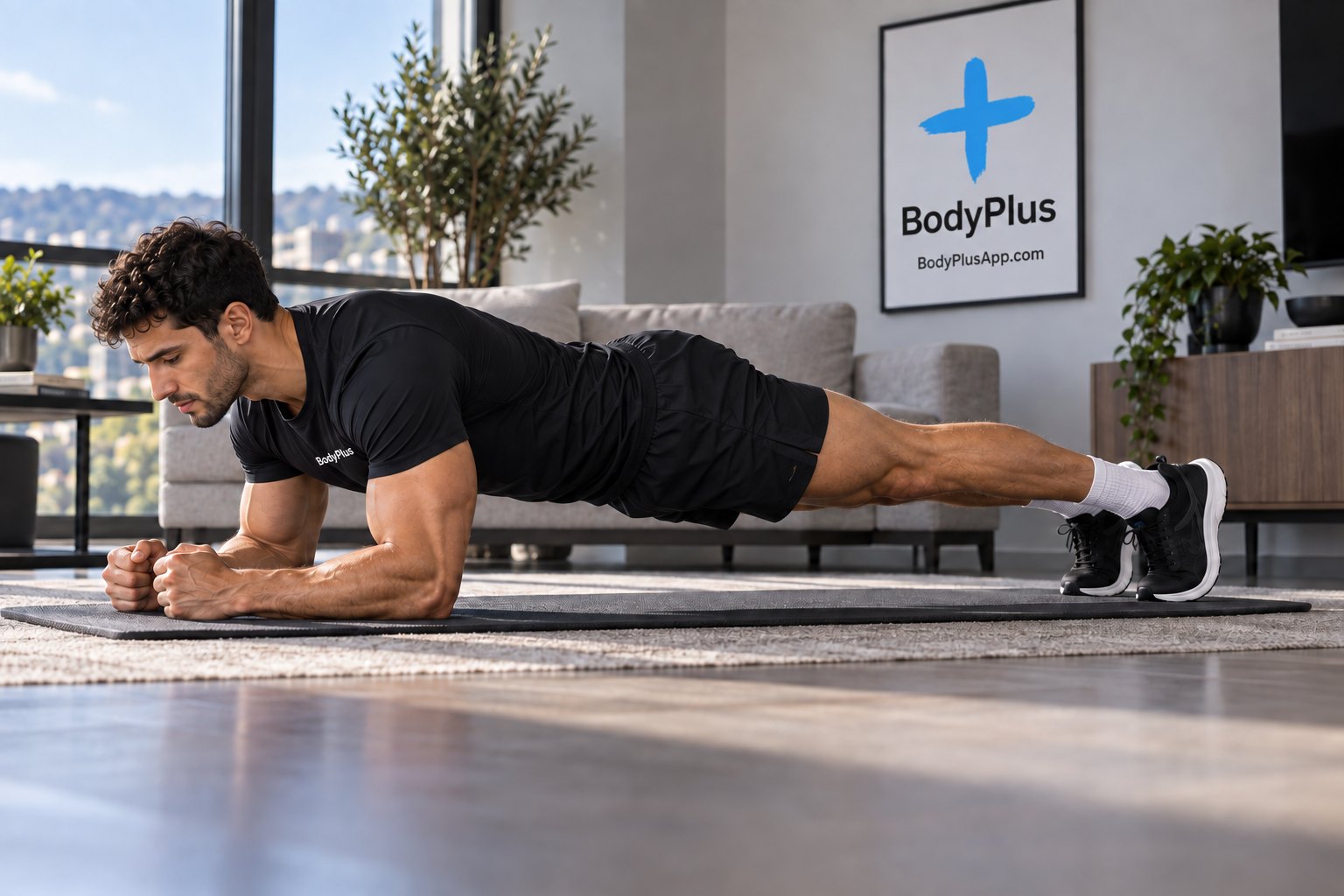
How to do a plank correctly
To do the plank well, follow these steps:
- Get down on the floor on your knees. Place your elbows directly under your shoulders.
- Stretch your legs back until your toes rest on the floor. Your weight is now on your forearms and feet.
- Hold the position as long as you can while keeping your body as straight as possible. Look at the floor and keep breathing.
Tighten your abs and glutes without letting your hips rise or drop. If you cannot keep a straight line yet, try the incline plank below.
Common mistakes
1. Holding it for too long
A lot of people think that the longer they hold it, the better. That isn't necessarily true, especially when the technique is poor and the muscles aren't doing their job.
If you can hold it for more than 1 to 2 minutes, check your technique every second and correct any drift. Fixing your technique will make the exercise much more intense. If you can hold a plank for a very long time, chances are your technique is off.
2. Looking up or down
Look at the floor during the exercise, and keep your neck in line with your spine. Don't lift your head and don't let it drop. Both hurt your stability and send a lot of load to your neck, which can make your neck hurt.
3. Letting your hips sag
When your arms and abs start to tire, your hips can drop toward the floor. That upsets the balance of the load on your core: a large part of it shifts to your lower back, which ends up doing work your abs should do.
Sagging hips usually have one of two causes: poor technique, or you simply can't continue.
- Technique: lift your hips slightly and squeeze your glutes, and keep your body as straight as you can. The moment you feel your hips start to drop, end the set. It is better to do more good sets than longer sets with poor technique.
- Fatigue: if it happens because you can't go on, stop and end the set. That is true for every exercise, not only the plank: when you can't keep good technique, end the set.
4. Raising your hips too high
Pushing your hips up is a great way to hold the plank longer, because it makes the position easier. But it is not the right way to train: it takes much of the work away from your abs, so you are mostly wasting your time. If you catch yourself piking, lower your hips back into the line.
Variations, from easy to hard
| Variation | Difficulty | Main difference |
|---|---|---|
| Plank on knees | easier | shorter lever |
| Incline plank | easier | elbows higher than your feet |
| Side plank | medium | more work for the obliques and side glutes |
| Mountain climber | medium | adds a cardio element |
| Decline plank | harder | feet higher than your elbows |
| TRX plank | harder | your feet must be stabilized |
| Hard (RKC-style) plank | harder | full-body tension, longer lever |
| Weighted plank | harder | extra load on your back |
Side plank
If you want to emphasize your obliques, this is an excellent exercise. Many people find it easier on the lower back and neck. It also helps you work on your stability and balance. In a 2007 lab study of 30 healthy adults by Ekstrom and colleagues, the side plank worked the external oblique and the gluteus medius (the side glute) hard enough to count as strengthening work, while the front plank on the elbows worked them less, closer to endurance and stability training. The study measured muscle activity in one session, not muscle growth.
How to do it:
- Lie on your left or right side with your legs straight.
- Place your bottom elbow directly under your shoulder and lean on your forearm.
- Stack your top foot on top of your bottom foot, then lift your hips so your body forms a straight line.
- You can raise your top arm toward the ceiling; it helps you keep your balance.
- Hold, then switch sides. Beginners can keep the bottom knee on the floor.
For a harder version that works the side of your hips more, lift your top leg (the side plank with leg raise in my hip dips exercises guide).
Incline plank
The incline plank is a great variation for beginners and for people with extra body weight. You do the plank with your elbows on a surface higher than your feet, so you support less of your weight. Your body will be at an angle, but it still has to stay in a straight line.
How to do it: take a gym bench, or anything stable that is higher than the floor, and place your elbows on it. Make sure your elbows are directly under your shoulders. Then straighten your legs back and hold.
Decline plank
This variation suits advanced trainees. Your elbows are lower than your feet, which increases the load on your body. Before you try it, make sure you have mastered the regular version. Also keep in mind that the decline puts more pressure on your shoulders, so if your shoulders are injured or sensitive, it is not for you; stay with the regular or incline plank.
How to do it: use a gym bench or another stable object that is higher than the floor. Place your elbows on the floor, directly under your shoulders. Then place your feet on the bench one at a time and hold.
TRX plank
This variation is also harder than the classic version. Your feet rest in the TRX straps (suspension straps), so they are not planted on the ground, and you have to stabilize them.
How to do it: adjust the straps so the foot cradles hang a little above the floor. Get into a regular plank position next to the straps, facing away from the anchor. Then carefully place your feet in the straps, one at a time, and hold. To finish, lower your knees to the floor before you take your feet out.
Hard (RKC-style) plank
You don't always need more time or more equipment to make it harder. You can create more tension instead. A version often called the RKC plank does this:
- Place your elbows a little further forward than your shoulders (a longer lever).
- Tuck your pelvis under slightly (a posterior pelvic tilt), as if you were pulling your belt buckle toward your chin.
- Squeeze your glutes, thighs and fists hard, and pull your elbows toward your toes without moving them.
- Hold for 10 to 20 seconds; keep breathing in short, controlled breaths, and don't hold your breath.
In a small 2014 lab study of 19 people by Schoenfeld and colleagues, a plank with the elbows further forward and the pelvis tucked produced clearly more activity in the upper rectus abdominis, the lower abdominal wall and the external oblique than the standard plank, and the longer lever seemed to matter more than the pelvic tilt. Each plank was held for 30 seconds, and the study measured muscle activity, not long-term growth.
Weighted plank
If the classic version feels easy, this variation is for you. You make it harder by adding weight on your back. There are two easy ways to do it:
- Put a weight in a backpack and wear it, with the backpack pulled tight against your back.
- Ask a training partner to place a weight plate on your upper back once you are in position, and to lift it off before you come down.
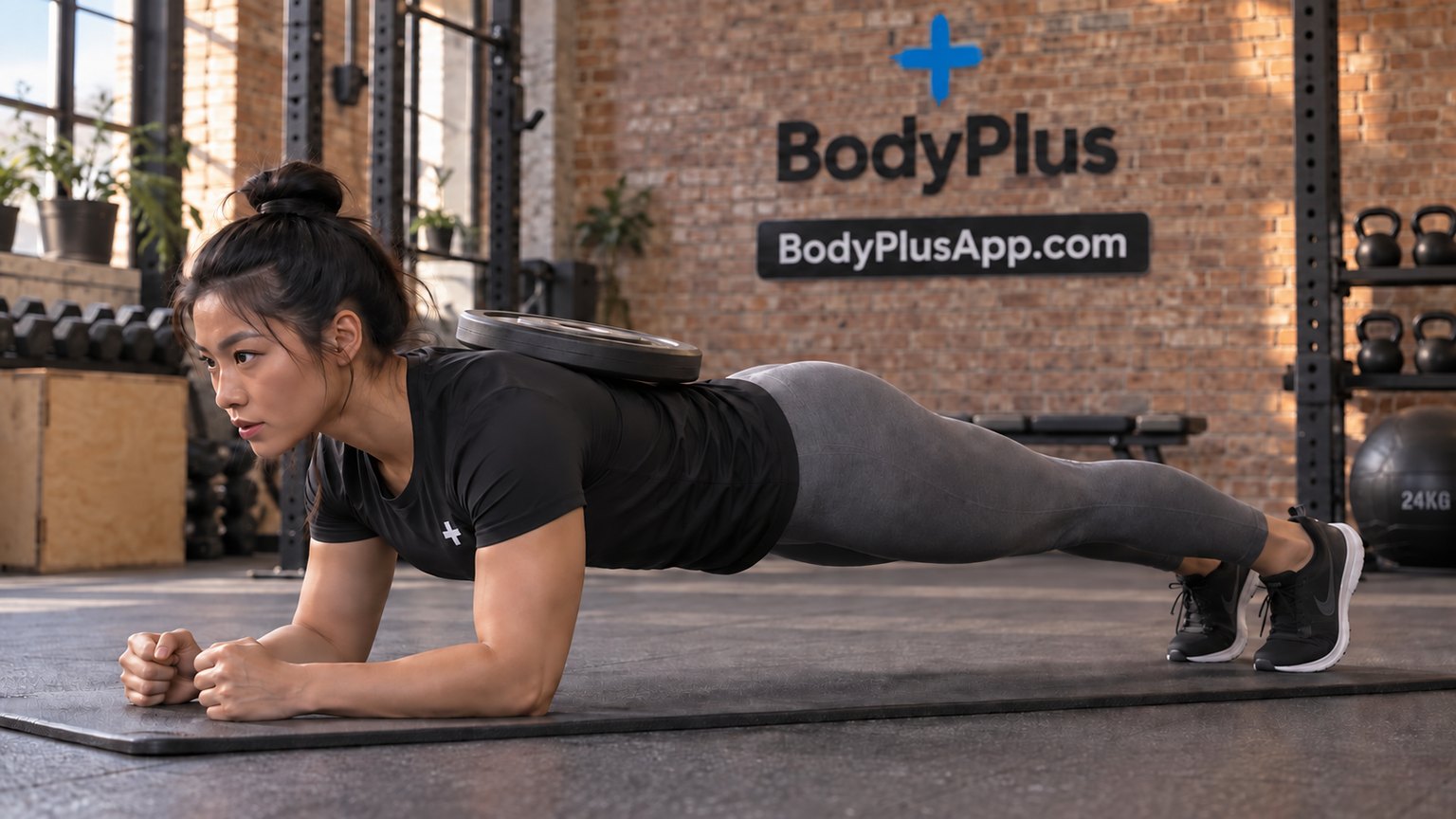
Keep the weight on your upper back, not on your lower back, keep your body in a straight line, and don't let the weight make your hips sag. Start light, for example 5 kg (about 11 lb), and add a little at a time.
Mountain climber
The mountain climber is for people who want to add a cardio element to their workout. It is named for the way your legs imitate climbing a mountain. It raises your heart rate, can help improve your cardiovascular fitness, and fits well into interval workouts. You can do it anywhere, too.
How to do it:
- Start in a push-up position (hands under your shoulders, arms straight).
- Pull your right knee toward your chest as far as you can.
- Return your right leg to the start, then do the same with your left leg, and keep alternating.
During this exercise you may catch yourself holding your breath. Make sure you keep breathing the whole time.
How to choose a variation
No single variation is the best. Each one works your muscles a little differently. Pick the one that:
1. challenges you, and 2. works what you want to improve.
Sets and a sample workout
I recommend doing planks on the day you train your abs (my best ab exercises guide has more ideas). A good hold is one you can finish with your body still straight. For most people, I recommend 30 to 60 seconds per set; when 60 seconds becomes easy, choose a harder variation.
| Your level | How long per set | Sets |
|---|---|---|
| Beginner (plank on knees or incline plank) | 20-30 seconds | 2-3 |
| Can hold a straight line for 30 seconds | 30-60 seconds | 3 |
| 60 seconds feels easy | 10-20 seconds of the hard (RKC-style) plank, or 30-45 seconds weighted | 3 |
Sample core finisher
| Exercise | Sets | Time | Rest |
|---|---|---|---|
| Plank (your level from the table above) | 3 | Use the time for your level above | 60 s |
| Side plank | 2 each side | 20-45 s | 45 s |
| Mountain climber | 2 | 20-30 s | 60 s |
How to track it
Write down your time and the variation for every set. Here is an example log (selected weeks):
| Week | Variation | Set 1 | Set 2 | Set 3 |
|---|---|---|---|---|
| 1 | Plank | 30 s | 25 s | 20 s |
| 2 | Plank | 35 s | 30 s | 25 s |
| 3 | Plank | 35 s | 30 s | 30 s |
| 5 | Plank | 45 s | 40 s | 35 s |
| 8 | Plank | 60 s | 60 s | 60 s |
| 9 | Hard (RKC-style) plank | 15 s | 12 s | 10 s |
The rule: when all three sets reach 60 clean seconds, move to a harder variation and start again at a shorter time. Progress is not the same every week (week 3 barely moved), and that is normal.
Safety
Keep breathing throughout the hold instead of holding your breath. Start with a time for which you can keep a straight line, even if that is only 20 seconds. End the set when your hips sag or you feel the work shifting into your lower back. If you have a shoulder, lower-back or pelvic injury, it is better to skip this exercise. If your shoulders complain without an injury, try an incline plank on a stable bench; if a straight-arm version bothers your wrists, use your forearms. Stop if something hurts, and skip planks for this session if an easier version still hurts.
Frequently asked questions
How much planking should you do per day?
My recommendation is to do planks on a day when you train your abs, for about 30 to 60 seconds per good-form set. If 60 seconds feels easy, try a harder variation instead of holding longer.
Does a plank give you defined abs?
Planks train your abdominal muscles, but no exercise can promise a particular look. The small Vispute trial above found that ab exercises alone did not reduce belly fat.
Which plank variation is best?
There is no single best variation. I would pick one that challenges you and works on what you want to improve.
Why does my lower back hurt when I plank?
Check whether your hips are sagging or your lower back is arching. Squeeze your glutes, shorten the hold, or try the incline version. If it still hurts, stop planking for this session.
Which is better, a plank on the elbows or on straight arms?
Both work your core. The elbow version is the classic plank; the straight-arm version is the start position for mountain climbers. Pick the one you can hold with good form.
Bottom line
Now that you know how to do a plank correctly, you can add it to your ab workout. Whatever your level, there is a variation you can try.
Just keep your technique. Don't be tempted to keep going endlessly with poor form. Remember: the goal is to work the muscles, not to hold the position for as long as possible.
The information on this page and on this website is intended to provide general information only. The content on this website does not constitute a professional opinion, a recommendation, or a substitute for consulting an expert in a specific field or obtaining a medical opinion. It is not medical advice. BodyPlus is not a medical device. If you have a health condition or an injury, or are pregnant, talk to a qualified healthcare professional before starting. Stop exercising and seek appropriate help if you feel pain, dizziness or other concerning symptoms.
Sources
Accessed September 29, 2026.
- Schoenfeld B.J. et al., "An electromyographic comparison of a modified version of the plank with a long lever and posterior tilt versus the traditional plank exercise", Sports Biomech 2014;13(3):296-306. pubmed.ncbi.nlm.nih.gov/25325773
- Ekstrom R.A. et al., "Electromyographic analysis of core trunk, hip, and thigh muscles during 9 rehabilitation exercises", J Orthop Sports Phys Ther 2007;37(12):754-762. pubmed.ncbi.nlm.nih.gov/18560185
- Eimiller K. et al., "The Core of the Issue: Plank Performance and Pain in the Lower Back", J Clin Med 2025;14(11):3926. pubmed.ncbi.nlm.nih.gov/40507688
- Prat-Luri A. et al., "Effect of Trunk-Focused Exercises on Pain, Disability, Quality of Life, and Trunk Physical Fitness in Low Back Pain and How Potential Effect Modifiers Modulate Their Effects: A Systematic Review With Meta-analyses", J Orthop Sports Phys Ther 2023;53(2):64-93. pubmed.ncbi.nlm.nih.gov/36645193
- Vispute S.S. et al., "The effect of abdominal exercise on abdominal fat", J Strength Cond Res 2011;25(9):2559-2564. pubmed.ncbi.nlm.nih.gov/21804427
- Park S.K. et al., "Effects of High Intensity Plank Exercise on Physical Fitness and Immunocyte Function in a Middle-Aged Man: A Case Report", Medicina (Kaunas) 2021;57(8):845. pubmed.ncbi.nlm.nih.gov/34441051