
How to Deadlift: Form, Muscles Worked, Grips and Belts
In short
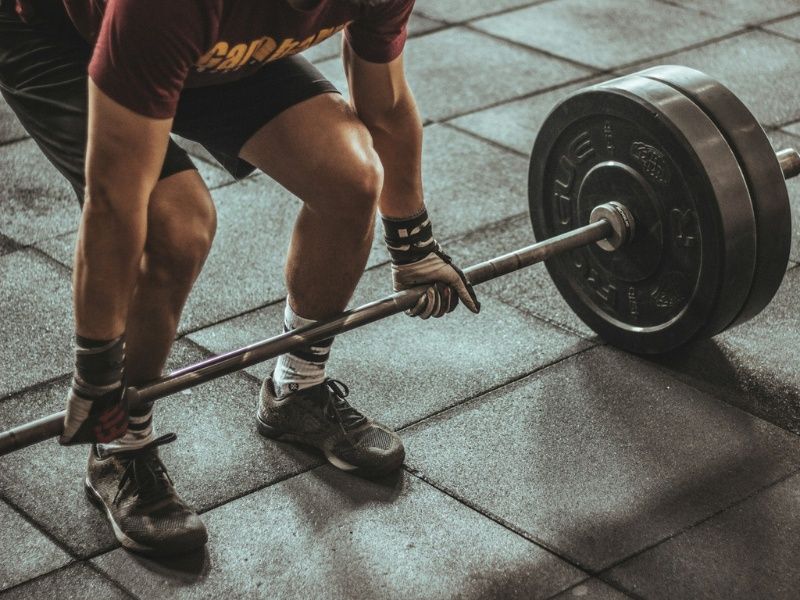
To deadlift, stand with the bar over the middle of your feet, push your hips back and bend your knees until you can grip the bar just outside your legs, with your back long and your shins close to the bar. Brace your core, then stand up by driving through your feet and extending your hips, keeping the bar close to your legs. Finish standing tall without leaning back, and lower the bar the same way, under control. The lift works most of your body, above all your glutes, thighs and back.
The deadlift is weightlifting in its purest form: you simply lift a heavy weight off the floor. It is an old-school classic that works muscles all over your body and can build a lot of strength and muscle. This guide covers everything you need to know about it: the benefits, the technique, common mistakes, variations and tips. So let's start!
This page goes deep into one lift. For complete workouts, see my guides to the best back exercises and the best leg exercises.
What is a deadlift?
The deadlift is one of the three core exercises in every training program that focuses on strength, together with the squat and the bench press. It is also one of the three lifts in powerlifting competitions.
True, the movement sounds basic and simple: "lift a bar from the floor". But that is a huge mistake. You can't just bend over and lift the bar with the weight. You need to know how to do the exercise with perfect technique before you start working with heavy weights. Start with light weights and high repetitions in order to practice the technique.
Muscles worked
The main muscles that work in the deadlift are the trapezius, latissimus dorsi, glutes, hamstrings, quadriceps, erector spinae, forearms, abdomen and more. Besides all these, there are countless other muscles that support or stabilize your body during the movement. The deadlift helps a lot in balancing and developing muscles that are sometimes neglected.
| Muscle | Role in the lift |
|---|---|
| Gluteus maximus (the big glute muscle) | a main mover: extends your hips as you stand up |
| Quadriceps (front of the thigh) | a main mover off the floor: straighten your knees |
| Hamstrings (back of the thigh) | help extend your hips, especially in the top half |
| Adductor magnus (inner thigh) | helps extend your hips |
| Spinal erectors (muscles along your spine) | hold your back flat under the load |
| Lats (sides of the back) | keep the bar close to your body |
| Traps and rhomboids (upper back) | hold your shoulders in place under the bar |
| Forearms, upper arms and grip | hold the bar without moving (isometric work) |
| Abs and core | brace your trunk |
| Calves | help push the floor away and keep you steady |
The muscle names and their basic actions follow a standard anatomy textbook (OpenStax); the roles in this lift are coaching descriptions.
What research says: in one study, 13 college football players did conventional and sumo pulls with a weight they could lift about 12 times (a 12-rep max), while sensors measured the activity of 16 muscles. Both styles used a wide range of leg, hip and back muscles. The wide-stance sumo style showed more activity in two of the quad muscles, and the conventional style more in the calf. That study measured muscle activity, not growth.
Benefits: why it is worth learning
It builds muscle and strength in almost every muscle of the body
The deadlift is an exceptional exercise. The movement works almost all the muscles we have, whether as main movers or as stabilizers. It is impossible to list all of them, but broadly they are the muscles of the back, the legs, the core, the upper arms and the forearms. All of them work toward one shared goal: getting the weight off the floor.
That joint work can help you build a balanced, strong body with a lot of muscle.
It helps build a lower back that is more resistant to pain
Lower back pain is a super common problem in every part of the population. One of the most common reasons is weakness of the core and lower back muscles. When these muscles are strong, they take part of the load that is placed on your spine and pelvis, which may help ease the strain on them.
Some research has tested the deadlift for people with back pain. In a trial of 70 adults with recurring low back pain of a mechanical type, one group did 8 weeks of supervised deadlift training and the other did individually chosen low-load exercises for movement control; both groups also got education about pain. Pain went down and strength went up in both groups, with no difference in pain between them. The low-load group improved more on a patient-rated activity scale and on movement control tests.
That is one trial in a specific group of patients, with supervision, so the deadlift is a strength exercise and not a treatment on its own. It is important to keep correct technique: during the movement your spine should stay in a neutral position, so the vertebrae of your spine don't take a lot of extra load.
It briefly raises anabolic hormones
The deadlift recruits a huge number of muscles for one goal, lifting the bar. This joint work releases anabolic hormones, such as testosterone and growth hormone, for a short time after a heavy set, but that short rise is not what builds muscle; the work your muscles do is.
The deadlift is not for everyone!
You need to understand that the deadlift loads your nervous system in an exceptional way. After a heavy set you will probably feel completely drained of energy, and the rest of your workout will likely suffer.
Beyond that, the risk-benefit ratio of the deadlift is not always worthwhile. The reason is simple: it is an exercise that draws trainees to try to lift weights beyond their real ability. The problem is that the load is spread out and a rounding back is not always visible in the mirror, so many people don't even notice that they are losing their technique. And that is exactly where injuries begin.
If you are focused purely on bodybuilding, I recommend other variations, such as the stiff-leg deadlift or the Romanian deadlift, for all the reasons above.
How to deadlift correctly
The pull is decided before the bar leaves the floor, so start with the setup and take the same steps every rep.
Setup
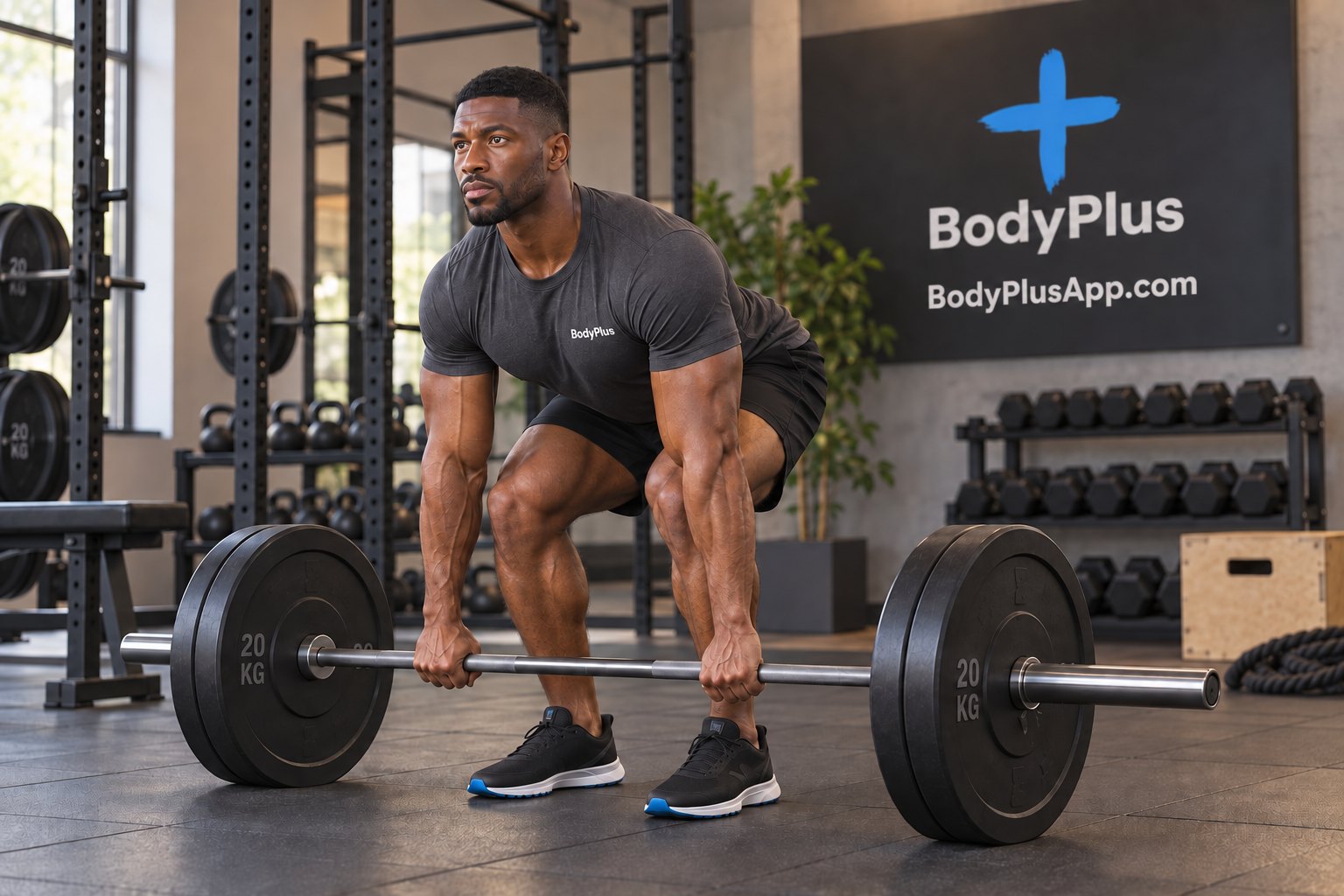
- Feet: position the bar over the middle of your shoe, over the laces, with your feet about shoulder-width apart. When you lift, the bar moves close to your shins and may even scrape them.
- Grip: reach down and grab the bar at shoulder width, just outside your knees, so your arms don't rub your legs on the way up.
- Hips and back: push your hips back until your lower back is almost parallel to the floor, and bend your knees until you can reach the bar. Keep your back long and flat from your head to your tailbone.
- Arms and lats: keep your arms straight, pull the slack out of the bar (you will hear the plates click against the bar) and tighten your lats, as if you want to squeeze your armpits shut.
The pull
- Breathe with the effort. (For heavy pulls, see the bracing and breathing section below.)
- Lift the bar by pushing your legs upward from the knees. The start of the lift should come from the quadriceps, the front of your thighs. Tip: try to think that you are pushing the floor away with your legs.
- Be careful not to raise your hips first, so that your body tips forward and your back rounds.
- Don't try to lift the bar with your hands. Your arms stay straight under the load, holding the bar while your legs push up.
- Keep the bar close: it travels along your shins in a nearly straight line over the middle of your feet. If it swings forward, your lower back has to work much harder.
Lockout
Come all the way up to a full standing position, with the bar almost touching your thighs and resting around hip height. Pull your shoulders back as far as you can without leaning backward.
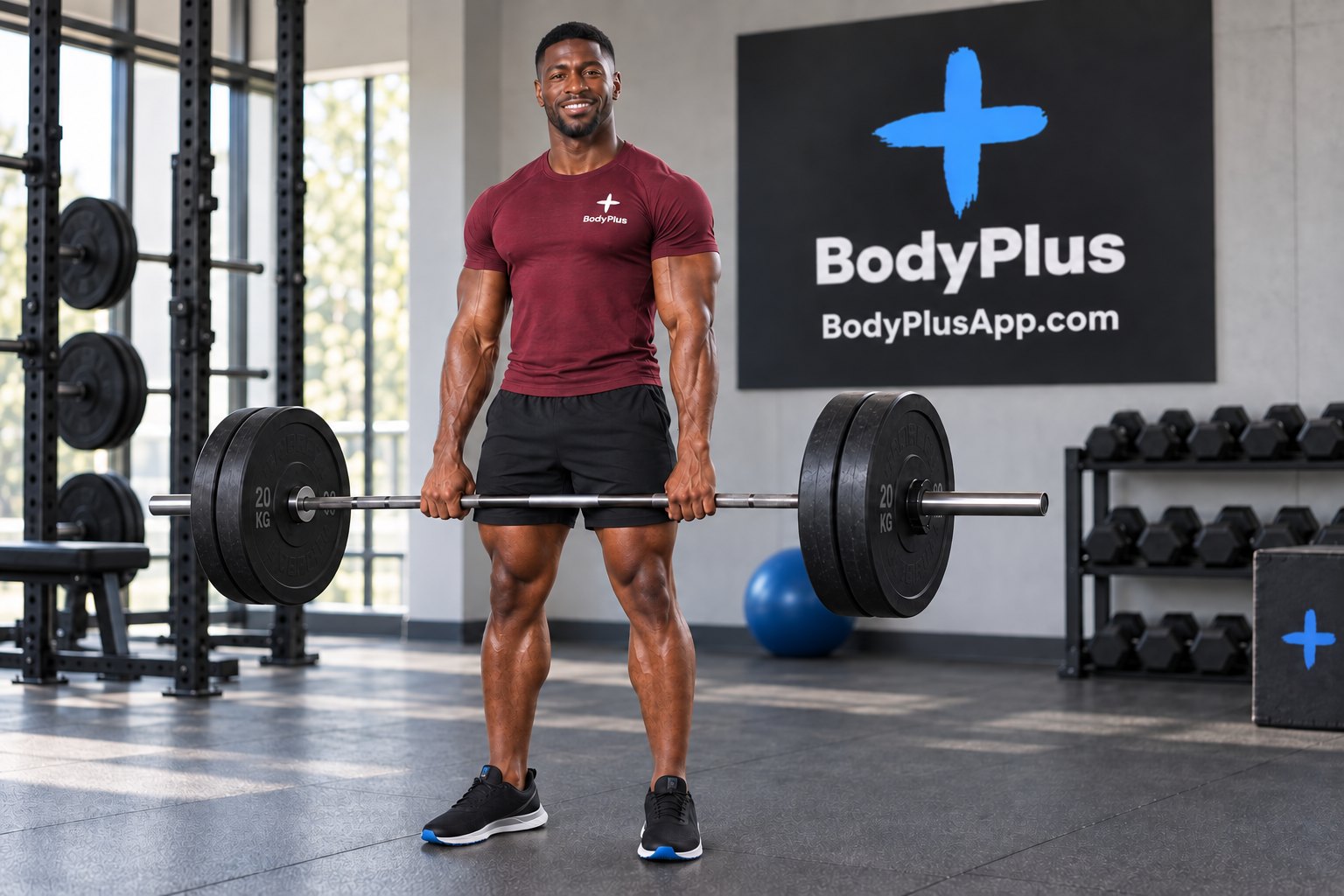
- Finish with your glutes, not your lower back: once the bar passes your knees, drive your hips forward, squeeze your glutes and stand tall.
- Your knees and hips straighten at the same time, and your body forms a straight line.
- Don't lean back past upright and don't shrug the bar up. Leaning back adds nothing for your muscles and puts extra load on your lower back.
Lowering the bar
Lower the bar to the floor in the reverse movement, to keep your back straight:
- Push your hips back first and let the bar slide down your thighs.
- Once the bar passes your knees, bend your knees and let it travel down along your shins to the floor.
- Lower it under control, but you don't need to lower it slowly. The way up is where the main work happens.
- Put the bar down on the floor before the next rep and set up again. A short reset between reps (breath, brace, pull the slack out) is a good habit for beginners; don't bounce the bar off the floor.
- Don't drop the bar from the top unless you use bumper plates and your gym allows it.
Bracing and breathing
My cue is to breathe with the effort: breathe out steadily as you come up. On a hard pull, many lifters brace and hold their breath instead:
- Before each rep, take a big breath into your belly (not up into your chest), then tighten your abs as if you are about to be poked in the stomach.
- Hold that breath and the tension through the hardest part of the lift, off the floor and past your knees.
- Breathe out at the top or once the bar is back on the floor, then take a new breath before the next rep.
Hold your breath for one rep at a time only, and never carry it from one rep to the next.
Grips and lifting straps
Your grip is often the first thing to fail on heavy pulls. There are four common ways to hold the bar:
| Grip | How | Good for | Watch out for |
|---|---|---|---|
| Double overhand | both palms face you | warm-ups and most training sets; builds grip | the bar may roll out of your hands on heavy sets |
| Mixed (alternate) grip | one palm faces you, the other faces away | heavy sets, the bar can't roll | uneven load; the arm with the palm facing forward is exposed to a rare biceps injury |
| Hook grip | overhand, with your thumb wrapped under your fingers | heavy sets with even arms | uncomfortable on the thumbs at first |
| Straps | a strap wraps the bar and your wrist | when your grip gives out before your legs and back | they don't train your grip |
What research says about grips: in one study, 29 trained men and women pulled 50%, 70% and 90% of their one-rep max with a double overhand, mixed and hook grip. The mixed grip used the least forearm muscle activity and was rated the easiest grip at every load. The authors suggest the double overhand or hook grip if you also want to build your grip.
A mixed grip has one known drawback. In a review of 35 biceps tendon ruptures filmed during powerlifting and posted on YouTube, 25 happened during the deadlift. In 24 of those, the lifter used a mixed grip, and every tear was in the arm whose palm faced forward. That is a set of video cases, not a controlled study, and these injuries are rare. In those videos the elbows were already straight, so a straight arm alone does not remove the risk; the authors suggest that holding the bar with both palms facing you (double overhand, a hook grip or straps) may lower it. If you still use a mixed grip:
- keep both arms straight and never bend the arm with the forward-facing palm to pull the bar, as a basic rule, not a guarantee;
- switch which hand faces forward from set to set;
- save it for your heaviest sets and use double overhand, a hook grip or straps for the rest.
Lifting straps: many lifters who train seriously use them on their heaviest pulls, and at really heavy weights many find it very hard to go without them. In one study, 16 young men did 4 sets of 4 reps at 80% of their max, with and without straps (the weight was based on their max without straps). With the same weights, straps let them move the bar faster, their grip tired less, they felt their grip was more secure, and the work felt easier. That was one short study in young men, but it matches what many lifters feel. Do your warm-up sets without straps so your grip still gets trained. Keep your upper back tight at the top when you use them.
Lifting belts: do you need one?
A lifting belt is not a must, especially while you learn. Here is what the evidence says:
- In a small study of 6 people squatting at 90% of their max, a belt raised the pressure inside the abdomen and reduced the activity of the lower back muscles. The authors concluded that a belt can help support the trunk. That study used squats, not deadlifts.
- In an observational study of 20 male recreational lifters, wearing a belt, straps or both made the lift feel easier, and a belt and straps together made the pull a little faster. No combination changed the curve of the lower back, but straps alone rounded the upper back a little more at the top than a belt alone.
None of these studies shows that a belt prevents injuries. If you use one:
- learn to brace without a belt first; the belt gives your abs something to push against, it doesn't brace for you;
- wear it tight but not so tight that you can't take a full breath;
- use it for your heaviest sets, not for warm-ups;
- a belt never makes up for poor technique or a weight you can't handle.
Common deadlift mistakes
Too much weight
Lifting too heavy a weight is one of the most dangerous mistakes you can make in the deadlift. Too heavy a weight will cause cheating in the technique, which may lead to too great a load on the various joints or on the spine. If a great load is placed on your joints in an unstable position, the chance of injury will be huge.
Fix: practice the technique with a light weight until you master it. You can ask an experienced coach to check whether your technique is correct. Just be careful: there are a lot of trainers who do the technique incorrectly themselves. Tip: you can film yourself and check the technique in the video.
Bending the back
Bending the back may cause especially high pressure on the vertebrae of the spine, and that pressure may lead to injury. Usually the mistake is caused by too heavy a weight.
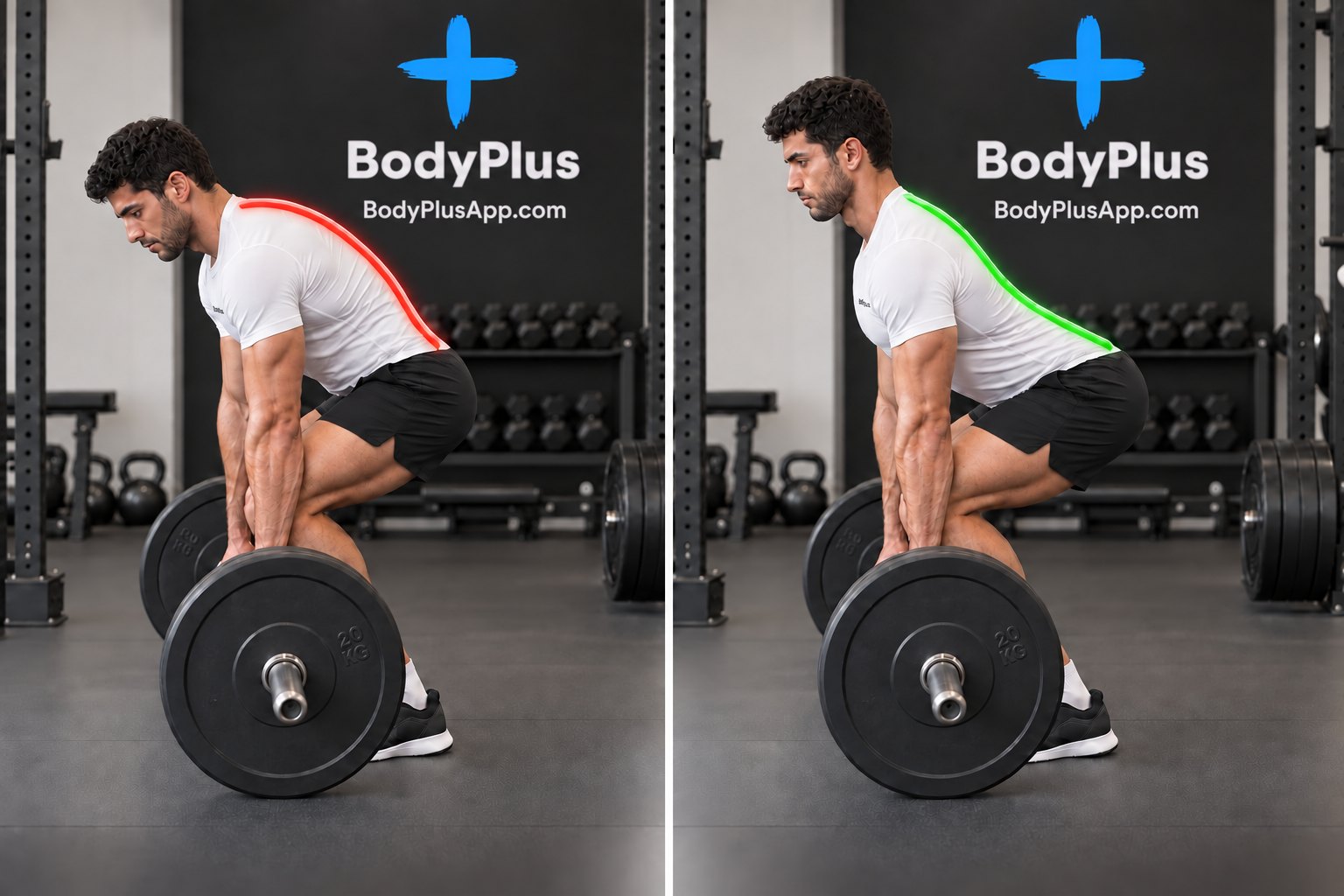
Fix: choose the weight wisely, brace before every rep, and keep a straight and stable back throughout the whole movement. If your back rounds, the set is over.
The hips rise too fast
If your hips rise right at the start of the movement, you reduce your ability to recruit the quadriceps for the exercise. This mistake makes you lose a lot of strength, because the quadriceps is a muscle that can produce amazing power.
It can also happen when the quadriceps is weak relative to your other muscles; that weakness keeps you from starting the movement properly.
Fix: lower the weight and practice the technique. Think "push the floor away" and let your chest and hips rise together. This improves your movement and also strengthens your quadriceps.
Standing far from the bar
If you are too far from the bar, there is a high chance that you will round your back. The bar should be 1-2 centimeters (under an inch) from your shins. The bar may scrape your shins, but that is a matter of practice.
Fix: set the bar over your shoelaces before you bend down, and don't roll it toward you after you grip it. Long socks or track pants protect your shins.
Deadlift variations
There are several popular variations of the lift. Here is how the main ones compare:
| Conventional | Sumo | Romanian (RDL) | |
|---|---|---|---|
| Stance | about shoulder-width, hands outside the legs | very wide, hands inside the legs | about hip-width |
| Starts from | the floor | the floor | the top (standing) |
| Knees | bend and straighten a lot | bend a lot, pushed out | slightly bent, fixed |
| More emphasis on | back, glutes, hamstrings | quads, glutes, inner thighs | hamstrings, glutes |
| Best for | overall strength | lifters who find the wide stance stronger or more comfortable | building muscle on the back of the thighs |
Romanian deadlift
The Romanian deadlift is a variation where you don't lower the weight to the floor. On each rep, you lower the bar to about shin height and then come back up.
The goal is to give your muscles a constant load, make the technique easier to learn and lower the working weights. Not everyone wants to take the risk of lifting heavy weights, and the Romanian deadlift is an excellent solution for bodybuilding. My Romanian deadlift guide explains it step by step.
What research says: in one study, 21 men did both lifts with the same weight. The conventional lift showed more activity in the front of the thigh (rectus femoris) and somewhat more in the glutes, which fits its bigger knee bend. That was a measure of muscle activity, not growth.
Sumo deadlift
The sumo deadlift is performed with a very wide stance, similar to the way sumo wrestlers stand before a match. This variation reduces part of the load from your lower back and spine, and increases the load on your leg and glute muscles.
What research says: a study of 57 powerlifters at a national championship estimated the loads on the lower spine with a body model. The sumo style showed about 10% less bending load (joint moment) and 8% less shear force at the lower spine than the conventional style. Those were calculated loads, not injury results, and neither style is "safer" for everyone.
Stiff-leg deadlift
In the stiff-leg deadlift, you lower your upper body toward the floor while your legs stay almost straight through the whole movement. To do it well you need to be very flexible. This movement neutralizes the quadriceps and shifts the load to your glutes, hamstrings and back.
What research says: in a study of 10 competitive bodybuilders, the stiff-leg version showed more activity in the glutes than the Romanian deadlift, while the Romanian version showed more activity in one of the inner hamstrings.
Beginners will usually not manage this exercise. The problem with the stiff-leg deadlift is that its technique is hard and you need to be very flexible. Beginners don't yet know the principles of training with a barbell.
Romanian deadlift with dumbbells
Yes, the exercise can also be done with dumbbells. If you train at home and only have dumbbells, this can be a good option for you. It works the same muscles as the classic variation. The technique is similar to the regular Romanian deadlift; you just replace the bar with dumbbells.
How to learn the deadlift
I recommend that beginners first learn the technique of the Romanian deadlift, and only afterward the classic version. The Romanian deadlift is relatively easy to learn, and it teaches you to push your hips back with a flat back, which is the core of the lift.
A simple order that works for many people:
- Practice the hip hinge with no weight: push your hips back until they touch a wall behind you, with your back flat.
- Learn the Romanian deadlift with dumbbells or a light bar.
- Pull a light bar from blocks at about knee height.
- Pull a light bar from the floor, with a full reset on every rep.
Sets, reps and where it fits in your workout
- Learning: 3-4 sets of 5-8 reps with a light weight, stopping well before your technique changes.
- Strength: 3-5 sets of 3-6 reps, with 2-4 minutes of rest.
- Muscle building: 2-4 sets of 6-10 reps, with 2-3 minutes of rest. Very high reps are not a good fit for this lift, because your technique tends to fade before your muscles tire.
- Effort: stop most sets when you could still do two or three more good reps.
- How often: once a week is plenty for most people; twice at most, with a lighter second session. Heavy pulls are very tiring.
- Order: early in the workout, after a warm-up, when you are fresh.
- Weekly volume: for muscle growth, a large review by the American College of Sports Medicine linked about 10 or more hard sets a week per muscle group with more growth. Deadlift sets count toward your glutes and back, alongside your other exercises.
Sample lower-body workout
| Exercise | Sets | Reps | Rest |
|---|---|---|---|
| Deadlift | 3 | 5 | 3 min |
| Bulgarian split squat | 3 | 8-10 each leg | 90 s |
| Leg press | 2 | 10-12 | 2 min |
| Leg curl | 2 | 10-15 | 60-90 s |
| Plank | 3 | 30-45 s | 60 s |
How to track it and when to go heavier
One pulling session a week, 3 sets of 5, with the total weight including the bar. The rule: when you finish all three sets of 5 with a flat back and no grinding, add 5 kg (about 10 lb) next week. When you miss a rep, keep the weight until you get all 15 reps. When progress stalls for three weeks, add smaller steps of 2.5 kg (about 5 lb).
| Week | Weight | Set 1 | Set 2 | Set 3 | Note |
|---|---|---|---|---|---|
| 1 | 60 kg (about 130 lb) | 5 | 5 | 5 | an easy weight for this lifter, practicing the setup |
| 2 | 65 kg (about 145 lb) | 5 | 5 | 5 | |
| 3 | 70 kg (about 155 lb) | 5 | 5 | 5 | |
| 4 | 75 kg (about 165 lb) | 5 | 5 | 4 | back started to round on the last rep, set ended |
| 5 | 75 kg (about 165 lb) | 5 | 5 | 5 | |
| 6 | 80 kg (about 175 lb) | 5 | 5 | 5 | straps on the last set |
| 7 | 85 kg (about 185 lb) | 5 | 4 | 4 | |
| 8 | 85 kg (about 185 lb) | 5 | 5 | 4 |
Beginners often add weight quickly for the first weeks, and then progress slows down. That is normal. Write down the grip you used and any rep where your form slipped. If you want to estimate your strength without testing a true max, the one rep max calculator can help.
Safety
- Warm up: do a few light sets, starting with the empty bar, and add weight gradually up to your working weight.
- Set up your space: pull from a flat, non-slip floor with enough room around you, and use collars so the plates can't slide.
- Raise the bar if you need to: if you can't reach the bar with a flat back, start from blocks under the plates or from the pins of a rack set just below knee height, and lower the height over time.
- A failed rep: don't grind on. If the bar doesn't move or your back starts to round, set it back down in front of you; if it stalls halfway, lower it under control instead of dropping it onto your feet.
- Stop for pain: end the set if you feel sharp pain, pain in your lower back or dizziness, and switch to a lighter or pain-free variation.
- Soreness: muscle soreness the next day is normal.
Bottom line
There is no doubt that the deadlift is an exercise with tremendous benefits, and it can help you build a lot of muscle across your whole body. It suits almost everyone; it's just worth mastering the technique first. I recommend that beginners first learn the technique of the Romanian deadlift, and only afterward the classic variation.
Some people avoid the deadlift entirely on the claim that it is dangerous, but that is a mistake. True, it has risks, but as long as you master the technique and work with reasonable weights, the risk of injury is relatively low.
It's better to have an experienced coach teach you the technique. Just make sure they really know it, because there are a lot of certified trainers who don't.
Frequently asked questions
Is the deadlift a back or a leg exercise?
Both. Your legs and hips do most of the lifting, and your back holds the load. That is why it leads my back guide, and its variations appear in my leg guide.
What is the difference between the deadlift and the Romanian deadlift?
The conventional lift starts from the floor on every rep and uses a big knee bend. The Romanian deadlift starts from standing, keeps your knees slightly bent, and stops at about shin height, so it focuses more on your hamstrings and glutes.
Should the bar touch the floor between reps?
Yes, in the conventional lift the bar comes back to the floor on every rep. Beginners should reset briefly before each rep instead of bouncing the bar.
Why do I feel it in my lower back?
Your back may round, the bar may drift away from your legs, or your hips may rise too early. Lower the weight and film yourself. Your lower back does work hard to hold your position, but sharp pain is a sign to end the set and switch to a lighter or pain-free variation.
Can beginners deadlift?
Yes, with a light weight and a focus on technique. Many beginners find it easier to learn the Romanian deadlift first.
How much should I be able to deadlift?
There is no single right number. It depends on your body weight, experience and training. Compare yourself with your own log, not with others.
The information on this page and on this website is intended to provide general information only. The content on this website does not constitute a professional opinion, a recommendation, or a substitute for consulting an expert in a specific field or obtaining a medical opinion. It is not medical advice. BodyPlus is not a medical device. If you have a health condition or an injury, or are pregnant, talk to a qualified healthcare professional before starting. Stop exercising and seek appropriate help if you feel pain, dizziness or other concerning symptoms.
Sources
Accessed September 17, 2026.
- Escamilla R.F. et al., "An electromyographic analysis of sumo and conventional style deadlifts", Med Sci Sports Exerc 2002;34(4):682-688. pubmed.ncbi.nlm.nih.gov/11932579
- Cholewicki J., McGill S.M., Norman R.W., "Lumbar spine loads during the lifting of extremely heavy weights", Med Sci Sports Exerc 1991;23(10):1179-1186. pubmed.ncbi.nlm.nih.gov/1758295
- Lee S. et al., "An electromyographic and kinetic comparison of conventional and Romanian deadlifts", J Exerc Sci Fit 2018;16(3):87-93. pubmed.ncbi.nlm.nih.gov/30662500
- Coratella G. et al., "An Electromyographic Analysis of Romanian, Step-Romanian, and Stiff-Leg Deadlift: Implication for Resistance Training", Int J Environ Res Public Health 2022;19(3):1903. pubmed.ncbi.nlm.nih.gov/35162922
- Aasa B. et al., "Individualized low-load motor control exercises and education versus a high-load lifting exercise and education to improve activity, pain intensity, and physical performance in patients with low back pain: a randomized controlled trial", J Orthop Sports Phys Ther 2015;45(2):77-85. pubmed.ncbi.nlm.nih.gov/25641309
- West D.W. et al., "Elevations in ostensibly anabolic hormones with resistance exercise enhance neither training-induced muscle hypertrophy nor strength of the elbow flexors", J Appl Physiol 2010;108(1):60-67. pubmed.ncbi.nlm.nih.gov/19910330
- Pratt J. et al., "Forearm electromyographic activity during the deadlift exercise is affected by grip type and sex", J Electromyogr Kinesiol 2020;53:102428. pubmed.ncbi.nlm.nih.gov/32446132
- Kapicioglu M. et al., "The Role of Deadlifts in Distal Biceps Brachii Tendon Ruptures: An Alternative Mechanism Described With YouTube Videos", Orthop J Sports Med 2021;9(3):2325967121991811. pubmed.ncbi.nlm.nih.gov/34250167
- Jukic I. et al., "Ergogenic effects of lifting straps on movement velocity, grip strength, perceived exertion and grip security during the deadlift exercise", Physiol Behav 2021;229:113283. pubmed.ncbi.nlm.nih.gov/33306977
- Lander J.E., Simonton R.L., Giacobbe J.K., "The effectiveness of weight-belts during the squat exercise", Med Sci Sports Exerc 1990;22(1):117-126. pubmed.ncbi.nlm.nih.gov/2304406
- Fong S.S.M. et al., "The influence of weightlifting belts and wrist straps on deadlift kinematics, time to complete a deadlift and rating of perceived exertion in male recreational weightlifters: An observational study", Medicine (Baltimore) 2022;101(7):e28918. pubmed.ncbi.nlm.nih.gov/35363215
- Currier B.S. et al., "American College of Sports Medicine Position Stand. Resistance Training Prescription for Muscle Function, Hypertrophy, and Physical Performance in Healthy Adults: An Overview of Reviews", Med Sci Sports Exerc 2026;58(4):851-872. pubmed.ncbi.nlm.nih.gov/41843416
- OpenStax, Anatomy and Physiology 2e, "11.6 Appendicular Muscles of the Pelvic Girdle and Lower Limbs" (names and actions of the glutes, quadriceps, hamstrings and adductors). openstax.org/books/anatomy-and-physiology-2e/pages/11-6-appendicular-muscles-of-the-pelvic-girdle-and-lower-limbs