
How to Bench Press: Form, Safety and Muscles Worked
In short
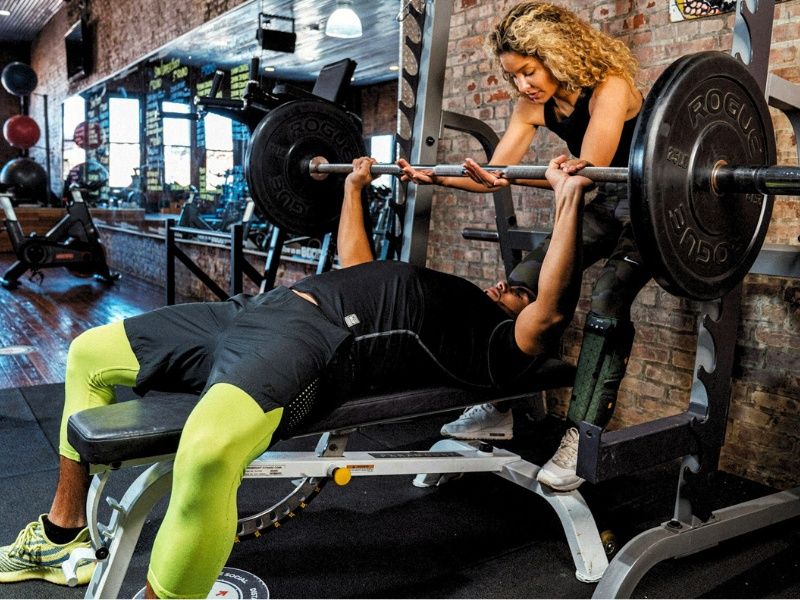
To bench press, lie on a flat bench with your eyes under the bar, grip it a little wider than your shoulders, pull your shoulder blades back and down, and plant your feet. Lift the bar out of the rack, hold it over your nipple line, lower it under control until it touches your chest with your elbows at about 45 degrees from your body, then press it back up until your arms are straight. The bench press mainly works your chest, the front of your shoulders and your triceps.
When people think of training in a gym, the barbell bench press is usually the first exercise that comes to mind. This iconic exercise is part of almost everyone's chest workouts, from beginners to professional bodybuilders. With good technique it is a safe and very effective exercise. In this guide I explain everything you need to know: the benefits, the technique, common mistakes, tips, safety, variations and more. Let's start!
The bench press is a compound chest exercise, which means several muscles work together: your shoulders and triceps work very hard too. It is no surprise that it is so popular and loved. The weight you can bench is a clear sign of upper-body strength.
The technique is not simple at all, and you should master it before you start lifting heavy. For a full chest workout with eight more exercises, see my guide to the best chest exercises.
Muscles worked
| Muscle | Role in the exercise |
|---|---|
| Chest (pectoralis major) | the main mover: brings your upper arms forward and in as you press |
| Front of the shoulders (anterior deltoids) | helps the chest press the bar up |
| Triceps (back of the upper arm) | straighten your elbows, especially in the top half |
| Upper back, core and legs | hold your shoulder blades, body and bar steady |
Benefits: why the barbell version is worth learning
It builds chest muscle
The barbell bench press is an excellent exercise for building chest muscle, because it trains the pectoralis major, the largest muscle in the chest, in an exceptional way. It recruits a great many muscle fibers, which helps drive muscle growth (hypertrophy) and strength gains in the chest.
What research says: in a small study, seven untrained young men did only the bench press, 3 sets of 10 at 75% of their one-rep max, three times a week for 24 weeks. Their chest muscle thickness increased, and so did their triceps thickness and their strength on the lift. It was a small study without a comparison group, so treat it as a sign, not as proof of how much you will grow.
Heavy weights also load your central nervous system (CNS) and make it more efficient. As a result you learn to contract your muscle fibers more strongly, recruit more of them, and lift heavier weights in all exercises.
It builds your shoulders and triceps too
Everyone knows the bench press as THE chest exercise, but it doesn't end there. It is a compound exercise that works many upper-body muscles, either as main movers or as stabilizers. That mainly means your shoulders and your triceps, and it can help them grow as well.
It will also help you improve your working weights in shoulder and triceps exercises, and in other pressing exercises such as the overhead press and the French press (lying triceps extension, or skull crusher).
It is easier to add weight than with dumbbells
When you reach heavy weights, it is very hard to keep progressing with free dumbbells, because the jumps between dumbbells are relatively big. In most gyms they go up by 2.5 kg (5 lb), so you have to go up 2.5 kg in each hand. With a barbell, you can go up 2.5 kg (5 lb) across both hands together.
It is also easier to start a set with a barbell than with dumbbells. You have to lift dumbbells off the floor and get them into the starting position. That lift wastes a lot of energy, especially once the weights get heavy (about 35 kg, or 75 lb, each and up).
Still, dumbbells have their own unique advantages, such as a bigger range of motion and balance between the sides of your body (more on that below). You can switch between the variations every few weeks, so you get all the benefits and add variety to your chest workouts.
When should you start benching?
First, before you lie down under the bar, make sure you are strong enough to lift the bar itself. The Olympic bar, the standard bar in most gyms, weighs exactly 20 kg (44 lb). That is not a heavy weight, but whether it is heavy for you depends on your fitness.
If you can lift the empty bar with control, you can start doing the exercise. If not, start with push-ups, dumbbells or a chest press machine, or look for a lighter bar. As a beginner, it is better to stick to a high number of reps (for example 10-15), so you practice the technique.
How to bench press with good form
Setup
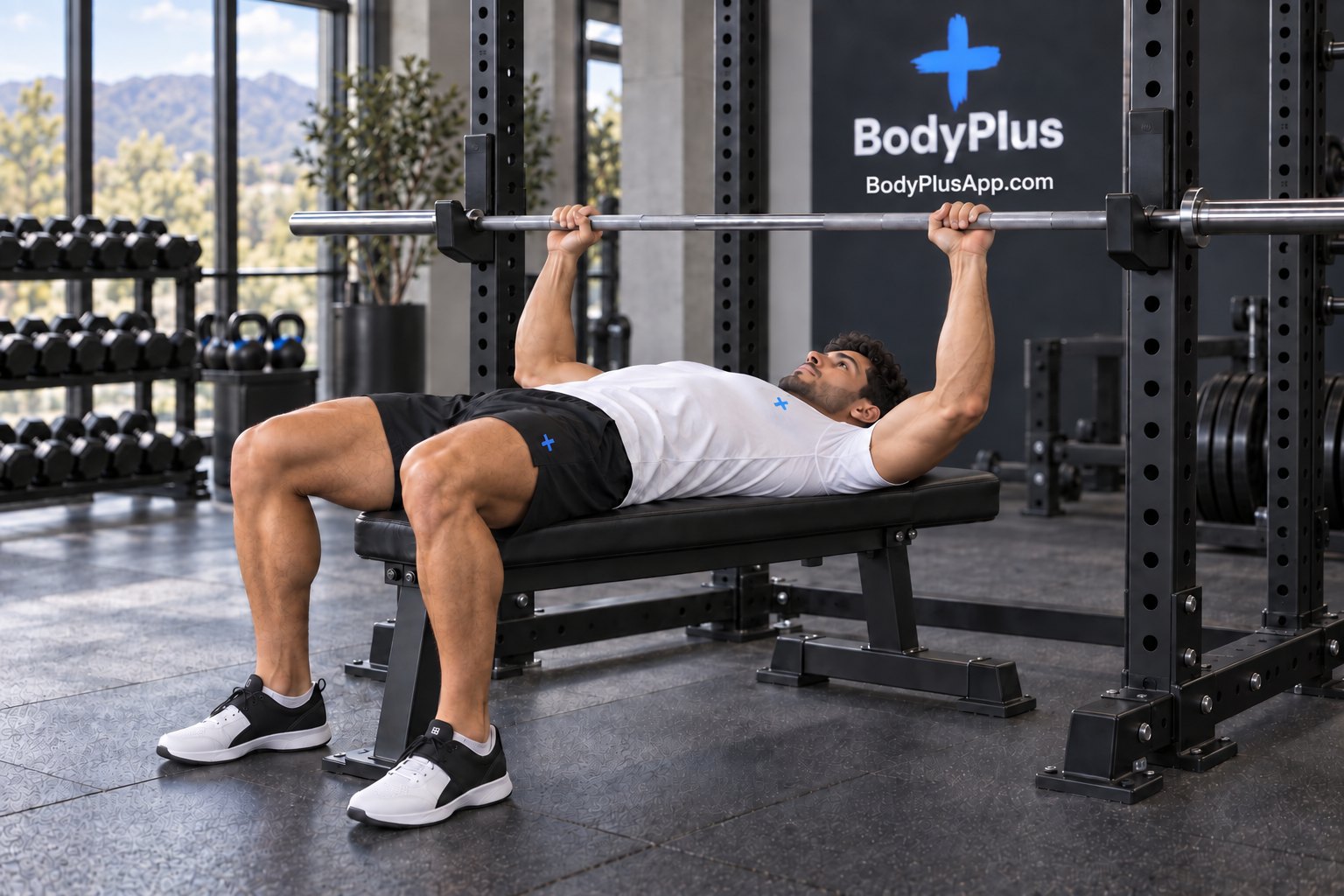
- Lie on the bench with your eyes directly under the bar.
- Grip the bar a little wider than your shoulders, with your thumbs wrapped around it (see the tips below).
- A very important step: pull your shoulder blades back and down, to lock them in place. Don't start the exercise with your shoulders pointing forward.
- Plant your feet firmly on the floor, and press your glutes against the bench.
- Take a deep breath and brace your core before you unrack the bar.
Unracking
- Lift the bar off the rack with straight arms and aim it at your nipple line. Don't swing it in an arc away from the rack and start lowering it right away.
- Pause for a moment and steady the bar above your nipple line.
Lowering and pressing
- Start lowering. Bring the bar down toward your nipple line until it touches your chest. Your elbows should be at about 45 degrees from your body, that is, between your shoulders and your stomach.
- Pause for a moment with the bar on your chest. Then press it back up until your arms are completely straight. The bar moves slightly back toward your shoulders on the way up; that is normal.
- Repeat for the planned number of reps, then guide the bar back into the hooks with straight arms before you let go.
Throughout the movement, keep your eyes on the ceiling, not on the bar.
How wide should your grip be?
Start with your hands a little wider than your shoulders. When the bar touches your chest, your forearms should be about vertical. From there, small changes are fine: the best width differs a little from person to person.
What research says:
- In a study of 28 men, chest muscle activity was similar with a narrow grip (hands about armpit width apart), a medium grip and a wide grip (81 cm, the widest grip allowed in competition). The narrow grip lowered the weight they could lift for 6 reps, and in the trained men, the wide grip gave lower triceps activity than the medium grip. Earlier studies on grip width and chest activity disagree, so there is no proven "best" grip for the chest.
- In a computer-model study of 10 experienced strength athletes lifting a light 16 kg (35 lb) bar, grips narrower than about 1.5 times shoulder width and shoulder blades pulled back lowered the estimated load on the shoulder joint. It estimated forces; it did not track injuries.
For most people, a grip a little wider than the shoulders is a sound place to start.
Common mistakes
1. Lowering the bar toward your mouth or shoulders
Make sure you lower the bar toward your chest, not toward your shoulders or neck. Lowering it somewhere else may put too great a load on your shoulder joint in an unstable position, and that can lead to injury.
2. Lifting too heavy
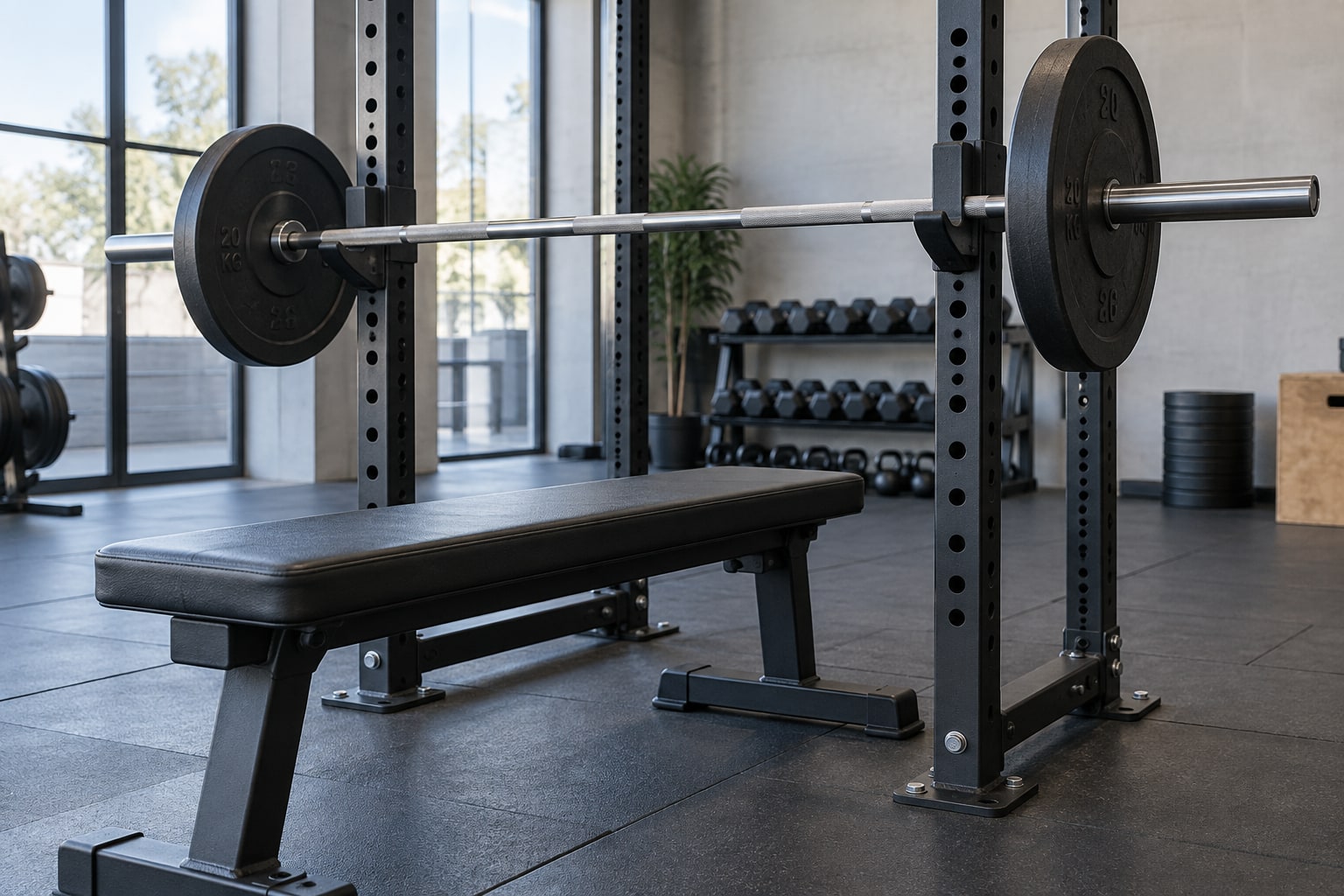
Choose a weight you can control with good technique for the reps you are doing. That is true here, like in any other exercise.
Once the weight is too heavy, your body starts using your legs, your shoulders, your hips and any way it can to lift it. That ruins your technique and may cause injuries, especially in the shoulder joint.
3. Not locking your shoulders back and down
Don't press with your shoulders pointing forward. This is the most destructive mistake you can make. In every pressing exercise it is very important to lock your shoulders back and down. Locking your shoulder blades spreads the load in a healthier way, helps you press more weight, and keeps your shoulder joint in a more stable position.
4. Lowering too fast and bouncing the bar off your chest
People tend to do anything to lift more weight. One thing they do is lower the bar very fast. Some go even further and bounce the bar off their chest. All of this can make you lose your shoulder-blade lock, ruin your technique, and make it hard to keep the load on your chest muscle fibers.
To fix it, count about 2 seconds on the way down. When the bar touches your chest, pause for a moment, then press it up with a burst of energy.
Tips for a stronger, safer press
Plant your feet on the floor
Don't do the exercise with your feet up on the bench. When you lie down, plant your feet on the floor as firmly as you can. Driving your feet into the floor helps you use force from your whole body to lift the weight, and it can make you go up in working weights right away.
Use a full grip
Many trainees bench with a grip where the thumb does not wrap around the bar (known as the "suicide grip"). You understand what can happen if an iron bar loaded with 100 kg (220 lb) slips and falls on your neck or chest, right?
Don't take unnecessary risks: wrap your thumbs around the bar.
Keep your elbows at about 45 degrees
Lower the bar so that your elbows are at about 45 degrees from your body, between your shoulders and your stomach. This angle lets you use your chest's strength and reduces the pressure on your shoulders, which is critical when you lift heavy.
Start your chest workout with the bench press
If you want to lift more on this exercise, do it first in your workout. It is a demanding exercise that takes a lot of energy, so do it while you are fresh and at your strongest.
Variations
There are countless variations of the barbell bench press. You can do it with dumbbells, on machines and at different inclines. Each variation has its own advantages and disadvantages (study). Here are a few examples.
What research says: in a study of 12 trained men, the maximal load was about 17% lower with dumbbells than with a barbell, and about 3% lower on a Smith machine than with a barbell. Chest and front-shoulder activity were similar in all three. Triceps activity was lower with dumbbells, and biceps activity rose as the exercise got less stable (Smith machine, then barbell, then dumbbells). This study compared one-rep maxes and muscle activity, not long-term growth.
1. Close-grip bench press
In this variation, you grip the bar narrower, about shoulder width, and lower your elbows closer to your body, toward your stomach. With the close grip, the load on your chest and shoulders goes down and the load on your triceps goes up. It also lowers the weight you can lift.
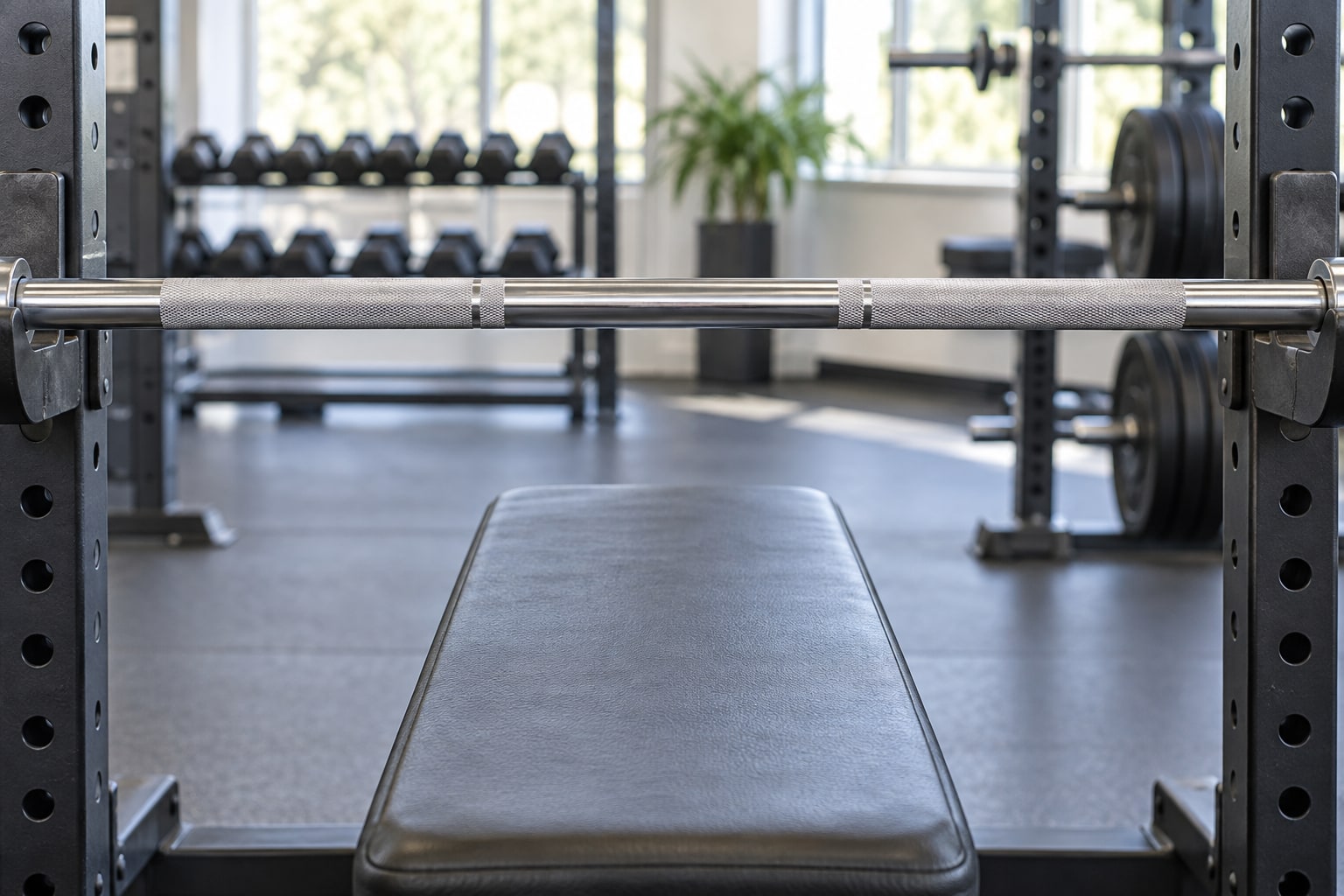
You can add the close-grip bench press to your triceps workout. It can help you build your triceps and improve your regular bench at the same time.
2. Dumbbell bench press
The dumbbell version is a very popular chest exercise. You do it with dumbbells instead of the bar, and there are a few differences.
First, it gives you a bigger range of motion than the barbell. You can lower your elbows below 90 degrees, below the level of the bench, and get a bigger stretch in your chest, as far as your shoulders are comfortable.
Second, there is an extra stability element: each hand has to steady its own dumbbell, so your stabilizing muscles work harder, and one side can't cover for the other.
3. Incline barbell bench press
Raising the incline of the bench shifts more of the load to your upper chest and shoulders. If your upper chest lags behind, it is worth including this exercise. It is less recommended if you have shoulder problems, because it loads the shoulder more: try a lower incline or dumbbells, and stop the set if it hurts. For the dumbbell version and the best bench angle, see my guide to the incline dumbbell press.
4. Machine chest press
Every gym today also has a chest press machine. Like any machine exercise, it has advantages and disadvantages. Some of the advantages:
- It is easy to learn.
- The load stays on your chest, because you don't need to stabilize the weight.
- A lower risk of injury.
- You don't need a spotter.
Still, the machine is an addition to your chest workout, not the main exercise. The stabilizing part is a double-edged sword. On one hand, the machine lets you focus on the main muscles, your chest and triceps. On the other hand, the smaller supporting and stabilizing muscles (for example, the rotator cuff) are not challenged.
A machine press builds muscle well too, so it is a good extra exercise next to the barbell press.
Sets, reps and where it fits in your workout
These are common starting points, not fixed rules:
- For strength: 3-5 sets of 3-6 reps, with 2-3 minutes of rest.
- For muscle: 3-4 sets of 6-12 reps, with about 2 minutes of rest.
- For beginners: 2-3 sets of 10-15 reps with a light weight, to practice the technique.
- Effort: stop most sets when you could still do one to three more good reps.
- Order: do it first in your chest or push workout.
To pick your working weights from a recent set, use the one rep max calculator. Don't test a true one-rep max without a spotter or safety arms.
Sample chest workout
| Exercise | Sets | Reps | Rest |
|---|---|---|---|
| Barbell bench press | 3-4 | 6-8 | 2-3 min |
| Incline dumbbell press (about 30 degrees) | 3 | 8-12 | 2 min |
| Close-grip bench press or machine chest press | 3 | 8-12 | 90 s |
| Cable or dumbbell fly | 2-3 | 12-15 | 60-90 s |
When every set reaches the top of your rep range with good form, add the smallest step, 2.5 kg (5 lb) in total. Some weeks you won't add anything, and that is normal.
Safety
Set up your way out before the first rep: with a spotter or safety arms, a failed rep is not a problem. Don't bench heavy alone; use a spotter, or bench inside a power rack with the safety arms set just below the height of your chest at the bottom of the rep, and test the height with the empty bar.
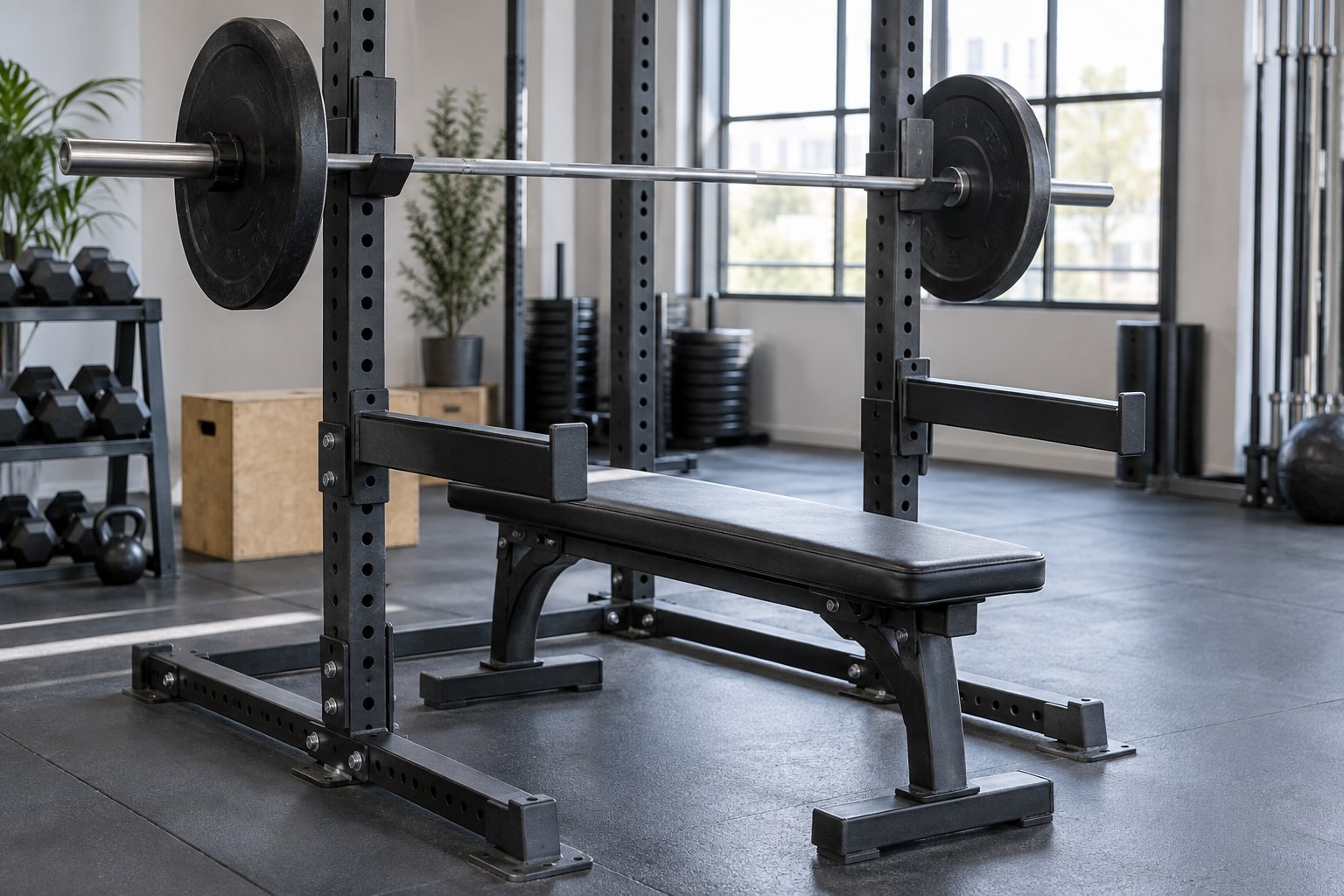
Agree with your spotter on the number of reps and the word you will say ("take"), and put collars on the bar so plates can't slide off one side. If you get stuck with safety arms, lower the bar under control until it rests on them, then slide out toward the head of the bench. Warm up with lighter sets, and when you train without a spotter stop each set a couple of reps before you would fail. If a rep hurts your shoulder, elbow or wrist, end the set and switch to a lighter or pain-free variation such as dumbbells or a machine chest press.
Bottom line
The bench press is a classic exercise and a symbol of the training world. It focuses on your chest, and your shoulders and triceps work hard too. If you put in the effort, it can help you build muscle and strength in your upper body.
You can switch variations from time to time, for example to the dumbbell press or an incline press. The change in load gives you the benefits of each exercise, and your body doesn't get used to one thing and keeps trying to get stronger.
It is very important that you stick to good technique. If you can, ask someone to spot you, because you don't want an iron bar falling on your chest or getting stuck under it. For more chest exercises, see my best chest exercises guide.
Frequently asked questions
How much does the bar weigh?
Most gyms use a standard Olympic bar, which weighs 20 kg (44 lb) and is 220 cm (about 7 ft 2 in) long. Some gyms also have lighter bars, for example 15 kg (33 lb) bars or short fixed bars, so check before you count your total.
Why do my arms shake when I bench?
If you are shaking, your stabilizing muscles are probably not developed enough yet, which is common when you are new to the exercise. Lower the weight a little and do more reps, to build your stability.
Is it worth doing the bench press on a Smith machine?
No, not if you are looking for the main exercise of a chest workout. The Smith machine lacks the stabilization element, so your stabilizing muscles work less. It can also be dangerous at high weights, because you can't correct the deviation of the bar. This means that your slightest movement can shift the load to another muscle or joint and put it in danger.
Should I touch my chest with the bar?
Yes, touch it lightly without bouncing, as long as your shoulders are comfortable. That is the full range of motion for this exercise.
Can I bench press without a spotter?
Yes, if you bench inside a power rack with the safety arms set, or use dumbbells or a machine. Don't bench heavy alone without safety arms.
How can I bench press more weight?
Keep your technique consistent, bench first in your workout, log your sets, and add weight in small steps when you reach the top of your rep range.
Is the bench press good for women?
Yes. The technique is the same for everyone. Choose a starting weight that fits your level; a lighter bar or dumbbells are good options if the 20 kg bar is too heavy at first.
The information on this page and on this website is intended to provide general information only. The content on this website does not constitute a professional opinion, a recommendation, or a substitute for consulting an expert in a specific field or obtaining a medical opinion. It is not medical advice. BodyPlus is not a medical device. If you have a health condition or an injury, or are pregnant, talk to a qualified healthcare professional before starting. Stop exercising and seek appropriate help if you feel pain, dizziness or other concerning symptoms.
Sources
Accessed September 17, 2026.
- Ogasawara R. et al., "Time course for arm and chest muscle thickness changes following bench press training", Interv Med Appl Sci 2012;4(4):217-220. pubmed.ncbi.nlm.nih.gov/24265879
- Saeterbakken A.H. et al., "The Effect of Grip Width on Muscle Strength and Electromyographic Activity in Bench Press among Novice- and Resistance-Trained Men", Int J Environ Res Public Health 2021;18(12):6444. pubmed.ncbi.nlm.nih.gov/34198674
- Noteboom L. et al., "Effects of bench press technique variations on musculoskeletal shoulder loads and potential injury risk", Front Physiol 2024;15:1393235. pubmed.ncbi.nlm.nih.gov/38974522
- Saeterbakken A.H. et al., "A comparison of muscle activity and 1-RM strength of three chest-press exercises with different stability requirements", J Sports Sci 2011;29(5):533-538. pubmed.ncbi.nlm.nih.gov/21225489
- Hernández-Belmonte A. et al., "Free-Weight and Machine-Based Training Are Equally Effective on Strength and Hypertrophy: Challenging a Traditional Myth", Med Sci Sports Exerc 2023;55(12):2316-2327. pubmed.ncbi.nlm.nih.gov/37535335
- Saeterbakken A.H. et al., "The Effects of Bench Press Variations in Competitive Athletes on Muscle Activity and Performance", J Hum Kinet 2017;57:61-71. pmc.ncbi.nlm.nih.gov/articles/PMC5504579