
How to Do a Lat Pulldown: Form, Grip and Muscles Worked

In short
Pull-ups are one of the best back exercises for building strength and muscle, but not everyone can do them yet. This is where the lat pulldown comes in. It lets you practice a similar pull on a machine, using a weight that suits you. Sit with your thighs under the pad, pull the bar down with your elbows and let it rise slowly. Let’s get started.
Professional bodybuilders also include this exercise in their back workouts. The machine's knee pads hold you in place, so you can focus on your back and control the movement more easily than in a pull-up.
There are two main versions: a cable pulldown and a lever machine with its own handles. There is no significant difference between them for this workout. You can switch between them from time to time to add variety to your back workout. For more ideas, see my guide to the best back exercises.
Muscles worked
The main muscles here are your latissimus dorsi, or lats, and your rear shoulders. Your upper back and arms help too:
| Muscle | Role in the exercise |
|---|---|
| Lats (latissimus dorsi) | the main mover: pull your upper arms down and in toward your body |
| Teres major (a small muscle under the armpit) | works together with the lats |
| Rear shoulders (posterior deltoids) | help pull your arms down and back |
| Middle and lower trapezius, rhomboids | pull your shoulder blades down and together |
| Biceps and forearm muscles | bend your elbows and hold the bar |
| Core muscles | keep your torso steady on the seat |
The benefits of the lat pulldown
Helps build a strong, muscular back
If you want to build your back muscles, this is an exercise I would include. The knee pads let you focus the load on your lats, the largest muscles in your back.
Include two or three variations in a back workout. Do eight reps with one grip and 12 with another. I like the change in grip and rep range when training the back.
A great exercise for beginners
When you are new to the gym, it is easy to feel unsure about what to do unless you work with a personal trainer. A regular gym trainer may not spend time teaching you every exercise and its technique; some are not very professional either. Some exercises, such as the deadlift, overhead press and bent-over row, can be hard to learn on your own.
The lat pulldown is easier to learn. The machine helps you repeat the movement, and you can start practicing today. If you cannot do a pull-up yet, it can help you work toward your first one: you train almost the same pulling muscles with a weight you can choose.
Tension on the muscles through the whole movement
The cable keeps resistance on your muscles throughout the movement. I like this for back training: you can feel the work as you pull and as you return the bar. In a review of eight training studies, Schoenfeld et al. (2015) found similar growth with reps lasting about 0.5 to 8 seconds; reps longer than 10 seconds appeared less effective, although few controlled studies tested them and the review was not specific to pulldowns.
Many back exercises on one machine
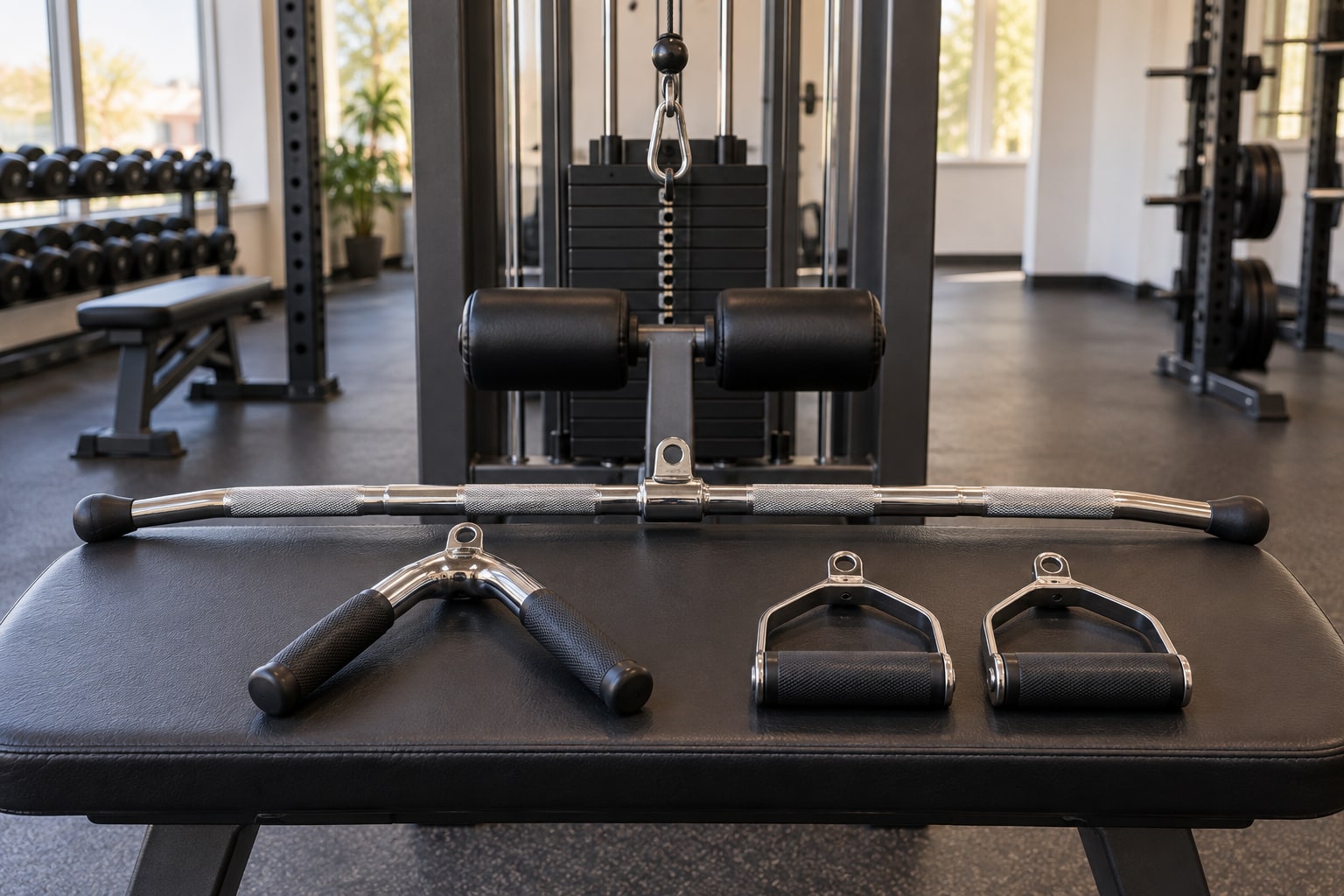
The beauty of this machine is how many back exercises you can do with it. Each grip works the back a little differently: some variations focus more on the trapezius, some on the lats and some on other muscles. You can try shoulder-width, narrow or reverse grips, then change the attachment: a straight bar, V-bar, D-handle or triangle handle.
How to do a lat pulldown
Setup
Before you start pulling, position yourself:
- Adjust the seat and knee pad so your thighs fit underneath. Set the seat so you can reach the bar by rising slightly, then let your arms straighten at the top. The ACE seated lat pulldown guide also shows the knee-pad setup.
- Sit with your back straight and your feet on the floor.
The movement
- Hold the bar a little wider than shoulder width. Hold it with your fingers, with your thumbs beside them rather than wrapped around the bar, so you can think about your elbows.
- Pull the bar down to about chin height. Breathe in as you lower it.
- You can lean back slightly to give the bar room to pass your face and increase your range. Keep the movement small and avoid using momentum.
- Contract your back muscles and pause for a second.
- Return the bar slowly. Control it while your back muscles stretch.
- Continue until you finish the reps you planned.
Torso angle: how far to lean back
Sit tall and lean back only a little so the bar can pass your face. Keep that angle through the set; if you have to rock backward to move the weight, go lighter. In one workout with 40 experienced men, Buonsenso et al. (2025) recorded similar lat activity across seven variations; the wide-overhand pull at roughly 30 degrees of lean raised rear-shoulder activity compared with both upright wide-overhand and upright wide-neutral pulls.
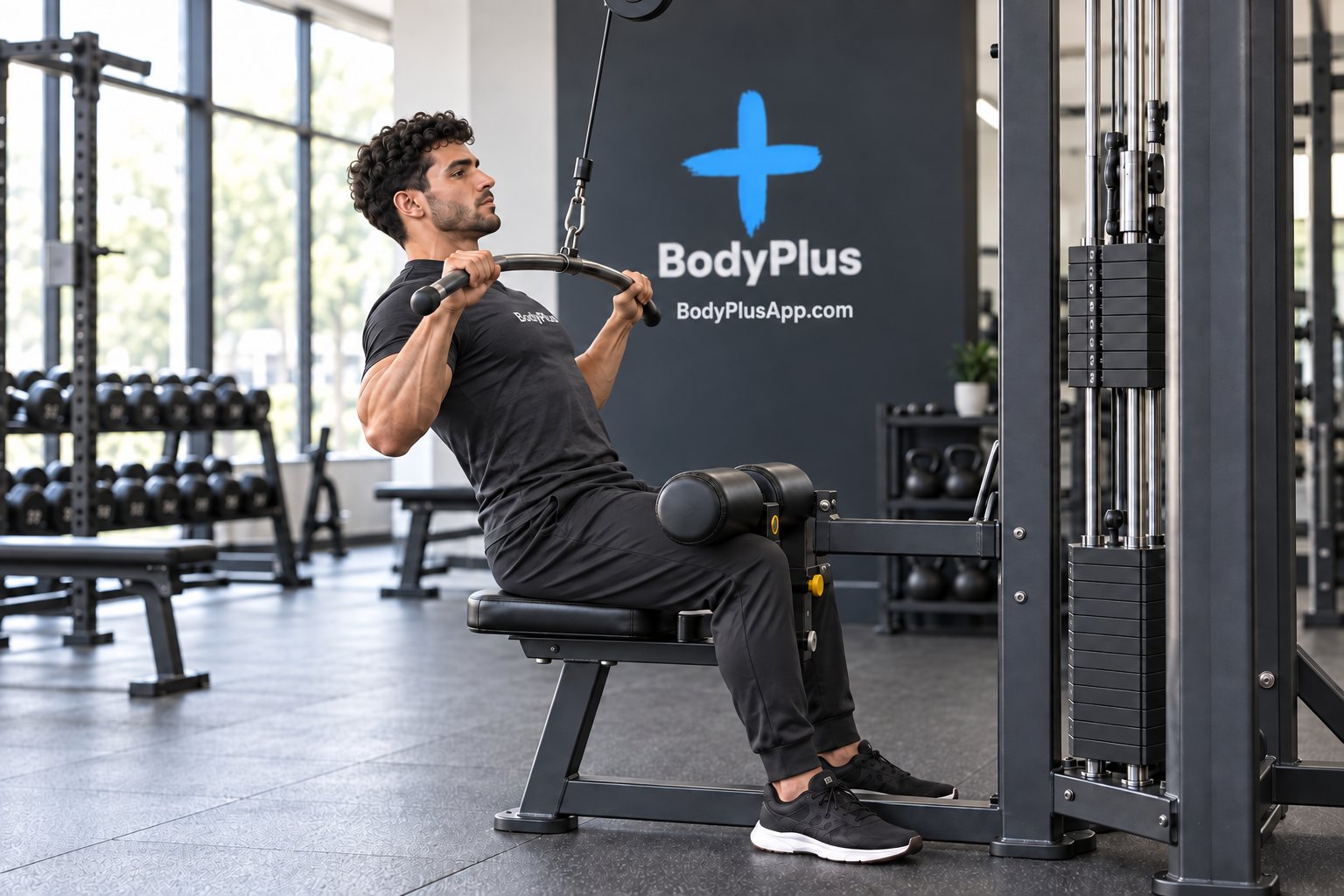
The image shows the bar a little lower than my chin-height cue. You do not need to pull that far down to follow these steps.
Where the bar goes: in front of your head, not behind it
Pull the bar in front of your face to about chin height, as in the steps above. In a short test, Sperandei et al. (2009) found similar lat activity across paths but more rear-shoulder and biceps activity behind the neck, and recommended avoiding that version. Padovan et al. (2024) found phase-specific differences in one session, not growth outcomes; Kolber et al. (2013) found an association with shoulder looseness, which cannot show cause.
Common mistakes
Using momentum
Next time you go to the gym, look at people doing pulldowns: you will probably see some swinging back and forth. You can move a little backward as you lower the bar, but keep that movement small. Pull with your elbows, not with a swing of your body.
When you train, put your ego aside. Choose a weight you can control.
Gripping the bar tightly
When you squeeze the bar too hard, your arms can take a large share of the work. For back exercises, hold the bar with your fingers, thumbs beside them, and keep your grip fairly loose. Think of your hands as hooks and move your elbows backward. If the bar starts to slip, wrap your thumbs around it for that set.
In a coached session with eight women new to strength training, Snyder and Leech (2009) found that lat activity rose after a cue to focus on the lats; biceps activity did not fall.
Safety
Set the seat and knee pad so your thighs are held snugly and your feet rest flat on the floor. Start with a light set to check that you can pull smoothly in front of your face. Keep each return controlled, and let the stack rest before you release the bar. End the set when you have to swing, lose your grip, feel pain or feel dizzy. If your thighs lift against the pad, lighten the stack before the next set.
Lat pulldown variations
Pull-up
The pull-up is the king of back exercises. It uses almost the same pulling movement, works more muscles as you control your whole body, and you can do it wherever you have a sturdy bar.
Doma et al. (2013) studied chin-ups (palms facing you), not overhand pull-ups. In that one-workout comparison with pulldowns, chin-ups showed more biceps and lower-back activity and more shoulder and neck movement during the lifting phase.
| Lat pulldown | Pull-up | |
|---|---|---|
| Load | any weight on the stack | your body weight (plus or minus) |
| Stability | the pad holds you in place | you control your whole body |
| Equipment | cable or pulldown machine | any sturdy bar |
| Good for | beginners; a main or second vertical pull | strength, full-body control |
If you are working toward your first pull-up, keep doing pulldowns and add pull-up practice: slow lowering from the top, or an assisted pull-up machine. My best back exercises guide has more pull-up variations.
Wide-grip lat pulldown
A wide grip helps you emphasize your lats. I would not make it too wide: that can shorten your range, shift more work to your shoulders and arms, and put your shoulders at risk of injury. Find a width you can control.
Reverse-grip lat pulldown
Turn your palms toward you, as in a chin-up. I use this variation when I want to feel more work in the front of my arms and lats.
Other grips and handles
You can also use a shoulder-width grip, a narrow grip or a V-bar with your palms facing each other. Try the attachments and see which lets you pull with control.
Andersen et al. (2014) and Buonsenso et al. (2025) found similar lat activity across grips, while Signorile et al. (2002) and Lusk et al. (2010) recorded some differences. These one-workout recordings cannot establish which grip builds more muscle, as Vigotsky et al. (2022) explain; choose a comfortable grip that lets you control the range.
| Grip | Why you might choose it |
|---|---|
| Overhand, a little wider than shoulders | the standard version; a good default |
| Wide overhand | a different feel; keep a comfortable range |
| Narrow overhand or neutral (V-bar) | a closer handle; palms face each other with the V-bar |
| Underhand | a chin-up-like feel; many people feel their biceps more |
A sample back workout
My starting point is a pulldown you can control for eight to 12 reps. The example below uses one grip for the first sets and a second grip for 12 reps, as I suggested above.
| Exercise | Sets | Reps | Rest |
|---|---|---|---|
| Lat pulldown, overhand grip | 3 | 8-12 | 2 min |
| Seated row machine | 3 | 10-12 | 90 s |
| Lat pulldown, V-bar or underhand grip | 2 | 12 | 90 s |
| One-arm dumbbell row | 2 | 10-12 each side | 60-90 s |
This can fit a pull day in a push/pull/legs plan or an upper day in an upper/lower split.
How to track it and when to go heavier
| Session | Weight | Set 1 | Set 2 | Set 3 |
|---|---|---|---|---|
| Week 1 | 45 kg (about 100 lb) | 10 | 9 | 8 |
| Week 2 | 45 kg (about 100 lb) | 11 | 10 | 9 |
| Week 3 | 45 kg (about 100 lb) | 12 | 11 | 10 |
| Week 4 | 45 kg (about 100 lb) | 12 | 12 | 12 |
| Week 5 | 50 kg (about 110 lb) | 9 | 8 | 8 |
When all three sets reach 12 reps with good form, try the next available weight on the stack. If that jump breaks your form, stay at the lighter weight and repeat 12 clean reps before trying again. Weight stacks differ between machines, so compare your numbers on the same machine.
Frequently asked questions
Is the lat pulldown worth doing if I can already do pull-ups?
Yes, without a doubt. Pull-ups are excellent, but they use a lot of energy. Late in a back workout, they may be hard to repeat. On the pulldown you can choose a lighter weight, and the knee pad helps you control the movement while you focus on your lats.
Which lat pulldown variation is best?
There is no single best variation. Each grip trains the back with a slightly different feel. You can change the variation every few weeks. This change is very good for building muscle, because after a while your muscles get used to the exercises you do.
What muscles does the lat pulldown work?
Mainly your lats, together with the teres major, the rear shoulders, the middle and lower trapezius and rhomboids, and your biceps and forearms.
Is a close grip or a wide grip better?
I would start a little wider than shoulder width. If you want a closer grip, try a narrow hold or the V-bar. Choose one you can pull without swinging.
Where should I pull the bar to?
Pull it in front of your face to about chin height, as in the steps above.
Will the lat pulldown help me do a pull-up?
Yes, it can help you work toward your first pull-up. You train a similar pull with a load you choose; a pull-up also asks you to control your whole body.
Is the lat pulldown good for women?
Yes. The exercise and the technique are the same for everyone. Choose a weight that fits your level.
What if I feel pain in my shoulder?
If your shoulder hurts during the pull, end the set and do not force more reps. On another day, try a lighter load or a different grip only if it is pain-free.
Bottom line
There is no doubt in my mind that the lat pulldown deserves a place of honor in your back workout. It lets you focus on your lats and give those muscle fibers tremendous stimulation. To get the most out of it, use good technique: avoid momentum and choose a weight you can handle.
The information on this page and on this website is intended to provide general information only. The content on this website does not constitute a professional opinion, a recommendation, or a substitute for consulting an expert in a specific field or obtaining a medical opinion. It is not medical advice. BodyPlus is not a medical device. If you have a health condition or an injury, or are pregnant, talk to a qualified healthcare professional before starting. Stop exercising and seek appropriate help if you feel pain, dizziness or other concerning symptoms.
Sources
Original study list accessed September 17, 2026; ACE guidance checked September 29, 2026.
- Andersen V. et al., "Effects of grip width on muscle strength and activation in the lat pull-down", J Strength Cond Res 2014;28(4):1135-1142. pubmed.ncbi.nlm.nih.gov/24662157
- Buonsenso A. et al., "Electromyographic Analysis of Back Muscle Activation During Lat Pulldown Exercise: Effects of Grip Variations and Forearm Orientation", J Funct Morphol Kinesiol 2025;10(3):345. pubmed.ncbi.nlm.nih.gov/40981044
- Signorile J.F. et al., "A comparative electromyographical investigation of muscle utilization patterns using various hand positions during the lat pull-down", J Strength Cond Res 2002;16(4):539-546. pubmed.ncbi.nlm.nih.gov/12423182
- Lusk S.J. et al., "Grip width and forearm orientation effects on muscle activity during the lat pull-down", J Strength Cond Res 2010;24(7):1895-1900. pubmed.ncbi.nlm.nih.gov/20543740
- Sperandei S. et al., "Electromyographic analysis of three different types of lat pull-down", J Strength Cond Res 2009;23(7):2033-2038. pubmed.ncbi.nlm.nih.gov/19855327
- Padovan R. et al., "High-Density Electromyography Excitation in Front vs. Back Lat Pull-Down Prime Movers", J Hum Kinet 2024;91(Spec Issue):47-60. pubmed.ncbi.nlm.nih.gov/38689585
- Kolber M.J. et al., "Characteristics of anterior shoulder instability and hyperlaxity in the weight-training population", J Strength Cond Res 2013;27(5):1333-1339. pubmed.ncbi.nlm.nih.gov/22836608
- Snyder B.J., Leech J.R., "Voluntary increase in latissimus dorsi muscle activity during the lat pull-down following expert instruction", J Strength Cond Res 2009;23(8):2204-2209. pubmed.ncbi.nlm.nih.gov/19826307
- Doma K. et al., "Kinematic and electromyographic comparisons between chin-ups and lat-pull down exercises", Sports Biomech 2013;12(3):302-313. pubmed.ncbi.nlm.nih.gov/24245055
- Schoenfeld B.J. et al., "Effect of repetition duration during resistance training on muscle hypertrophy: a systematic review and meta-analysis", Sports Med 2015;45(4):577-585. pubmed.ncbi.nlm.nih.gov/25601394
- Vigotsky A.D. et al., "Longing for a Longitudinal Proxy: Acutely Measured Surface EMG Amplitude is not a Validated Predictor of Muscle Hypertrophy", Sports Med 2022;52(2):193-199. pubmed.ncbi.nlm.nih.gov/35006527
- American Council on Exercise, "Seated Lat Pulldown", Exercise Library. acefitness.org/resources/everyone/exercise-library/158/seated-lat-pulldown