
How to Do a Leg Curl: Form, Muscles Worked and Variations
In short
If you're at the leg curl machine, set the pad behind your ankles, bend your knees to bring them toward your glutes, then lower slowly.
If you want strong, powerful legs, give the hamstrings on the back of your thighs some attention. The machine leg curl is an outstanding isolation exercise: it puts the work right where you want it and lets you contract, stretch and feel those muscles. This article covers its benefits, technique, mistakes and variations. So let's begin!
Seated, lying and standing machines
There are two common leg curl machines in gyms: seated and lying. The seated machine is more common. Some gyms also have a standing machine that trains one leg at a time.
| Machine | Your position | Good to know |
|---|---|---|
| Seated | sitting, hips bent, a pad locks your thighs down | stretches the hamstrings the most; grew the hamstrings more than the lying machine in the study below |
| Lying (prone) | face down on a bench, hips almost straight | your hips must stay on the pad; comfortable if the seated machine doesn't fit you |
| Standing | upright, one leg at a time, a pad behind your ankle | trains each leg on its own; keep your hips still and your torso upright |
One study showing a benefit for the seated curl is listed below. In a 12-week study, 20 healthy adults trained one leg on the seated leg curl and the other leg on the lying machine, 5 sets of 10 reps twice a week. MRI scans showed the whole hamstring group grew about 14% on the seated side and about 9% on the lying side. The difference came from the long hamstring muscles that cross both the hip and the knee; the short head of the biceps femoris, which crosses only the knee, grew about the same with both. It is one small study, so I wouldn't treat the result as a rule for everyone.
Still, if you have the option, change the variation from time to time. The change will keep your body from getting used to a particular exercise and add variety to your workout.
Muscles worked
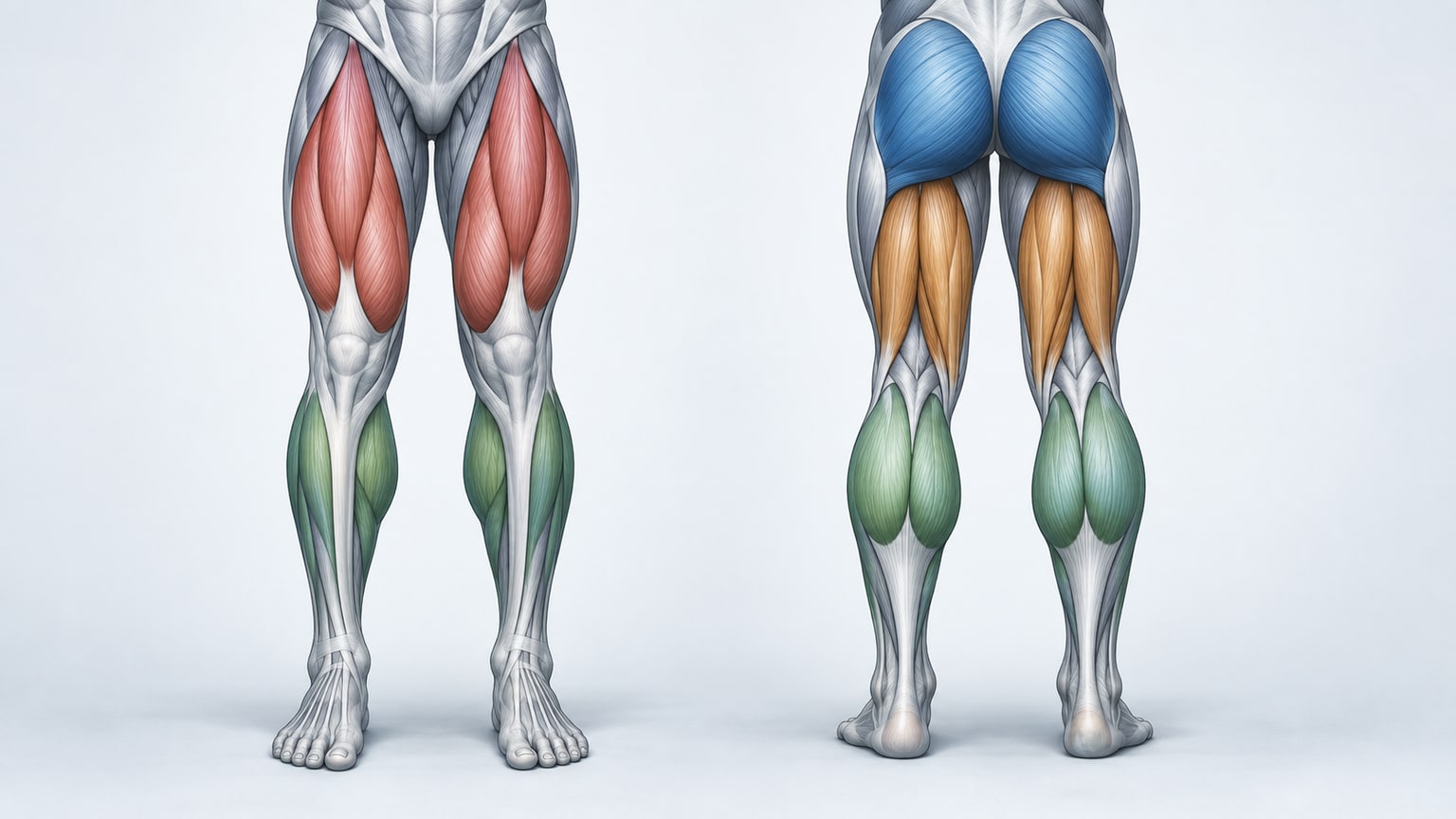
The main muscles worked are the hamstrings on the back of your thighs. They bend your knee as you curl the weight. Your calves help a little too. For a full map, see the leg muscles guide.
Benefits
Isolating the back of your thighs
The leg curl is one way to isolate the hamstrings. You can also work the back of your thighs very well with a Romanian deadlift or a stiff-leg deadlift, but not in such a focused way. Those exercises also work your back, forearms, traps, core and more. If you want to focus the work on your hamstrings, this is the exercise for you.
Balance between the front and back of your legs
Almost all men who work out focus mainly on exercises for the front of their legs. That can leave the hamstrings lagging behind and may hold back your progress in compound exercises. Your muscles work together, and their movements are linked; I don't think it makes sense to train only one part of your legs.
Everyday life
The hamstrings connect to your pelvis and help control movement. Today's lifestyle involves a lot of sitting, so they may not get much work during the day. I want you to train them alongside the rest of your legs, especially as you get older.
Think of carrying groceries, doing household chores or gardening. Those are the everyday tasks I have in mind when I talk about training the back of your legs.
Leg curl technique
Set the machine so your knee lines up with its pivot and the ankle pad rests just above your heels. Then use these steps:
- Seated machine: put your glutes all the way back in the seat so your legs and upper body make about a 90-degree angle. Set the thigh pad over your thighs and hold the handles.
- Lying machine: lie face down and position the lever pad behind your ankles. Hold the handles.
- Standing machine: rest the front of one thigh against its pad and put the ankle pad behind that leg. Hold the handles.
- Bend your knees and pull your ankles as close to your glutes as you can. Keep your back and glutes from rising.
- Hold for 1–2 seconds and contract the back of your thighs as hard as you can.
- Return your legs slowly and with control until they are almost straight. I prefer to stop just before straightening them to keep the load on the muscle.
- Do 8–20 repetitions to complete the set.
Common mistakes
Using too much weight
People tend to use very heavy weights on this exercise. The problem is that the weight stops you focusing the load on the hamstrings, controlling it and working the muscle fibers as well as you could.
The right weight is much lower than most people use. Choose one that lets you keep good technique: about 2 seconds to curl, a pause while you contract as hard as you can, then about 2 seconds to return. Do that, and you'll understand what a real hamstring pump feels like.
Sliding forward with your glutes
Sliding forward shifts the load from your hamstrings toward your lower back and pelvis. It usually happens for one of two reasons:
- the weight is too heavy;
- you're sitting incorrectly. Sit with about a 90-degree angle between your legs and upper body.
On the lying machine, watch for your hips rising off the bench. Keep them on the pad as you curl.
Straightening your legs all the way
On the return, I don't recommend straightening your legs completely and pausing there. Straightening the knees shifts a large part of the load toward the joints, and the muscle does less work. People also use that moment to rest between reps. To keep the hamstrings working, stop a moment before your legs are straight and change direction.
By the way, if you don't pause between repetitions, it's okay to straighten your legs. The point is to keep the set moving under control.
Leg curl variations
Leg curls with a dumbbell
You can also do leg curls at home with a dumbbell. Lie on your stomach, hold the dumbbell between your feet and bend your knees. I wouldn't use a heavy dumbbell here: it is hard to keep one held between your feet. Start light and keep it secure throughout the curl.
Standing leg curls with a resistance band
For this variation, you need a resistance band. Adding one is an excellent way to build strength and muscle when you work out at home.
Anchor the band in front of you at leg height. Attach it to your leg with a strap just above your ankle, then lift your foot backward against the resistance. Lower it slowly.
Safety
Before you start, line your knees up with the machine's pivot, set the ankle pad just above your heels and check that the adjustment pins are secure. Warm up with a light set and start with a weight you can control without swinging.
Take about 2 seconds to curl, pause to squeeze your hamstrings, then take about 2 seconds to return, keeping your hips against the seat or bench. End the set if you feel pain or dizziness, or if your hips lift or you can no longer control the weight. For the dumbbell variation, keep it light and stop if the dumbbell starts slipping between your feet.
Bottom line
The machine leg curl is a very special exercise in a leg workout, and it would be a shame to miss it. It lets you isolate and strongly emphasize the back of your legs. It may also help you improve flexibility, work on an imbalance and improve your performance in other exercises.
It is not the main exercise in your leg workout. Use compound exercises such as lunges, squats or split squats for that: they work many muscles at once and build overall muscle mass. The curl gives your hamstrings focused, additional work.
Frequently asked questions
What muscles does the leg curl work?
Mainly the hamstrings on the back of your thighs. Your calves help a little.
Is the seated leg curl better than the lying leg curl?
In the 12-week study above, the hamstrings grew about 14% with the seated curl and about 9% with the lying curl. I would use the seated machine if it's available, and change variations from time to time.
Should I straighten my legs all the way?
Lower until your legs are almost straight and turn the rep around there. If you don't pause between reps, straightening fully is fine.
How much weight should I use?
Choose a weight that lets you curl in about 2 seconds, squeeze at the top and return in about 2 seconds. If you can't control that tempo, go lighter.
How can I do leg curls without a machine?
Try the dumbbell or resistance-band versions above.
The information on this page and on this website is intended to provide general information only. The content on this website does not constitute a professional opinion, a recommendation, or a substitute for consulting an expert in a specific field or obtaining a medical opinion. It is not medical advice. BodyPlus is not a medical device. If you have a health condition or an injury, or are pregnant, talk to a qualified healthcare professional before starting. Stop exercising and seek appropriate help if you feel pain, dizziness or other concerning symptoms.
Sources
Accessed September 17, 2026.
- Maeo S. et al., "Greater Hamstrings Muscle Hypertrophy but Similar Damage Protection after Training at Long versus Short Muscle Lengths", Med Sci Sports Exerc 2021;53(4):825-837. pubmed.ncbi.nlm.nih.gov/33009197
- OpenStax, Anatomy and Physiology 2e, "11.6 Appendicular Muscles of the Pelvic Girdle and Lower Limbs" (names and actions of the hamstrings and the gastrocnemius). openstax.org/books/anatomy-and-physiology-2e/pages/11-6-appendicular-muscles-of-the-pelvic-girdle-and-lower-limbs