
How to Do Dumbbell Lunges: Form, Muscles Worked and Variations
In short
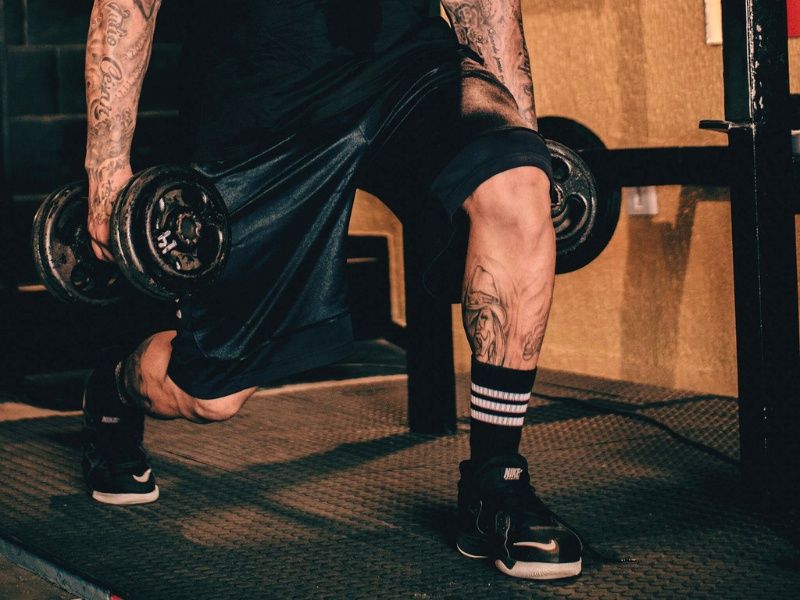
Dumbbell lunges are an exceptional exercise for leg workouts. It is a compound exercise that helps build serious muscle mass, strength, balance and coordination in the lower body.
This wonderful exercise suits all levels, and you can do it in many variations. I will show you how to do dumbbell lunges correctly, the benefits, common mistakes and variations, with tips to help you get the most out of them.
To do a dumbbell lunge, hold two dumbbells while standing. Step forward with one leg, bend your knees and lower your body. Return to standing and repeat with the other leg.
Muscles worked: your quadriceps, thighs, glutes, inner thighs, calves and core muscles. In one study of 20 adults doing forward lunges with a weight they could lift 12 times, muscle activity was high to very high in the quads and in both glute muscles, and moderate in the hamstrings, calves and inner thigh. Muscle activity measured this way is not a proven predictor of how much a muscle will grow.
A note on the hamstrings: many guides list them as a main lunge muscle, but no training study that measured hamstring growth from lunges was found for this guide. In a squat training study, a similar knee-and-hip movement, the hamstrings did not grow at all. So treat lunges as a quad and glute exercise, and train your hamstrings directly with a Romanian deadlift or a leg curl.
Benefits
An excellent exercise for building muscle mass and strength in the lower body
If you want to build strong legs, this is the exercise for you. All the muscles in your lower body work, either as primary muscles or as stabilizers. Your entire lower body takes part, so lunges can help improve the balance between your muscles.
A functional exercise that helps improve flexibility, balance and coordination
It is true that there is no clear definition of a functional exercise, but this one will help you improve many different elements: flexibility, balance, coordination and your core muscles.
Your abdominal and lower back muscles work very hard to stabilize your body, so they improve too. Lunges also mimic everyday movements such as walking and climbing stairs, working the same muscles and movements.
Simple technique you can adjust to yourself
Another significant benefit is that dumbbell lunges are perfect for beginners. First, they are fairly simple to learn. Second, you can adjust them to your abilities: you choose where your front foot lands to suit your body structure, flexibility and balance.
How to do dumbbell lunges
Step by step
- Start standing with your feet shoulder-width apart, holding a dumbbell in each hand.
- Take a big step forward with one leg. Plant your front foot on the floor, with your back foot on its toes.
- Lower your body by bending your knees until your front thigh is parallel to the floor.
- Pause at the bottom for a moment, then begin the upward movement.
- Rise by straightening your knees and hips, and bring the front leg back until your feet are next to each other.
- Repeat with the other leg.
- Continue until the set is finished, alternating legs on each repetition.
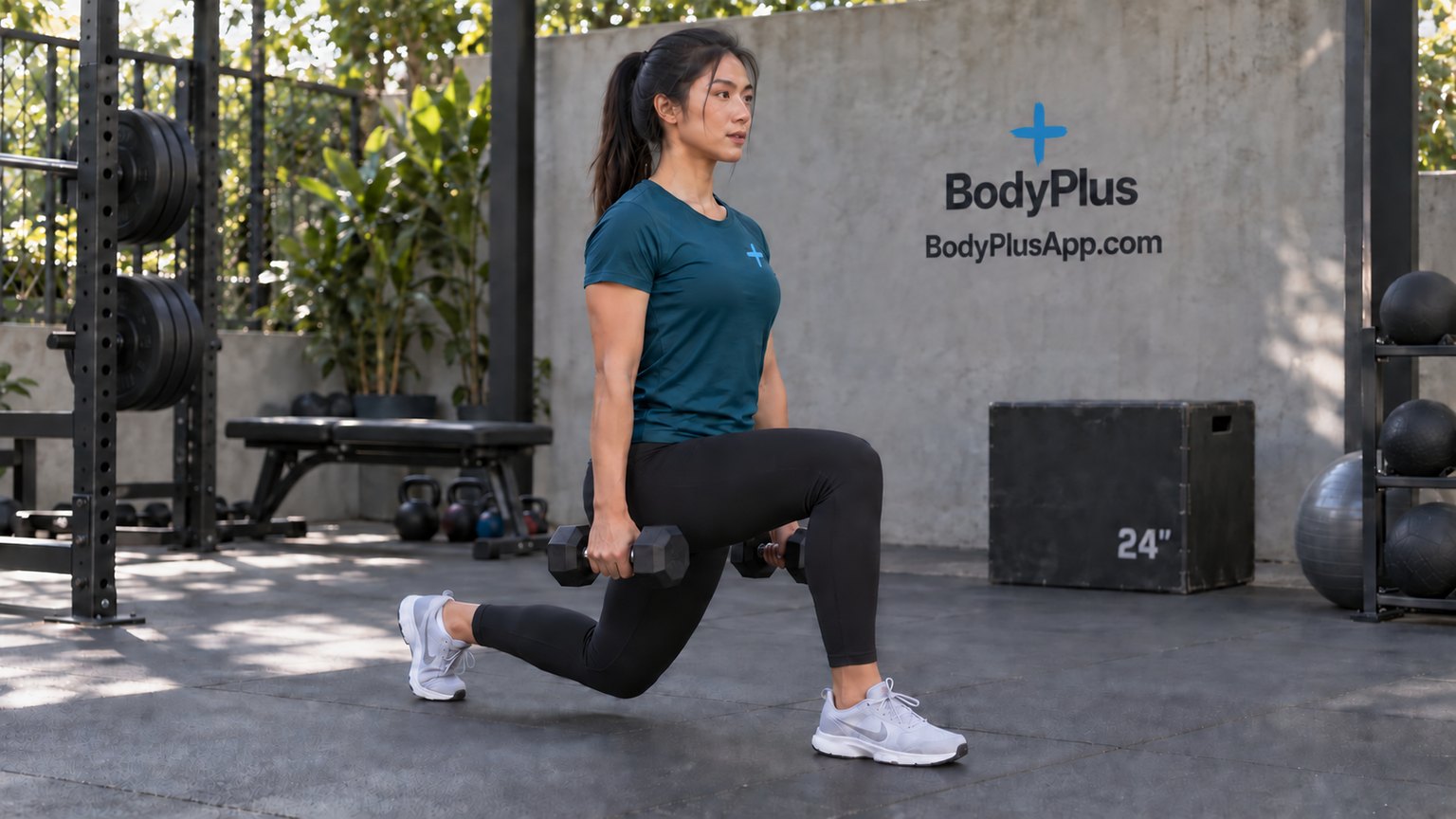
Breathe in before you step and lower, and breathe out as you push back up.
Form cues
- Front knee: keep it in line with your toes, so it doesn't cave inward or drift out. It may travel a little forward over your foot; what matters is that your front heel stays down.
- Torso: stand tall with your chest up and your core braced. A slight forward lean is fine (see below); rounding your back is not.
- Dumbbells: let them hang straight down by your sides. Don't swing them to help you up.
- Back leg: it goes straight down toward the floor. The back knee comes close to the floor but doesn't bang into it.
Picking up and putting down the dumbbells
Pick the dumbbells up with a flat back, bending at your knees and hips. Finish the last rep with your feet together before you put them down, and lower them under control rather than dropping them.
Forward, reverse and walking lunges
The three most common versions use the same bottom position. What changes is how you get there and back.
| Version | How you move | What it asks of you | Good for |
|---|---|---|---|
| Forward lunge | step forward, push back to the start | you must stop your body as you land and then push it back | the classic version in this guide |
| Reverse lunge | step backward, then step forward to the start | your front foot stays in place the whole time | learning the bottom position with less to coordinate |
| Walking lunge | step forward, then bring the back leg through into the next step | you travel across the room without stopping at the start | a longer, continuous set when you have space |
Reverse lunge form
Stand with a dumbbell in each hand. Step one foot back, land on the ball of that foot, and lower until your back knee is just above the floor. Keep most of your weight on your front foot, then push through it to bring your back leg forward to the start. You can alternate legs or finish all your reps on one side.
Walking lunges with dumbbells
Do a forward lunge, but instead of stepping back, push up through your front foot and bring your back leg forward into the next lunge. You move across the floor with each rep. Use a clear, flat path. Walk slowly enough to stop each step under control, and turn around with your feet together, not in the middle of a lunge. Because balance is harder while you travel, start with lighter dumbbells than you use for the forward lunge.
Step length: what it changes
A longer step and a shorter step are both correct. They just shift the work a little, and the research on this is still small.
- A long step (your front shin stays close to vertical at the bottom): in the 20-person study above, most of the leg muscles measured, including the glutes and the inner thigh, were more active with a long step than with a short one. A study of 32 young adults also found that, of the lunges it tested, a forward lunge with a long step (60% of body height) placed the greatest demand on the hip extensors.
- A short step (your front knee travels further forward): in a study of 18 people who lunged with a weight they could lift 12 times, the pressure behind the kneecap was higher with a short step when the knee was bent between 70 and 90 degrees. The same study found higher kneecap pressure when people stepped out and back (a stride) than when they stayed in place, in the upper part of the movement. These are calculated forces, not injury results, but if the front of your knee is sensitive, a longer step and a split squat in place are worth trying.
Choose a step that lets your front heel stay down, your back knee reach close to the floor, and your front thigh reach parallel.
Knee and torso position
Knee
Keep your front knee pointing the same way as your toes throughout the rep. If it caves inward, lighten the weight and slow down. A longer step keeps the shin more upright, so the knee travels less far forward.
Torso
Stand upright for the standard lunge. If you lean your torso slightly forward from your hips, with a flat back, your hips do a little more of the work. In a study of 10 adults, leaning forward increased the work at the hip and the activity of the glutes and a hamstring muscle, while leaning back changed little. In another study of 12 trained women lunging with 30% of their body weight, a forward lean increased lower back muscle activity but did not change hamstring activity, and the stepping and walking lunges activated the glutes more than a static lunge (a split squat in place). Both studies were small and measured muscle activity, not growth. Either way, keep your back flat: the lean comes from your hips, not from rounding your spine.
Balance tips
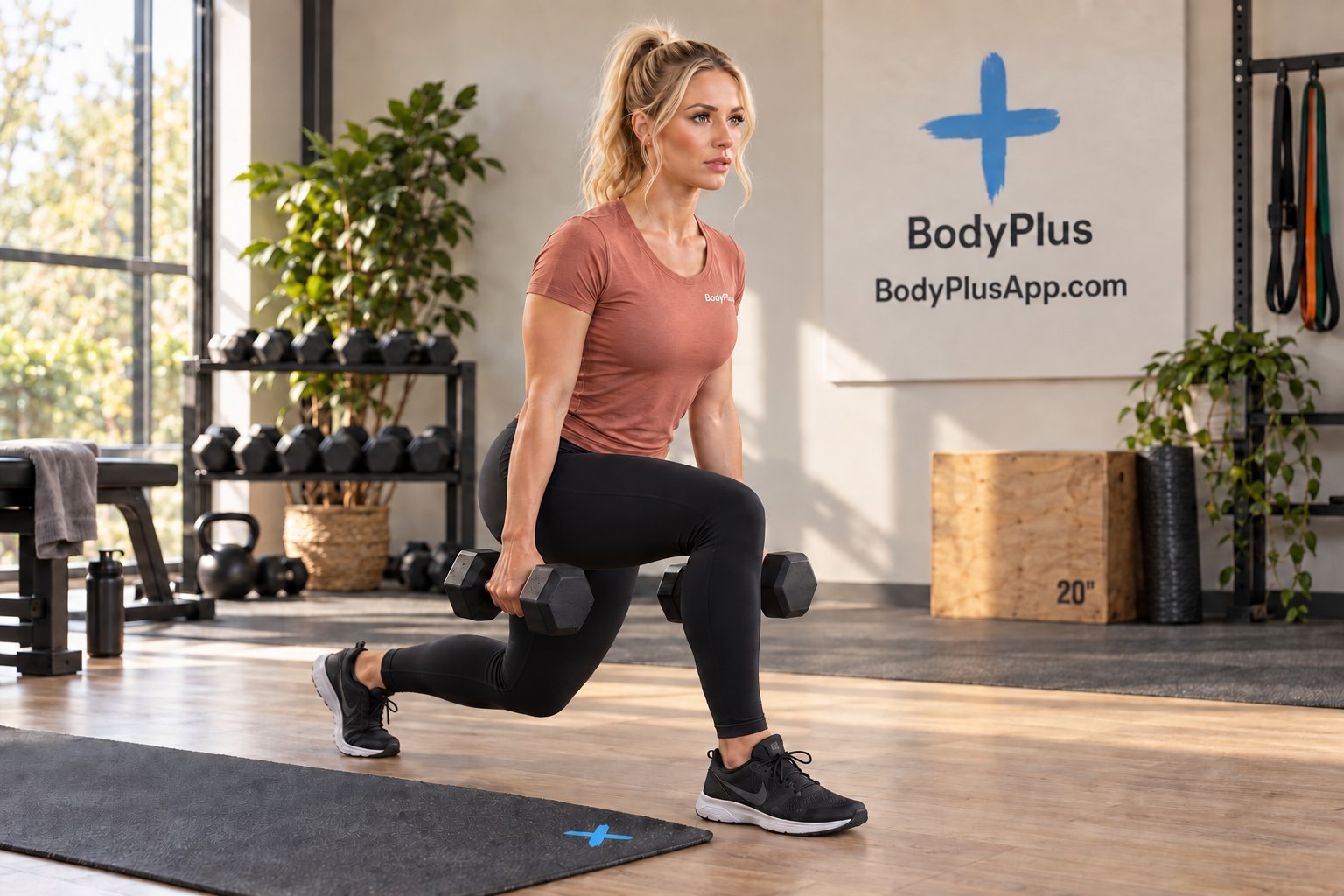
- Keep your stance width. Your feet should stay about shoulder-width apart from side to side, as if they were on two train tracks, not on one line.
- Look ahead, at a point on the wall or the floor a few meters in front of you.
- Slow down, especially on the way down, and pause at the bottom.
- Start easier. Do the reverse lunge or a split squat in place, or use only your body weight, until the movement feels steady.
- Use support while you learn. Stand next to a sturdy rack or wall, hold it with one hand and a dumbbell in the other, and do all your reps on the leg next to the rack (a reverse lunge or a split squat in place), so the dumbbell is in the hand opposite your front leg. Then turn around for the other leg. In one study of 28 men doing walking lunges with a single dumbbell, holding it in the hand opposite the front leg produced high activity in the side of the hip (gluteus medius), which works to keep you balanced.
Common mistakes
Half reps
Many people don't use the full range of motion in this exercise. They don't go down far enough, and so they lose a big part of what makes the exercise effective.
Go down until your front thigh is flat and parallel to the floor, and your back knee almost touches the ground.
A stance that is too narrow or too wide
Another mistake is standing too narrow or too wide. The wrong stance makes it harder to keep your balance, puts a lot of extra stress on your knees, and stops you from getting the most out of the exercise.
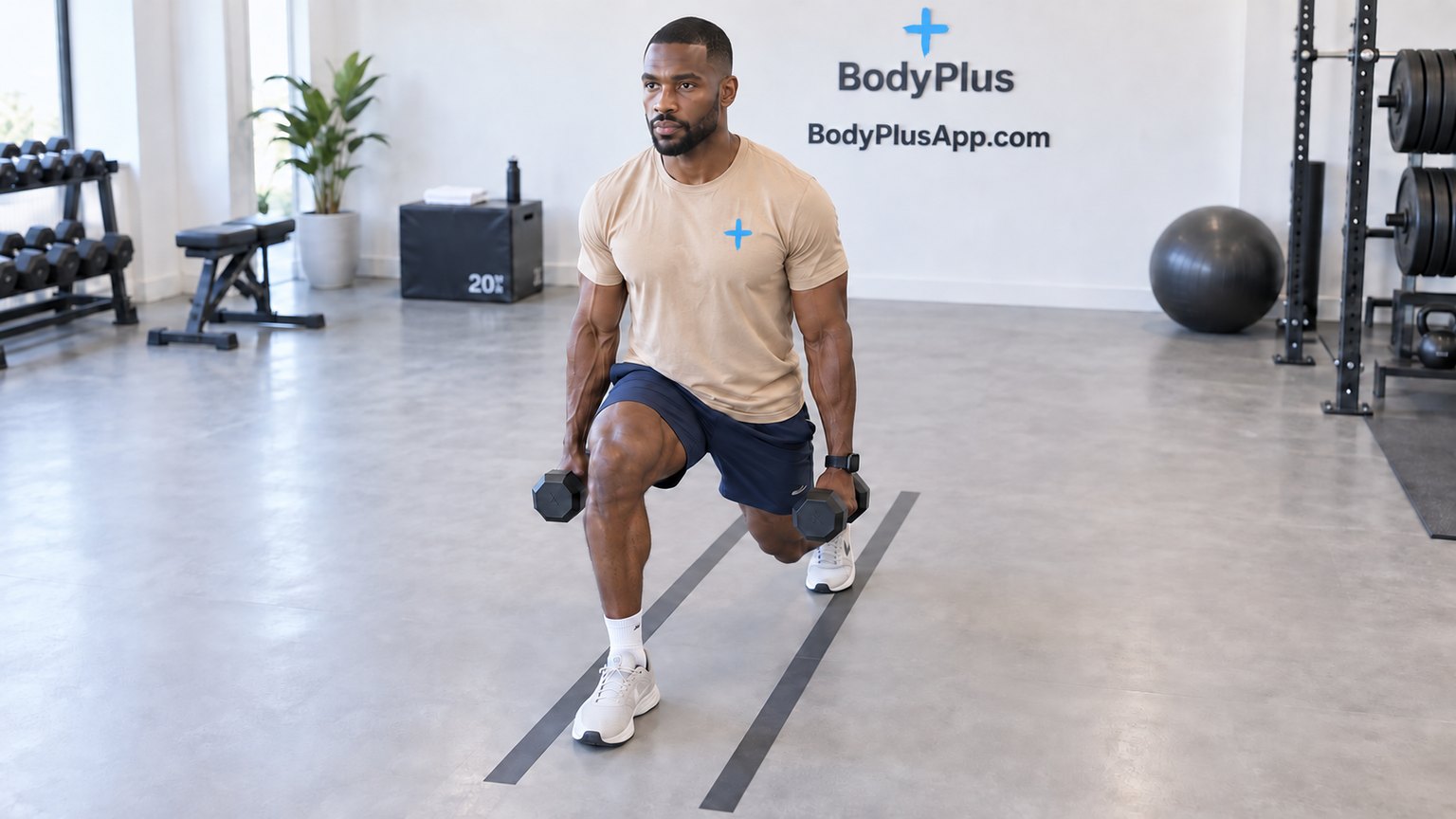
Everyone's build is different, but you should keep your feet within about shoulder-width apart. You can open or narrow your stance slightly for comfort; just make sure it isn't a big change.
Lifting the front heel
If your weight shifts onto your front toes, your heel lifts and your knee takes more of the load. Take a slightly longer step and push through your whole front foot.
Pushing off the back foot
Your back leg helps with balance, but your front leg should do most of the work. If you bounce off your back toes to get up, lighten the weight.
Letting the dumbbells swing
Swinging the weights shifts your balance. Keep your arms still and let the dumbbells hang by your sides.
Dumbbell lunge variations
Body-weight lunges
If you don't have access to dumbbells, you can do the exercise with your body weight. If you do it with good form, you will be surprised how hard it can be.
You can also make it harder in many ways: slow reps, two reps in a row on the same leg, and more.
Barbell lunges
If you are an advanced lifter, or you want to take the exercise to that level, this variation is for you. With heavy dumbbells, your hands and shoulders will tire before your legs do. With a barbell, you can load very heavy weights without tiring your forearms or shoulders.
In this variation, you rest the bar on your upper back, like in a squat, so your whole body steadies the weight. Unrack the bar from a squat rack, step back into position, and start with a weight you can balance easily: a barbell lunge is harder to bail out of than a squat.
Split squat
The split squat is similar to the lunge, with a small twist. You do the same movement, but you don't keep switching legs, and you don't step back to the start on every rep. You finish all the reps on one leg, then switch to the other. If you rest your back foot on a bench, it becomes the Bulgarian split squat.
Sets, reps and a sample workout
For most people, 2 to 4 sets of 8 to 12 reps per leg works well. Rest 60 to 120 seconds between sets, and stop most sets when you could do only one to three more good reps. Aim for about 10 or more hard sets per week for each main leg muscle group, such as your quads and glutes; lunges can count toward both.
A dumbbell leg workout
| Exercise | Sets | Reps | Rest |
|---|---|---|---|
| Dumbbell squat or goblet squat | 3 | 10-15 | 90 s |
| Dumbbell lunges | 3 | 8-12 each leg | 90 s |
| Dumbbell Romanian deadlift | 3 | 10-12 | 90 s |
| Calf raise on a step | 3 | 12-15 | 60 s |
Do it once or twice a week, with at least two days between hard leg sessions. For more choices, see my best leg exercises.
How to track your progress
Write down the weight and the reps for each leg. When every set reaches 12 reps per leg with good form and full depth, move to the next dumbbell (usually 2 kg, or 5 lb, per hand) and build the reps up again.
| Week | Weight per hand | Set 1 | Set 2 | Set 3 |
|---|---|---|---|---|
| 1 | 12 kg (about 26 lb) | 10 | 10 | 9 |
| 2 | 12 kg (about 26 lb) | 11 | 10 | 10 |
| 3 | 12 kg (about 26 lb) | 12 | 11 | 11 |
| 4 | 12 kg (about 26 lb) | 12 | 12 | 12 |
| 5 | 14 kg (about 31 lb) | 9 | 9 | 8 |
Reps are per leg. If your weaker leg can't match the other, let it set the number for both.
When heavier dumbbells get awkward to hold, use lifting straps, slow down the lowering phase, add a pause at the bottom, or switch to the barbell version.
Safety
Use a clear, flat, non-slip floor, and secure the collars if your dumbbells have removable plates. Warm up with body-weight lunges, then start with light dumbbells before adding weight. Lower slowly, pause briefly at the bottom and rise without swinging the weights. Keep your feet about shoulder-width apart from side to side, and let your back knee approach the floor without hitting it.
For the barbell variation, secure the plates with collars and have a spotter who knows how to help you return the bar to the rack. End the set if you feel pain or dizziness, lose your balance or can no longer control the movement; once stable, bring your feet together and put the dumbbells down under control.
Bottom line
Regularly including dumbbell lunges in a leg workout will improve it a great deal. It is a wonderful exercise for building muscle mass and strength across your lower body, especially your quads and glutes!
It can help improve the weights you use in squats and deadlifts, because it works the same muscles from a different angle. With all these benefits, there is no good reason not to include at least one variation of lunges in your training program.
Frequently asked questions
What muscles do lunges work?
Mainly your quads and glutes. Your inner thighs, hamstrings, calves and core help, and the side of your hip keeps you balanced.
Are dumbbell lunges good for your glutes?
Yes. In one study, the glutes were highly active in weighted forward lunges, and more so with a long step.
Are forward or reverse lunges better?
Both train the same main muscles. The reverse lunge keeps your front foot in place, so there is less to coordinate. The forward lunge adds the challenge of stopping your body as you land.
How heavy should my dumbbells be for walking lunges?
Lighter than for standing lunges. Pick a weight that lets you do 8 to 12 steady steps per leg, with one to three good reps left at the end of the set.
Should my knee go past my toes?
A little forward travel is normal. Keep your front heel down and your knee in line with your toes. A longer step keeps the knee further back.
How far should I step?
Far enough that your front thigh reaches parallel with your front heel down. A longer step shifts a little more work to your hips.
Lunges or split squats: which should I do?
Both are useful. Lunges add stepping and balance; split squats keep one leg working for the whole set. Many people do one of each over the week.
Can I do lunges at home?
Yes. You need a pair of dumbbells, a backpack with weight, or just your body weight, and a clear, flat floor.
The information on this page and on this website is intended to provide general information only. The content on this website does not constitute a professional opinion, a recommendation, or a substitute for consulting an expert in a specific field or obtaining a medical opinion. It is not medical advice. BodyPlus is not a medical device. If you have a health condition or an injury, or are pregnant, talk to a qualified healthcare professional before starting. Stop exercising and seek appropriate help if you feel pain, dizziness or other concerning symptoms.
Sources
Accessed September 17, 2026.
- Escamilla R.F. et al., "Effects of Step Length and Stride Variation During Forward Lunges on Lower-Extremity Muscle Activity", J Funct Morphol Kinesiol 2025;10(1):42. pubmed.ncbi.nlm.nih.gov/39982282
- Escamilla R.F. et al., "Patellofemoral joint force and stress between a short- and long-step forward lunge", J Orthop Sports Phys Ther 2008;38(11):681-690. pubmed.ncbi.nlm.nih.gov/18978453
- Riemann B. et al., "Biomechanical comparison of forward and lateral lunges at varying step lengths", J Sports Med Phys Fitness 2013;53(2):130-138. pubmed.ncbi.nlm.nih.gov/23584319
- Farrokhi S. et al., "Trunk position influences the kinematics, kinetics, and muscle activity of the lead lower extremity during the forward lunge exercise", J Orthop Sports Phys Ther 2008;38(7):403-409. pubmed.ncbi.nlm.nih.gov/18591759
- Bezerra E.S. et al., "Influence of Trunk Position during Three Lunge Exercises on Muscular Activation in Trained Women", Int J Exerc Sci 2021;14(1):202-210. pubmed.ncbi.nlm.nih.gov/34055138
- Stastny P. et al., "Does the Dumbbell-Carrying Position Change the Muscle Activity in Split Squats and Walking Lunges?", J Strength Cond Res 2015;29(11):3177-3187. pubmed.ncbi.nlm.nih.gov/25968228
- Vigotsky A.D. et al., "Longing for a Longitudinal Proxy: Acutely Measured Surface EMG Amplitude is not a Validated Predictor of Muscle Hypertrophy", Sports Med 2022;52(2):193-199. pubmed.ncbi.nlm.nih.gov/35006527
- Kubo K. et al., "Effects of squat training with different depths on lower limb muscle volumes", Eur J Appl Physiol 2019;119(9):1933-1942. pubmed.ncbi.nlm.nih.gov/31230110
- Currier B.S. et al., ACSM Position Stand, "Resistance Training Prescription for Muscle Function, Hypertrophy, and Physical Performance in Healthy Adults: An Overview of Reviews", Med Sci Sports Exerc 2026;58(4):851-872. pubmed.ncbi.nlm.nih.gov/41843416
- OpenStax, Anatomy and Physiology 2e, "11.6 Appendicular Muscles of the Pelvic Girdle and Lower Limbs" (the adductor magnus extends the thigh). openstax.org/books/anatomy-and-physiology-2e/pages/11-6-appendicular-muscles-of-the-pelvic-girdle-and-lower-limbs