
Chest Muscles: Anatomy, What Each Muscle Does and How to Train Them
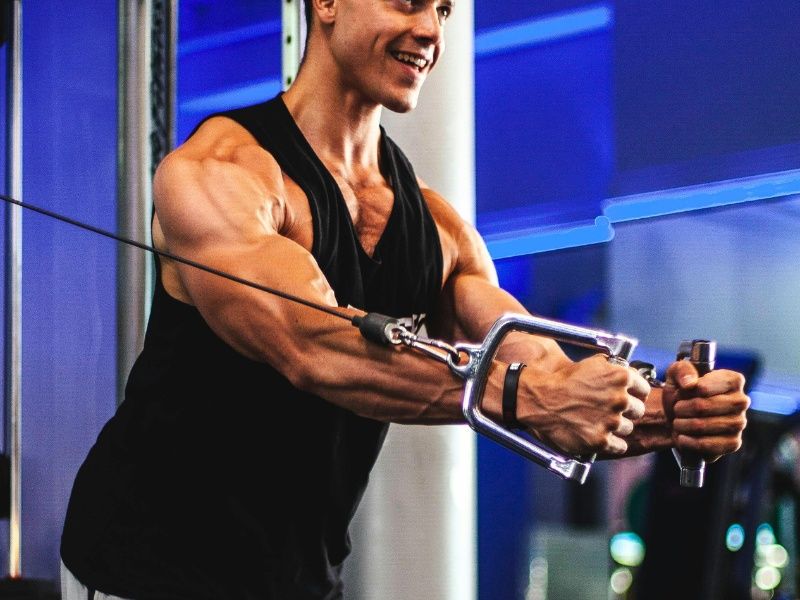
In short
Wondering what the chest muscles do and how to train them? Your main chest muscle is the pectoralis major, with a smaller pectoralis minor underneath. The major has fibers running at different angles, so I use a mix of pressing angles to train it.
There is a good reason why so many people want a muscular, toned chest. The chest muscles are a symbol of power, strength, athleticism and self-confidence. In this article, I will explain their anatomy, give you my chest training tips and show you a sample workout. So let's begin.
Anatomical structure of the chest muscles
Anatomically, your chest has two main muscles on each side:
- Pectoralis major — the large chest muscle, with a sternocostal head (middle chest) and a clavicular head (upper chest).
- Pectoralis minor — the small chest muscle beneath it.
Here is a quick map before I explain what each one does:
| Muscle | Starts on | Ends on | Main jobs | Do you see it? |
|---|---|---|---|---|
| Pectoralis major, clavicular head ("upper chest") | the front of the collarbone | the front of the upper-arm bone | raises the arm forward and up; brings it in and turns it inward | yes, the top of the chest |
| Pectoralis major, sternocostal head ("middle and lower chest") | the breastbone, the upper ribs and the sheet of tissue of the outer stomach muscle | the front of the upper-arm bone | brings the arm in and across the body; pulls a raised arm down; turns it inward | yes, most of the chest |
| Pectoralis minor | the 3rd to 5th ribs | a small hook on the front of the shoulder blade (the coracoid process) | pulls the shoulder blade down and forward; helps you breathe in | no, it lies under the pectoralis major |
| Serratus anterior | the outer surface of the upper 8 or 9 ribs | the inner edge of the shoulder blade, on the side that faces the ribs | pulls the shoulder blade forward around the ribcage; helps you breathe in | partly, on the side of the ribs |
Pectoralis major: the large chest muscle
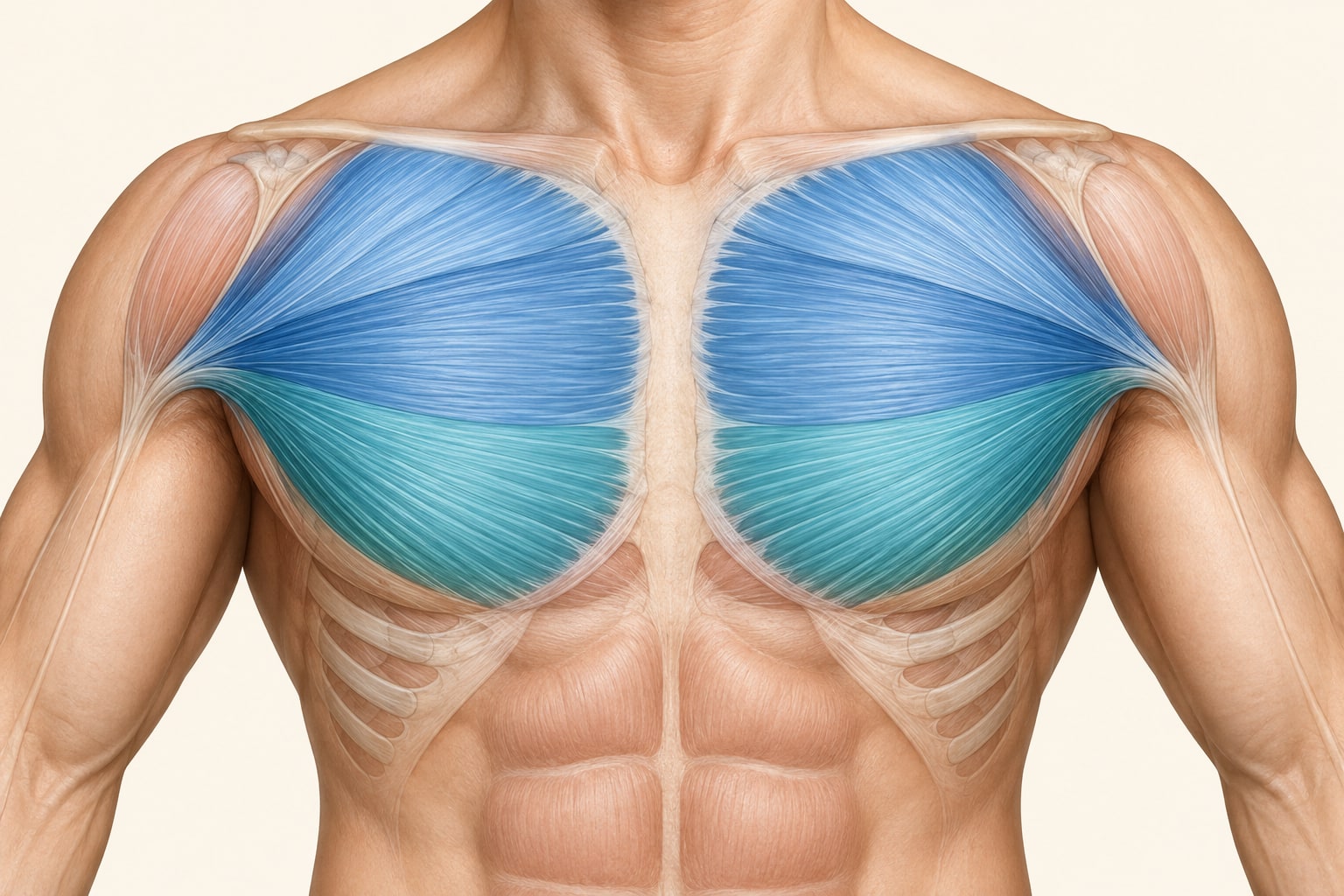
The pectoralis major is the large and significant part of your chest. It starts at the collarbone (clavicle), the breastbone (sternum) and the ribs. It spreads across your chest and ends at the upper-arm bone (humerus).
This muscle has a big part in everyday movements. It helps you raise the arm, rotate it inward and bring it forward and across your body.
The pectoralis major has two heads:
Sternocostal head — middle chest
This is the wider and more substantial part of the large chest muscle. It starts at the breastbone and makes up the larger part of the pectoralis major. This part gives the chest its main appearance. In movement, it does much of the work in pushes without an incline, such as the bench press.
Clavicular head — upper chest
The clavicular head is the part known as the upper chest, and it starts at the collarbone. It helps lift your arm forward and up. To train this part, do exercises on an upward incline, so your arms rise diagonally upward.
Pectoralis minor: the small chest muscle
The pectoralis minor lies beneath the pectoralis major. It starts at the middle ribs and connects to the shoulder blade. You cannot see it because it is underneath, and it does not affect how the chest looks. Nevertheless, it helps stabilize the shoulder blades, takes part in shoulder movement and helps with breathing.
You do not work this muscle directly in a chest workout. It acts as a stabilizer in many back, shoulder and chest exercises. That is one reason I like to train the muscles of the body in a balanced way.
The front shoulder, serratus anterior and subclavius also work with the chest. I will not go deep into them here: the front shoulder belongs with the shoulder muscles, and the others are smaller helpers. The serratus helps move the shoulder blade around the ribs; the subclavius helps steady the collarbone.
What the chest angles mean
The fibers spread at different angles. That is why I include different presses in a chest workout. The studies below help explain the incline choice; muscle activity in a single workout does not by itself prove long-term growth.
In Rodríguez-Ridao and colleagues' study of 30 trained adults, upper-chest activity was highest at a 30-degree bench incline; a flat bench emphasized the middle and lower fibers. Chaves and colleagues followed 47 untrained men for eight weeks and found similar strength gains with flat, incline or combined presses, while the incline group gained the most thickness at one upper-chest site. Those results support using more than one angle, without promising that one angle builds only one part.
Chest training tips
Focus on technique instead of heavy weights
Lifting heavy weights in chest exercises is tempting and fun, especially in the bench press, but it comes with problems. The heavier the weight for fewer reps, the greater the risk of injury, even if your technique is good. Put technique first.
If you still want to lift heavy for 1–5 reps, make sure you recover enough. Every few weeks, do a lighter workout so your body can recover. For a heavy barbell press, use a spotter or the safety bars of a rack; my bench press guide shows how.
Focus on stretching and contracting the chest
To train the chest as effectively as possible, you need to contract and stretch it during your exercises. It matters that you feel the muscle while you train it. That helps you focus, and it may help muscle growth; the evidence for the chest itself is limited.
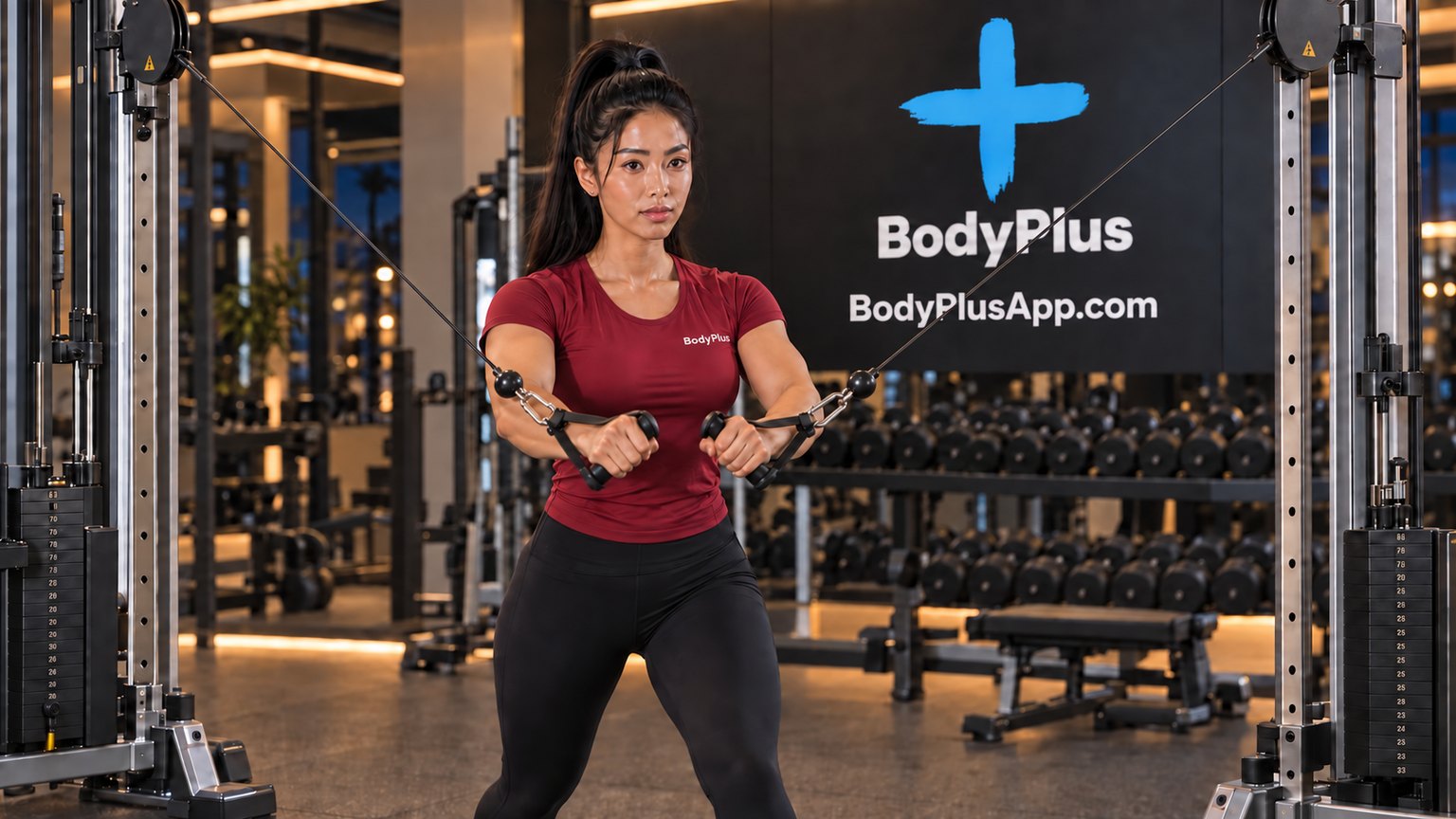
If you do not feel the chest during a workout, work on your mind-muscle connection: deliberately contract and stretch the muscle. The cause might also be your technique or a weak assisting muscle, such as the shoulders.
Schoenfeld and colleagues found more arm growth after eight weeks when beginners focused on the working muscle, but not more thigh growth. In Paoli and colleagues' bench-press study, an instruction to focus on the chest did not raise chest activity. That is why I treat the cue as a tip to try, rather than a guarantee.
Include a variety of movements
There is enormous value in including different movements. The chest fibers do not run in a straight line; they spread like a fan.
Why does this matter? Moving at different angles lets you emphasize different fibers of the pectoralis major. The whole muscle still works in a press, even when one area takes more of the work.
This is how to work the different parts:
- Upper part: exercises on a positive incline, such as the incline dumbbell press and the incline bench press.
- Middle part: exercises without an incline, such as the flat bench press, the dumbbell bench press and the chest press machine.
- Lower part: dips with a forward lean, or a cable fly from high to low.
Note that these are not three separate chest muscles. They are fibers at different angles, all part of the pectoralis major. The lower-chest choices above are my coaching examples; the studies listed here did not test those two exercises.
Focus on compound exercises
Compound exercises involve several joints and muscles at once. Here is why I put them at the center of a chest workout:
- A balanced body: in these movements your chest, triceps and shoulders work together. That helps you develop your whole upper body in harmony.
- Strength: these exercises let you lift a lot of weight. Your muscles and your nervous system adapt, and you get stronger.
- Function: these movements are often similar to things you do in everyday life, like pushing something away from you.
- Time savings: you work several muscles together, so you save time.
Barbell and dumbbell presses, the chest press machine, dips and push-ups are examples. My chest exercises guide has the full list.
An example chest workout
Planning a workout takes thought. You need to consider the anatomy, choose exercises that fit, balance strength and muscle growth, weigh risk against benefit, pay attention to technique and decide on sets and reps.
This is an illustrative workout with example sets, reps and rest times: compound presses first, two pressing angles, a fly and a movement for the serratus anterior.
| Exercise | Emphasis | Sets | Reps | Rest |
|---|---|---|---|---|
| Incline dumbbell press (about 30 degrees) | upper chest | 3 | 6-10 | 2 min |
| Flat bench press or chest press machine | middle chest | 3 | 6-10 | 2 min |
| Cable fly from high to low, or dips with a forward lean | lower fibers, stretch and squeeze | 2-3 | 10-15 | 60-90 s |
| Push-up plus | serratus anterior | 2 | 8-12 | 60 s |
How to use this example
- Try it once or twice a week, with at least two days between hard chest sessions.
- Warm up with one or two light sets. On most working sets, stop when you could do only one to three more good reps.
- For heavy barbell presses, use a spotter or safety bars. If dips bother your shoulders, choose the cable fly instead.
An example progression log
The log below illustrates how the incline dumbbell press might progress if weight goes up only after all three sets reach the top of the range with good form:
| Week | Exercise | Weight per dumbbell | Set 1 | Set 2 | Set 3 |
|---|---|---|---|---|---|
| 1 | Incline dumbbell press | 20 kg (about 44 lb) | 10 | 8 | 7 |
| 2 | Incline dumbbell press | 20 kg (about 44 lb) | 10 | 9 | 8 |
| 3 | Incline dumbbell press | 20 kg (about 44 lb) | 10 | 10 | 9 |
| 4 | Incline dumbbell press | 20 kg (about 44 lb) | 10 | 10 | 10 |
| 5 | Incline dumbbell press | 22 kg (about 48 lb) | 8 | 7 | 7 |
In week 5, the reps drop after the weight goes up. Build them back up to 10 before the next jump.
Bottom line
Understanding how the chest muscles are built gives you a foundation for training them. Now you know which movements they help with and why I use different angles.
It is very important to change your training program about every 6–12 weeks. That way your body does not adapt to the load and stop progressing.
There is more to consider in a full chest plan: the balance between the fibers, exercise angles, sets, reps and rep ranges. Review your plan about every 6–12 weeks. Keep what is helping you progress and adjust what needs a new challenge; you do not have to change exercises just because the calendar says so. A 2022 review by Kassiano and colleagues found that planned variation can help muscle growth and strength, while changing exercises too often or at random may hold progress back.
Frequently asked questions
What are the names of the chest muscles?
The pectoralis major (with a clavicular and a sternocostal head) and the pectoralis minor, together called the pectoral muscles or "pecs". The serratus anterior on the side of the ribs and the small subclavius under the collarbone also sit in the chest area.
What does the pectoralis major do?
It raises your arm forward, brings it in and across your body, turns it inward, and pulls a raised arm down.
What is the upper chest?
The clavicular head of the pectoralis major, the part that starts on your collarbone.
What are the best upper chest exercises?
Presses on an incline bench, such as the incline dumbbell press and incline bench press. In one barbell study, upper-chest activity peaked at a 30-degree incline.
Can you target the inner or lower chest?
Every chest exercise trains the whole pectoralis major. The angle can shift the emphasis, most clearly toward the upper chest on an incline, but no checked study shows that you can train the inner or lower chest on its own.
Do women have the same chest muscles?
Yes. The muscles are the same and lie under the breast tissue, and the exercises and technique are the same for everyone.
Why don't I feel my chest when I bench press?
Common causes are technique, a weight that is too heavy, or weaker shoulders or triceps taking over. Lower the weight, slow the lowering, and think about squeezing your chest.
What if my chest or shoulder hurts during training?
If you feel chest pain during training, stop the workout. Do not test it again with a lighter weight. If an exercise bothers your shoulder, stop that set and choose a pain-free variation or a lighter weight instead of pushing through it.
The information on this page and on this website is intended to provide general information only. The content on this website does not constitute a professional opinion, a recommendation, or a substitute for consulting an expert in a specific field or obtaining a medical opinion. It is not medical advice. BodyPlus is not a medical device. If you have a health condition or an injury, or are pregnant, talk to a qualified healthcare professional before starting. Stop exercising and seek appropriate help if you feel pain, dizziness or other concerning symptoms.
Sources
Accessed September 17, 2026.
- OpenStax, Anatomy and Physiology 2e, "11.5 Muscles of the Pectoral Girdle and Upper Limbs" (pectoralis major shape and actions; origins, insertions and actions of the pectoralis minor, serratus anterior and subclavius). openstax.org/books/anatomy-and-physiology-2e/pages/11-5-muscles-of-the-pectoral-girdle-and-upper-limbs
- Solari F., Burns B., "Anatomy, Thorax, Pectoralis Major", StatPearls, NCBI Bookshelf, updated 2023-07-24 (origins of each head, insertion, actions, nerve supply). www.ncbi.nlm.nih.gov/books/NBK525991
- Baig M.A., Bordoni B., "Anatomy, Shoulder and Upper Limb, Pectoral Muscles", StatPearls, NCBI Bookshelf, updated 2023-08-28 (pectoralis minor, serratus anterior, subclavius). www.ncbi.nlm.nih.gov/books/NBK545241
- Fung L. et al., "Three-dimensional study of pectoralis major muscle and tendon architecture", Clin Anat 2009;22(4):500-508. pubmed.ncbi.nlm.nih.gov/19291757
- Rodríguez-Ridao D. et al., "Effect of Five Bench Inclinations on the Electromyographic Activity of the Pectoralis Major, Anterior Deltoid, and Triceps Brachii during the Bench Press Exercise", Int J Environ Res Public Health 2020;17(19):7339. pubmed.ncbi.nlm.nih.gov/33049982
- Cabral H.V. et al., "Non-uniform excitation of the pectoralis major muscle during flat and inclined bench press exercises", Scand J Med Sci Sports 2022;32(2):381-390. pubmed.ncbi.nlm.nih.gov/34644424
- Albarello J.C.D.S. et al., "Non-uniform excitation of pectoralis major induced by changes in bench press inclination leads to uneven variations in the cross-sectional area measured by panoramic ultrasonography", J Electromyogr Kinesiol 2022;67:102722. pubmed.ncbi.nlm.nih.gov/36334406
- Chaves S.F.N. et al., "Effects of Horizontal and Incline Bench Press on Neuromuscular Adaptations in Untrained Young Men", Int J Exerc Sci 2020;13(6):859-872. pubmed.ncbi.nlm.nih.gov/32922646
- Pinto M.D. et al., "Pectoralis Clavicular and Sternocostal Thicknesses Increase Similarly in Response to One and Three Sets of Pec Deck Resistance Training in Untrained Young Men", J Strength Cond Res 2025;39(5):523-530. pubmed.ncbi.nlm.nih.gov/40266636
- Vigotsky A.D. et al., "Longing for a Longitudinal Proxy: Acutely Measured Surface EMG Amplitude is not a Validated Predictor of Muscle Hypertrophy", Sports Med 2022;52(2):193-199. pubmed.ncbi.nlm.nih.gov/35006527
- Ludewig P.M. et al., "Relative balance of serratus anterior and upper trapezius muscle activity during push-up exercises", Am J Sports Med 2004;32(2):484-493. pubmed.ncbi.nlm.nih.gov/14977678
- Kang F.J. et al., "Serratus Anterior and Upper Trapezius Electromyographic Analysis of the Push-Up Plus Exercise: A Systematic Review and Meta-Analysis", J Athl Train 2019;54(11):1156-1164. pubmed.ncbi.nlm.nih.gov/31584855
- Schoenfeld B.J. et al., "Differential effects of attentional focus strategies during long-term resistance training", Eur J Sport Sci 2018;18(5):705-712. pubmed.ncbi.nlm.nih.gov/29533715
- Paoli A. et al., "Mind-muscle connection: effects of verbal instructions on muscle activity during bench press exercise", Eur J Transl Myol 2019;29(2):8250. pubmed.ncbi.nlm.nih.gov/31354928
- Kassiano W. et al., "Does Varying Resistance Exercises Promote Superior Muscle Hypertrophy and Strength Gains? A Systematic Review", J Strength Cond Res 2022;36(6):1753-1762. pubmed.ncbi.nlm.nih.gov/35438660
- Currier B.S. et al., ACSM Position Stand, "Resistance Training Prescription for Muscle Function, Hypertrophy, and Physical Performance in Healthy Adults: An Overview of Reviews", Med Sci Sports Exerc 2026;58(4):851-872. pubmed.ncbi.nlm.nih.gov/41843416