
Back Muscles: Anatomy, Names and How to Train Each One
In short
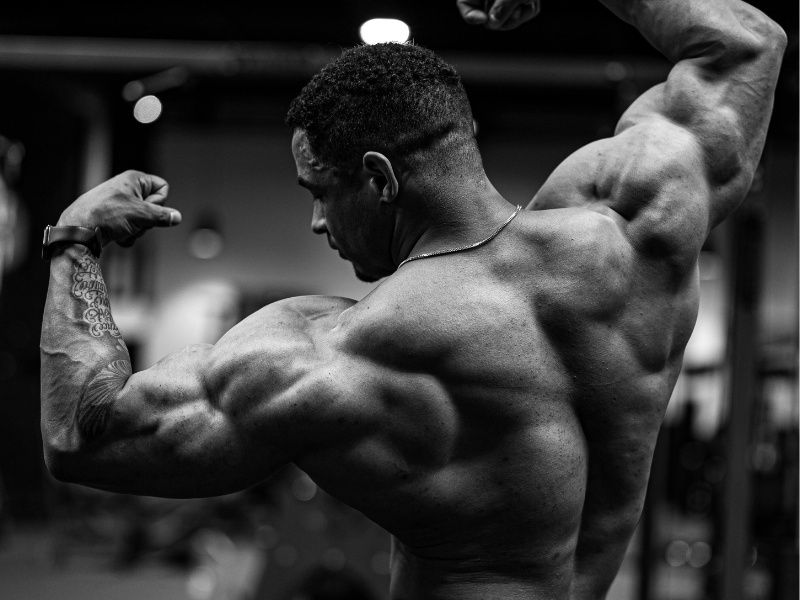
You can't see your back muscles in the mirror, and they won't stand out in a photo taken from the front. But in bodybuilding they are a symbol of strength and power. Your back contains many muscles, not just one: the lats give it width, the traps and rhomboids work around your shoulder blades, and the spinal erectors run along your spine. I will show you how they fit together and how I plan a back workout. So come on, let's get started.
A developed back can give your body a harmonious, complete look. The more you understand these muscles, the easier it is to choose movements for them.
Anatomical structure of the back muscles
Many people treat the back as one muscle, but they are wrong. It is made up of many different muscles. The exact number depends on how you define the boundaries of the back; broadly speaking, there are about 40, with 20 on each side.
Since our goal is bodybuilding and building muscle in the back, I'll focus on the main muscles. There is no point in going into all the small ones. The large muscles give the back its main appearance, and the small muscles help when you train them.
These are the main groups I'll cover: the trapezius, rhomboids, latissimus dorsi, rotator cuff and erector spinae. The table also shows the teres major and rear deltoids, which help in back exercises.
The back muscles at a glance
| Muscle | Where it is | Main job | Train it with |
|---|---|---|---|
| Latissimus dorsi (lats) | the wide muscles on the sides of your mid and lower back | pull your upper arm down, back and in toward your body; turn it inward | pull-ups, lat pulldowns, rows, pullovers |
| Trapezius (traps), upper part | from the base of your skull and your neck to the top of your shoulders | lift your shoulder blades (shrug); help move your head and neck | shrugs (deadlifts also load them) |
| Trapezius, middle part | across the top of your back, between your shoulder blades | pull your shoulder blades together | rows, face pulls |
| Trapezius, lower part | from the middle of your back up to your shoulder blades | pull your shoulder blades down | I-Y-T raises, bent-over rows |
| Rhomboids | under the traps, between your spine and your shoulder blades | pull your shoulder blades together and hold them steady | rows, face pulls, band pull-aparts |
| Teres major | a small, thick muscle at the outer edge of your shoulder blade, near the armpit | helps the lats pull your arm back and in | pull-ups, pulldowns, rows |
| Rotator cuff (four muscles) | on and around your shoulder blade, wrapping the shoulder joint | turn your upper arm in and out; keep the shoulder joint steady | compound pulls; light band rotations |
| Erector spinae | two columns along your spine, from your pelvis up | straighten your spine, hold it upright, bend it to the side | deadlifts, bent-over rows, back extensions |
| Rear deltoids (shoulder muscles) | the back of your shoulders | help pull your arm back | rows with elbows out, face pulls |
Trapezius (traps)
The trapezius muscles start at the base of your skull and extend to the middle of your back. They are large, central muscles; if you want to develop your back, don't leave them out.
So where is the problem? Most people who train don't know how to train them. Either they don't train them enough, or they focus only on the upper traps (shrugging the shoulders up).
The traps are divided into three parts: upper, middle and lower. The fibers of each part run at a different angle:
- Upper traps: lift your shoulder blades up (the shrug) and help tilt your head back and to the side.
- Middle traps: mainly pull your shoulder blades back, toward each other.
- Lower traps: mainly pull your shoulder blades down, and help them rotate as you raise your arms.
The traps support shoulder-blade movement and help steady your neck and tilt your head. I would train all three parts, not just the upper traps.
To train the traps, shrugs work the upper part, and rows work the middle part. In an ACE-sponsored (not peer-reviewed) study of 19 young men with training experience, which measured muscle activity in eight back exercises, the bent-over row, the inverted row and the seated row were among the top exercises for the middle traps, while a set of I, Y and T raises (lifting straight arms in those letter shapes while lying face down or bent forward) led for the lower traps.
Rhomboids
The rhomboids sit under the traps, so you can't see them. They run from your spine to the inner edge of your shoulder blades. Their main job is to pull your shoulder blades back and to help hold them steady, which helps you keep a good posture.
To work these muscles, you need to squeeze your shoulder blades back. They are trained like the middle and lower traps: rows, face pulls and band pull-aparts.
Latissimus dorsi (lats)
Many trainees aim for a V-shaped back, and this is the muscle they focus on. One of its most common nicknames is "the wings." The lats are the largest muscles of the back. They spread out to the sides, making them one of the main muscles behind its width.

The lats start in the lower back and spread upward and across to the upper arm. They connect through a broad sheet of tissue near the spine and pelvis, then wrap under the armpit to attach to the upper-arm bone.
Their main jobs are to move your shoulder and arm: they pull your arm down and back, bring it in toward your body, and turn it inward. When your hands are fixed on a bar above you, as in a pull-up, they pull your body up.
Rotator cuff
The shoulder rotators are small muscles that don't take up much volume, but they help steady the shoulder joint. They also add small details to the look of a developed back.
The rotator cuff is made of four muscles: the supraspinatus, the infraspinatus, the teres minor and the subscapularis. Their tendons connect your shoulder blade to your upper-arm bone and form a ring around the shoulder joint.
Their main job is to rotate your shoulder and to keep your shoulder girdle steady. If you are a beginner, there is no need to isolate them: they work enough in compound exercises.
When you train them directly is to use a light load for a high number of repetitions,
- Band rotations: anchor a light band at about elbow height, beside you. Keep your elbow bent at 90 degrees and against your side, and turn your forearm out, away from your body, or in, across your body, depending on which side the band pulls from. Move slowly.
- Holds for stability: hold a light weight in front of your body with your elbow bent at 90 degrees, and keep it still for a few seconds (an isometric hold).
Stop if either exercise causes sharp pain in your shoulder.
Erector spinae (spinal erectors)
The erector spinae is one of the most important muscle groups in your body. Its main jobs are to straighten your spine, to control it when you bend forward, to bend it to the side, and to keep it steady. These muscles work very hard all day long: whenever you stand, sit, bend over or straighten up.
The group consists of three muscles: the spinalis, longissimus and iliocostalis. They start near the sacrum and pelvis, run along the spine and reach toward the skull. They attach at different points on the vertebrae and ribs.
In practice, many people think of them as the muscles of "the lower back".
The bent-over row and deadlift make these muscles work to hold your position. In the ACE study, the bent-over row produced the highest erector activity of the eight exercises. A back extension gives them direct work.
Tips for training the back muscles
Proper technique
Most people in the gym don't know how to train their back with good technique. Here are some of the most common mistakes:
1. Short range of motion, momentum and weights that are too heavy
These mistakes usually come together, mostly because of ego. They can put more stress on your shoulders and lower back.
They also reduce the load that reaches the muscles you want to train. The number on the weight matters less than the work your muscles actually do. Choose a weight you can move through the full range with control.
2. Loose shoulder blades and rounded shoulders
The second mistake is not squeezing your shoulder blades back and down, and letting your shoulders round forward.
When you train, squeeze your shoulder blades back and down, especially when you work with heavy weights. It keeps your shoulders in a steady position and prevents many related technique problems.
3. Rounding your lower back
In some exercises, such as the deadlift or the bent-over row, rounding your lower back under a heavy load is a recipe for trouble. Keep your back long and neutral for the whole set, and stop when you can no longer hold that position. In a small lab study of seven healthy men, the standing bent-over row produced large muscle activity from the upper to the lower back, but also the largest load on the lower spine of the three rows tested. That doesn't make the row dangerous; it means the position has to be solid before the weight goes up.
4. Gripping too hard
Your back moves your shoulder and arm, so there is no reason to crush the bar. Gripping too tightly can tire your biceps and forearms quickly and hurt the effectiveness of your back workout. In rows, think of your hands as lifting hooks and your elbows moving backward. Keep your thumb around the bar so the grip stays secure.
Good technique is a skill you build over time. What matters most at the start is to avoid the main mistakes that can lead to injury.
Use compound exercises
Compound exercises have countless benefits, especially for building your back muscles. A compound exercise is one that moves more than one joint of your body, and usually many muscles work together in it.
Once you understand how many muscles your back has, you can see that it's impossible to isolate each one. Only when you include compound exercises in your workout will you work all the parts of your back properly. They save you time, and they help you avoid weak spots and imbalances between the parts of your back.
Compound exercises also let you lift heavier weights. A review of the research explains that early strength gains from resistance training are thought to come mainly from the nervous system learning to use your muscles more fully. This helps you recruit more strength and contract the muscles harder as your training progresses.
Back thickness and width
Bodybuilding looks at two main things you can see in a back: width and thickness. For your back to look really good and balanced, you need to work on both.
Back width
The main muscle behind the width of your back is the latissimus dorsi. You can work on it mainly with pulling exercises, such as the wide-grip pull-up or the wide-grip lat pulldown.

Lat activity is similar across grip widths and grip types. Pick a grip that feels good for your shoulders and lets you pull through a full range; the lat pulldown guide has the details.
Back thickness
The main muscles behind the thickness of your back are the traps, the rhomboids and the teres major. You can work on them with the bent-over row, the deadlift, the underhand-grip pull-up (chin-up) and more.
On row machines, grip and elbow position change how the work is shared. A 2026 review of 23 muscle-activity (EMG) studies on the lats found that in the seated row, a narrower grip and keeping the elbows closer to your body were each linked with more lat activity, in separate studies. The authors suggest that the angle between your upper arm and your body is a key factor in how the work is shared; coaches often use rows with the elbows out to put more work on the upper back and rear shoulders. The review calls its findings a tentative starting point.
When you plan a back workout, include at least one row, one pull and a pullover variation. The pullover (straight-arm pulldown) trains your lats with straight arms and gives them another angle; the same review found that it also works your chest muscles a lot, so treat it as an addition to your rows and pulls, not a replacement.
All of these studies measured muscle activity in one session, and higher activity does not prove an exercise builds more muscle over time.
Plan the workout properly
When you plan a back workout, you need to take many things into account: which exercises, their order, the number of reps, and your own strengths and weaknesses. Your back workout must follow a certain order, or you won't get the most out of it.
For example, if you do a deadlift in your back workout, I put it first. It demands the most resources from your body. After several other exercises, you may not lift as much weight, and your technique may slip. The 2026 position stand of the American College of Sports Medicine (ACSM) supports this: strength gains were better when an exercise was done at the start of the session.
Another example: back exercises tire your forearms a lot. If your grip is a problem, put an exercise like the pullover in the middle of the workout. The pullover is easier on your forearms than rows are. It gives them a little time to recover, so you can finish the workout properly.
There are countless other situations to consider. Beginners may find it hard to choose exercises, order and repetitions, so start with a simple plan you can follow and adjust.
Ready-made training programs for back muscles
Here is a sample you can use to put the ideas above into practice.
A sample back workout
Here is a sample workout built on the ideas above, with the pullover in the middle to rest your forearms.
| Exercise | Main muscles | Sets | Reps | Rest |
|---|---|---|---|---|
| Barbell bent-over row | lats, traps, rhomboids, erectors | 3 | 6-10 | 2 min |
| Pull-up or lat pulldown | lats, teres major | 3 | 6-12 | 2 min |
| Cable pullover (straight-arm pulldown) | lats | 2 | 10-15 | 60-90 s |
| Seated row machine, close neutral grip | lats, middle traps, rhomboids | 3 | 10-12 | 90 s |
| Face pull or prone Y raise | rear deltoids, middle and lower traps, rotator cuff | 2 | 12-15 | 60 s |
That is 13 working sets in this example. The ACSM position stand linked about 10 or more hard sets per muscle group per week with more muscle growth. Use the table as an example, and adjust the amount of work to your current training.
How to use it
- Effort: stop most sets when you could do only one to three more good reps. Warm up with one or two light sets of the first exercise.
- With deadlifts: if you deadlift on this day, do it first. Then cut the bent-over row to 2 sets or swap it for a chest-supported row, because both exercises load your lower back.
- Lower back: if you don't deadlift or row with a barbell, add 2 sets of slow back extensions at the end.
- Shrugs: for more upper-trap work, add 2-3 sets at the end.
- At home: one-arm dumbbell rows, a doorway pull-up bar or band pulldowns, band pullovers, band rows and band pull-aparts cover the same movements. See home workout exercises.
- In a weekly plan: it fits the pull day of the push/pull/legs plan or an upper day of the upper/lower split.
Face pull, step by step
1. Set a cable at about face height with a rope, hold both ends, and step back until your arms are straight and the cable is tight; stand tall with your stomach braced. 2. Pull the rope toward your face, spreading the ends apart, with your elbows high and out to the sides. Squeeze your shoulder blades back and down at the end. 3. Return slowly until your arms are straight, then repeat. Use a light weight.
A simple log
Write down every set. Add weight only when every set reaches the top of the rep range with good form:
| Week | Exercise | Weight | Set 1 | Set 2 | Set 3 |
|---|---|---|---|---|---|
| 1 | Seated row machine | 40 kg (about 88 lb) | 12 | 11 | 10 |
| 2 | Seated row machine | 40 kg (about 88 lb) | 12 | 12 | 11 |
| 3 | Seated row machine | 40 kg (about 88 lb) | 12 | 12 | 12 |
| 4 | Seated row machine | 45 kg (about 99 lb) | 10 | 10 | 9 |
In week 4 the reps drop after the jump; build them back up to 12 before the next one. Weight stacks differ between machines, so compare your numbers on the same machine.
Bottom line
The back muscles are not just another muscle group. To me, they are a symbol of strength, power and dedication. Developing the lats can add width, while the traps, rhomboids and other muscles add thickness. Training both is how I think about a complete back.
Building a good back program is not simple. There are many muscles, and you have to think about exercise choice, movement angles, sets, repetitions, order and the balance between work and risk. Putting those pieces together takes real knowledge and experience. Start with the simple row, pull and pullover plan above, then adapt it as you learn what works for you.
Frequently asked questions
What are the main muscles of the back?
The lats, traps, rhomboids, teres major, rotator cuff and erector spinae, helped by the rear deltoids.
How many muscles are in the back?
About 40, 20 on each side, by a common estimate; it depends on where you draw the borders of the back.
What are the upper back muscles?
The upper and middle traps, the rhomboids, the teres major and the rotator cuff, helped by the rear deltoids. Rows, face pulls and shrugs train them.
Which is the largest back muscle, and which adds width?
The latissimus dorsi. It spreads from your lower back and pelvis to your upper arm and helps add width to your back; pull-ups and lat pulldowns train it directly.
What exercises work all the back muscles?
No single exercise works every back muscle hardest; in the ACE-sponsored study the bent-over row was the best all-round choice. Combine a row, a vertical pull and a pullover.
Is the lower back a muscle?
No, it is an area. People usually mean the erector spinae, which are thickest there.
The information on this page and on this website is intended to provide general information only. The content on this website does not constitute a professional opinion, a recommendation, or a substitute for consulting an expert in a specific field or obtaining a medical opinion. It is not medical advice. BodyPlus is not a medical device. If you have a health condition or an injury, or are pregnant, talk to a qualified healthcare professional before starting. Stop exercising and seek appropriate help if you feel pain, dizziness or other concerning symptoms.
Sources
Accessed September 17, 2026.
- OpenStax, Anatomy and Physiology 2e, "11.5 Muscles of the Pectoral Girdle and Upper Limbs" (trapezius, rhomboids, latissimus dorsi, teres major, the rotator cuff muscles and the deltoid, their attachments and actions). openstax.org/books/anatomy-and-physiology-2e/pages/11-5-muscles-of-the-pectoral-girdle-and-upper-limbs
- Ourieff J., Scheckel B., Agarwal A., "Anatomy, Back, Trapezius", StatPearls, NCBI Bookshelf, updated 2023-03-11 (extent, the three parts and their actions, posture). www.ncbi.nlm.nih.gov/books/NBK518994
- Jeno S.H., Varacallo M.A., "Anatomy, Back, Latissimus Dorsi", StatPearls, NCBI Bookshelf, updated 2023-03-05 (attachments, actions, pulling the body up with the arms fixed, the teres major link). www.ncbi.nlm.nih.gov/books/NBK448120
- Modes R.J., Lafci Fahrioglu S., "Anatomy, Back", StatPearls, NCBI Bookshelf, updated 2023-02-27 (the layers, the rhomboids under the traps, the three erector spinae muscles, their origins and actions). www.ncbi.nlm.nih.gov/books/NBK539746
- Henson B., Kadiyala B., Edens M.A., "Anatomy, Back, Muscles", StatPearls, NCBI Bookshelf, updated 2023-08-14 (the erectors control forward bending). www.ncbi.nlm.nih.gov/books/NBK537074
- Elzanie A., Varacallo M.A., "Anatomy, Shoulder and Upper Limb, Deltoid Muscle", StatPearls, NCBI Bookshelf, updated 2024-01-30 (the posterior deltoid works with the lats to extend the arm). www.ncbi.nlm.nih.gov/books/NBK537056
- Edelburg H. et al., "ACE-Sponsored Research: What Is the Best Back Exercise?", ACE Certified, April 2018. www.acefitness.org/continuing-education/certified/april-2018/6959/ace-sponsored-research-what-is-the-best-back-exercise
- Fenwick C.M., Brown S.H., McGill S.M., "Comparison of different rowing exercises: trunk muscle activation and lumbar spine motion, load, and stiffness", J Strength Cond Res 2009;23(5):1408-1417. pubmed.ncbi.nlm.nih.gov/19620925
- Andersen V. et al., "Effects of grip width on muscle strength and activation in the lat pull-down", J Strength Cond Res 2014;28(4):1135-1142. pubmed.ncbi.nlm.nih.gov/24662157
- Buonsenso A. et al., "Electromyographic Analysis of Back Muscle Activation During Lat Pulldown Exercise: Effects of Grip Variations and Forearm Orientation", J Funct Morphol Kinesiol 2025;10(3):345. pubmed.ncbi.nlm.nih.gov/40981044
- Di Fonza D. et al., "Electromyographic Analysis of Latissimus Dorsi Activation During Common Resistance Training Exercises: A Narrative Review", J Funct Morphol Kinesiol 2026;11(3):315. pubmed.ncbi.nlm.nih.gov/42647355
- Škarabot J. et al., "The knowns and unknowns of neural adaptations to resistance training", Eur J Appl Physiol 2021;121(3):675-685. pubmed.ncbi.nlm.nih.gov/33355714
- Vigotsky A.D. et al., "Longing for a Longitudinal Proxy: Acutely Measured Surface EMG Amplitude is not a Validated Predictor of Muscle Hypertrophy", Sports Med 2022;52(2):193-199. pubmed.ncbi.nlm.nih.gov/35006527
- Currier B.S. et al., ACSM Position Stand, "Resistance Training Prescription for Muscle Function, Hypertrophy, and Physical Performance in Healthy Adults: An Overview of Reviews", Med Sci Sports Exerc 2026;58(4):851-872. pubmed.ncbi.nlm.nih.gov/41843416