
Shoulder Muscles: The Deltoid, the Rotator Cuff and How to Train Them
In short
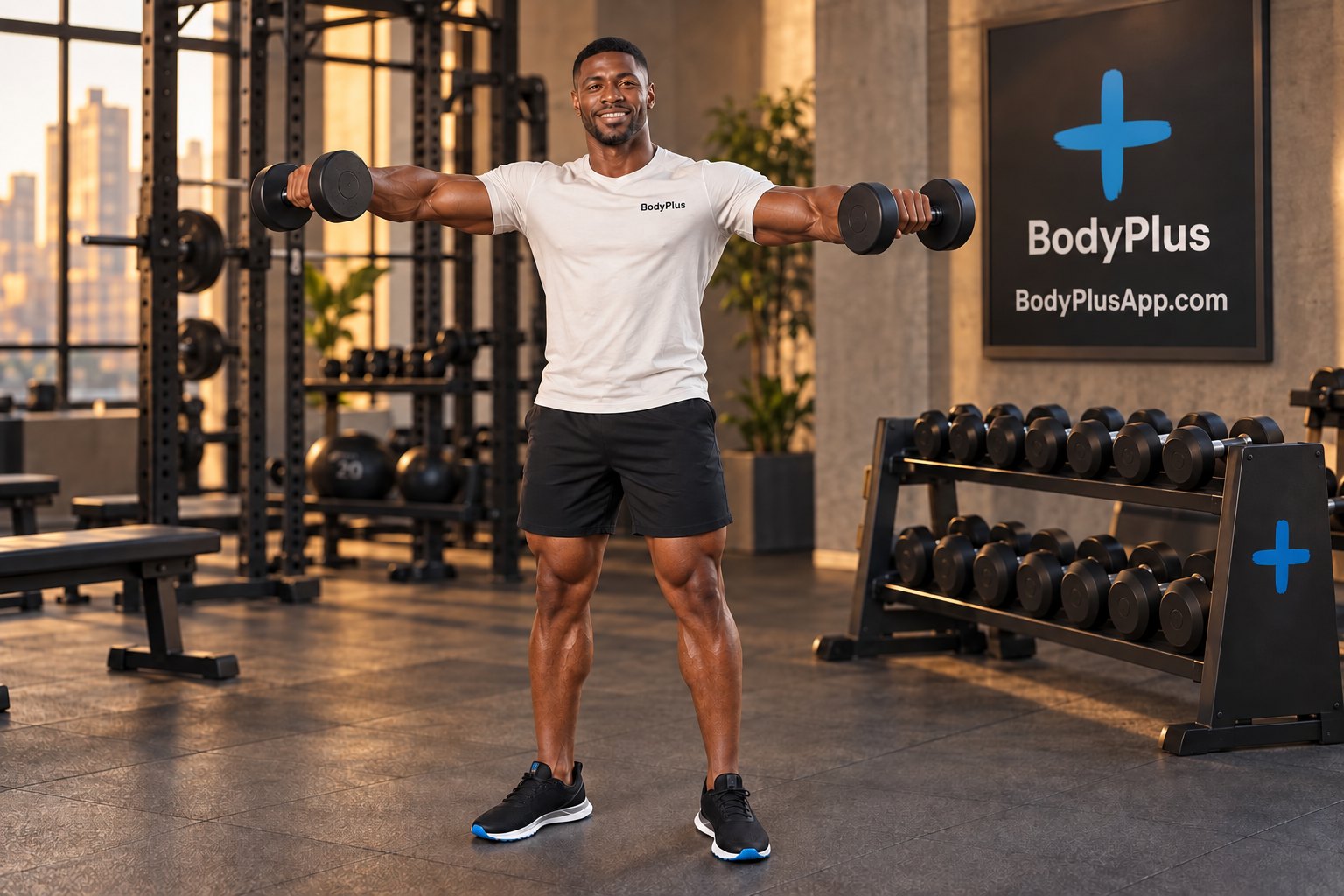
Your shoulders have three deltoid parts: front, side and rear. The front helps raise your arm forward, the side raises it out to the side, and the rear pulls it back. If you want to train all three, remember that pressing and rowing already give the front and rear some work; plan direct work for the side too.
Developed shoulders are one of the first things people notice. They add width and power to an upper body and give it an athletic look. In this article, I'll explain how your shoulder muscles are built, share my training tips, and give you a shoulder workout you can use. We'll start with the anatomy, then move to the tips and the program. Come on, let's get started.
Anatomy of the shoulder muscles
The shoulder muscles I want to start with are the deltoids. They have three parts:
- Front deltoid (anterior deltoid)
- Side deltoid (also called the middle or lateral deltoid)
- Rear deltoid (posterior deltoid)
These three parts give the shoulder its rounded look. Let's go a little deeper into each one.
The front deltoid
The fibers of the front deltoid start on the front of your collarbone (the clavicle), on its outer third, and run out and down to about the middle of your upper-arm bone (the humerus). Its main jobs are to raise your arm forward and to turn it inward.
The front delts give your upper body a rounded look from the front, and they can help show the line between your chest and shoulders. The front delt works very hard in pressing exercises and in front raises.
The side deltoid
This is the muscle on the outer side of your shoulder. Its fibers start on the highest point of your shoulder (the acromion) and run down to the middle of your upper-arm bone. Its main job is to raise your arm out to the side. A small rotator cuff muscle, the supraspinatus, starts that movement, and the deltoid takes over as the main lifter once your arm is a little away from your body.
In terms of looks, the side delt contributes to upper-body width. It can make your shoulders look broader, the V-shaped look many people train for.
The rear deltoid
The fibers of the rear deltoid start on the back of your shoulder, on the bony ridge of your shoulder blade (the spine of the scapula). You can feel this area at the top and outer part of your back. Like the other two parts, it ends at the middle of your upper-arm bone. The rear delt helps you pull your arm back and turn it outward, as when you open a door.
In terms of looks, the rear delt adds thickness to your shoulders and upper back, and gives the whole shoulder area a full, rounded look.
You can see that all three parts attach to the same point on the upper-arm bone (the deltoid tuberosity). A single nerve, the axillary nerve, supplies all three. Together they let you move your arm in many different directions.
The rotator cuff
Under the deltoid lie four smaller muscles whose tendons wrap around the shoulder joint like a cuff. All four start on your shoulder blade and attach near the top of your upper-arm bone. Anatomy courses often remember them as "SITS":
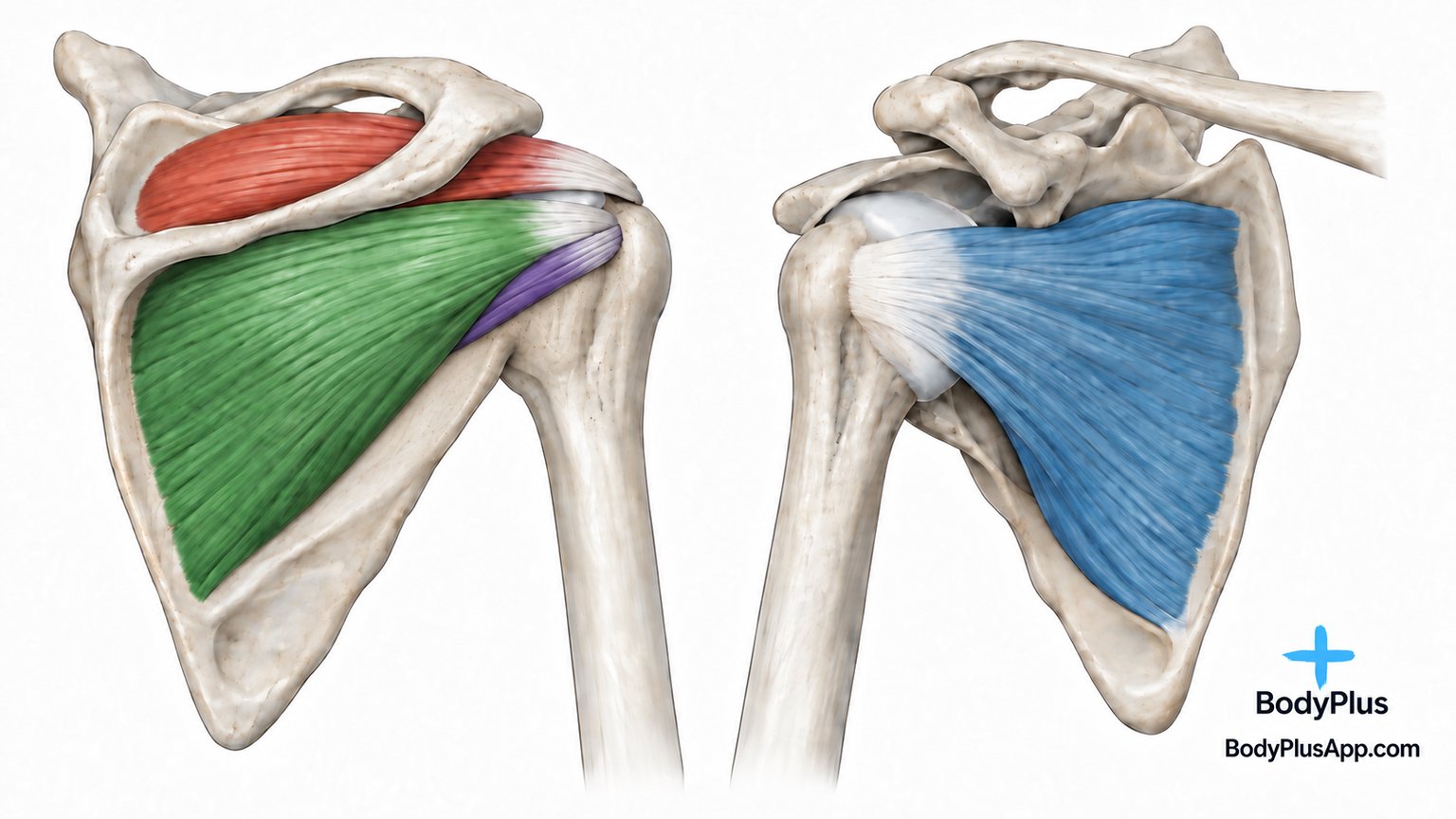
- Supraspinatus: sits on top of the shoulder blade and starts the movement of raising your arm to the side.
- Infraspinatus: covers most of the back of the shoulder blade and turns your arm outward.
- Teres minor: a small muscle below the infraspinatus that also turns your arm outward.
- Subscapularis: lies on the front of the shoulder blade, against your ribs, and is the rotator cuff muscle that turns your arm inward.
Together, these muscles keep pulling the ball at the top of your arm bone into its shallow socket while you move. That job matters because the shoulder is a ball-and-socket joint with the largest range of motion in the body, and that freedom comes at the cost of stability.
Other muscles move your shoulder too, including the trapezius, the chest and the lats. This guide focuses on the deltoid and the rotator cuff; for the rest, see the chest muscles and back muscles guides.
Why the shoulder muscles matter
When I plan a shoulder workout, I think about more than lifting serious weights. I also want your shoulder joint to be strong and stable through the range of motion you use.
The shoulder's structure lets you move your arm in many different directions, so your shoulders matter a lot, both in bodybuilding and in everyday life. Here are the main benefits of strengthening them:
- Strength: strong shoulders help you in training and in daily life, whenever you push, pull or lift.
- Joint stability: your shoulder muscles, especially the rotator cuff, help hold the joint in place while you move.
- Upper-body training: strong shoulders support and steady you in chest, back and arm exercises. It is very hard to build those areas without them.
Shoulder training tips
Warm up well before you train
The shoulders are a complex and sensitive area of the body. The shoulder joint is a synovial ball-and-socket joint, which gives it a very large range of motion. That range has a downside: the joint is less stable, and shoulder injuries are common.
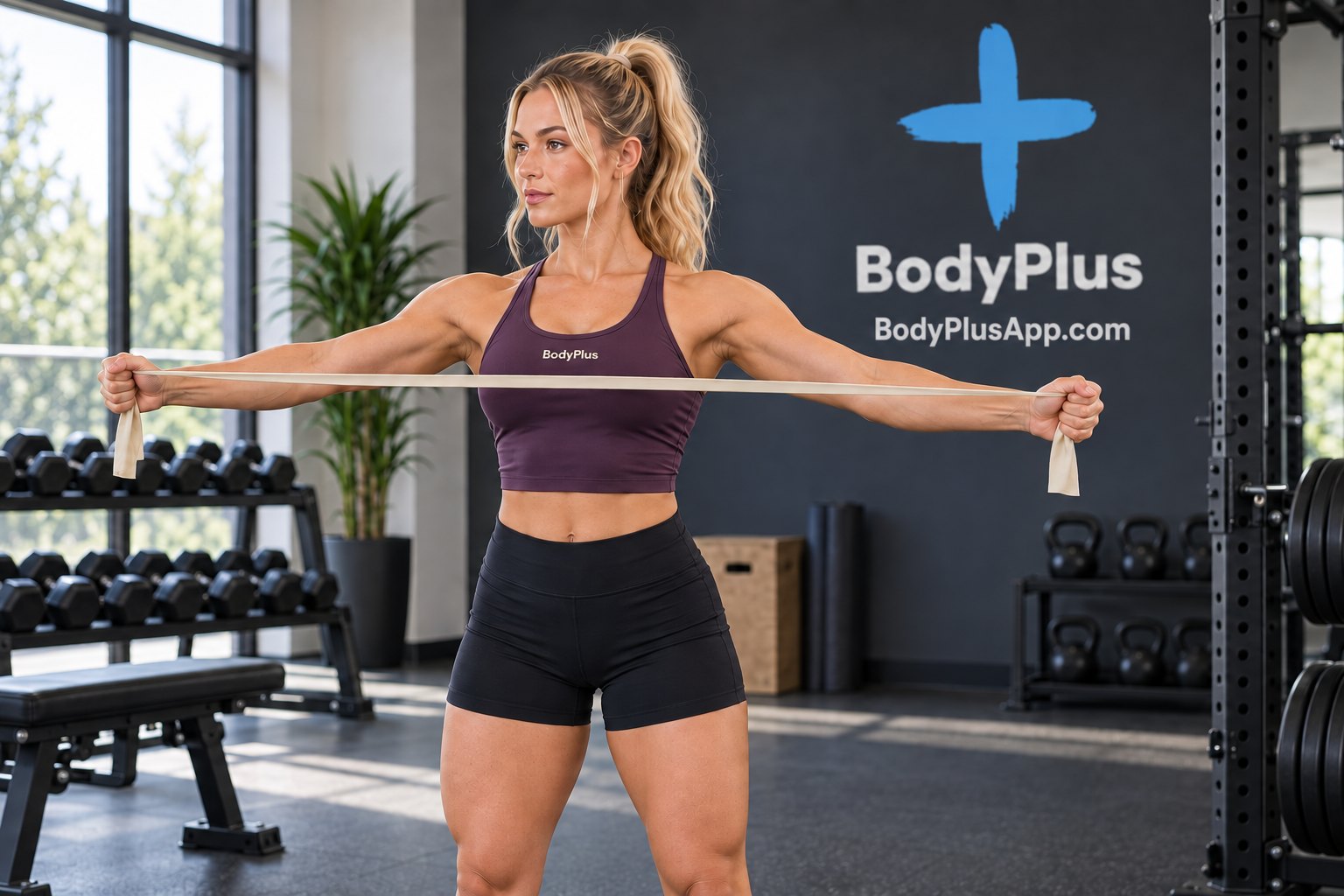
A good warm-up increases blood flow and helps your shoulders move freely. It also prepares your muscles for the load of weight training. This matters enormously, especially when you lift heavy, so don't neglect it.
Start with a few minutes of dynamic movements, such as arm circles and shoulder-blade rotations. Then do 2-4 light sets of your first exercise before the working sets.
Don't use momentum
If there is one thing I want you to avoid, it is swinging the weight through shoulder exercises. Usually, that happens when the weight is too heavy. An uncontrolled movement with a heavy weight can strain this sensitive joint.
Momentum also takes tension off the muscles you want to train. Slow the movement down and let the shoulder muscles do the work.
Plan a balanced workout for all the shoulder muscles
Many people don't know how to spread the work evenly across their shoulder muscles. Keep in mind that your front delt works in pressing exercises and your rear delt works in rowing exercises. The side delt often needs more direct work.
It's important to find a balance in your program, so each part of your shoulders gets enough work, but not too much. Also, if one part is weak, give it extra attention.
Work in all rep ranges
There is a lot of value in training across rep ranges. For most people, the shoulder muscles respond well to all of them. Lower reps can help you work on strength, while higher reps can build muscular endurance. If you want to work on shoulder stability too, include an isometric (static) hold.
You can combine all the rep ranges in one workout. You can also do the whole workout in a similar rep range and change the range every few weeks.
This fits the research: a 2026 position stand of the American College of Sports Medicine (ACSM), which pooled 137 systematic reviews, found that heavier loads (80% of your one-rep max or more) helped strength most, while muscle growth was enhanced by doing enough sets: about 10 or more hard sets per muscle group per week.
Choosing shoulder exercises
All three parts work together in many shoulder exercises, but I like to give each one a clear job in a program. Presses, including the bench press, give the front delt plenty of work. A lateral raise works the side directly; rows, reverse flies and face pulls reach the rear. If you want light, direct rotator cuff work, side-lying external rotation is an option. See the shoulder press guide for pressing technique.
In one study, 15 healthy men did barbell and dumbbell shoulder presses, seated and standing, at 80% of their one-rep max. The standing dumbbell press showed the highest activity in all three deltoid heads, but it was also the version with the lowest maximum weight. Sitting down lowered rear-delt activity by about a quarter.
In one small study, 10 competitive bodybuilders did seated raises to shoulder height with a weight they could lift eight times. The raise with the upper arm in a neutral position (thumbs pointing forward at the top) gave higher side-delt activity than the thumbs-up version, a version with the elbows bent to 90 degrees, and the front raise. In that study, the thumbs-down raise ("pouring a jug") gave the highest activity in the rear delt and upper trapezius.
In a study of 10 healthy people, researchers placed fine-wire electrodes in the muscles and compared seven common external rotation exercises. Side-lying external rotation with a dumbbell gave the highest activity in the infraspinatus and teres minor. A prone raise (lying face down, lifting the straight arm out to the side to just above shoulder level, with the thumb pointing up) gave the highest activity in the supraspinatus and in the side and rear delts. The researchers designed the study to help plan rehabilitation programs, and it measured one session.
These three studies measured muscle activity in a single session, in small groups. Muscle activity alone does not reliably predict how much a muscle will grow over time. Use them as hints for choosing a mix of exercises, not as proof that one exercise builds the biggest shoulders. For more ideas, see my best shoulder exercises guide and the guide to planes of motion.
A sample shoulder workout
Not many people know how much goes into a shoulder program. I think about the muscles and joints, strength and muscle work, the risk and benefit of each exercise, how hard its technique is to learn, rep ranges, sets, stability and mobility. The sample workout below puts those ideas into one session. Use it as an example, not a fixed plan you must follow: it gives each part of the shoulder work and includes a light rotator cuff exercise.
Warm-up: 2-3 minutes of arm circles and shoulder-blade circles, then 2-4 light sets of the first exercise.
| Exercise | Main target | Sets | Reps | Rest |
|---|---|---|---|---|
| Seated dumbbell shoulder press | front delt | 3 | 8-10 | 2 min |
| Lateral raise | side delt | 3 | 10-15 | 60-90 s |
| Reverse dumbbell fly (chest on an incline bench) | rear delt | 3 | 12-15 | 60 s |
| Side-lying dumbbell external rotation | infraspinatus, teres minor | 2 | 12-15 per arm | 60 s |
| Lateral raise hold at shoulder height, light weight | side delt (isometric) | 2 | 15-20 seconds | 60 s |
How to use it
- How often: once or twice a week, with at least two days between sessions. If you do the same workout twice, you can switch the press to a standing barbell press in the second session (see the shoulder press guide for technique and safety).
- With a chest day: your chest presses already load your front delts. If you train chest and shoulders on different days, leave at least a day between the hard sessions when you can; on a push day they share one session.
- How hard: stop most sets when you could do only one to three more good reps. Keep the rotator cuff exercise and the hold light and smooth. End a set if you start swinging the weight or lose control of the movement.
- At home: use dumbbells or a resistance band: a band pull-apart instead of the reverse fly, and a standing band external rotation with your elbow at your side instead of the side-lying version.
For weekly structures that include these exercises, see the push/pull/legs and upper/lower split plans.
Side-lying external rotation, step by step
- Lie on your side on a mat or flat bench, with a very light dumbbell in your top hand. Start with 1-2 kg (about 2-4.5 lb).
- Rest your top upper arm against your side, with your elbow bent to 90 degrees and your forearm across your stomach.
- Keeping your elbow against your side, turn your forearm up until it points toward the ceiling, or as far as feels comfortable.
- Lower the dumbbell slowly. Finish all reps, then turn over for the other arm.
A simple log
Write down every set. For the dumbbell press, add weight only when all three sets reach 10 good reps:
| Week | Exercise | Dumbbells (each) | Set 1 | Set 2 | Set 3 |
|---|---|---|---|---|---|
| 1 | Seated dumbbell press | 14 kg (about 31 lb) | 10 | 9 | 8 |
| 2 | Seated dumbbell press | 14 kg (about 31 lb) | 10 | 10 | 9 |
| 3 | Seated dumbbell press | 14 kg (about 31 lb) | 10 | 10 | 10 |
| 4 | Seated dumbbell press | 16 kg (about 35 lb) | 9 | 8 | 8 |
In week 4 the reps drop after the weight goes up; that is normal. Build them back up to 10 before the next jump.
Bottom line
Your shoulder muscles play a big part in your upper-body training and appearance. I started with their anatomy so you can understand why I give the front, side and rear delts different work.
It is very important to change your training program about every 6–12 weeks. That way your body does not adapt to the load and stop progressing.
This article gives you the foundation. There are many things to consider when planning a shoulder program, and the sample above puts the main parts together. Start light enough to control each movement, then track your sets and progress.
I like to review a program every 6-12 weeks. You do not have to replace it on a fixed date if you are still progressing. When it needs a change, make one with a plan: a 2022 review found that planned variation in exercises can help muscle growth and strength, while changing exercises too often or at random may hold your progress back.
Frequently asked questions
What are the shoulder muscles called?
The main one is the deltoid, with its front, side and rear heads. Under it are the four rotator cuff muscles: the supraspinatus, infraspinatus, teres minor and subscapularis.
What are the three parts of the deltoid?
The front (anterior), side (lateral or middle) and rear (posterior) deltoid. The front raises your arm forward, the side raises it out to the side, and the rear pulls it back.
What are the four rotator cuff muscles and what do they do?
The supraspinatus starts raising your arm to the side, the infraspinatus and teres minor turn your arm outward, and the subscapularis turns it inward. Together they hold the top of your arm bone in its socket.
What are the origin and insertion of the deltoid?
The front part starts on the outer third of the collarbone, the side part on the acromion (the top of the shoulder) and the rear part on the spine of the shoulder blade. All three attach to the deltoid tuberosity, about halfway down the upper-arm bone.
Which nerve supplies the deltoid?
The axillary nerve, which also supplies the teres minor.
Which part of the shoulder gives it width?
The side deltoid. Lateral raises train it most directly.
Are shoulder presses enough for the whole shoulder?
Presses work mainly the front delts. Add a lateral raise for the side and a reverse fly, row or face pull for the rear.
What exercises work the rotator cuff?
The cuff works in most upper-body exercises. For direct work, use light external and internal rotation exercises, such as side-lying external rotation with a dumbbell or rotations with a band.
The information on this page and on this website is intended to provide general information only. The content on this website does not constitute a professional opinion, a recommendation, or a substitute for consulting an expert in a specific field or obtaining a medical opinion. It is not medical advice. BodyPlus is not a medical device. If you have a health condition or an injury, or are pregnant, talk to a qualified healthcare professional before starting. Stop exercising and seek appropriate help if you feel pain, dizziness or other concerning symptoms.
Sources
Accessed September 17, 2026.
- OpenStax, Anatomy and Physiology 2e, "11.5 Muscles of the Pectoral Girdle and Upper Limbs" (the deltoid as the major abductor of the arm; the four rotator cuff muscles). openstax.org/books/anatomy-and-physiology-2e/pages/11-5-muscles-of-the-pectoral-girdle-and-upper-limbs
- OpenStax, Anatomy and Physiology 2e, "9.6 Anatomy of Selected Synovial Joints" (the shoulder joint: ball-and-socket, largest range of motion, less stability, the rotator cuff holding the humeral head, common injuries). openstax.org/books/anatomy-and-physiology-2e/pages/9-6-anatomy-of-selected-synovial-joints
- Elzanie A., Varacallo M.A., "Anatomy, Shoulder and Upper Limb, Deltoid Muscle", StatPearls, NCBI Bookshelf, updated 2024-01-30 (origins of the three parts, the deltoid tuberosity, the axillary nerve, the deltoid taking over abduction after the first degrees). www.ncbi.nlm.nih.gov/books/NBK537056
- La Rose J., Madrazo-Ibarra A., Varacallo M.A., "Anatomy, Rotator Cuff", StatPearls, NCBI Bookshelf, updated 2026-06-18 (origin, insertion, action and nerve of each rotator cuff muscle; centering of the humeral head). www.ncbi.nlm.nih.gov/books/NBK441844
- Saeterbakken A.H., Fimland M.S., "Effects of body position and loading modality on muscle activity and strength in shoulder presses", J Strength Cond Res 2013;27(7):1824-1831. pubmed.ncbi.nlm.nih.gov/23096062
- Coratella G. et al., "An Electromyographic Analysis of Lateral Raise Variations and Frontal Raise in Competitive Bodybuilders", Int J Environ Res Public Health 2020;17(17):6015. pubmed.ncbi.nlm.nih.gov/32824894
- Reinold M.M. et al., "Electromyographic analysis of the rotator cuff and deltoid musculature during common shoulder external rotation exercises", J Orthop Sports Phys Ther 2004;34(7):385-394. pubmed.ncbi.nlm.nih.gov/15296366
- Vigotsky A.D. et al., "Longing for a Longitudinal Proxy: Acutely Measured Surface EMG Amplitude is not a Validated Predictor of Muscle Hypertrophy", Sports Med 2022;52(2):193-199. pubmed.ncbi.nlm.nih.gov/35006527
- Currier B.S. et al., ACSM Position Stand, "Resistance Training Prescription for Muscle Function, Hypertrophy, and Physical Performance in Healthy Adults: An Overview of Reviews", Med Sci Sports Exerc 2026;58(4):851-872. pubmed.ncbi.nlm.nih.gov/41843416
- Kassiano W. et al., "Does Varying Resistance Exercises Promote Superior Muscle Hypertrophy and Strength Gains? A Systematic Review", J Strength Cond Res 2022;36(6):1753-1762. pubmed.ncbi.nlm.nih.gov/35438660