
Leg Muscles: Anatomy, Names and How to Train Each One
In short
Your legs have four main muscle groups: the quadriceps, hamstrings, glutes and calves. If you want to train them all, I would build your session around a squat or leg press, add a hip hinge, then give the muscles those lifts miss some direct work.
Everyone dreams of muscular legs, because they are special and most people who train do not have them. If you want to build legs you can be proud of, you have come to the right article. I will explain how your leg muscles are built, give you my training tips and show you a ready-made workout. So let's begin!
The anatomical structure of the leg muscles
We have four main muscle groups in our legs: the quadriceps at the front of the thigh, the hamstrings at the back, the glutes around the buttocks and the calves at the back of the lower leg. The inner thighs and outer hips also matter. Here are their names, jobs and exercises at a glance.
| Muscle group | Muscles (names) | Where | Main job | Exercises that train it |
|---|---|---|---|---|
| Quadriceps | rectus femoris, vastus lateralis, vastus medialis, vastus intermedius | front of the thigh | straighten the knee | squat, leg press, split squat, leg extension |
| Hamstrings | biceps femoris, semitendinosus, semimembranosus | back of the thigh | bend the knee, extend the hip | Romanian deadlift, leg curl |
| Glutes | gluteus maximus, gluteus medius, gluteus minimus | buttocks and side of the hip | extend the hip, move the leg out, steady the pelvis | hip thrust, squat, leg press |
| Calves | gastrocnemius, soleus | back of the lower leg | point the foot down | standing and seated calf raise |
| Adductors | adductor magnus, longus and brevis, and others | inner thigh | pull the thigh inward | deep squat, leg press, adductor machine |
| Hip abductors | gluteus medius and minimus, tensor fasciae latae | outer hip | move the leg out to the side | hip abduction machine, side-lying leg raise |
An MRI study of healthy young adults measured 35 major muscles in the lower limb, but for training you only need to know the main groups. Let's look at each one.
Quadriceps (quads)
The quadriceps sit at the front of your thigh bone (the femur). They are called quadriceps because the group is made of four muscles:
- Rectus femoris: runs down the middle of your thigh. It is the only one of the four that also crosses your hip, so it helps lift your thigh forward as well.
- Vastus lateralis: the outer part of your thigh, and the largest of the four.
- Vastus medialis: the inner part, just above your knee (the "teardrop").
- Vastus intermedius: lies underneath the rectus femoris.
All four have a similar role: their main job is to straighten (extend) your knee. The quads are the main muscles that show at a glance whether your legs are developed. When they are developed, you can see the separation between the heads, which, greatly improves how the legs look.
Squats, the leg press, split squats and lunges all train the quads. In a 10-week study of 17 men, squat training grew the quads as a whole but did not grow the rectus femoris. In a 12-week study of 17 untrained adults, each person trained one leg with the leg extension and the other with the leg press: the rectus femoris grew about 13% with the leg extension and barely at all with the leg press, while the other three heads grew by similar amounts with both. That is why I also like the leg extension alongside a squat or leg press.
Hamstrings
The hamstrings sit on the back of your thigh bone, in the upper part of your leg. The group is made of three muscles: the biceps femoris (which has a long and a short head), the semitendinosus and the semimembranosus.
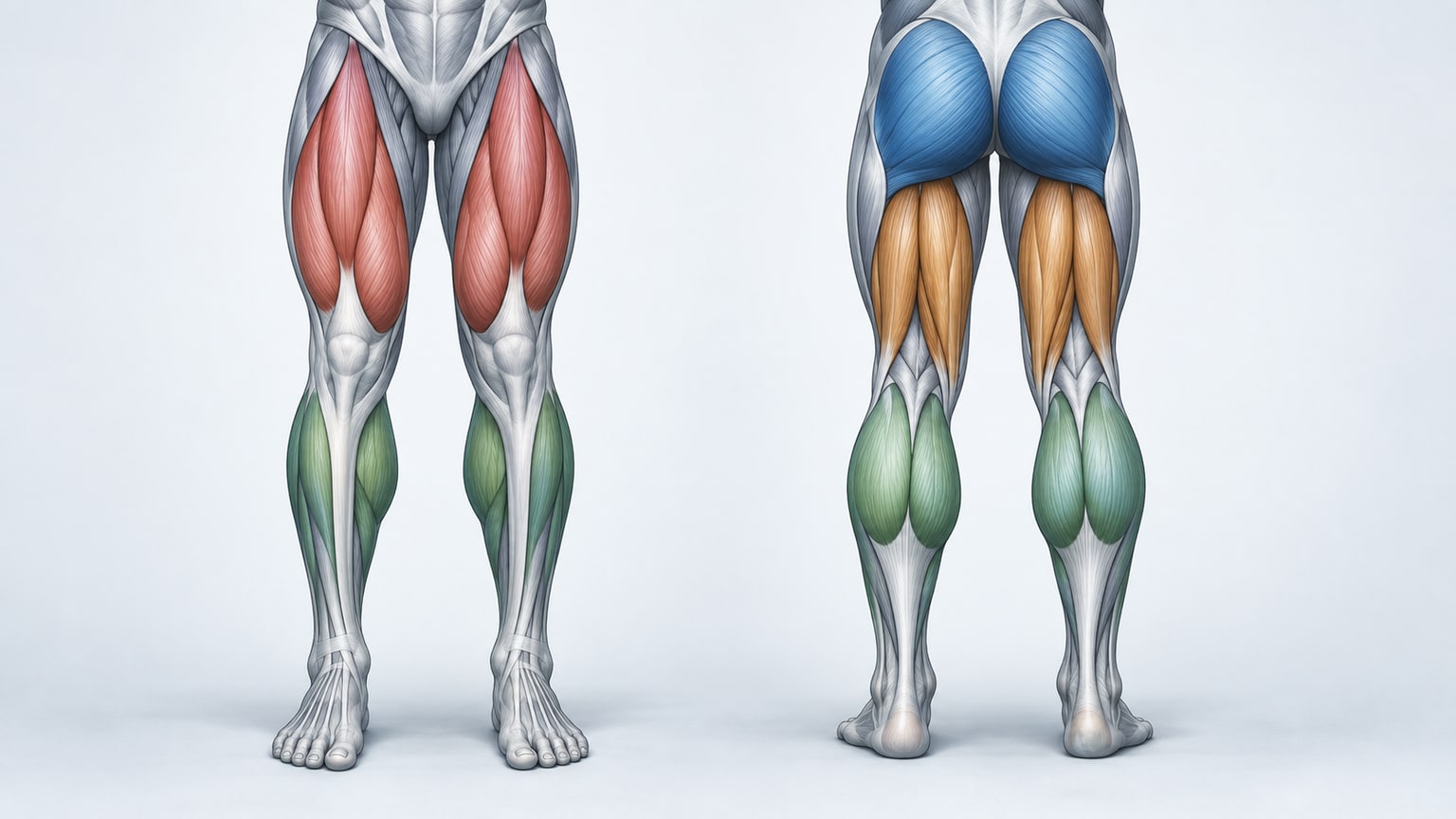
Their main jobs are to bend your knee, extend your hip (move your thigh back) and help keep your pelvis steady. They work when you pick things up, bend over, walk and more.
They can produce a lot of force, so they matter in exercises like the deadlift and squat. Developing them also gives the quads a strong-looking foundation. I would not rely on squats alone for them: in the same 10-week squat study, the hamstrings did not grow at all, at either squat depth.
A hip hinge such as the Romanian deadlift works them at the hip; a leg curl works them at the knee. In a 12-week study of 20 adults, each person trained one leg with the seated leg curl and the other with the lying (prone) leg curl. The whole hamstrings grew about 14% with the seated version and about 9% with the lying version. The seated position stretches the hamstrings more, which seems to help, so choose the seated machine when your gym has one.
Glutes
The glutes are a group of three muscles in your buttocks. The main one is the gluteus maximus, one of the largest muscles in your body. The two smaller ones, the gluteus medius and gluteus minimus, sit higher on the side of your hip.
The main job of the glutes is to extend your hip. That means they move your thigh back from your hip, as in a hip thrust. They also help move your legs out to the side and help keep your pelvis steady.
This is where strength and looks meet. The visual reason is clear, but the glutes have another advantage: they can produce a lot of force. They sit around your pelvis, near your body's center of mass, and play a big part in compound exercises such as the squat and deadlift.
The hip thrust loads your glutes directly. Deep squats work them too: in the squat study, full squats grew the gluteus maximus about three times as much as half squats. In the leg-press study, the leg press grew the gluteus maximus by about 15%, while the leg extension did not grow it. For more options, see my best glute exercises.
Calves
The calves are the muscles on the back of your lower leg. They are made of two main muscles:
- Gastrocnemius: the visible, two-headed muscle near the top of your calf. It crosses your knee as well as your ankle, so it works hardest when your knee is straight.
- Soleus: a flat muscle underneath the gastrocnemius. It crosses only your ankle, so it keeps working when your knee is bent.
The main job of the calves is to point your foot down (plantar flexion), as when you rise onto your toes. They also help keep your legs steady when you walk, run or jump.
Not many people who train have calves that really look good, so developed calves stand out easily. Building both your quads and calves makes a big difference to the front view of your legs. Use the standing calf raise, with straight knees, for the gastrocnemius, and the seated calf raise, with bent knees, to work the soleus more. Give the calves their own sets.
There are also smaller muscles I have not covered yet, including the inner thigh muscles (adductors) and outer hip muscles (abductors).
- Adductors (inner thigh): the adductor magnus, adductor longus, adductor brevis and a few smaller muscles. They pull your thigh toward the middle of your body and help steady your hips. Deep squats and the leg press train them well: in the studies above, full squats grew them more than half squats, and the leg press grew the adductor magnus about 6%.
- Hip abductors (outer hip): mainly the gluteus medius and minimus, with the tensor fasciae latae. They move your leg out to the side and keep your pelvis level when you stand on one leg, for example in a split squat.
Compound exercises work these muscles along with the big groups. If you want extra work, the adductor and hip abduction machines are simple options.
Tips for training the leg muscles
Full range of motion
You have surely seen people load huge weights on a squat or a leg press machine and then do a quarter or half of the movement.
I want you to work through a full range you can control, rather than pile on weight for a quarter rep. A 2021 review of 16 studies found that full-range training built more lower-limb muscle and more strength than partial-range training. A 2023 review added a nuance: partial reps done in the stretched, bottom part of the movement also built muscle well, while partial reps done only in the top part built less. The quarter squat with a huge weight is exactly that top part.
Remember: the smart thing is not to lift as much weight as possible. The smart thing is to load the muscle fibers well. Choose a weight that lets you control the movement.
Focus on compound exercises
With all due respect to machine extensions and curls, I would make compound exercises the foundation of your leg training. When you see someone with impressive legs, they are often lifting substantial weights in exercises such as squats, deadlifts, lunges and split squats. For more choices, see my best leg exercises.
These exercises work many muscles at once, including the smaller adductors and abductors. That is why I like them for building balanced legs. Still, squats and leg presses grow the rectus femoris and the hamstrings very little in the studies above. Use the leg extension and leg curl alongside your bigger lifts to give those muscles direct work.
Don't neglect the back of your legs
One of the most common mistakes in leg training is neglecting the muscles on the back of your legs. Because they are behind you, it is hard to see them and to know whether they are developed enough.
If the back of your legs is weak, it can hold back the weights you use in the big exercises. I also think developed hamstrings and glutes give the front of your legs a better foundation and make your training look more balanced.
They help steady your body and work when you walk, run or bend over. That is another reason I do not want you to neglect them.
Advanced tip: take a lighter week now and then
If you like training with very heavy weights and low reps (1 to 5), do a recovery workout from time to time. Two exercises can put a lot of load on the body: the squat and the deadlift. They tax not only your muscles but your whole body, including your central nervous system.
It's great that you train hard, but you also need to recover well. Your body can't handle heavy squats without end: the fatigue in your muscles, joints, tendons and ligaments builds up.
Every few weeks, take a lighter week. You still train that week, but lighter: reduce the weight and the intensity. Many times, you will see your working weights go up after it.
This is common practice. In a 2024 survey of 246 competitive strength and physique athletes, all of them used such light weeks, usually for about a week every 5 to 6 weeks, and mostly by cutting sets, reps and load. Research on whether it helps is still limited. One 9-week study in trained adults took a full week off training (not a light week) in the middle: leg muscle growth was similar to continuous training, and leg strength gains were a little smaller. So treat a lighter week as a tool to manage fatigue, not as a required step, and use it when your joints ache or your lifts stall.
Ready-made leg workout
Designing a high-level leg workout takes more than picking a few exercises. I look at what each muscle does, how the exercises fit together, their benefits and demands, how hard the technique is to learn, and the number and order of sets and reps.
The two plans mentioned in my original article were behind a subscriber lock. This is a separate sample session that covers each main group. Do it once or twice a week, with at least two rest days between hard leg sessions.
| Exercise | Sets | Reps | Rest | Main muscles |
|---|---|---|---|---|
| Back squat or leg press | 3 | 6-10 | 2-3 min | quads, glutes, adductors |
| Romanian deadlift | 3 | 8-12 | 2 min | hamstrings, glutes |
| Hip thrust | 2 | 8-12 | 90 s | glutes |
| Seated leg curl | 2 | 10-15 | 60-90 s | hamstrings |
| Leg extension | 2 | 10-15 | 60-90 s | quads, including the rectus femoris |
| Standing calf raise | 3 | 8-12 | 60 s | calves (gastrocnemius) |
If you train legs twice a week, change the second session a little: swap the squat for a split squat (2-3 sets of 8-12 each leg), and the standing calf raise for the seated calf raise (3 sets of 10-15) to work the soleus. Keep the other exercises. A 2026 position stand of the American College of Sports Medicine linked about 10 or more hard sets per muscle per week with more muscle growth. This sample is a starting point: across two sessions it has six direct calf sets, not ten.
How hard to work: stop most sets when you could do only one to three more good reps. Warm up with one or two light sets before the squat and the Romanian deadlift. Squat in a rack with the safety bars set just below your lowest point. Choose a load you can control, and end the set if your form breaks down or you feel pain or dizziness.
At home: goblet or dumbbell squat, dumbbell Romanian deadlift, single-leg glute bridge, split squat and calf raises on a step cover the same muscles.
A simple log. Write down every set, and add weight only when every set reaches the top of the rep range with full depth:
| Session | Exercise | Weight | Set 1 | Set 2 | Set 3 |
|---|---|---|---|---|---|
| Week 1 | Romanian deadlift | 50 kg (110 lb) | 10 | 9 | 8 |
| Week 2 | Romanian deadlift | 50 kg (110 lb) | 11 | 10 | 9 |
| Week 4 | Romanian deadlift | 50 kg (110 lb) | 12 | 12 | 12 |
| Week 5 | Romanian deadlift | 55 kg (121 lb) | 9 | 8 | 8 |
For split options that fit this workout, see the upper/lower split and push/pull/legs plans.
Bottom line
Strong legs are a clear sign of fitness and, among the most impressive muscles in the body. You cannot neglect them. Many people do not train legs at all because they do not see results; sometimes they just do not know how to train them. Now that you know how the leg muscles are built, you have the foundation for a good leg workout.
Putting a really good plan together takes knowledge and experience: exercise choice, order and amount, balance between the muscles, and what each exercise gives you for the effort and risk. It is very important to change your plan every 6 to 12 weeks, so your body does not adapt to the load and stop progressing. A 2022 review found that planned variation, such as adding an exercise that trains a muscle from a different angle, can help muscle growth and strength, while switching exercises too often or at random may hold your progress back. Keep your main exercises long enough to add weight and reps to them, and change the ones that stopped moving forward.
Frequently asked questions
What are the main leg muscles called?
The four main groups are the quadriceps (quads), the hamstrings, the glutes and the calves. The adductors (inner thigh) and the hip abductors (outer hip) are smaller groups.
How many muscles are in your leg?
It depends on how you count. An MRI study of healthy adults measured 35 major muscles in the lower limb. For training, the six groups in the table above are enough.
What are the upper leg muscles?
The quadriceps on the front of your thigh, the hamstrings on the back, the adductors on the inside, and the glutes and hip abductors around your hip.
What is the biggest muscle in the leg?
The quadriceps are the largest muscle group, and the gluteus maximus is one of the largest single muscles in your body.
What are the four quadriceps muscles?
The rectus femoris, vastus lateralis, vastus medialis and vastus intermedius.
Is there one exercise that works all the leg muscles?
No single exercise trains all of them well. Squats and leg presses train your quads, glutes and inner thighs, but they do little for your hamstrings and the rectus femoris, so add a hip hinge, a leg curl, a leg extension and calf raises.
Do leg extensions and leg curls build muscle?
Yes. In controlled studies, the leg extension grew the rectus femoris far more than the leg press, and the seated leg curl grew the hamstrings. Use them with your compound exercises.
How often should I train my legs?
Once or twice a week. Twice a week makes it easier to reach about 10 hard sets per muscle group, if you can recover from it.
The information on this page and on this website is intended to provide general information only. The content on this website does not constitute a professional opinion, a recommendation, or a substitute for consulting an expert in a specific field or obtaining a medical opinion. It is not medical advice. BodyPlus is not a medical device. If you have a health condition or an injury, or are pregnant, talk to a qualified healthcare professional before starting. Stop exercising and seek appropriate help if you feel pain, dizziness or other concerning symptoms.
Sources
Accessed September 17, 2026.
- OpenStax, Anatomy and Physiology 2e, "11.6 Appendicular Muscles of the Pelvic Girdle and Lower Limbs" (names, positions and actions of the hip, thigh and calf muscles). openstax.org/books/anatomy-and-physiology-2e/pages/11-6-appendicular-muscles-of-the-pelvic-girdle-and-lower-limbs
- Handsfield G.G. et al., "Relationships of 35 lower limb muscles to height and body mass quantified using MRI", J Biomech 2014;47(3):631-638. pubmed.ncbi.nlm.nih.gov/24368144
- Kinoshita M. et al., "Hypertrophic Effects of Single- versus Multi-Joint Exercise: A Direct Comparison between Knee Extension and Leg Press", Med Sci Sports Exerc 2026;58(7):1566-1580. pubmed.ncbi.nlm.nih.gov/41630124
- Kubo K. et al., "Effects of squat training with different depths on lower limb muscle volumes", Eur J Appl Physiol 2019;119(9):1933-1942. pubmed.ncbi.nlm.nih.gov/31230110
- Maeo S. et al., "Greater Hamstrings Muscle Hypertrophy but Similar Damage Protection after Training at Long versus Short Muscle Lengths", Med Sci Sports Exerc 2021;53(4):825-837. pubmed.ncbi.nlm.nih.gov/33009197
- Pallarés J.G. et al., "Effects of range of motion on resistance training adaptations: A systematic review and meta-analysis", Scand J Med Sci Sports 2021;31(10):1866-1881. pubmed.ncbi.nlm.nih.gov/34170576
- Kassiano W. et al., "Which ROMs Lead to Rome? A Systematic Review of the Effects of Range of Motion on Muscle Hypertrophy", J Strength Cond Res 2023;37(5):1135-1144. pubmed.ncbi.nlm.nih.gov/36662126
- Kassiano W. et al., "Does Varying Resistance Exercises Promote Superior Muscle Hypertrophy and Strength Gains? A Systematic Review", J Strength Cond Res 2022;36(6):1753-1762. pubmed.ncbi.nlm.nih.gov/35438660
- Rogerson D. et al., "Deloading Practices in Strength and Physique Sports: A Cross-sectional Survey", Sports Med Open 2024;10(1):26. pubmed.ncbi.nlm.nih.gov/38499934
- Coleman M. et al., "Gaining more from doing less? The effects of a one-week deload period during supervised resistance training on muscular adaptations", PeerJ 2024;12:e16777. pubmed.ncbi.nlm.nih.gov/38274324
- Currier B.S. et al., ACSM Position Stand, "Resistance Training Prescription for Muscle Function, Hypertrophy, and Physical Performance in Healthy Adults: An Overview of Reviews", Med Sci Sports Exerc 2026;58(4):851-872. pubmed.ncbi.nlm.nih.gov/41843416