
Push Pull Legs Split: The Complete Guide With 3- and 6-Day Plans
In short
A push pull legs (PPL) split divides your training into three workouts: push (chest, shoulders, triceps), pull (back, biceps) and legs (quads, glutes, hamstrings, calves). You train three to six days a week: beginners and intermediate trainees three or four days, advanced trainees five or six. Each workout has about 18 to 24 sets, led by compound exercises.
Looking to build muscle and strength with a plan that suits both beginners and advanced trainees? PPL is the perfect answer. In this guide I go through its advantages, its disadvantages, my tips, how to build your own plan, and ready sample plans, so you know what to do at your next workout.
What is a push pull legs split?
A PPL plan is a plan where you train 3 to 6 workouts a week. Beginner and intermediate trainees should do it 3 to 4 times a week. Advanced trainees should do it 5 to 6 times a week.
The workouts are divided into three:
- Push: chest, shoulders and the back of the arm (triceps)
- Pull: back and the front of the arm (biceps)
- Legs: quadriceps, glutes, hamstrings and calves
There are two main goals for dividing the muscles into three different workouts. The first is to give each muscle enough volume (sets). The second is to give the muscles enough time to recover, rest and be built effectively.
This plan puts emphasis on compound exercises that work a lot of muscles at the same time, such as barbell rows and the Romanian deadlift. These exercises help increase overall strength and muscle mass, improve athleticism and save time. In addition, isolation exercises are combined, to put emphasis on certain muscles specifically.
The PPL plan is not a pre-built workout plan but a training method. There is a whole doctrine in the way of building it. But don't worry, you have come to the right place. So let's continue!
Pros of this split
It builds muscle and strength
Push, Pull, Legs is an outstanding plan for building significant strength and muscle in all the muscles of the body. It focuses on compound exercises, such as the bench press and the squat, and more.
These exercises work several muscle groups at the same time, and they help us build a lot of strength and muscle. This means you can build muscle and increase your strength and working weights at the same time.
A plan with a lot of variety
The PPL plan focuses on compound exercises, but most people also combine isolation exercises. Isolation exercises work one specific muscle, such as biceps curls and skull crushers (French press).
Make the compound exercises the main ones, and do them at the beginning of the workout. After them, do isolation exercises to put emphasis on certain muscles more precisely.
Excellent recovery
This plan is very balanced, and it gives each muscle enough rest time. The reason to keep the order of Push, Pull, Legs is that this way every muscle group gets enough rest.
It is worth taking the rest before and after a Pull workout, so that the shoulders do not limit you or have excessive load placed on them. The 3-day plan does this automatically. On four to six days the shoulders get less rest, so rotate which press comes first (see the tip below) and use your rest days.
Cons of this split
It is not built for specific goals
This point can be both an advantage and a disadvantage. The plan suits building serious muscle across the whole body in a fairly balanced way, but not focusing on a specific muscle. You can make personal adjustments in a PPL plan, but for the vast majority of people that is not relevant.
If the plan is built in a professional and balanced way, the combination of exercises means that once there is a weak muscle, the body will improve it in order to improve in the exercises. For example, if your glutes are weak, a correct combination of leg exercises will force them to get stronger, in order to assist the quadriceps or the hamstrings.
You need to understand that everything you do in the plan comes at the expense of something. If you give emphasis to something in particular, make sure you are not harming something else too much. In addition, without correct planning, excessive load may develop on the joints, which can lead to injury.
A heavy load on the shoulders on push day
There is a potential problem when you train shoulders and chest together. The shoulders are a very complex and sensitive joint. It is very easy to make incorrect movements in it, or to reach excessive load in it.
The shoulders work hard in all pressing exercises, such as the bench press, the chest press machine, pressing with dumbbells and more. It is reasonable to assume that after you train the chest, the shoulders will no longer be fresh. If you start training them when they are already tired, you may reach excessive load and injury.
In addition, the shoulders work in almost every exercise there is, whether as a main muscle, a helper or a stabilizer.
Tip: on some push days, start with the shoulder press instead of the bench press, and keep your direct shoulder work to one press plus lateral raises.
How to build your own push pull legs plan
- Set goals. Before you build the plan, understand what your goal is: building strength, muscle mass, both, cutting/toning and more.
- Set the number of workouts and rest days. Set the number of days you plan to train, in an amount that depends on your level. The higher the level, the higher the amount. In addition, think about how this fits into your lifestyle.
- Choose exercises. Choose 2 to 4 exercises for each muscle. The first exercises should be compound, then isolation. When you choose the exercises, pay attention that you work each muscle from all possible angles. It is also important that the workout has a logical order for the compound exercises.
- Set the number of sets and reps. Each workout should be between 18 and 24 sets. Large muscles like the back should get more sets than small muscles like the biceps.
Important points
Not all exercises are equal. A workout of 18 sets may be much more intense than a workout of 24 sets. After all, a set of squats loads the body much more than a set of biceps curls.
Note that these are the most basic steps. Building a high-level workout plan is a whole doctrine, and every exercise you choose affects the one after it.
There are countless things to think about, such as managing the load on the joints and muscles, making sure you recover as much as possible in order to maximize hypertrophy, and choosing exercises with a deep understanding of the anatomy of the body.
It is impossible to teach in one article how to build a high-level plan without teaching anatomy, movement theory and the principles of building workout plans. That is why the sample plans below are a good place to start.
Sample push pull legs plans
Weekly schedules
| Day | 3 days a week | 6 days a week |
|---|---|---|
| Monday | Push | Push |
| Tuesday | rest | Pull |
| Wednesday | Pull | Legs |
| Thursday | rest | Push |
| Friday | Legs | Pull |
| Saturday | rest | Legs |
| Sunday | rest | rest |
With four days a week, rotate the three workouts in order (push, pull, legs, push, then pull, legs, push, pull the next week), for example on Monday, Tuesday, Thursday and Friday. With five days, keep rotating push, pull, legs and take two rest days.
Push workout
| Exercise | Sets | Reps | Rest |
|---|---|---|---|
| Bench press | 3 | 6-10 | 2-3 min |
| Incline dumbbell press | 3 | 8-12 | 90 s |
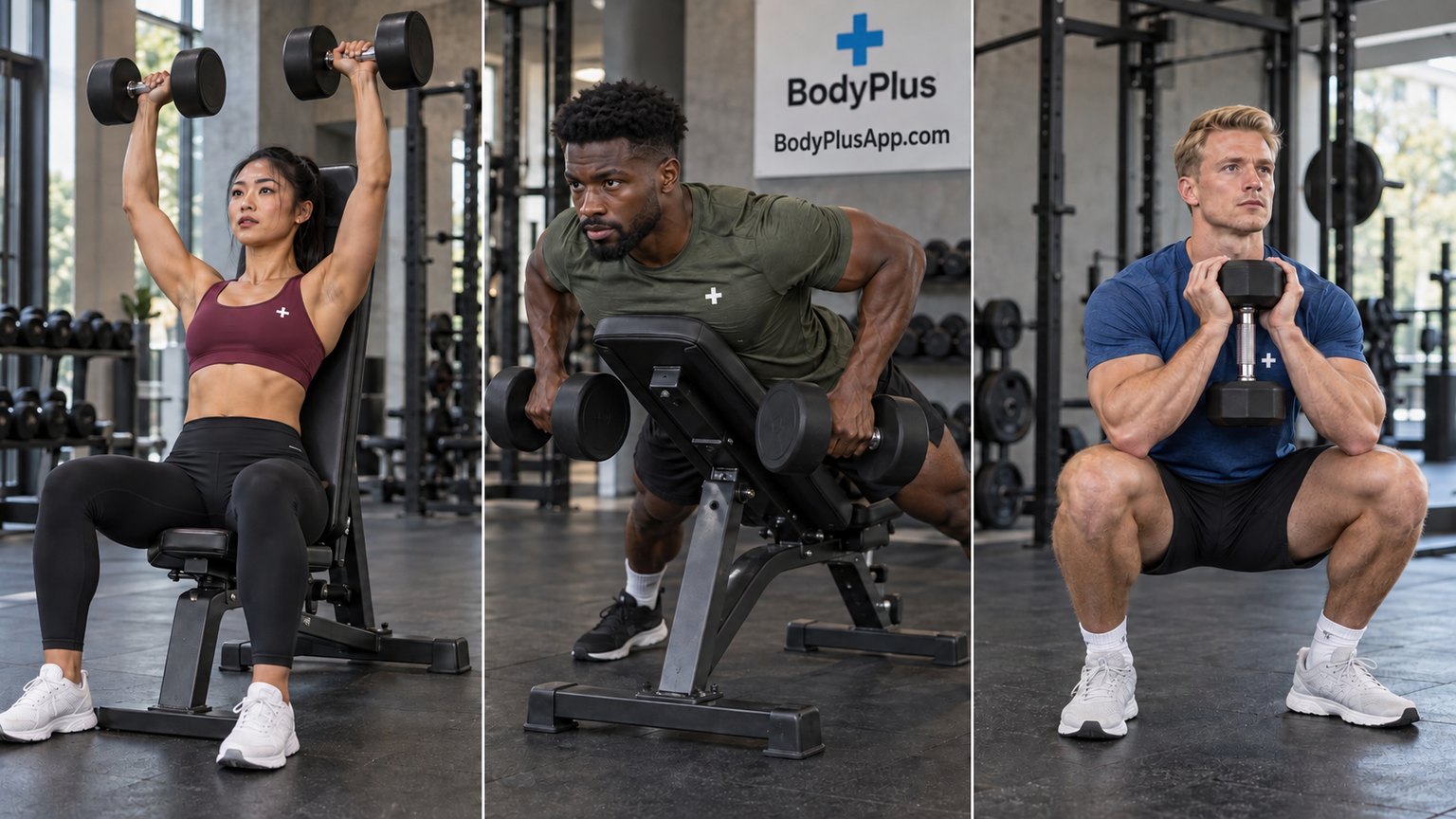
| Seated dumbbell shoulder press | 3 | 8-12 | 90 s |
| Lateral raise | 3 | 12-15 | 60 s |
| Triceps rope pushdown | 3 | 10-15 | 60 s |
| Overhead triceps extension | 3 | 10-15 | 60 s |
On every second push day, start with the seated dumbbell shoulder press, then do the bench press and the incline press.
Pull workout
| Exercise | Sets | Reps | Rest |
|---|---|---|---|
| Pull-up or lat pulldown | 3 | 6-10 | 2 min |
| Barbell row | 3 | 8-10 | 2 min |
| Seated cable row | 3 | 10-12 | 90 s |
| Face pull | 3 | 12-15 | 60 s |
| EZ-bar curl | 3 | 8-12 | 60 s |
| Hammer curl | 3 | 10-12 | 60 s |
Legs workout
| Exercise | Sets | Reps | Rest |
|---|---|---|---|
| Squat | 3 | 6-10 | 2-3 min |
| Romanian deadlift | 3 | 8-10 | 2 min |
| Leg press or split squat | 3 | 10-12 | 2 min |
| Leg curl | 3 | 10-15 | 60-90 s |
| Calf raise | 3 | 10-15 | 60 s |
| Hanging knee raise or plank | 3 | 10-15 or 30-45 s | 60 s |
Each workout has 18 sets and takes about 60 to 75 minutes. On the 6-day schedule, do each workout as written. You can also swap the barbell row for a chest-supported row to rest your lower back before leg day. Stop most sets when you could do only one to three more good reps.
For more exercise ideas, see our guides to the best chest, shoulder, back, biceps, triceps, leg and glute exercises.
Dumbbell or home version
| Workout | Gym exercise | Dumbbell or home swap |
|---|---|---|
| Push | bench press | dumbbell floor press or push-ups |
| Push | incline dumbbell press | feet-elevated push-ups |
| Push | seated dumbbell shoulder press | the same, seated on a chair or standing |
| Push | triceps pushdown | band pushdown |
| Pull | pull-up or lat pulldown | pull-ups on a securely fitted bar, or band pulldown |
| Pull | barbell row | one-arm dumbbell row |
| Pull | seated cable row | band row |
| Pull | face pull | band face pull |
| Pull | EZ-bar curl | dumbbell curl |
| Legs | squat | goblet squat |
| Legs | Romanian deadlift | dumbbell Romanian deadlift |
| Legs | leg press | split squat |
| Legs | leg curl | single-leg glute bridge or band leg curl |
Common push/pull/legs mistakes
- Always pressing your shoulders last. After heavy chest work they are tired. Rotate which press comes first.
- Piling on sets. Stay within 18 to 24 sets per workout, as in the sample plans. More is not better if you cannot recover from it.
- A light leg day. Legs are a third of the plan. Give them the same effort as push and pull.
- Adding weight without a log. Write down every set, so you add weight only when all sets reach the top of the rep range.
- Six days with too little sleep. The 6-day schedule works only if you recover. If you feel run down, drop to four days.
How to progress
Log every set. When you reach the top of the rep range on all sets of an exercise, add a small amount of weight next time.
| Date | Exercise | Weight | Set 1 | Set 2 | Set 3 |
|---|---|---|---|---|---|
| Wed | Barbell row | 50 kg (110 lb) | 10 | 9 | 8 |
| next Wed | Barbell row | 50 kg (110 lb) | 10 | 10 | 10 |
| week 3 Wed | Barbell row | 52.5 kg (116 lb) | 9 | 8 | 8 |
Safety tips
Use a spotter or set the safety arms when you bench press or squat heavy. Start with light weights and build up over your first weeks on the plan. Lower every rep under control, and end the set when your form breaks down, not when you run out of reps. If a joint hurts, stop the set and switch to a lighter or pain-free variation. Make sure a pull-up bar is fitted securely before you hang on it.
What research says
- Frequency can help, but weekly sets matter most. An earlier, smaller 2016 review (10 studies) found that training a muscle twice a week built more muscle than once a week. A larger 2019 review (25 studies) found that when weekly sets were equal, frequency made little difference. Training more often mainly helps you fit in more weekly sets. The 6-day plan trains each muscle twice; the 3-day plan works too, as long as your weekly sets are enough.
- About 10 or more sets a week. The 2026 position stand of the American College of Sports Medicine (ACSM) found better muscle growth with 10 or more sets per muscle group per week. On the 3-day plan, most muscles get 6 to 9 direct sets a week, plus the work they do in other exercises. If you want more, move to four or six days.
Bottom line
The PPL plan is a popular plan that suits both beginner and advanced trainees. It divides the body into three: push, pull and legs. The goal of the plan is to build serious muscle and strength.
It has advantages and disadvantages that you should take into account before you decide whether it suits you. If it is not planned properly, you can reach overtraining or get hurt. Start with the sample plans above, keep the push, pull, legs order, and log every workout. The best time to start is now!
Frequently asked questions
Is push pull legs good for beginners?
Yes, at three or four days a week. If you want to start simpler, a full body plan or an upper/lower split are good first steps.
Should I do push pull legs 3 or 6 days a week?
Three or four days suit beginners and intermediate trainees. Five or six days suit advanced trainees who recover well.
How long should a PPL workout take?
About 60 to 75 minutes.
Push/pull/legs or upper/lower split?
An upper/lower split is simpler and fits three or four days. Push/pull/legs gives each muscle group more attention and suits people who can train more often.
Where do abs go in a PPL split?
Add them to leg day, as in the sample plan, or at the end of any workout.
Can I do cardio on a PPL split?
Yes. Light cardio on rest days or after upper-body workouts usually fits well.
How many rest days do I need?
At least one a week, and more on the 3- and 4-day schedules.
The information on this page and on this website is intended to provide general information only. The content on this website does not constitute a professional opinion, a recommendation, or a substitute for consulting an expert in a specific field or obtaining a medical opinion. It is not medical advice. BodyPlus is not a medical device. If you have a health condition or an injury, or are pregnant, talk to a qualified healthcare professional before starting. Stop exercising and seek appropriate help if you feel pain, dizziness or other concerning symptoms.
Sources
Accessed September 17, 2026.
- Schoenfeld B.J. et al., "Effects of Resistance Training Frequency on Measures of Muscle Hypertrophy: A Systematic Review and Meta-Analysis", Sports Med 2016;46(11):1689-1697. pubmed.ncbi.nlm.nih.gov/27102172
- Schoenfeld B.J. et al., "How many times per week should a muscle be trained to maximize muscle hypertrophy? A systematic review and meta-analysis of studies examining the effects of resistance training frequency", J Sports Sci 2019;37(11):1286-1295. pubmed.ncbi.nlm.nih.gov/30558493
- Currier B.S. et al., ACSM Position Stand, "Resistance Training Prescription for Muscle Function, Hypertrophy, and Physical Performance in Healthy Adults: An Overview of Reviews", Med Sci Sports Exerc 2026;58(4):851-872. pubmed.ncbi.nlm.nih.gov/41843416