
ABC Split Workout: A 3-Day Muscle Group Split With a Sample Plan

In short
An ABC split workout divides your muscles into three different workouts, A, B and C, and you do them three or four times a week. In the split I recommend, workout A is chest, biceps and abs, workout B is back and triceps, and workout C is shoulders and legs.
This article has everything you need to know about ABC training: the advantages, the disadvantages, my tips, and a ready sample plan you can start with. So let's begin!
What is an ABC split?
An ABC workout plan is a plan in which all the muscles of the body are divided into three different workouts, and you do them three to four times a week.
Each workout should be about 18 to 26 sets and last around an hour. You also shouldn't do more than two workouts in a row, day after day.
This plan suits beginner and intermediate trainees with at least three months of training experience, assuming they invest in their nutrition and in their workouts.
It is an advanced variation of the A/B workout, in which the body is divided into two (the most common A/B split is the upper lower split).
How to divide the days
You can split the days in many different ways, and the split is very important. Match the exercises to the days, and make sure every muscle gets enough sets and enough time to recover.
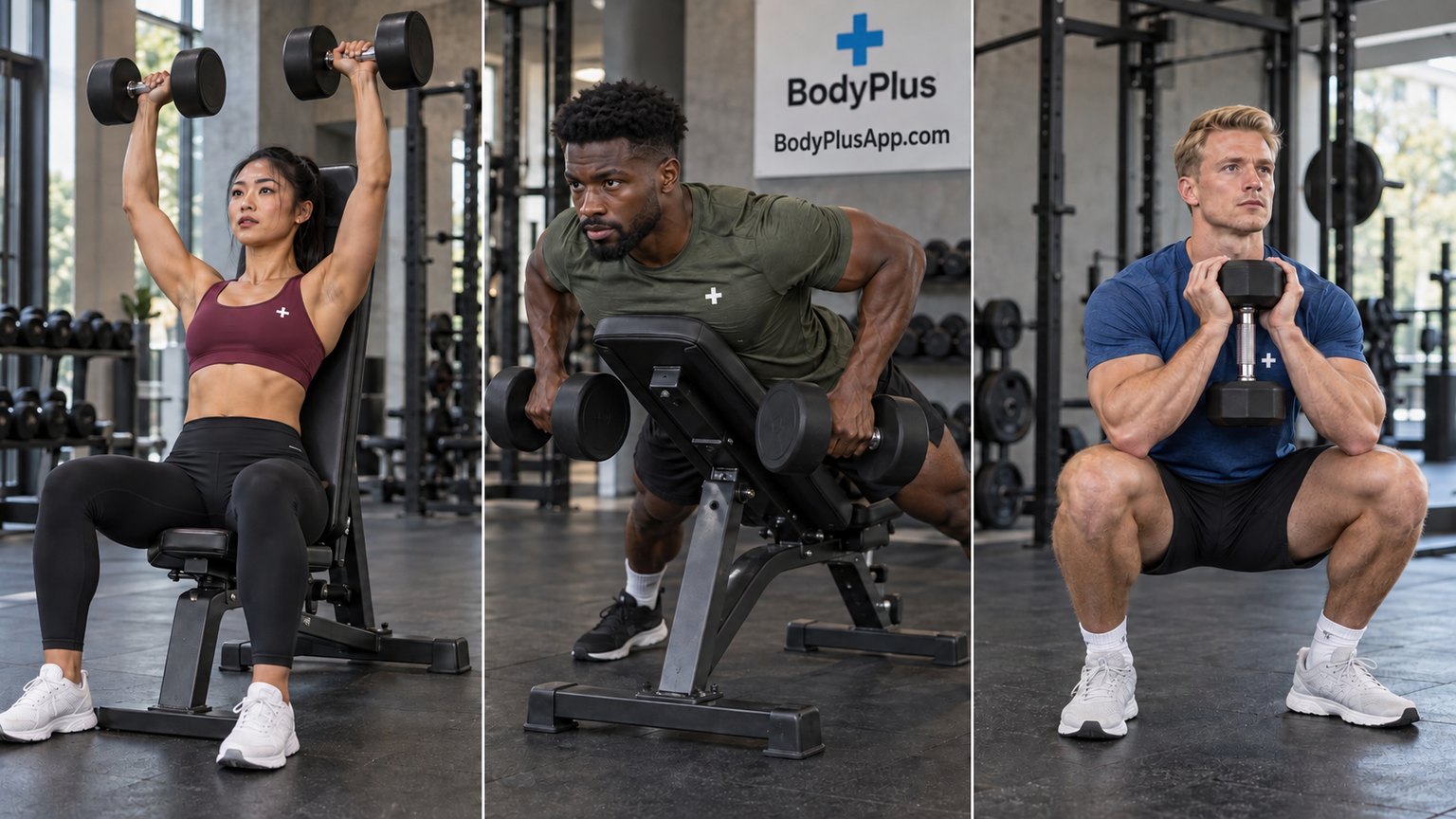
This is the split I recommend, and the one the sample plan below uses:
- Workout A: chest, biceps, abs
- Workout B: back, triceps
- Workout C: shoulders, legs
This split puts the emphasis on the upper body. Almost all the upper-body muscles work in every workout, whether as the main muscle or as a helping muscle.
If it is not planned correctly, you can end up overloading them. Then you won't recover enough, and you will hardly build muscle. With this split you also need to make sure the lower body gets enough load and is not neglected.
Some people add another workout to increase the volume. Either they add a full body workout, or they do two different workouts every week. For example: week 1 has two A workouts, week 2 has two B workouts, and week 3 has two C workouts. You will find both options in the sample schedules below.
Which exercises should you do?
In any workout plan, focus on compound exercises, such as the barbell bench press and the shoulder press. These exercises work many muscles at the same time, and they are the ones that will build you powerful muscle mass.
When you combine them correctly, you can be sure that all the muscles in your body are working, even the smallest ones. In the squat, for example, the quadriceps is the main muscle, but the spinal erectors also work, and in fact the entire lower body.
Next to them we have isolation exercises, such as the barbell biceps curl. These exercises take away a considerable part of the need to stabilize the body, so they help us increase the volume that one specific muscle receives.
Pros of the ABC split
Most muscles work more than once a week
The split above puts the emphasis on the upper body, and the muscles are divided so that some of them work twice a week.
Your biceps work in both workout A and workout B, because they also work in back exercises. Your triceps work in both workout B and workout A, because they also work in chest exercises. The same goes for your shoulders, which also work in the chest workout.
The advantage of this split is that the muscles work several times a week even though you are not working on them directly. This continuous work gives them an enormous stimulus. If you give your body enough recovery time, they will grow really well.
Good recovery between workouts
In bodybuilding there is a critical point that most people do not understand. Hypertrophy (building muscle) happens while we rest and recover, not while we are training.

The workout is the signal. After it, while we rest, eat and sleep, our body repairs and rebuilds the muscle fibers and adapts them to the load that was placed on them during the workout.
If you plan your ABC split carefully, your muscles get enough rest time between workouts, and that recovery makes a big difference to how much muscle you build.
A very flexible plan
This plan is very flexible and suits busy people who can only train three times a week. You can also train on whichever days are convenient for you. Even if you missed a workout, you simply do that same workout the next day. Of course, this assumes the plan itself is well built.
Cons of the ABC split
Not for brand-new beginners
The plan is not suitable for beginner trainees, because of the large volume that each muscle receives. Beginners will find it very hard to do a lot of sets for each muscle with heavy weights.
If you are only starting to train, it is better to do a full body workout or an A/B workout plan. In those plans you progress faster, because you work each muscle twice a week, and beginners do not need a lot of volume to progress. As you progress, you will need to increase the load on the muscles, and as the load grows, the recovery time grows as well.
There is no perfect split; every split has its advantages and disadvantages. The problem with the ABC split is that you will probably not manage to work out day after day, because your muscles will be tired.
The muscle pairing can backfire if you don't recover
If you did workout A, which is chest and biceps, you will not be able to do workout B, back and triceps, the next day.
The triceps will be tired from the chest workout, and you will not manage to lift your usual weights. The same with the back: the tired biceps will make it hard for you to train the back properly.
Every split has its advantages and disadvantages, so it is important to plan it carefully and precisely, to maximize recovery for all the muscles.
A good ABC plan gives every muscle enough load on one hand, and enough recovery on the other, with no substantial conflict between the exercises. That is the idea behind the sample plan below.
It is also important to rest between one workout and the next. If you rest before a workout, you arrive at it after you have recovered to some extent.
A sample ABC split workout plan
Here is a ready plan for three or four days a week, with the sets, reps and rest for every exercise.
Weekly schedules
| Day | 3 days a week | 4 days a week |
|---|---|---|
| Monday | A (chest, biceps, abs) | B (back, triceps) |
| Tuesday | rest | C (shoulders, legs) |
| Wednesday | B (back, triceps) | rest |
| Thursday | rest | A (chest, biceps, abs) |
| Friday | C (shoulders, legs) | rest |
| Saturday | rest | Full body |
| Sunday | rest | rest |
On the 4-day schedule, the only back-to-back days are B and C, the pair that clashes least. Don't put B the day after A. If you prefer to repeat one of the workouts instead of the full body day (two A workouts in week 1, two B in week 2, two C in week 3), keep at least two days between the two workouts of the same type, and keep a rest day between A and B.
Workout A: chest, biceps, abs
| Exercise | Sets | Reps | Rest |
|---|---|---|---|
| Bench press | 3 | 6-10 | 2-3 min |
| Incline dumbbell press | 3 | 8-12 | 90 s |
| Cable or dumbbell fly | 3 | 10-15 | 60 s |
| EZ-bar curl | 3 | 8-12 | 60 s |
| Hammer curl | 3 | 10-12 | 60 s |
| Hanging knee raise | 3 | 10-15 | 60 s |
| Plank | 2 | 30-45 s | 60 s |
Workout B: back, triceps
| Exercise | Sets | Reps | Rest |
|---|---|---|---|
| Pull-up or lat pulldown | 3 | 6-10 | 2 min |
| Barbell row or chest-supported row | 3 | 8-10 | 2 min |
| Seated cable row | 3 | 10-12 | 90 s |
| Face pull | 3 | 12-15 | 60 s |
| Triceps rope pushdown | 3 | 10-15 | 60 s |
| Overhead triceps extension | 3 | 10-15 | 60 s |
Workout C: shoulders, legs
| Exercise | Sets | Reps | Rest |
|---|---|---|---|
| Squat | 3 | 6-10 | 2-3 min |
| Romanian deadlift | 3 | 8-10 | 2 min |
| Leg press or split squat | 3 | 10-12 | 2 min |
| Leg curl | 3 | 10-15 | 60-90 s |
| Seated dumbbell shoulder press | 3 | 8-12 | 90 s |
| Lateral raise | 3 | 12-15 | 60 s |
| Calf raise | 3 | 10-15 | 60 s |
Full body day (4-day schedule only)
| Exercise | Sets | Reps | Rest |
|---|---|---|---|
| Leg press or goblet squat | 3 | 10-12 | 2 min |
| Leg curl | 3 | 10-15 | 60-90 s |
| Machine chest press or push-ups | 2 | 10-12 | 90 s |
| Lat pulldown or one-arm dumbbell row | 2 | 10-12 | 90 s |
| One exercise for a muscle you want to bring up | 2-3 | 10-15 | 60 s |
Workouts A, B and C have 18 to 21 sets each and take about 60 to 75 minutes; the full body day takes about 40 minutes. Workout C starts with legs, so your lower body gets your freshest effort. If your lower back feels tired on leg day, use the chest-supported row in workout B. Stop most sets when you could do only one to three more good reps.
How many sets each muscle gets per week
| Muscle | 3 days | 4 days |
|---|---|---|
| Chest | 9 | 11 |
| Back | 12 | 14 |
| Quads | 6 | 9 |
| Hamstrings and glutes | 6 | 9 |
| Shoulders | 6 direct, plus chest presses | 6 direct, plus chest presses |
| Biceps and triceps | 6 each, plus rows and presses | 6 each, plus rows and presses |
The table counts direct sets only; squats and Romanian deadlifts also work your glutes. On three days, your legs get the fewest direct sets (6 each), which is exactly the risk I described above. If your legs fall behind, the 4-day schedule is the easiest fix: it brings them to 9 direct sets, and using the free slot of the full body day for your weaker leg muscle takes that group past 10.
For more exercise ideas, see our guides to the best chest, back, shoulder, biceps, triceps, leg, glute and ab exercises.
Dumbbell or home version
| Workout | Gym exercise | Dumbbell or home swap |
|---|---|---|
| A | bench press | dumbbell floor press or push-ups |
| A | cable fly | dumbbell fly on the floor |
| A | EZ-bar curl | dumbbell curl |
| B | pull-up or lat pulldown | pull-ups on a securely fitted bar, or band pulldown |
| B | barbell row | one-arm dumbbell row |
| B | seated cable row | band row |
| B | triceps pushdown | band pushdown |
| C | squat | dumbbell squat or goblet squat |
| C | Romanian deadlift | dumbbell Romanian deadlift |
| C | leg press | split squat |
| C | leg curl | single-leg glute bridge or band leg curl |
How to progress on an ABC split
Set clear, specific goals
Before you start any workout plan, define a specific goal. The more specific and clear the goal is, the easier it will be to achieve it.
You can set yourself a goal of adding 10 kg (22 lb) in a certain exercise, and then plan the whole plan so that it supports that exercise. A one-rep max calculator can help you track your strength in it. The goal can also be to put special emphasis on the chest. Then the plan needs to be built so that the chest can recover as well as possible.
The same goes for building muscle or strength. If your goal is hypertrophy, work in a range of 8 to 15 reps. If your goal is purely strength, do 5 to 8 reps.
You can combine a wide variety of rep ranges, as the sample plan does: fewer reps in the first compound exercise, more reps later. The point is that you need to know how to plan it correctly, because working with heavy weights and low rep ranges puts a lot of load on the body.
When all your sets reach the top of the rep range, add a small amount of weight next time, and write down every set so you can see your progress.
| Date | Exercise | Weight | Set 1 | Set 2 | Set 3 |
|---|---|---|---|---|---|
| Fri | Squat | 70 kg (154 lb) | 10 | 9 | 8 |
| next Fri | Squat | 70 kg (154 lb) | 10 | 10 | 10 |
| week 3 Fri | Squat | 72.5 kg (160 lb) | 9 | 8 | 8 |
Eat right
It does not matter whether you do an ABC workout plan or any other plan; one of the most important things for success in a workout plan is to keep proper nutrition for bodybuilding. You need to adjust your nutrition to your goal.
If your goal is building muscle, you need to eat enough calories. If your goal is cutting, be careful to eat the right amount, a little less than your body needs.
Rest well between workouts
As I explained before, our muscles grow during rest. Good rest gives your body enough time to build the muscles, refill the energy stores and arrive at the workout with full strength.
Take at least one rest day between most workouts, and make sure to sleep at least 7 hours a night.
Which plan is right for you?
| Where you are | Plan |
|---|---|
| Just starting out | Full body, 2-3 days a week |
| After about 2 months of steady training | Upper/lower (A/B) split, 3-4 days |
| At least 3 months of steady training, 3-4 days a week | ABC split |
| More experience, 3-6 days a week | Push/pull/legs split |
What research says
- Weekly sets matter most. An earlier, smaller 2016 review (10 studies) found that training a muscle twice a week built more muscle than once a week. A larger 2019 review (25 studies) found that when weekly sets were equal, frequency made little difference. On an ABC split most muscles get their direct work once a week, so make sure your weekly sets are enough.
- About 10 or more sets a week. The 2026 position stand of the American College of Sports Medicine (ACSM) found better muscle growth with 10 or more sets per muscle group per week. That is why the set table above matters: the 4-day schedule brings your legs to 9 direct sets, and the free slot can take one leg muscle group to 10 or more.
- Heavier and lighter loads both build muscle. In two small 8-week studies of well-trained young men (17 and 18 people), programs with sets of 3 to 35 reps built similar muscle size (in the lighter-load study, every set was taken to failure), while heavier loads built more strength in the bench press (2014) or the squat (2015). That supports mixing rep ranges by goal.
- Muscle damage is not the goal. A 2018 review concluded that muscle damage does not drive muscle growth; programs that cause little damage built similar muscle. Soreness is not a sign of a better workout.
- Sleep at least 7 hours. A joint statement of the American Academy of Sleep Medicine and the Sleep Research Society recommends at least 7 hours of sleep a night for adults aged 18 to 60.
Safety tips
- Use the safety arms or a spotter on the bench press and the squat, and add collars to the bar.
- Warm up with a few lighter sets, and start light on any lift that is new to you.
- Lift with control, and end the set when your form breaks down.
- Stop the set if it hurts, and switch to a lighter or pain-free variation.
- If you feel worn out before a workout, take an extra rest day or use lighter weights that day.
Bottom line
The ABC workout plan is an outstanding plan that suits beginner and intermediate trainees with at least about three months of training experience. It splits your body into three workouts, puts the emphasis on the upper body, and fits a busy three- or four-day week. If you apply everything in this article, it will help you build muscle.
A good ABC plan takes a wide variety of things into account: the split into days, an understanding of muscle anatomy and choosing the exercises accordingly, the right combination of sets and rep ranges, recovery, and more. Start with the sample plan above, keep a rest day between A and B, give your legs full effort, and log every workout.
Frequently asked questions
What is an ABC workout?
A training plan that splits your muscles into three workouts, A, B and C, done three or four times a week. Here: A is chest, biceps and abs, B is back and triceps, and C is shoulders and legs.
A/B or ABC split: which is better?
It depends on your fitness level and how many days you can train. An A/B split suits beginners; the ABC split suits people with more experience.
Is an ABC split good for beginners?
Not in your first months. Start with a full body or A/B plan, and move to an ABC split after about three months of steady training.
Is a 3-day split enough to build muscle?
It can be, if every muscle gets enough weekly sets and you add weight over time. Check the set table above.
ABC split or push/pull/legs?
Both use three workouts. Push/pull/legs groups muscles by movement and can run up to six days a week; this ABC split groups them so the arms get work twice a week and fits three or four days.
How long should an ABC workout take?
About an hour, and up to 75 minutes on the longer workouts.
Where do abs go in an ABC split?
In workout A, as in the sample plan. You can also add a short ab exercise at the end of workout C.
What if I miss a workout?
Do that workout the next day and keep the order. If it puts A right before B, move B one day later.
The information on this page and on this website is intended to provide general information only. The content on this website does not constitute a professional opinion, a recommendation, or a substitute for consulting an expert in a specific field or obtaining a medical opinion. It is not medical advice. BodyPlus is not a medical device. If you have a health condition or an injury, or are pregnant, talk to a qualified healthcare professional before starting. Stop exercising and seek appropriate help if you feel pain, dizziness or other concerning symptoms.
Sources
Accessed September 17, 2026.
- Schoenfeld B.J. et al., "Effects of Resistance Training Frequency on Measures of Muscle Hypertrophy: A Systematic Review and Meta-Analysis", Sports Med 2016;46(11):1689-1697. pubmed.ncbi.nlm.nih.gov/27102172
- Schoenfeld B.J. et al., "How many times per week should a muscle be trained to maximize muscle hypertrophy? A systematic review and meta-analysis of studies examining the effects of resistance training frequency", J Sports Sci 2019;37(11):1286-1295. pubmed.ncbi.nlm.nih.gov/30558493
- Currier B.S. et al., ACSM Position Stand, "Resistance Training Prescription for Muscle Function, Hypertrophy, and Physical Performance in Healthy Adults: An Overview of Reviews", Med Sci Sports Exerc 2026;58(4):851-872. pubmed.ncbi.nlm.nih.gov/41843416
- Schoenfeld B.J. et al., "Effects of different volume-equated resistance training loading strategies on muscular adaptations in well-trained men", J Strength Cond Res 2014;28(10):2909-2918. pubmed.ncbi.nlm.nih.gov/24714538
- Schoenfeld B.J. et al., "Effects of Low- vs. High-Load Resistance Training on Muscle Strength and Hypertrophy in Well-Trained Men", J Strength Cond Res 2015;29(10):2954-2963. pubmed.ncbi.nlm.nih.gov/25853914
- Damas F. et al., "The development of skeletal muscle hypertrophy through resistance training: the role of muscle damage and muscle protein synthesis", Eur J Appl Physiol 2018;118(3):485-500. pubmed.ncbi.nlm.nih.gov/29282529
- Watson N.F. et al., "Recommended Amount of Sleep for a Healthy Adult: A Joint Consensus Statement of the American Academy of Sleep Medicine and Sleep Research Society", J Clin Sleep Med 2015;11(6):591-592. pubmed.ncbi.nlm.nih.gov/25979105
- Schoenfeld B.J. et al., "Loading Recommendations for Muscle Strength, Hypertrophy, and Local Endurance: A Re-Examination of the Repetition Continuum", Sports (Basel) 2021;9(2):32. pmc.ncbi.nlm.nih.gov/articles/PMC7927075