
How to Do Pull-Ups: Technique, Benefits and Variations
In short
To do a pull-up, hang from a bar with your palms facing away and your hands a little wider than your shoulders. Brace your stomach, draw your shoulder blades down and back, and pull yourself up until your chin passes the bar. Pause for a moment, then lower yourself under control until your arms are straight. If you can't do one yet, start with slow negatives, band-assisted reps and the lat pulldown (there is a full plan below).
If you want to test how strong and athletic people really are, count how many pull-ups they can do. There is a reason that athletes and bodybuilders have been using this exercise for decades to build upper-body strength and muscle mass. It is a simple exercise with crazy benefits. In this article, you will discover the huge benefits of pull-ups, the correct technique, different variations and even some secret tips.
Benefits
Builds crazy strength and muscle mass in the upper body
Pull-ups are a wonderful exercise for building muscle mass and strength in the upper body, because many muscles work in the exercise, including the back, the arms and the shoulders.
When you do a pull-up, you use the latissimus dorsi (the "wings") to pull your body weight up. The biceps and the forearms also help in the pulling movement. The upper-back muscles (trapezius and rhomboids) work at stabilizing the shoulder blades and maintaining correct posture.
Strengthens grip strength
During the exercise, you have to grip the bar firmly and lift your body weight with your hands and forearms. This constant load on the forearms and hand muscles helps improve their strength and endurance. A strong grip is important for all pulling exercises, such as the bent-over row, the deadlift, other rows and the one-arm dumbbell row.
An exercise for building athleticism and strength relative to body weight
It is important to include bodyweight exercises, exactly like pull-ups or push-ups. Bodyweight exercises are very important for building athleticism. They help improve coordination, balance and strong core muscles. These exercises help a lot in everyday activities, because they mimic movements that we do all the time, like pulling yourself up, climbing and lifting.
Muscles worked
Many muscles work in this exercise, including your back, arms and shoulders:
| Muscle | Where it is | Its job in the exercise |
|---|---|---|
| Lats (latissimus dorsi) | the wide muscles on the sides of your back, the "wings" | the main movers: pull your upper arms down toward your body |
| Teres major | a small muscle under the armpit | helps the lats bring the arms down |
| Biceps, brachialis, brachioradialis | front of the upper arm and forearm | bend your elbows |
| Forearm and grip muscles | forearm | hold the bar |
| Middle and lower trapezius, rhomboids | upper and middle back | move and steady your shoulder blades |
| Rear shoulders (posterior deltoids) | back of the shoulder | help pull your arms down and back |
| Pectoralis major | chest | helps pull the arms down |
| Core (abdominals, obliques, lower back) | trunk | keep your body steady under the bar |
In a study that measured muscle activity in 25 young adults (21 men and 4 women), the lats were the most active of the muscles tested with both the overhand and the underhand grip, followed by the biceps. The chest, lower trapezius, lower back and obliques also worked.
Pull-ups for beginners: what to do if you can't do one
Don't worry, there are exercises that will help you manage to do a pull-up, even if you can't do one at all today. You can do a negative pull-up or a pull-up with the help of a resistance band. In a negative pull-up you jump up above the bar and try to come down as slowly as possible. With a resistance band, the band helps you lift part of your body weight. In both, you work all the muscles that work in the exercise, and so you strengthen them in preparation for a regular pull-up.
There is a more detailed explanation of these variations further on, and the 8-week plan below puts them together. Here are a few more excellent exercises that can help you manage to do pull-ups:
- chin-ups (reverse grip), which many people find a little easier
- the lat pulldown
- the one-arm dumbbell row
- the bent-over row
- the deadlift, which trains your grip hard
- inverted rows: lie under a barbell set in a squat rack at about waist height (or a Smith machine bar), hold it, and pull your chest to the bar with your body straight and your heels on the floor. The more upright you stand, the easier it gets.
The lat pulldown is especially useful because you can pick the exact weight. In a study of 34 recreationally active male students, eight weeks of lat pulldown training raised the number of reps they could do on the bar (an unstable-setup group improved most). The students could already do some reps, so the study does not show how to get the first one.
Yes, it can be a little frustrating at first, but don't give up before you start. If you are consistent, there is no doubt that you will succeed.
How to do a pull-up with good form
Get on the bar
Use a sturdy bar that is high enough for you to hang with straight arms. If you can't reach it with a small jump, stand on a stable box or step.
The movement
- Start by hanging from the bar with a grip slightly wider than shoulder width, palms facing away from you. Wrap your thumbs around the bar.
- Tighten your abdominal muscles and pull your shoulder blades down and back. Your arms stay straight; your shoulders just move away from your ears.
- Start pulling yourself up by contracting your back muscles. Think about driving your elbows down toward your ribs.
- Go up until your chin passes the bar.
- Pause for a moment at the top, then begin to lower back down in a controlled way. Don't throw yourself down.
- Repeat for the number of reps you want.
Breathe steadily. Many people breathe out on the way up and in on the way down; whatever you do, don't hold your breath through the whole set.
Small details that make a big difference
- Start from a real dead hang. Every rep starts with straight arms. You can keep a little tension in your shoulders, but don't start with bent elbows.
- Keep your legs quiet. Legs straight and slightly in front of you, or knees bent with ankles crossed. Either is fine; just don't swing them.
- Look forward or slightly up. Don't crane your neck to get your chin over the bar. The body comes up; the chin doesn't reach.
- Practice the first part on its own. If the start of the pull feels weak, hang from the bar and pull your shoulder blades down without bending your arms, hold for a second and relax. These are called scapular pulls, and I like them as a warm-up too.
Common mistakes
Half reps
This is a mistake that a lot of people make, because they want to manage to do more reps. Remember: half a rep equals half a stimulus to the muscle fibers. The goal in training is to be truly strong and to succeed, not to fool yourself. Use correct technique; only this way will you be able to make use of all the benefits this exercise offers.
A full rep goes from straight arms at the bottom to your chin over the bar at the top. I would rather see you do three clean reps than six half ones. If you can't reach both ends yet, do fewer full reps, or use one of the easier versions below.
Using momentum (kipping)
This is a mistake that a lot of CrossFit coaches teach. They teach using momentum in certain exercises, because it helps increase power and speed. Power and speed are critical in CrossFit training; the problem is that it also significantly reduces the effectiveness of the exercise, and it raises the risk of injuries.
A study of 11 athletes who did sets of five strict and five kipping reps found that the kip used the core and hip muscles more, while biceps activity was lower. The researchers concluded that the strict version is the choice for more upper-body muscle activity, and the kip for more whole-body activity and possibly more reps. The study measured muscle activity in one session, not growth or injuries.
So that you can make use of all the benefits of the exercise, do the exercise slowly and in a controlled way.
Other mistakes to watch for
- Shrugging your shoulders up to your ears. Pull your shoulder blades down first, then pull with your elbows.
- Going extremely wide. An extremely wide grip shortens the pull and is less comfortable for many shoulders (see the wide-grip variation below).
- Adding weight too early. Build clean body-weight reps first (see the weighted version below).
Pull-up vs chin-up
In a chin-up, your palms face you, and your hands are usually about shoulder width apart. In a pull-up, your palms face away and your grip is a little wider.
Both exercises work the lats hard. The differences are smaller than many people think:
- In the study of 25 young adults mentioned above, the chin-up brought more activity from the biceps and the chest, and the overhand version brought more activity from the lower trapezius. Lat activity was high in both.
- In a study of 19 strength-trained men, overhand, underhand, neutral (palms facing each other) and rope versions showed similar muscle activity over a full rep. The only difference was more middle trapezius activity with the overhand grip than with the neutral grip.
- A study that compared chin-ups with the lat pulldown found more biceps and lower-back activity and more shoulder movement in the chin-up, with the lats working strongly in both.
All of these studies measured muscle activity in a single session. Higher activity in one session does not prove more growth over time.
| Overhand (pull-up) | Underhand (chin-up) | |
|---|---|---|
| Grip | palms away, a little wider than shoulders | palms toward you, about shoulder width |
| Extra emphasis (in one study) | lower trapezius | biceps and chest |
| Lats | work hard | work hard |
| How it feels | many people find it harder | many people find it a little easier |
So which one should you do? Both. Pick the grip that feels good for your shoulders and elbows, and switch between them from one training block to the next. If one grip bothers your joints, try a neutral grip on parallel handles.
Variations
Negative pull-up
This variation is suitable for people who can't do a pull-up at all. In this variation you do only the lowering part. Position yourself with a chair or by jumping, so that your chin is above the bar. Then try to lower yourself as slowly as possible.
In this exercise you will work all the muscles that work in the classic pull-up. After these muscles get a little stronger, you will manage to do full reps. Use a sturdy chair or box that can't tip over, and step back down onto it after each rep instead of dropping from the bar.
Pull-ups with a resistance band
Another variation that is excellent for trainees who can't do a pull-up at all. In this exercise you use a resistance band. The band helps us lift the body upward, and so it reduces the weight that we actually lift. A thicker band helps more.
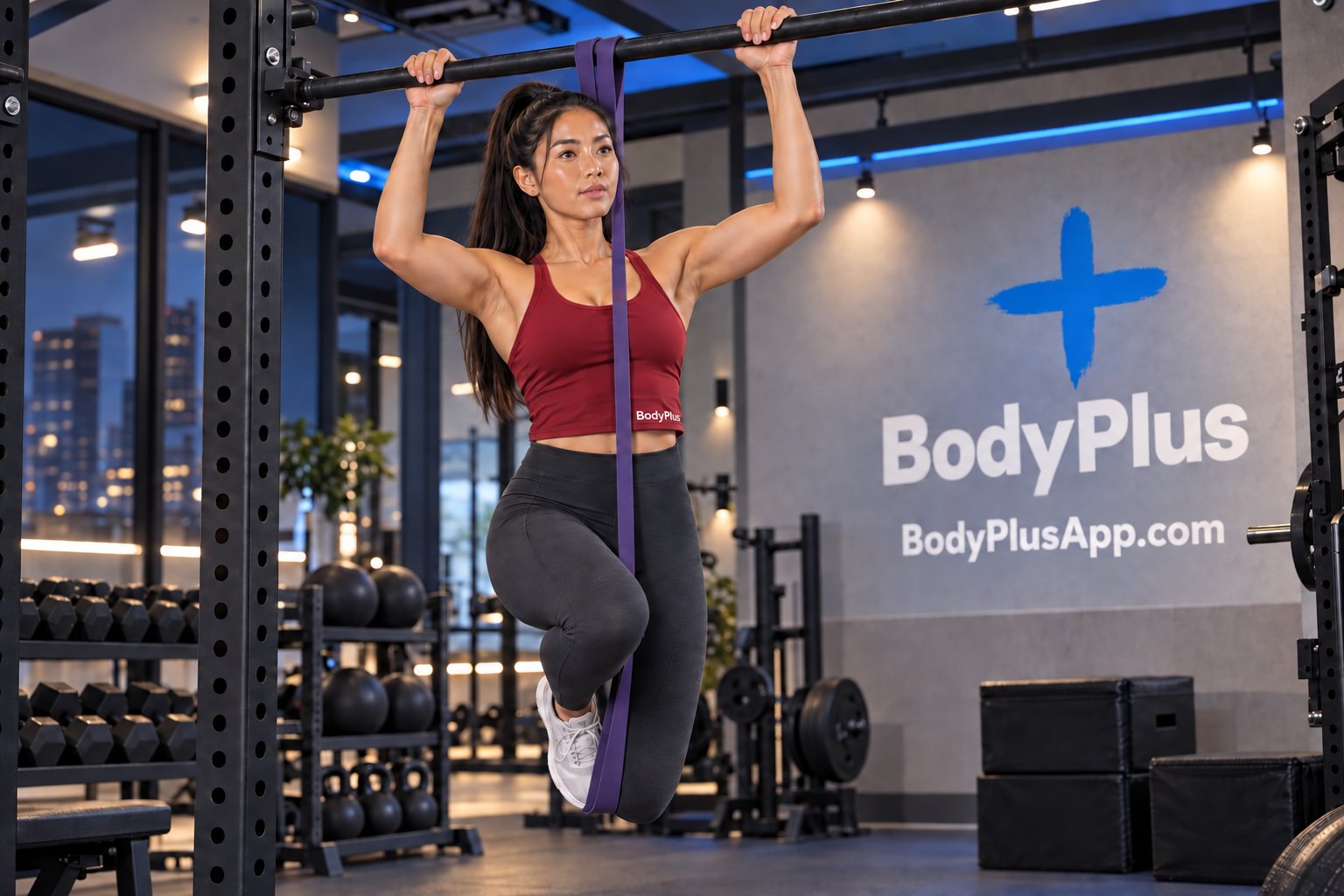
Loop the band around the bar and pull it through itself so it is secure, then put one foot or one knee in the band.
It is important to do the exercise with a good-quality resistance band, so that it doesn't snap on you in the middle. In addition, when you finish the exercise, take your leg out of the band slowly. Do it slowly, so that the band doesn't snap back at your face quickly.
Chin-up (reverse grip)
A lot of people look down on this variation, but professional bodybuilders understand the huge benefits it offers. The chin-up is one of the best compound exercises for the biceps (see the comparison above). The exercise also gives stimulus to the muscles that attach to the biceps. This will help you create a strong environment around the biceps, which will support their growth. For more arm training, see the best biceps exercises.
Wide-grip pull-up
This is already a harder variation than the regular one. The wide grip demands serious upper-body strength and control. It reduces the help from the biceps and puts the emphasis on the latissimus dorsi.
Keep the grip only moderately wide, though. A small motion study of 11 people who regularly train on the bar found that the wide and underhand grips put the shoulder in positions the researchers linked with a higher risk of shoulder pinching (impingement). This was a motion study, not an injury study; still, it is a good reason to switch to a neutral grip on parallel handles if the wide or underhand grip bothers your shoulders.
Pull-up with a weight belt
If you want to take your pull-ups to the next level, and get truly crazy results, you need to add resistance to the exercise. This is done with a special belt for adding weight, often called a dip belt.
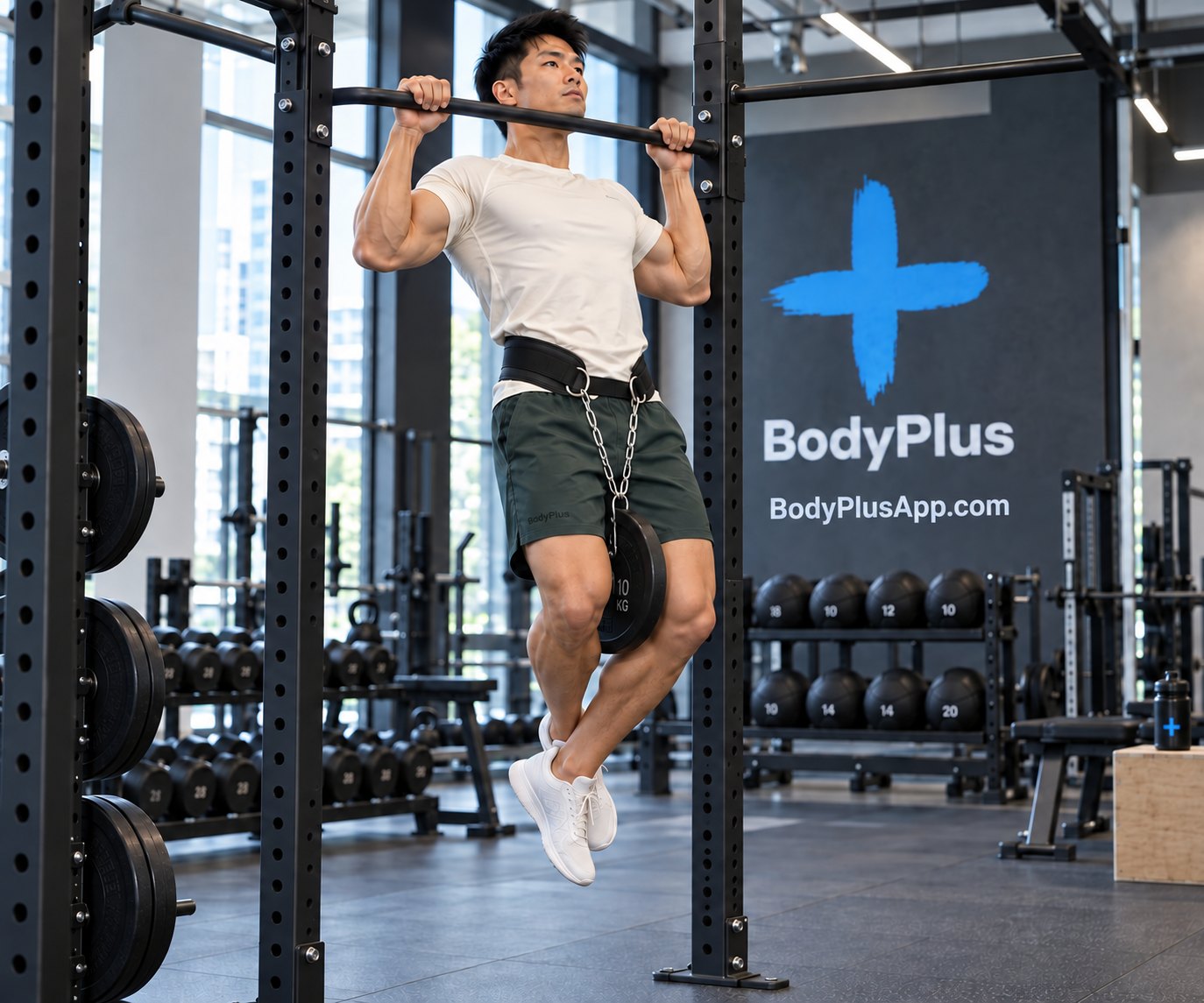
The belt is worn around our waist, and with a chain we attach it to a weight plate, a dumbbell or a kettlebell. The belt gives us the ability to add weight to our body with maximum comfort. As a result, we can tailor the workout with wonderful precision to our goals.
You will be able to perform exercises in the exact rep range that you want, whether 8-12 reps for building muscle mass, or 1-5 reps for improving strength.
A few practical points:
- A sensible time to start is when you can do about 8-10 strict body-weight reps.
- Start light, for example 2.5-5 kg (about 5-10 lb), and add small amounts.
- Attach the weight while standing on a box, and step back onto the box at the end of the set.
- Some people hold a dumbbell between their feet instead, but it tends to shift or drop, which makes it hard to focus on the exercise. I prefer the belt because it keeps the weight steadier.
One-arm pull-up
Anyone who sees you doing this exercise will be left open-mouthed. It is an advanced exercise that doesn't require only exceptional strength, but also a powerful grip. Start training today and you will be able to impress anyone you want.
In this exercise the entire body weight is pulled upward with one arm, so it takes serious strength. In addition, the core muscles work very hard to stabilize the whole body during the movement.
You can practice this variation with the help of a resistance band. With the band you can do the exercise, just with a reduced level of difficulty. It will help you work on exactly the same muscles that work in the regular variation. So what are you waiting for? Just build up to it slowly: the load on one elbow and shoulder is very high, so first be able to do many strict reps and heavy weighted reps.
An 8-week plan for your first pull-up
Train two days a week with at least one rest day in between (for example, Monday and Thursday). Warm up with a few minutes of easy movement and two sets of five scapular pulls (see the small details above).
| Day A | Sets x reps | Rest |
|---|---|---|
| Test (from week 4): one full attempt after the warm-up | 1 | - |
| Negatives, lowering in 3-6 seconds | 3-4 x 3-5 | 2 min |
| Lat pulldown | 3 x 8-12 | 90 s |
| Inverted row | 2 x 8-12 | 90 s |
| Day B | Sets x reps | Rest |
|---|---|---|
| Band-assisted reps | 3 x 4-8 | 2 min |
| Inverted row | 3 x 8-12 | 90 s |
| One-arm dumbbell row | 2 x 10-12 each side | 60-90 s |
| Dead hang, arms straight | 2 x as long as you can hold with good form | 60 s |
Progression rules:
- Negatives: when every set reaches 5 reps and each lowering lasts about 5 seconds, slow them to about 6 seconds. When that feels steady, add a fourth set.
- Band-assisted reps: when you can do 3 sets of 8 full reps, move to a thinner band.
- Lat pulldown: when all three sets reach 12 reps with good form, add one plate (about 5 kg).
What a realistic log looks like
Here is a sample log for an imaginary trainee who starts with zero full reps. It is an illustration, not a promise: some people need more weeks, some fewer, and body weight and training history make a big difference.
| Week | Negatives | Band-assisted | Lat pulldown | Test |
|---|---|---|---|---|
| 1 | 3 x 3, about 3 s each | thick band: 5, 5, 4 | 35 kg (about 77 lb): 10, 9, 8 | - |
| 2 | 3 x 3, about 4 s | thick band: 6, 6, 5 | 35 kg: 11, 10, 9 | - |
| 3 | 3 x 4, about 4 s | thick band: 8, 8, 8 | 35 kg: 12, 11, 10 | - |
| 4 | 3 x 4, about 5 s | medium band: 5, 5, 4 | 35 kg: 12, 12, 12 | 0 (stuck at the bottom) |
| 5 | 3 x 5, about 5 s | medium band: 6, 6, 5 | 40 kg (about 88 lb): 9, 8, 8 | 0 |
| 6 | 3 x 5, about 6 s | medium band: 8, 8, 8 | 40 kg: 10, 9, 9 | 0 (about halfway up) |
| 7 | 4 x 5, about 6 s | thin band: 4, 4, 4 | 40 kg: 11, 10, 10 | 0 (almost) |
| 8 | 4 x 5, about 6 s | thin band: 5, 5, 4 | 40 kg: 12, 11, 10 | 1 full rep |
Notice that progress is not a straight line: the first weeks of testing show zero, and the reps drop each time the band gets thinner or the weight goes up. That is normal. Weight stacks differ between machines, so compare your numbers on the same machine.
After your first rep, keep the plan and replace the test with a few sets of 1-2 full reps at the start of Day A. Add reps slowly.
How many sets and reps?
- If you can do 0-2 reps: follow the 8-week plan above.
- If you can do 3-7: do 4-5 sets, each 1-3 reps short of your best (for example, sets of 3 if your best is 5), with about 2 minutes of rest. Add a rep to a set when it feels easy.
- If you can do 8 or more: 3-4 sets, stopping each set when you could do one to three more good reps. Add weight with a belt, or slow down the lowering, when sets get easy.
- Weighted: 8-12 reps for muscle, 1-5 reps for strength.
- Weekly volume: a 2026 position stand from the American College of Sports Medicine found that about 10 or more hard sets per muscle group per week favored muscle growth. Your pull-ups, pulldowns and rows all count toward your back (lats and upper back).
This exercise fits a pull day in a push/pull/legs plan or the start of any back workout. For more back exercises, see my best back exercises guide, and if you train at home, the home workout exercises guide shows how to fit a bar into a home routine.
Safety
Before your first hard set, warm up with a few minutes of easy movement and two sets of scapular pulls. Make sure the bar is fixed firmly and rated for your body weight; with a doorway bar, follow the maker's instructions and test it before every session.
Lower yourself under control on every rep, and finish the set by stepping onto a box rather than dropping from the top (if you do drop from a short height, land with soft knees). End the set when your form starts to break down, with swinging legs, half reps or shrugged shoulders, instead of grinding out ugly reps.
With a band, use a good-quality one and take your foot out slowly; with a belt, attach the weight while standing on a box. If your shoulder or elbow hurts, stop the set and switch to a neutral grip or an easier variation such as negatives or band-assisted reps.
Bottom line
To sum up, pull-ups are one of the best bodyweight exercises you can do for the upper body. It is a central exercise in calisthenics and bodybuilding training, because it builds serious muscle mass in the back, the shoulders and the arms.
One of its most significant advantages is that you can do it anywhere. All you need is a bar to hang from. You can raise the difficulty of the exercise with the different variations or with a weight belt.
Remember that this exercise is one of the best measures for testing your strength relative to body weight. Invest in it, and one day you will be able to do a one-arm pull-up and impress everyone.
Frequently asked questions
How do I do pull-ups as a beginner, and why can't I do a single one?
A pull-up asks you to lift your whole body weight with your back and arms; if that is more than your current strength, the bar doesn't move. Start with the versions you can do with good form: negatives, band-assisted reps, the lat pulldown and inverted rows. Train them two days a week and, from week 4, test one full rep on Day A. The 8-week plan above puts it all together.
How long does it take to do your first pull-up?
It depends on your starting strength and body weight. Some people need a few weeks, others several months. Track your negatives, band and pulldown numbers; if they go up, you are moving in the right direction.
Are chin-ups easier than pull-ups?
Many people find them a little easier, probably partly because the biceps help more. Both work the lats hard.
Can I do pull-ups at home?
Yes, with a doorway bar or a wall-mounted bar. Band-assisted reps and negatives work at home too. See the safety section above for checking the bar.
Can I do pull-ups every day?
Two or three sessions a week, with rest days in between, work well for most people. If you practice more often, keep the sets easy and well short of failure.
Are pull-ups good for women?
Yes. The exercise and the technique are the same for everyone. Many women start with the negative and band-assisted versions, just like any other beginner.
What if I feel pain in my shoulder or elbow?
Stop the set. Try a shoulder-width or neutral grip, choose an easier variation and lower your volume.
The information on this page and on this website is intended to provide general information only. The content on this website does not constitute a professional opinion, a recommendation, or a substitute for consulting an expert in a specific field or obtaining a medical opinion. It is not medical advice. BodyPlus is not a medical device. If you have a health condition or an injury, or are pregnant, talk to a qualified healthcare professional before starting. Stop exercising and seek appropriate help if you feel pain, dizziness or other concerning symptoms.
Sources
Accessed September 17, 2026.
- Youdas J.W. et al., "Surface electromyographic activation patterns and elbow joint motion during a pull-up, chin-up, or perfect-pullup rotational exercise", J Strength Cond Res 2010;24(12):3404-3414. pubmed.ncbi.nlm.nih.gov/21068680
- Dickie J.A. et al., "Electromyographic analysis of muscle activation during pull-up variations", J Electromyogr Kinesiol 2017;32:30-36. pubmed.ncbi.nlm.nih.gov/28011412
- Doma K. et al., "Kinematic and electromyographic comparisons between chin-ups and lat-pull down exercises", Sports Biomech 2013;12(3):302-313. pubmed.ncbi.nlm.nih.gov/24245055
- Dinunzio C. et al., "Alterations in kinematics and muscle activation patterns with the addition of a kipping action during a pull-up activity", Sports Biomech 2019;18(6):622-635. pubmed.ncbi.nlm.nih.gov/29768093
- Prinold J.A.I., Bull A.M.J., "Scapula kinematics of pull-up techniques: Avoiding impingement risk with training changes", J Sci Med Sport 2016;19(8):629-635. pubmed.ncbi.nlm.nih.gov/26383875
- Li Q. et al., "Eight-week lat pull-down resistance training with joint instability leads to superior pull-up endurance performance and reduced antagonist coactivation in recreationally active male college students", Eur J Sport Sci 2025;25(1):e12243. pubmed.ncbi.nlm.nih.gov/39716392
- Vigotsky A.D. et al., "Longing for a Longitudinal Proxy: Acutely Measured Surface EMG Amplitude is not a Validated Predictor of Muscle Hypertrophy", Sports Med 2022;52(2):193-199. pubmed.ncbi.nlm.nih.gov/35006527
- Currier B.S. et al., ACSM Position Stand, "Resistance Training Prescription for Muscle Function, Hypertrophy, and Physical Performance in Healthy Adults: An Overview of Reviews", Med Sci Sports Exerc 2026;58(4):851-872. pubmed.ncbi.nlm.nih.gov/41843416
- OpenStax, Anatomy and Physiology 2e, "11.5 Muscles of the Pectoral Girdle and Upper Limbs" (the latissimus dorsi and teres major move the arm, the biceps, brachialis and brachioradialis flex the elbow, the rhomboids move the scapula). openstax.org/books/anatomy-and-physiology-2e/pages/11-5-muscles-of-the-pectoral-girdle-and-upper-limbs