
What Is a Superset? Types, Examples and How to Use Them in Your Workout
In short
A superset is a training technique where you do two exercises back to back, without resting between them, and rest only after the pair. For example, you do a set of dumbbell presses for your chest and go straight into a set of rows for your back. Research reviews show that this cuts session time while keeping about the same amount of work, as long as you pair the exercises wisely.
Want to take your workout to the next level? One way to do that is with the superset technique. The technique is very popular among bodybuilders. You can gain a lot from it, as long as you use it wisely. In this article we will explain what a superset is, what its benefits are, and how you can combine supersets into your workouts in a smart and correct way, with example pairs and a sample workout.
What a superset is
A superset is a training technique in which you do two or more exercises without resting between them. Athletes and bodybuilders use this technique to increase the intensity of the workout, and thereby increase muscle hypertrophy.
You can do supersets with almost any exercise and any equipment in the gym: barbells, dumbbells, cables, machines, your own body weight and more. You can even combine them, for example one exercise with a barbell and the next on a machine. You can also do supersets in any training program, from a full body plan to an upper/lower split.
How it compares with straight sets, circuits and drop sets
| Method | How it works |
|---|---|
| Straight sets (traditional sets) | one exercise, rest, the same exercise again |
| Superset | usually two exercises back to back, then rest |
| Tri-set or giant set | three, or four and more, exercises back to back, then rest |
| Circuit | a round of several exercises, often for the whole body, repeated |
| Drop set | one exercise: finish the set, lower the weight and continue with no rest; in the classic method only the last round goes to failure |
Benefits of supersets
This technique has several significant benefits:
- Building muscle mass. Supersets build muscle as well as straight sets, in less time.
- Saving time. Because you do two exercises without rest between them, you save time. If you are in a hurry, this helps you do an effective, hard workout in a short time.
- Workout variety. It's true that it's a bit boring to always do the same workout, isn't it? This technique can bring new interest into your workout and give you a shot of motivation.
- Breaking a plateau. A plateau is a state in which you are stuck in your training and can't manage to improve. Including supersets in your training program can give the muscles a new stimulus, and this will prevent the body from adapting to the workout. If you stay stuck for a long time, also check your sleep, recovery and how you add weight or reps over time.
Types of supersets
Antagonist supersets: opposing muscles
In an antagonist superset you do two exercises in a row that work different muscle groups, usually muscles on opposite sides of a joint. For example, a chest press and afterwards a row for the back. This type of superset is excellent for raising the overall intensity of the workout and the pump in your muscles, it helps improve the balance between the muscles, and it saves time, a lot of time.
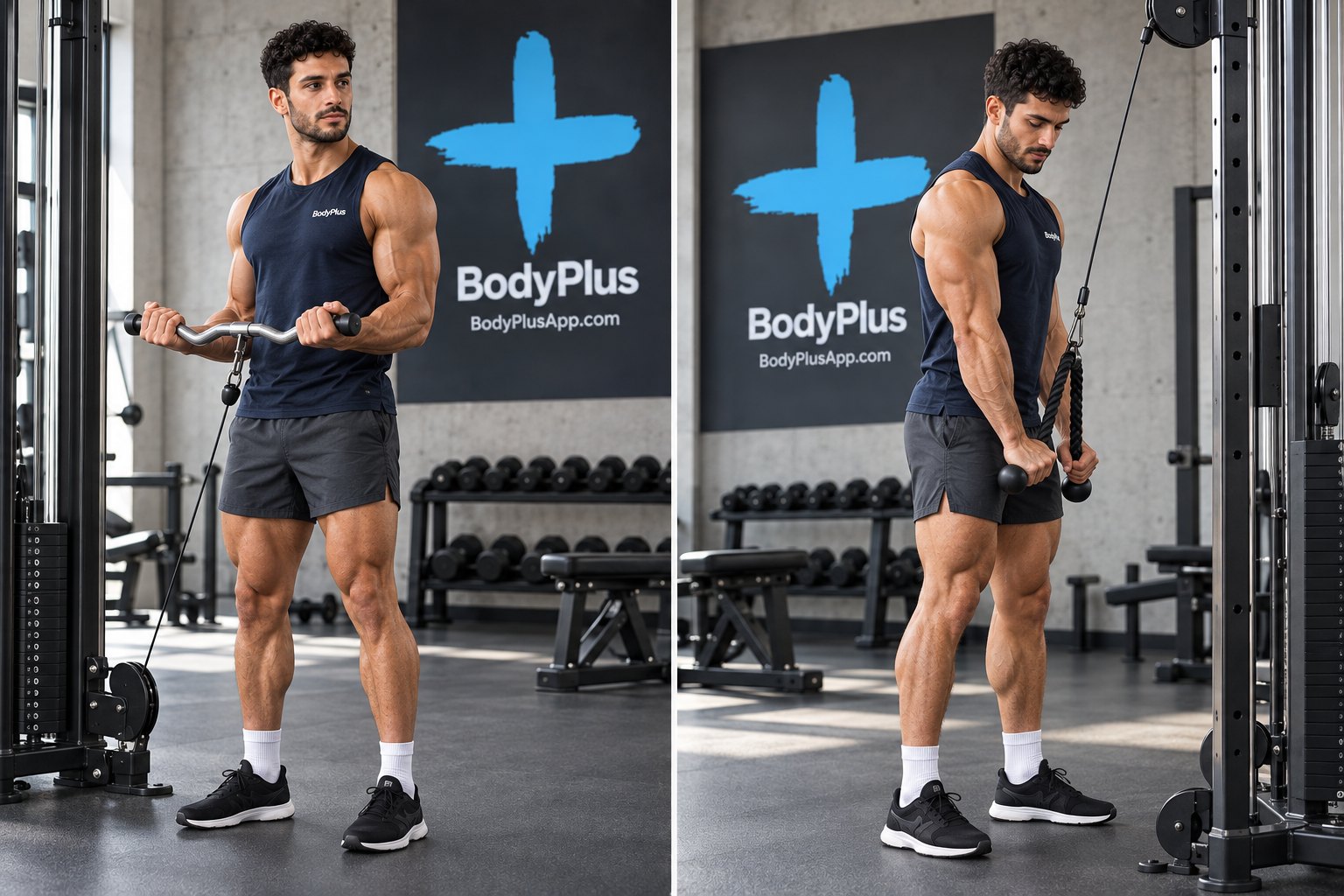
Usually when using this type, you do it throughout the whole workout. If you are doing an arms workout, then you do a set for the front arm and a set for the back arm in a row. After the two sets you rest. This is the reason the workout becomes significantly shorter: you cut the rest times in half.
Same-muscle supersets (compound sets)
In a same-muscle superset (in the research called an agonist superset, and in many gyms a compound set) you do two exercises in a row that work the same muscle group. For example, a French press (skull crusher) followed by a tricep pushdown on a high cable. This type is excellent for people who want to increase the intensity of the workout significantly.
There is an advanced version of this technique. You start with a compound exercise (one that trains several muscles at once), followed by an isolation exercise. This first lets us work the whole muscle group, and then focus on a specific part of the muscle. For example, you can do a squat, which is an exercise for all the muscles in the legs. Then do a leg extension on the machine, which is an isolation exercise for the quadriceps (the front of your thighs).
This type is the hardest on the target muscle. In research it also lowered the total weight people could lift across their sets, so use it for a few hard sets, not for your whole workout.
Upper-lower supersets
An upper-lower superset pairs a lower-body exercise with an upper-body exercise, for example a goblet squat with a push-up. The two muscle groups do not compete, so each one rests while the other works. This type suits full body workouts well.
What the research shows
- Time and volume. A 2025 systematic review and meta-analysis pooled 19 studies with 313 participants, most of them young, trained men. Compared with straight sets, supersets gave a similar number of reps and a similar volume load (weight times reps) in a shorter session. Antagonist pairs allowed more reps than straight sets. Same-muscle pairs lowered the volume load.
- Long-term results. In the same review, only three studies followed people over weeks. In those, strength and muscle growth were similar with both methods. A 2025 narrative review reached the same careful conclusion: similar results in about half the time, with a literature that differs a lot between studies.
- Heavy compound lifts. In one 10-week randomized trial, adults trained a full body workout of leg press, bench press, lat pulldown and seated row twice a week, with paired or with straight sets. Both groups got stronger and improved their body composition similarly, but the straight-set group gained about 5 kg (about 11 lb) more on the lat pulldown.
- Antagonist pairs. In one study, 16 trained men did heavy sets (their 4-rep max) of bench pulls and bench presses in about 10 minutes, either alternating the two or doing all sets of one exercise first. Alternating kept a higher volume load and was more efficient.
- The cost. Paired sets feel harder: the reviews report higher perceived effort, heart rate and blood lactate than straight sets. In one crossover study of 14 men, jump performance was still lower 24 hours after a paired session than after a straight-set session.
- Order matters. In one study of 12 trained men, doing the leg curl before the leg extension allowed more total volume, with lower perceived effort, than the reverse order.
In short: pairing exercises is a good way to save time, and antagonist pairs keep your work level best. If your main goal is maximum strength on heavy compound lifts, straight sets with full rest may have a small edge: one trial found slightly smaller gains on one of four lifts with supersets, while the pooled long-term studies found similar strength.
How to add supersets to your training plan
You can combine supersets into a training program in a variety of ways. There are a few main ways:
- A full superset workout. Pair all your exercises, and after every two exercises take a rest.
- Part of a workout. Do your main heavy lift with straight sets, then pair the rest.
- A finisher. Add one superset at the end of the workout, to take the muscles to the limit of their ability.
You can start by working with an antagonist superset that works different muscles. It is less intense and suitable for the beginning. For example, you can do a back exercise, after it a chest exercise, and then a rest of 1-2 minutes.
If you have been training for a while and you are in pretty good shape, you can do it on the same muscles. For example, you can do a dumbbell bench press and then immediately a dumbbell fly. Both of these exercises work the chest. Doing two exercises for the same muscle like this will cause a crazy pump. Just make sure you rest properly afterwards.
If you want to start combining supersets into your training program, the most important thing is to do it gradually. A gradual start will let your body adapt to the high load, and can lower your risk of getting injured.
Supersets suit people who are short on time or want variety; they are less ideal in a phase focused on maximum strength, or before you can keep good form when tired.
Setting up in a gym
A pair only works if both stations are ready. A few practical habits:
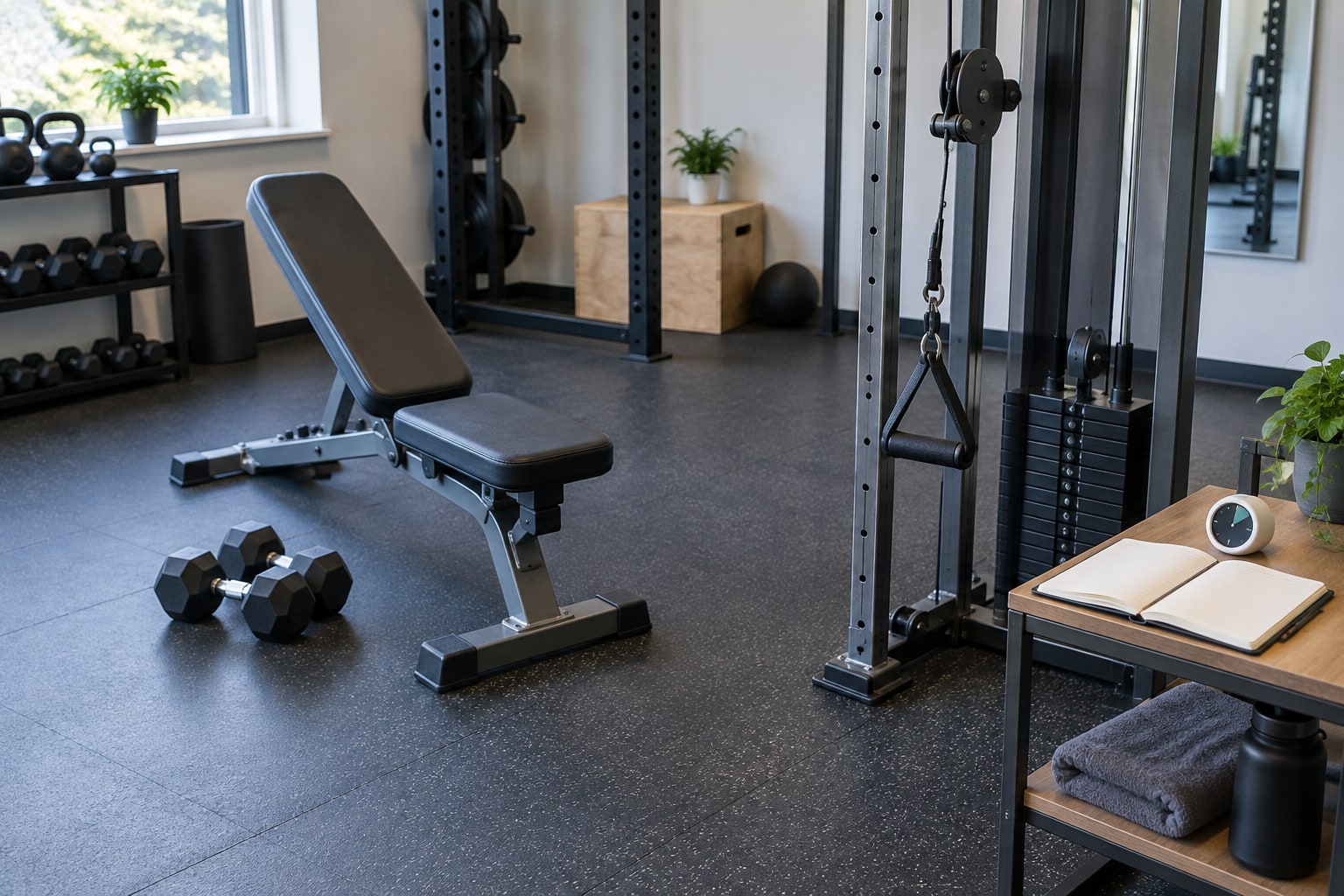
- Keep it in one place. Choose exercises you can do at one station, for example a bench with two pairs of dumbbells close by for a press and a dumbbell row, or one cable station with two handles.
- Set up both stations first. Load the second exercise before you start the first one, so you move straight across.
- Be fair in a busy gym. Holding two machines at peak hours is often not possible. Choose a dumbbell or body-weight exercise for the second slot, or ask whether you can share.
- Rest after the pair. Take about 1-2 minutes after antagonist and upper-lower pairs, and about 2 minutes or more after a hard same-muscle pair or heavy compound lifts.
Superset examples
Here are a few examples you can combine into your training program:
| Pair (A1 then A2) | Type | What it works |
|---|---|---|
| Biceps curl, then tricep pushdown on a high cable | antagonist | the first for the biceps, the second for the triceps |
| Leg press, then leg extension on a machine | same muscle | the first works the whole legs, the second focuses on the quadriceps |
| Dumbbell chest press, then machine row | antagonist | the first for the chest, the second for the back |
| Dumbbell chest press, then dumbbell fly | same muscle | the first works the chest, shoulders and triceps; the second focuses the work on the chest |
| Wide-grip pull-ups, then reverse-grip pull-ups (chin-ups) | same muscle | in a body-weight workout you can also pair two variations of the same exercise |
| Push-ups, then seated cable row | antagonist | chest, shoulders and triceps, then back and biceps |
| Leg curl, then leg extension | antagonist | back of the thighs, then front of the thighs |
| Goblet squat, then push-ups | upper-lower | legs and glutes, then chest and triceps |
The pull-up pair is hard: both exercises load your back and biceps. If you cannot do clean reps on the second one, use an assisted machine or a band, or swap it for a lat pulldown.
Sample superset workout (full body, about 45 minutes)
Do the pairs in order: A1, then A2 with no rest, then the rest shown. Repeat until you finish the sets, then move to pair B. The weights in the log below are an example; pick your own.
| Pair | Exercise | Sets | Reps | Rest after the pair |
|---|---|---|---|---|
| A1 | Dumbbell bench press | 3 | 8-12 | - |
| A2 | Dumbbell row (each arm) | 3 | 8-12 | 90 s |
| B1 | Goblet squat | 3 | 10-12 | - |
| B2 | Lat pulldown | 3 | 10-12 | 90 s |
| C1 | Leg curl | 3 | 10-15 | - |
| C2 | Leg extension | 3 | 10-15 | 60-90 s |
| D1 | Biceps curl | 2 | 10-15 | - |
| D2 | Tricep pushdown | 2 | 10-15 | 60 s |
- Warm up first with a few easy sets of the first pair.
- Stop most sets when you could still do one to three more good reps.
- The same workout with straight sets and full rest usually takes much longer.
- For a plan built around muscle growth, see my guide to hypertrophy training.
How to track it
| Session | A1 press (each dumbbell) | A2 row (each dumbbell) | Reps A1 / A2, sets 1-3 |
|---|---|---|---|
| 1 | 14 kg (about 30 lb) | 18 kg (about 40 lb) | 12/12, 10/11, 9/10 |
| 2 | 14 kg (about 30 lb) | 18 kg (about 40 lb) | 12/12, 11/12, 10/11 |
| 3 | 14 kg (about 30 lb) | 18 kg (about 40 lb) | 12/12, 12/12, 12/12 |
| 4 | 16 kg (about 35 lb) | 20 kg (about 45 lb) | 10/10, 9/10, 8/9 |
When you reach 12 reps on all three sets with good form, move up to the next pair of dumbbells for that exercise and start again near the bottom of the range. Notice that your reps drop a little from set to set: that is normal with short rest.
Safety
In general, this technique is pretty safe. Still, there are a few things to take into account before you combine supersets into your workouts.
First, a superset is a technique that loads the body, and can cause overtraining. Overtraining can lead to injuries. After a workout in which you combined this technique, make sure you let your body recover well.
Second, as a result of the intensity, you might cheat on your form. For this reason, choose exercises whose technique is relatively simple. For example, instead of a barbell chest press, do a dumbbell chest press or a machine chest press. If you do pair a heavy barbell lift, use safety arms or a spotter.
It is important to choose a weight that will challenge you, but that you can control. You don't want to cheat on your form and risk an injury just to do a superset. Remember that the benefits of this technique are not worth it if it puts you at risk of injury.
Start with one or two pairs in a session and add more over the following weeks, so your body can adapt. Give the muscles you worked hard about a day or two before you train them hard again, and if you feel run down, drop a pair or lower the weight. Set up both stations before you start, and check that the bench, the collars and the cable attachments are secure. End the set when your reps slow down a lot or your form starts to slip, even if you planned more reps.
- Move on calmly. "No rest" means going to the next exercise right away, not racing through sloppy reps.
- Expect to go a little lighter. You will usually use a little less weight, or get a few fewer reps, than with straight sets.
- Stop the set if you feel dizzy, sick or sharp pain, and drink water between pairs.
Bottom line
Supersets are an excellent technique for increasing the difficulty level of the workout. You can gain a lot from this technique, as long as you combine it into your workouts in a smart way. It can help you build muscle mass, improve strength, vary your workouts and save you time in the gym, with research showing similar results to straight sets in less time. Moreover, you can do supersets with almost any exercise and any equipment in the gym. It is an important and effective tool for the toolbox of trainees and bodybuilders.
You can also combine a drop set, to increase the difficulty level of the workouts.
Frequently asked questions
What is a superset in the gym?
Two exercises done back to back without rest, with a rest only after the pair. For example, a chest press followed right away by a row.
Are supersets better than straight sets?
Not better, but faster. Research reviews found similar volume, strength and muscle growth in less time, mostly in young, trained men. For maximum strength on heavy compound lifts, straight sets with full rest may have a small edge.
Are supersets good for building muscle?
They can be. The few long-term studies so far (three in a 2025 review, mostly in young, trained men) found similar muscle growth to straight sets.
How long should I rest between supersets?
About 1-2 minutes after antagonist or upper-lower pairs, and about 2 minutes or more after a hard same-muscle pair.
What is the difference between a superset and a compound set?
Many people use "superset" for any pair and "compound set" for two exercises for the same muscle. Both mean doing the exercises back to back.
What is the difference between a superset and a circuit?
A superset pairs two exercises. A circuit links several exercises, often for the whole body, before you rest.
Can beginners do supersets?
Yes, once they know the basic exercises. Start with light antagonist or upper-lower pairs and add them gradually.
Are supersets good for women?
Yes. Nothing suggests the technique works differently for women, although most of the research so far was done in men. Choose weights that fit your level.
The information on this page and on this website is intended to provide general information only. The content on this website does not constitute a professional opinion, a recommendation, or a substitute for consulting an expert in a specific field or obtaining a medical opinion. It is not medical advice. BodyPlus is not a medical device. If you have a health condition or an injury, or are pregnant, talk to a qualified healthcare professional before starting. Stop exercising and seek appropriate help if you feel pain, dizziness or other concerning symptoms.
Sources
Accessed September 17, 2026.
- Zhang X. et al., "Superset Versus Traditional Resistance Training Prescriptions: A Systematic Review and Meta-analysis Exploring Acute and Chronic Effects on Mechanical, Metabolic, and Perceptual Variables", Sports Med 2025;55(4):953-975. pubmed.ncbi.nlm.nih.gov/39903375
- Mang Z.A. et al., "The Acute and Chronic Effects of Superset Resistance Training Versus Traditional Resistance Training-A Narrative Review", J Strength Cond Res 2025;39(11):1216-1234. pubmed.ncbi.nlm.nih.gov/41118588
- Iversen V.M. et al., "Efficacy of Supersets Versus Traditional Sets in Whole-Body Multiple-Joint Resistance Training: A Randomized Controlled Trial", J Strength Cond Res 2024;38(8):1372-1378. pubmed.ncbi.nlm.nih.gov/39072654
- Robbins D.W. et al., "The effect of an upper-body agonist-antagonist resistance training protocol on volume load and efficiency", J Strength Cond Res 2010;24(10):2632-2640. pubmed.ncbi.nlm.nih.gov/20847705
- Weakley J.J.S. et al., "The effects of traditional, superset, and tri-set resistance training structures on perceived intensity and physiological responses", Eur J Appl Physiol 2017;117(9):1877-1889. pubmed.ncbi.nlm.nih.gov/28698987
- Balsamo S. et al., "Exercise order affects the total training volume and the ratings of perceived exertion in response to a super-set resistance training session", Int J Gen Med 2012;5:123-127. pubmed.ncbi.nlm.nih.gov/22371654