
What Is Tabata? The 4-Minute Interval Workout, How to Do It and Sample Workouts
In short
A Tabata workout is a high-intensity interval workout. The whole workout is supposed to take 4 minutes: you work at very high intensity for 20 seconds, then rest for 10 seconds, for 8 rounds. It is little time, but it is so effective because of its high intensity.
What is a Tabata workout?
The Tabata workout is named after the Japanese scientist Dr. Izumi Tabata and a team of researchers from the National Institute of Fitness and Sports in Kagoshima. The pattern itself came from Kouichi Irisawa, head coach of Japan's speed skating team in the 1980s, and Tabata and his team tested it in a study on two groups.
- The first group trained at moderate intensity: five days a week for six weeks, one hour per workout, at a steady effort of about 70% of their maximal oxygen uptake (VO2max, a standard measure of aerobic fitness).
- The second group trained at high intensity: four days a week for six weeks, on an exercise bike. Each workout was seven to eight 20-second sprints at about 170% of VO2max, with 10 seconds of rest between them, so about four minutes. On a fifth day they rode 30 minutes at a moderate effort and then did four of the hard sprints.
Dr. Tabata found that the high-intensity training led to a 28% increase in anaerobic fitness (the energy you can produce in hard, short efforts) and 14% in aerobic fitness. The moderate group improved its aerobic fitness too, but its anaerobic capacity did not change. These results were groundbreaking, and since then Tabata workouts (and high-intensity interval training, or HIIT) have found a place in mainstream fitness, for beginner athletes as well as professional athletes.
What that study does and does not tell you
The study is famous, but it is small and specific:
- The original effort was extreme. About 170% of VO2max is a sprint beyond your aerobic maximum, and the riders were a small group of seven subjects. Most people cannot reach that level with push-ups, squats or jumping jacks.
- Most "Tabata" workouts are easier. In one small study, 16 trained volunteers did a 20-minute body-weight and jumping workout with the 20/10 timing at about 74% of VO2max and 86% of their maximal heart rate: hard, but far from the original intensity.
- The evidence for other exercises is thin. In a 2019 review, Tabata himself wrote that the published evidence for running and body-weight versions (such as burpees and squat jumps) is insufficient.
So a body-weight Tabata is a good, hard interval workout. It is just not the same thing the 1996 study measured.
What is the difference between a Tabata workout and a HIIT workout?
HIIT covers all types of high-intensity interval workouts. A Tabata workout is a type of HIIT workout. In a HIIT workout there are no defined work and rest times, which means you can set the times yourself. A Tabata workout has defined times of 20 seconds of work and 10 seconds of rest, so the whole workout should take you 4 minutes. Usually in a HIIT workout you set longer rest times and it takes between 10 and 30 minutes.
| Tabata | HIIT in general | |
|---|---|---|
| Work and rest | 20 s work, 10 s rest (fixed) | you choose, for example 30 s / 30 s or 4 min / 3 min |
| Effort | as hard as you can, every interval | hard, adjusted to the interval length |
| Best for | people who already have a fitness base | a wide range of levels |
If you are new to hard intervals, start with the longer rests in my HIIT guide.
The advantages of a Tabata workout
High-intensity training has several advantages for anyone who wants an active, balanced and healthy lifestyle.
Increased calorie burning after the workout
Studies (for example) show that high-intensity workouts such as HIIT or Tabata keep your energy use a little higher after the workout (often called "afterburn"). A research review found that this extra is small: about 6-15% of the energy cost of the workout itself (the authors note it may be somewhat higher for interval sessions). So most of the energy you use still comes from the workout. A 4-minute block uses little energy in total, and your overall activity and eating habits over weeks matter far more than any single workout.
Tabata workouts are short and save time
A full Tabata workout takes only 4 minutes. This is excellent for everyone who has no time to do 20-30 minutes of aerobic exercise. Even with a warm-up and a cool-down, a session can fit into 15 minutes.
Muscle: more endurance than size
These workouts demand maximum effort, commitment and stimulation of the muscle tissue. Therefore, the exercises of the Tabata method put the body under the task of rebuilding these fibers. The effect is more on muscular endurance than on muscle size: in a 6-week study of 35 inactive middle-aged men, a HIIT group gained some lean mass (about 1.6%), but the strength training group gained about twice as much and got much stronger. If building muscle is your goal, keep strength training as the base and add Tabata on top.
Improvement of aerobic and anaerobic fitness
Dr. Izumi Tabata points to a 14% increase in aerobic capacity and 28% in anaerobic capacity of the trainees. The improvement is expressed in an increase in the people's endurance.
The disadvantages of a Tabata workout
A Tabata workout doesn't have many disadvantages, but there are some that you must know.
Not suitable for everyone
If you have heart disease or high blood pressure, avoid this workout. A high-intensity interval workout raises the heart rate within a short period of time.
The workout is also not suitable for beginner trainees who are not yet fit enough to complete a workout. You should avoid this type of workout if you haven't been training for at least a few months. Build a base first with steady cardio and easier intervals.
Increased risk of injury
The risk of injury is always present, but here it grows because of the high intensity. The great difficulty causes two things. One, cheating in the technique of the exercises. Two, too great a load on the body. Both of these can cause you an injury that will sideline you for a considerable time.
How to do a Tabata workout

Step by step
- Pick one to four exercises you know well (see the tips below). You can use one exercise for all 8 intervals or switch between them.
- Set a timer to 20 seconds of work and 10 seconds of rest, 8 rounds.
- Warm up for 5-10 minutes with dynamic moves.
- Work hard for 20 seconds on each interval, with good form.
- Rest for 10 seconds.
- Repeat for 8 rounds. If you do a second block, rest 1-2 minutes before it.
- Cool down for a few minutes with easy walking or cycling.
How hard is "hard"?
On a 0-10 effort scale, the first intervals should feel like about an 8 and the last ones like a 9 or more: you can only say a word or two. If you could hold a conversation, it is not Tabata-level effort.
Tips for a Tabata workout
Do exercises that work the whole body
Traditionally, a Tabata workout was done with exercise bikes or a treadmill. Today most trainees combine the workout with strength exercises. You can do squats, deadlifts, push-ups and any exercise you can think of, as long as you can do it safely at speed. Many home workout exercises work well here.
Many people do an abs Tabata workout. They take the principle of the workout and simply do only abdominal exercises. That way they both shorten the time and achieve efficient and effective work.
Choose exercises you know how to do well
Choose exercises that you know very well and can perform with perfect technique. Choosing the right exercises will make your technique good even when you are tired.
Work with a timer
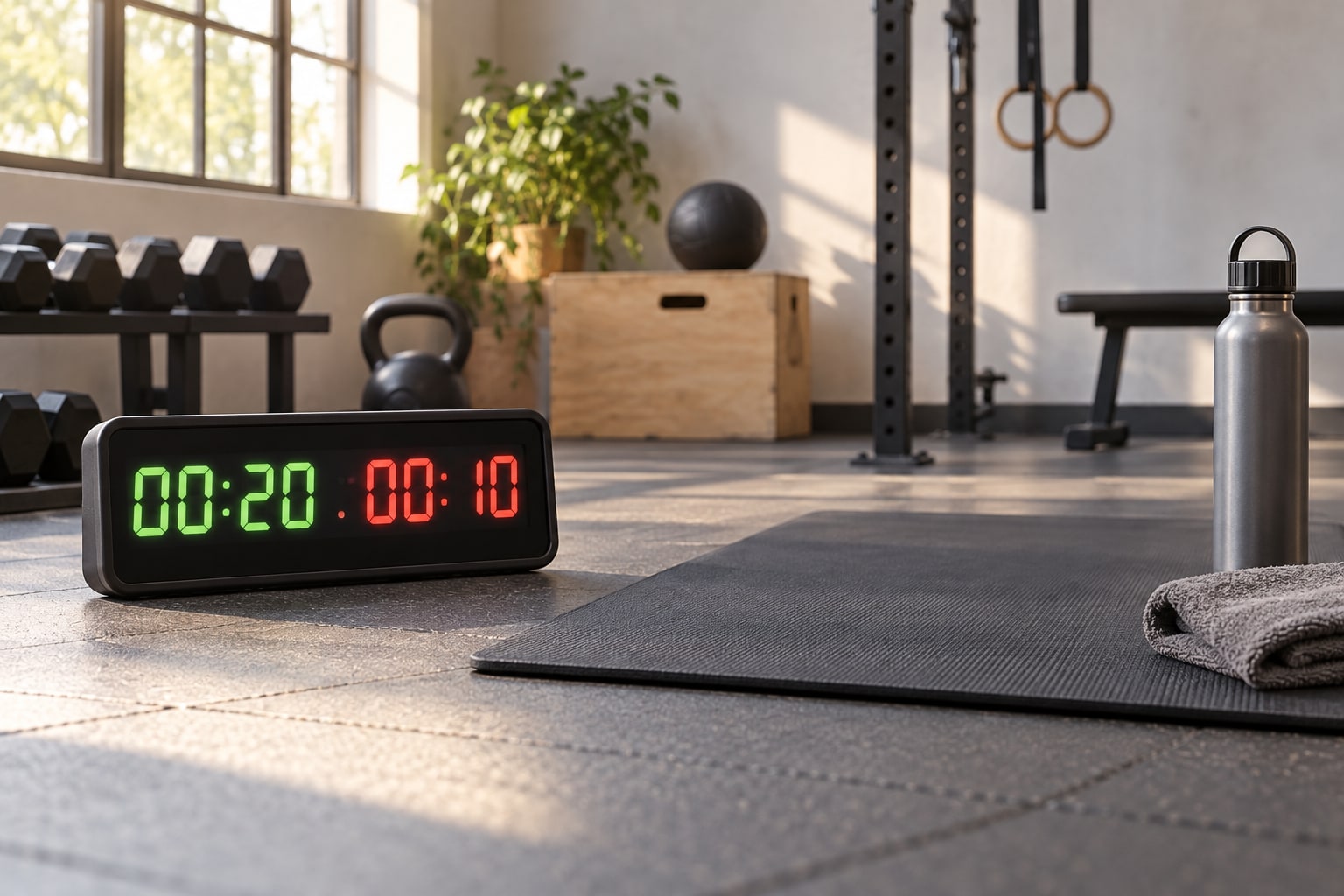
Work with a timer or a phone app that will ring at the times you set. That way you will be able to stay focused on the workout and won't need to look at every second to check the times.
Safety and injury prevention
Do a good warm-up before the workout
HIIT workouts and Tabata workouts are hard workouts that load the body heavily, so you must prepare for them properly. A good warm-up will help you both improve performance and minimize the risks of injury. So make sure you warm up before you start.
A good warm-up is a dynamic warm-up. A dynamic warm-up is a warm-up with movements without resistance that activate large parts of the body. As a result, all the muscles, joints and tendons will prepare themselves for strenuous work. You can do arm circles, bodyweight squats, knee raises and more. Finish with one or two short, easier intervals of the exercise you are about to do.
Maintain correct technique
Because of the high intensity, toward the end of the workout you will probably be very tired. There is a high chance that as a result of the fatigue your technique in the exercises will be somewhat sloppy. Poor technique in exercises is something you must avoid at all costs. It will increase your chance of injuries that will sideline you for a good few months. And then you will lose all the progress you have achieved.
If you see that your technique is starting to get cheated, rest until the next exercise.
A few practical cautions
- Stop right away if you feel chest pain or pressure, unusual shortness of breath, dizziness or faintness, a racing or irregular heartbeat, or sharp pain. If you have concerning chest pain or pressure, especially with breathlessness, dizziness or faintness, or sudden severe difficulty breathing, call your local emergency services immediately. Do not wait to see whether it eases after stopping. See the American Heart Association's warning signs.
- If jumping moves bother your knees, ankles or pelvic floor, use the low-impact swaps in the table below.
- Drink water and train in a space with room to move and a non-slip floor.
- Don't do Tabata right before a heavy strength session for the same muscles; your lifting form will suffer.
Examples of Tabata workout plans
Each workout below is one 4-minute block. Warm up first and cool down after.
Easy abs Tabata workout
You can do an abs Tabata workout and thereby shorten the time of the workout, without harming its effectiveness. This plan is the easiest of the workouts below, for trainees who are newer to Tabata but have a few months of training behind them:
- Crunches: 20 seconds
- Rest: 10 seconds
- Plank: 20 seconds
- Rest: 10 seconds
Repeat the sequence 4 times (8 intervals in total).
Advanced abs Tabata workout
This workout is harder than the previous one and is suitable for more experienced trainees:
- Hanging leg raises: 20 seconds
- Rest: 10 seconds
- Bicycle crunches: 20 seconds
- Rest: 10 seconds
You repeat this workout 4 times in a row, of course only if you can. For more core moves, see my list of the best ab exercises.
Full body workout with four exercises
You can change the structure of the workout slightly: add 2 exercises and remove two rounds, and it will still be 4 minutes.
You repeat this workout twice, and between exercises you do 10 seconds of rest. If you cannot do pull-ups for 20 seconds, do a few good reps and hang for the rest of the interval, or use a band.
Aerobic Tabata workout
If you want an efficient and fast aerobic workout, you can combine several different types of exercises such as sprints, burpees, jumping jacks, jump squats and so on. Here is an example aerobic Tabata workout:
- Sprint: 20 seconds
- Rest: 10 seconds
- Jumping jacks: 20 seconds
- Rest: 10 seconds
You repeat the workout 4 times in a row. Sprint only after a full warm-up and on a flat surface, or do the sprint intervals on an exercise bike.
Bike workout (closest to the original)
- Warm up for 10 minutes at an easy to moderate pace.
- 8 rounds of 20 seconds as hard as you can pedal against a firm resistance, and 10 seconds of very easy pedaling.
- Cool down for 5 minutes of easy pedaling.
Exercises you can use
There are plenty of exercises you can combine in your Tabata workout. Choose them according to the goal you want to improve in. Here are some examples, with an easier or low-impact swap for each:
| Exercise | Low-impact or easier swap |
|---|---|
| Burpees | step back instead of jumping, no push-up |
| Crunches | dead bug |
| Bicycle crunches | slow bicycle crunches |
| Pull-ups | band-assisted pull-ups or a dead hang |
| Push-ups | push-ups with your hands on a bench |
| Sprints | fast marching or high knees in place |
| Jumping jacks | step jacks (one foot out at a time) |
| Boxing workout | shadow boxing with slower punches and a step |
How often to train this way
For a healthy adult with a fitness base, one to three Tabata sessions a week is a reasonable starting range, with at least one easier day between them. The original study had its subjects training five days a week (four hard days and one longer day), which is far more than most people need or can recover from.
For health, the World Health Organization (WHO) 2020 guidelines recommend that adults do at least 150-300 minutes of moderate-intensity aerobic activity, or at least 75-150 minutes of vigorous-intensity aerobic activity, or an equivalent mix, each week, plus muscle-strengthening activities that work all major muscle groups on 2 or more days a week. Hard intervals count as vigorous activity, but a few 4-minute blocks are only a small part of that goal, so use Tabata next to walking, longer cardio and strength training.
A sample week
| Day | Session |
|---|---|
| Monday | strength training + one 4-minute block at the end |
| Tuesday | 30-40 minutes of easy to moderate cardio |
| Wednesday | rest or a walk |
| Thursday | strength training |
| Friday | warm-up + 2-3 blocks with 1-2 minutes of rest between them |
| Saturday | an active day (walk, bike ride, sport) |
| Sunday | rest |
Add walks on other days to reach the WHO range.
How to track your progress
A simple way to track a body-weight block is to count your reps in each interval and add them up. Example for body-weight squats, one block a week:
| Week | Reps in intervals 1-8 | Total |
|---|---|---|
| 1 | 14, 14, 13, 12, 12, 11, 11, 10 | 97 |
| 2 | 15, 14, 13, 13, 12, 12, 11, 11 | 101 |
| 3 | 15, 15, 14, 13, 13, 12, 12, 11 | 105 |
| 4 | 16, 15, 14, 14, 13, 13, 12, 12 | 109 |
Your reps drop from interval to interval: that is normal with 10-second rests. Only count reps with full range and good form. When your total stops rising for two or three weeks, switch to a harder exercise (for example jump squats, if your joints tolerate impact) or add a second block.
Bottom line
A Tabata workout is an excellent workout, especially if you are short on time. You can get a highly efficient workout in 4 minutes. The traditional Tabata workout is structured from 4 minutes, of which 20 seconds you do an exercise and 10 seconds you rest. You choose the exercises according to the goal you want to improve in. Keep in mind that the famous study used an all-out bike effort in a small group of seven subjects, so treat body-weight versions as hard interval training, build up gradually, and keep your form.
Frequently asked questions
Is a 4-minute Tabata enough exercise?
It can improve fitness when the effort is very high, but it covers only a small part of the WHO's weekly activity goals. Most people add more blocks or combine it with other training.
Does a Tabata workout burn fat?
Not by itself. A 4-minute block uses little energy in total, and no workout burns fat from one specific area. Your overall activity and eating habits over time matter far more.
What exercises are best for Tabata?
Simple moves you can do safely at speed: an exercise bike, squats, push-ups, jumping jacks, burpees, mountain climbers and core exercises. Choose lifts you can control when you are tired.
How many calories does a Tabata workout burn?
It depends on your body size, the exercises and your effort, so any single number is a guess. A fitness tracker can give you a rough estimate.
The information on this page and on this website is intended to provide general information only. The content on this website does not constitute a professional opinion, a recommendation, or a substitute for consulting an expert in a specific field or obtaining a medical opinion. It is not medical advice. BodyPlus is not a medical device. If you have a health condition or an injury, or are pregnant, talk to a qualified healthcare professional before starting. Stop exercising and seek appropriate help if you feel pain, dizziness or other concerning symptoms.
Sources
Accessed September 17, 2026.
- Tabata I. et al., "Effects of moderate-intensity endurance and high-intensity intermittent training on anaerobic capacity and VO2max", Med Sci Sports Exerc 1996;28(10):1327-1330. pubmed.ncbi.nlm.nih.gov/8897392
- Tabata I., "Tabata training: one of the most energetically effective high-intensity intermittent training methods", J Physiol Sci 2019;69(4):559-572. pubmed.ncbi.nlm.nih.gov/31004287
- Emberts T. et al., "Exercise intensity and energy expenditure of a tabata workout", J Sports Sci Med 2013;12(3):612-613. pubmed.ncbi.nlm.nih.gov/24137082
- LaForgia J. et al., "Effects of exercise intensity and duration on the excess post-exercise oxygen consumption", J Sports Sci 2006;24(12):1247-1264. pubmed.ncbi.nlm.nih.gov/17101527
- Callahan M.J. et al., "Skeletal Muscle Adaptive Responses to Different Types of Short-Term Exercise Training and Detraining in Middle-Age Men", Med Sci Sports Exerc 2021;53(10):2023-2036. pubmed.ncbi.nlm.nih.gov/33867497
- Bull F.C. et al., "World Health Organization 2020 guidelines on physical activity and sedentary behaviour", Br J Sports Med 2020;54(24):1451-1462. pubmed.ncbi.nlm.nih.gov/33239350
- Wingfield H.L. et al., "The acute effect of exercise modality and nutrition manipulations on post-exercise resting energy expenditure and respiratory exchange ratio in women: a randomized trial", Sports Med Open 2015;1(1):11. pubmed.ncbi.nlm.nih.gov/27747847