
What Is Hypertrophy? How Muscles Grow and How to Train for It
In short
Hypertrophy is the growth of your muscles. When you lift weights regularly, your muscle fibers get thicker, so the muscle as a whole gets bigger. It comes from training that challenges your muscles, enough recovery and enough food, repeated for months.
If you train in a gym and want to develop your body, you have surely heard the term "hypertrophy". It is one of the foundations of bodybuilding, and it is important that you understand what it means and why it matters. This guide also gives you a few rules and tips for reaching hypertrophy in the most effective way.
What hypertrophy means
Hypertrophy is basically a state in which muscle mass grows, meaning the amount of material in the muscle fibers grows. It refers to the enlargement of the fibers themselves, not to an increase in the number of muscle fibers.
The OpenStax anatomy textbook describes it the same way: resistance training adds structural proteins to muscle fibers, so each fiber gets wider. New muscle cells are not formed when muscles grow. That is also the short answer to "hypertrophy vs hyperplasia": hyperplasia means more cells, while muscle growth from training is mainly about larger fibers. The opposite of hypertrophy, when muscles lose protein and shrink, is called atrophy.
Why building muscle matters for your health
Contrary to what people think, building muscle matters for more than a muscular, good-looking body. A focus on muscle growth is useful for everyone: people who work in an office, athletes and older adults alike.
- A higher metabolism. More muscle mass can increase your metabolism. Muscle needs energy even at rest, so the number of calories your body uses at rest can go up.
- Strengthening the body and helping to prevent injuries. Strength training can strengthen your joints. It can also increase bone density, and so help slow the thinning of bone density that happens as we get older.
- Slowing the effects of aging. Strength training can increase the ability of older adults to perform tasks related to an independent life, such as climbing stairs, bending down, and more.
- Better performance in other sports. If you play a sport, it is likely that gaining a reasonable amount of muscle mass will improve your performance.
A 2012 review of strength training and health (Westcott) describes these benefits.
How muscle growth happens
The process has two parts that repeat: training and recovery.
Training: the stimulus
When your muscles face a difficulty they are not used to, as in strength training, they experience trauma. The workouts cause very, very small, microscopic tears in the muscle fibers. These tears cause an inflammatory response in the cells, and they send a message to the immune system to repair them.
Researchers still debate how much the tearing matters: a 2018 review (Damas and colleagues) argued that muscle damage is not what drives muscle growth. So soreness is not proof that a workout worked, and you do not need to chase it.
Recovery: rebuilding the muscle
This is where the "magic" of building muscle happens. After a workout, the tears activate the immune system, which repairs the damage caused by the workout.
When there is this cycle of training and recovery, your muscles will grow. They will grow because they are trying to adapt to the load placed on them.
The growth of the muscles depends on the body having more amino acids (proteins) than it needs to repair all the tears. Some of the amino acids repair the tears, and with the amino acids left after the repairs the body builds more muscle.
How do you reach hypertrophy? The training variables
How heavy is heavy enough?
To start reaching hypertrophy, load your muscles with at least about 40% of the most weight you can lift once (your one-rep max). For example, if the most you can curl once is 20 kg (about 44 lb), 40% is 8 kg (about 18 lb). A light weight like that builds muscle when you take the set close to failure, which can mean many reps.
It is important to understand that 40% is only the starting point. In a 12-week study (Lasevicius 2018), 30 men trained one arm and leg at 20% of their one-rep max and the other arm and leg at 40%, 60% or 80%, with the total work matched. The 40%, 60% and 80% limbs grew by similar amounts, while the 20% limbs grew by less than half as much (about 9 to 11% against about 20 to 25%). A 2017 meta-analysis of 21 studies (Schoenfeld and colleagues), where all sets went to failure, also found similar muscle growth with light and heavy loads, but heavy loads built more maximal strength. So you do not need a very heavy weight to grow, but a heavier weight means fewer reps per set and makes you stronger. You can find your estimated one-rep max with the one-rep max calculator.
The main variables at a glance
| Variable | What research suggests | In practice |
|---|---|---|
| Weekly sets (volume) | more sets per week tended to build more muscle (Schoenfeld 2017, 15 studies); ACSM 2026 found better growth with 10 or more sets per muscle group per week | start at about 10 hard sets per muscle group per week and add slowly if you recover well |
| Effort | training to failure gave at most a trivial edge over stopping short, and no clear edge in the sub-analysis of true failure (Refalo 2023, 15 studies) | stop most sets when you could do about 1 to 3 more good reps |
| Load | similar growth from light and heavy loads taken to failure (Schoenfeld 2017, 21 studies) | mostly 6 to 15 reps per set; lighter sets only if you push them hard |
| Frequency | with weekly sets equal, training a muscle more often made little difference (Schoenfeld 2019, 25 studies) | two to three times a week per muscle makes 10 or more sets easier to fit in; once a week also works if the weekly sets add up |
| Range of motion | full range built more strength and more lower-body muscle than partial range (Pallares 2021, 16 studies) | use the full range you can control |
How long does it take to see results?
Hypertrophy and building muscle is a process that takes time and depends on many factors: your age, your sex, how much muscle you already have, your genetics, how much protein your body is able to absorb, your nutrition, and more. (Source: ACE Fitness)
For a rough sense of scale, one review (Westcott 2012) reports that 10 weeks of resistance training may add about 1.4 kg (about 3 lb) of lean weight. That is an average from studies, not what any one person will gain, and lean weight is not all muscle. Numbers like these apply to natural trainees who do not use anabolic steroids.
It is true that even when you do everything right, it is a process that takes time, but you need to look at the long term. Over time the muscle adds up, and you can become more and more muscular.
If bodybuilding were an easy and quick process, everyone would be a bodybuilder, and there would be nothing special about it.
How to train for hypertrophy
Correct technique
The most important thing in reaching hypertrophy is proper technique. Many people think the goal in training is to lift the highest weight. As a result, they cheat on technique, use momentum or do half a movement. Of course this is not right at all!
Besides the muscles not working as they should, this cheating in exercises also increases the risk of inflammation and injuries.
To reach hypertrophy well, you need to load the muscles in a correct and effective way. So when you do an exercise, make sure of a few things:
- correct body positioning
- full range of motion
- no momentum and swinging
- choosing the right weight
- slow and controlled movement
Warm up before your first heavy exercise with a few minutes of easy movement and one or two lighter sets, and use a spotter or safety bars when you take heavy barbell sets close to failure.
Compound exercises first
One of the most effective ways to reach hypertrophy and build muscle across your whole body is with exercises that work many muscles at the same time.
Start your workout with exercises such as the bench press, the squat and the Romanian deadlift. When you do these exercises at the beginning of the workout, you will also be able to lift your greatest weights.
After that, do isolation exercises. With isolation exercises you can focus the load on a specific muscle.
Count your weekly sets
Add up the hard sets each muscle group gets across the week. For example, for the chest:
| Day | Exercise | Sets |
|---|---|---|
| Monday | Bench press | 3 |
| Wednesday | Incline dumbbell press | 3 |
| Friday | Bench press | 3 |
| Friday | Push-ups | 2 |
| Week total | 11 |
If a muscle group lands well under 10, add a set or an exercise on one of your days. To build the whole week, follow how to make a workout plan, or pick a ready plan such as the full body plan or the upper/lower split.
More tips for better muscle growth
- Change the training program from time to time. You do this so the muscles do not get used to the load placed on them. You can change the exercises, the repetition range, the order of the exercises, the division of the muscles, and more.
- Work with the right weights. Heavy weights with a low repetition range raise the risk of injury. However, weights that are too low will not maximize hypertrophy.
- Repetition range. I suggest a repetition range between 6 and 15. This way you also work the muscles in every possible way. Many plans on this site use 8 to 12, the middle of that range.
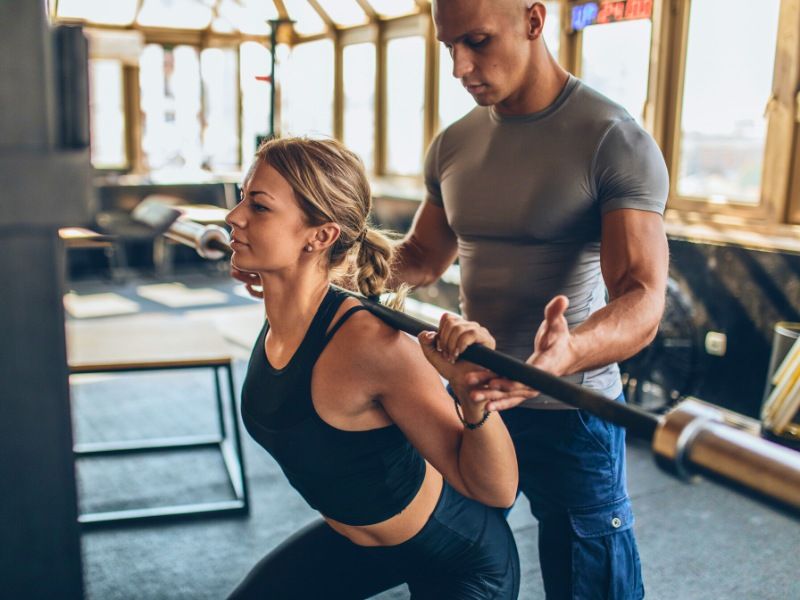
- Work with a good trainer. A good trainer will accompany you, answer questions and help you avoid mistakes right from the start.
- Patience. One of the most important things is patience. Although the process takes time, it is worth it!
Nutrition for muscle growth
To reach hypertrophy, you must give your body enough food. Protein is the building block of muscle, and carbohydrates give you the energy to train and recover. If you do not eat enough, not only will you not reach hypertrophy, the body will break down muscle.
Our body uses food as a source of energy. When we do not eat enough, two things can happen:
- It will break down muscle and use it as a source of energy.
- It will break down fat stores and use them as a source of energy (this is basically cutting).
The body will break down muscle and use it as a source of energy when you do not eat enough protein. This is the reason protein is critically important both in bulking and in cutting.
According to studies (see the sources below), the optimal protein intake for bodybuilders is between 1.6 and 2.2 grams of protein per kilo of body weight (about 0.7 to 1 gram per pound). Most experienced trainers and bodybuilders recommend starting from 2 grams of protein per kilo of body weight.
If you do not really understand nutrition, here are 9 simple rules and tips in bodybuilding nutrition that will help you at the start of the road. A BMR calculator gives you a starting estimate of your energy needs, and for the full picture of training, food and rest together, see how to build muscle.
Safety
Muscle grows while you recover, so give a muscle a day or two before you train it hard again, and sleep enough. Add weight or reps in small steps, such as 2.5 kg at a time, and only when your reps stay clean. Go lighter when your technique slips, when a joint gives you a sharp pain, or when you are unusually tired. On most sets keep one or two good reps in reserve, and end a set when the movement turns into swinging or the last rep slows sharply. On heavy barbell sets, set the safety arms at the rack or use a spotter.
Bottom line: how to track your muscle growth
Because each of us has a different body and different genetics, each person will reach their best hypertrophy in a different way. There is no single factor for hypertrophy and for building muscle. The best way to know whether you are really succeeding in building muscle is to track your results.

Check your body weight once a week and write it down. If your body weight is going up and your performance in the gym is going up too, it is likely that you have also built some muscle.
However, because the amount of muscle we can build is limited, do not gain body weight too fast. A rapid increase in body weight will cause you to gain a lot of fat.
A simple way to track progress in the gym
Pick a rep range, for example 8 to 12. When you reach the top of the range on every set, add a small amount of weight next time and work back up.
| Week | Exercise | Weight (each hand) | Set 1 | Set 2 | Set 3 |
|---|---|---|---|---|---|
| 1 | Dumbbell bench press | 20 kg (about 44 lb) | 12 | 10 | 9 |
| 2 | Dumbbell bench press | 20 kg (about 44 lb) | 12 | 11 | 10 |
| 3 | Dumbbell bench press | 20 kg (about 44 lb) | 12 | 11 | 11 |
| 4 | Dumbbell bench press | 20 kg (about 44 lb) | 12 | 12 | 12 |
| 5 | Dumbbell bench press | 22.5 kg (about 50 lb) | 10 | 9 | 8 |
In week 3 only one rep was added. Slow weeks like that are normal.
Frequently asked questions
What is hypertrophy in simple terms?
It means your muscles get bigger. Your muscle fibers get thicker, mostly because training makes your body add protein to them.
What is hypertrophy training?
Training built to grow muscle: mostly 6 to 15 reps per set, about 10 or more hard sets per muscle group per week, sets taken close to failure, and a slow increase in weight or reps over time.
What is the best rep range for hypertrophy?
Muscle can grow across a wide range of reps when sets are hard. Most people do well with about 6 to 15 reps, because it is practical and lets you use good technique.
How many sets do I need for muscle growth?
A good start is about 10 hard sets per muscle group per week. Research shows more sets tend to build more muscle, but only add sets you can recover from.
Do I need to train to failure to build muscle?
No. Research found little or no extra growth from going all the way to failure. Stopping when you could do about 1 to 3 more good reps works well and is easier to recover from.
Do I need to be sore to grow?
No. Soreness is not a reliable sign of muscle growth, and a 2018 review argued that growth does not depend on muscle damage.
How long does hypertrophy take?
It takes time and depends on your age, sex, genetics, nutrition and how much muscle you already have. Look at the long term: for natural trainees the muscle adds up over months and years of steady training.
What is the difference between hypertrophy and hyperplasia?
Hypertrophy means bigger muscle fibers. Hyperplasia means more cells. Muscle growth from training comes mainly from bigger fibers.
The information on this page and on this website is intended to provide general information only. The content on this website does not constitute a professional opinion, a recommendation, or a substitute for consulting an expert in a specific field or obtaining a medical opinion. It is not medical advice. BodyPlus is not a medical device. If you have a health condition or an injury, or are pregnant, talk to a qualified healthcare professional before starting. Stop exercising and seek appropriate help if you feel pain, dizziness or other concerning symptoms.
Sources
Accessed September 17, 2026.
- Currier B.S. et al., ACSM Position Stand, "Resistance Training Prescription for Muscle Function, Hypertrophy, and Physical Performance in Healthy Adults: An Overview of Reviews", Med Sci Sports Exerc 2026;58(4):851-872. pubmed.ncbi.nlm.nih.gov/41843416
- OpenStax, Anatomy and Physiology 2e, "10.6 Exercise and Muscle Performance". openstax.org/books/anatomy-and-physiology-2e/pages/10-6-exercise-and-muscle-performance
- Schoenfeld B.J. et al., "Dose-response relationship between weekly resistance training volume and increases in muscle mass: A systematic review and meta-analysis", J Sports Sci 2017;35(11):1073-1082. pubmed.ncbi.nlm.nih.gov/27433992
- Schoenfeld B.J. et al., "Strength and Hypertrophy Adaptations Between Low- vs. High-Load Resistance Training: A Systematic Review and Meta-analysis", J Strength Cond Res 2017;31(12):3508-3523. pubmed.ncbi.nlm.nih.gov/28834797
- Lasevicius T. et al., "Effects of different intensities of resistance training with equated volume load on muscle strength and hypertrophy", Eur J Sport Sci 2018;18(6):772-780. pubmed.ncbi.nlm.nih.gov/29564973
- Refalo M.C. et al., "Influence of Resistance Training Proximity-to-Failure on Skeletal Muscle Hypertrophy: A Systematic Review with Meta-analysis", Sports Med 2023;53(3):649-665. pubmed.ncbi.nlm.nih.gov/36334240
- Schoenfeld B.J. et al., "How many times per week should a muscle be trained to maximize muscle hypertrophy? A systematic review and meta-analysis of studies examining the effects of resistance training frequency", J Sports Sci 2019;37(11):1286-1295. pubmed.ncbi.nlm.nih.gov/30558493
- Pallarés J.G. et al., "Effects of range of motion on resistance training adaptations: A systematic review and meta-analysis", Scand J Med Sci Sports 2021;31(10):1866-1881. pubmed.ncbi.nlm.nih.gov/34170576
- Damas F. et al., "The development of skeletal muscle hypertrophy through resistance training: the role of muscle damage and muscle protein synthesis", Eur J Appl Physiol 2018;118(3):485-500. pubmed.ncbi.nlm.nih.gov/29282529
- Westcott W.L., "Resistance training is medicine: effects of strength training on health", Curr Sports Med Rep 2012;11(4):209-216. pubmed.ncbi.nlm.nih.gov/22777332
- Phillips S.M. et al., "Dietary protein for athletes: from requirements to optimum adaptation", J Sports Sci 2011;29 Suppl 1:S29-38. pubmed.ncbi.nlm.nih.gov/22150425
- ACE Fitness, "How Muscle Grows". acefitness.org/resources/everyone/blog/6538/how-muscle-grows